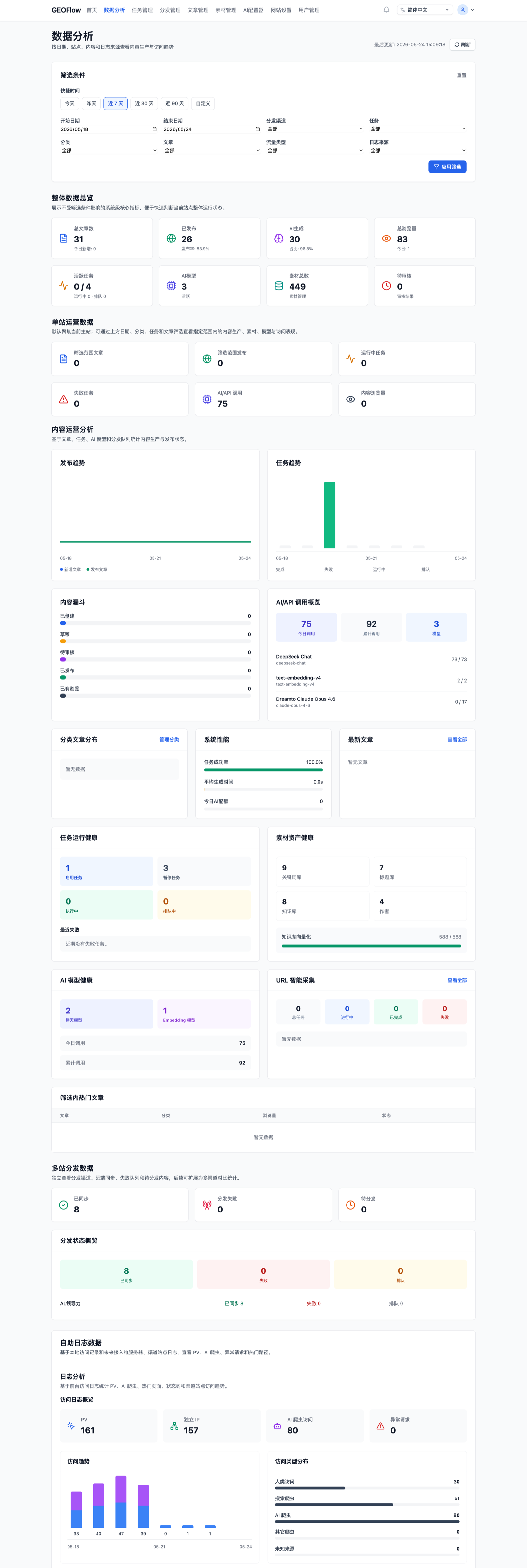
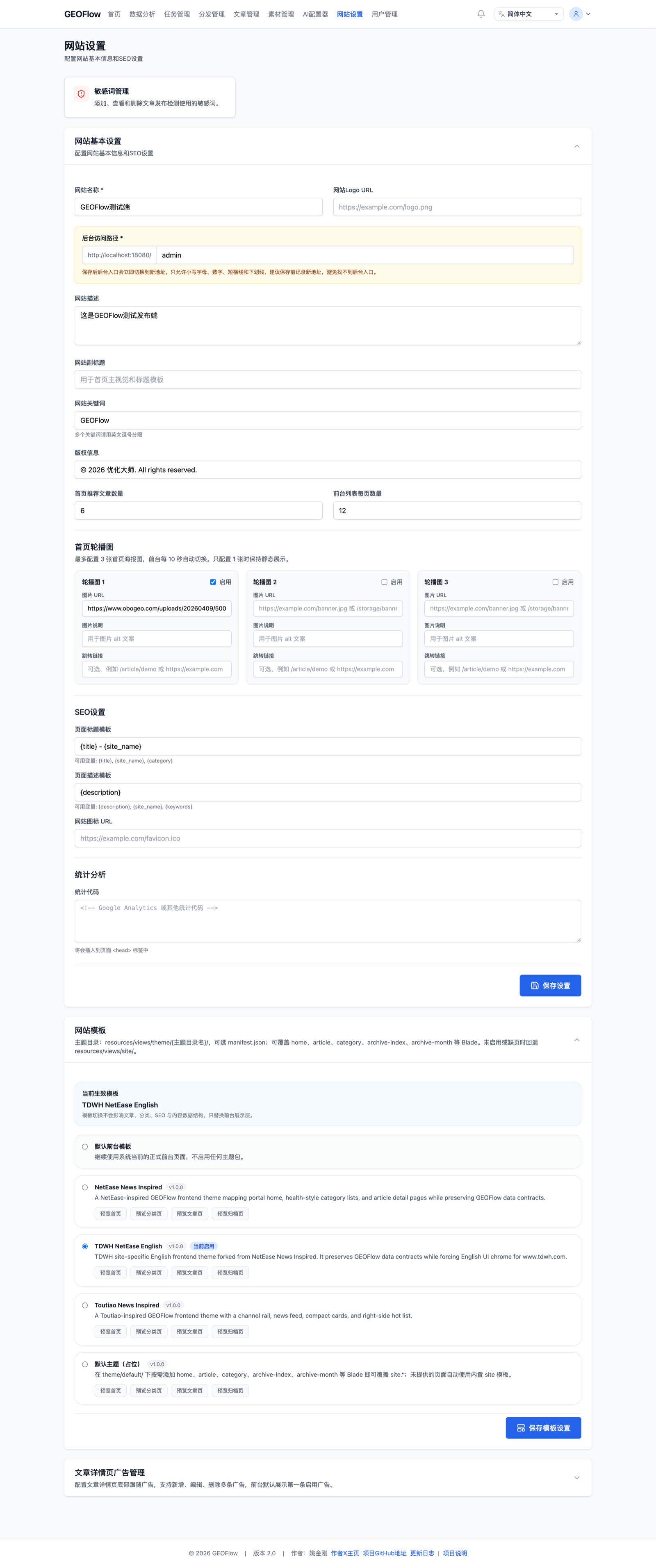
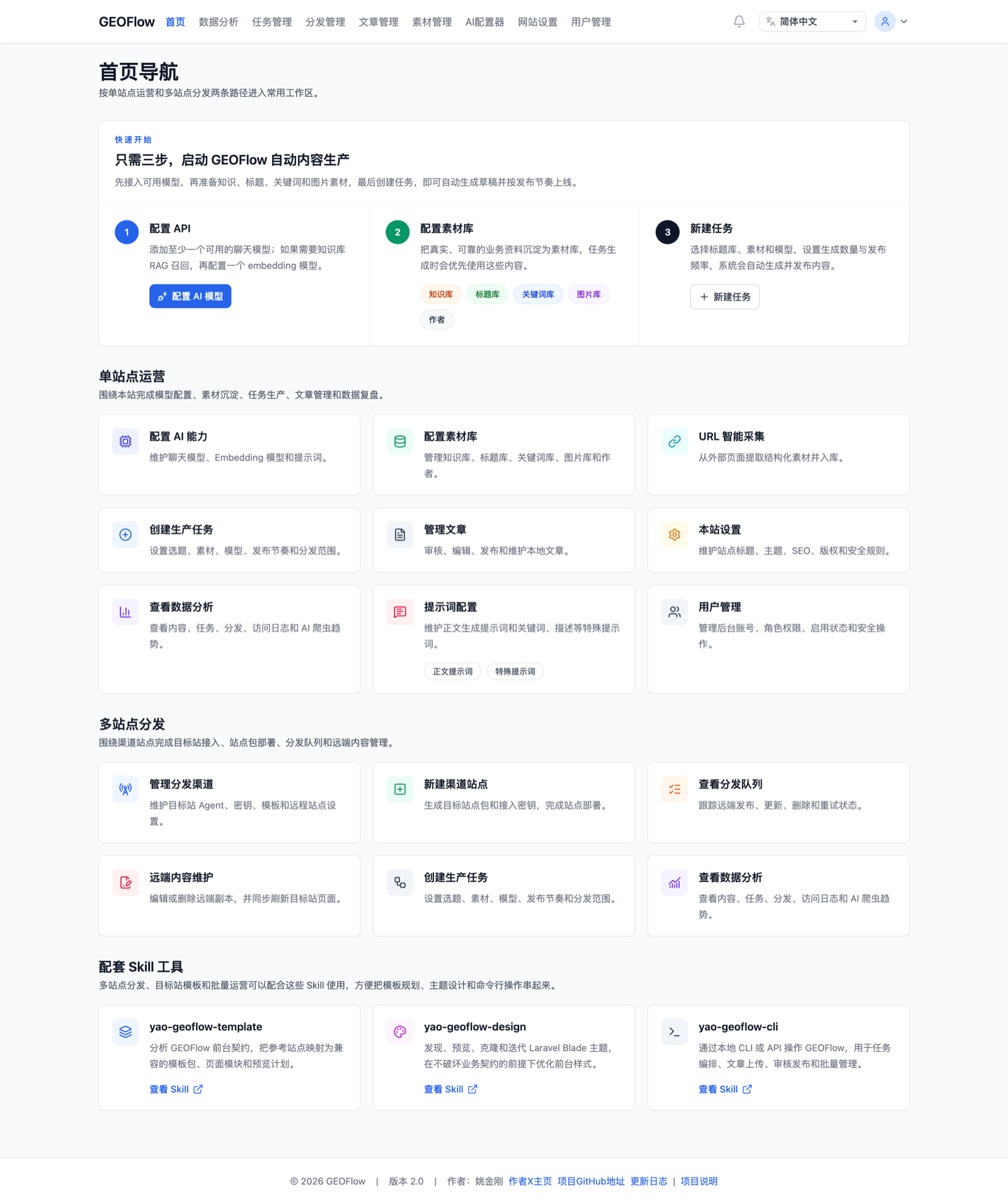
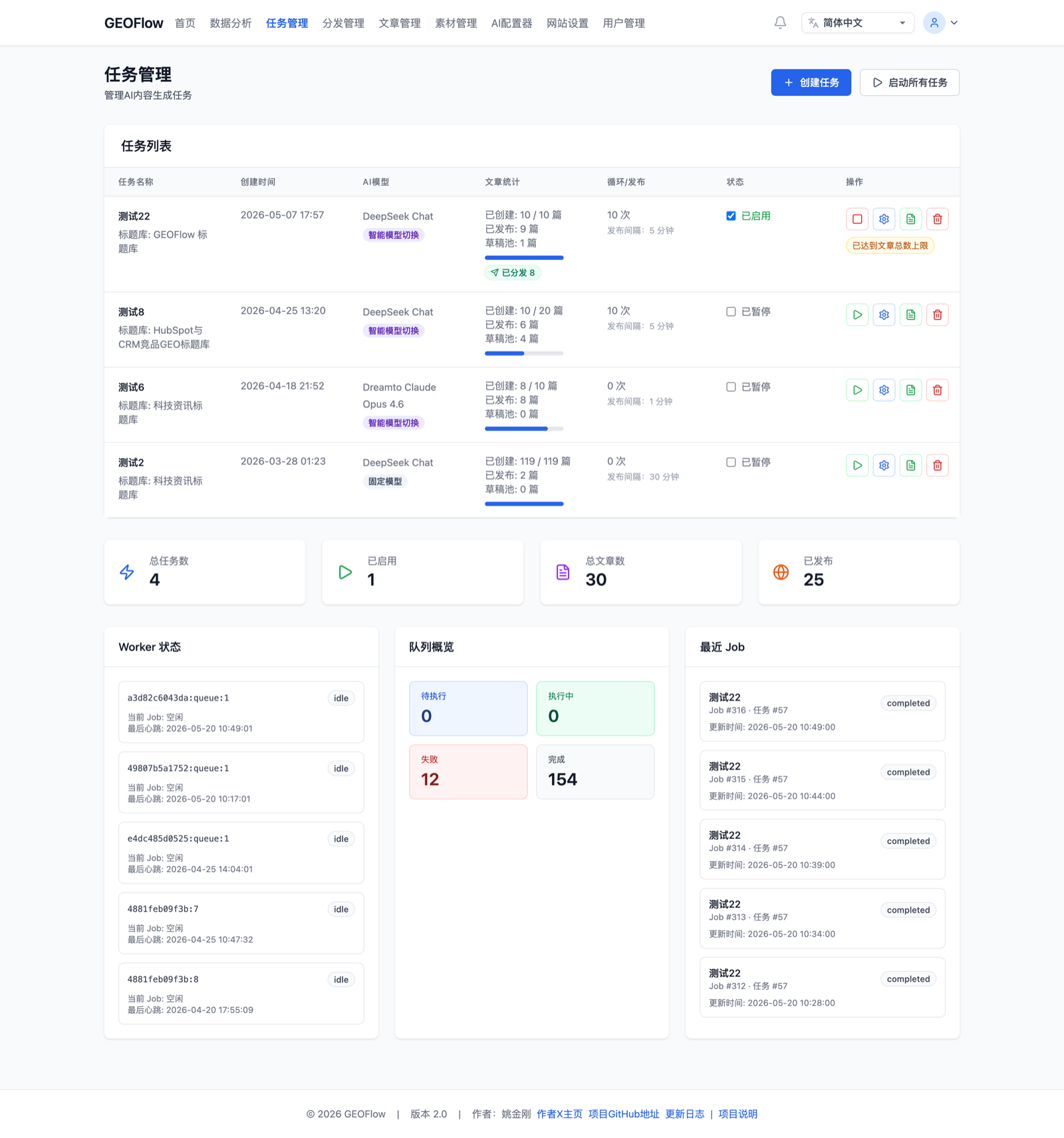
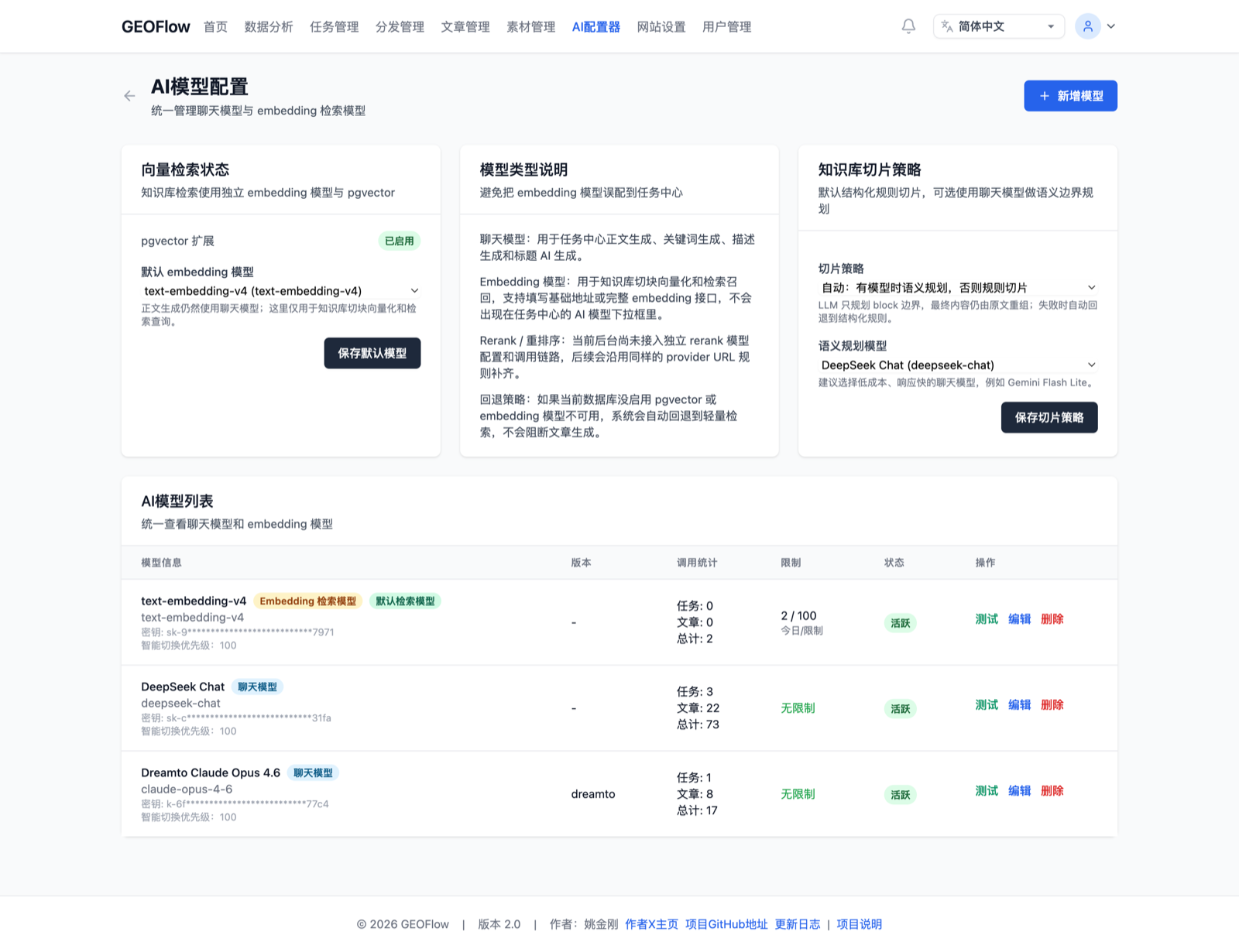
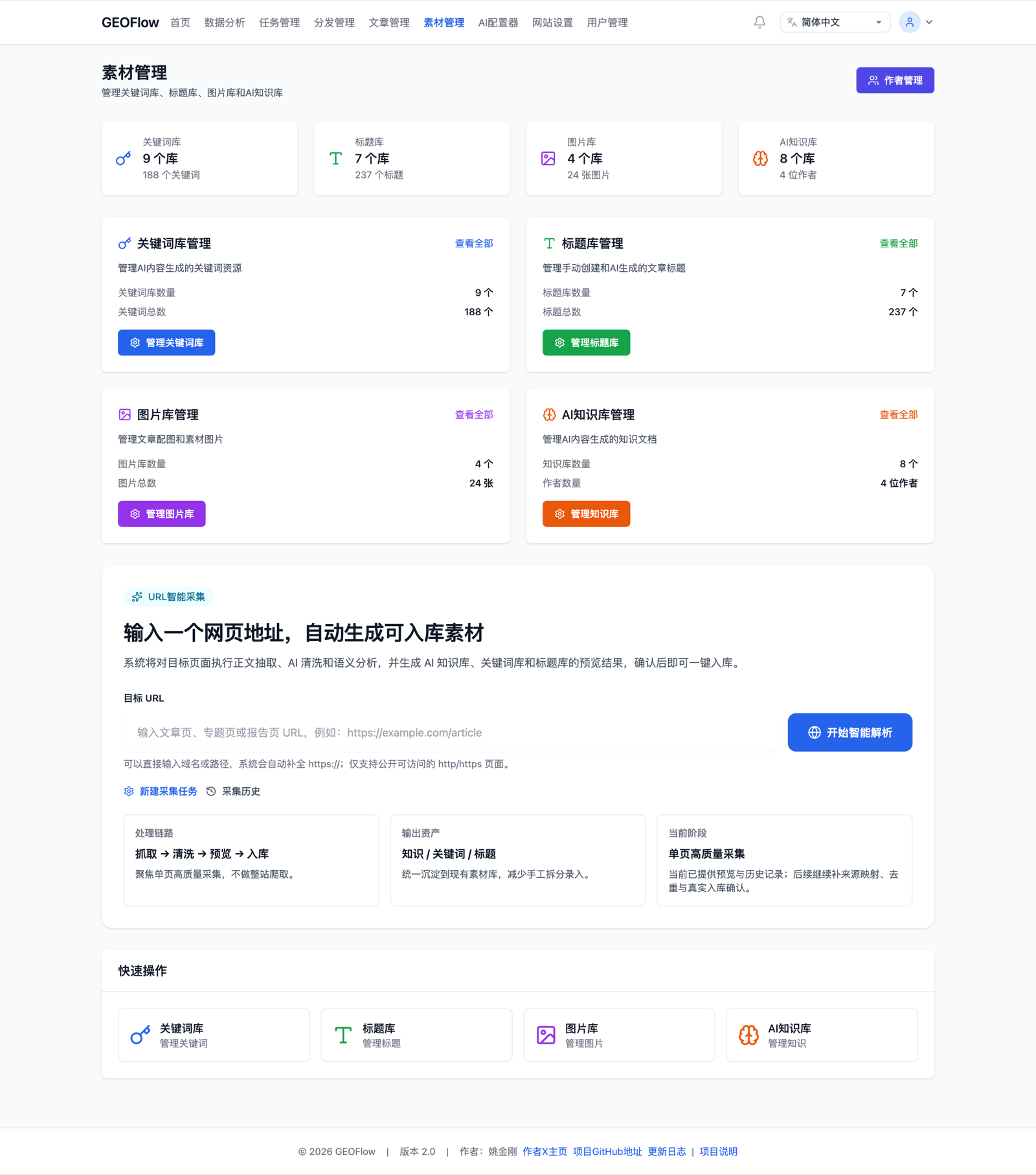
Open-source GEO content engineering and multi-site distribution system with AI tasks, RAG/semantic chunking, analytics, GEOFlow Agent and WordPress target publishing.
2.9k
Stars
664
Forks
1
Open issues
7
Contributors


AI Analysis
GEOFlow is a PHP-based open-source content management and multi-site distribution platform specifically designed for GEO (Generative Engine Optimization) workflows. It combines knowledge bases, AI content generation (compatible with OpenAI and Gemini APIs), RAG with semantic chunking, task automation, and multi-channel publishing (WordPress REST, HTTP API, static distribution) into an integrated pipeline. This tool is best suited for content teams and agencies managing large-scale AI-generate...
Inferred from signals mentioned in the README (tests, CI, type safety) — not a review of the actual code.
AI's overall editorial judgment — not an average of the bars above, can weigh other factors too.
PHP-based GEO content system with multi-site distribution, RAG, and AI task automation
GEOFlow is a PHP+Laravel-based content management and distribution platform designed for generative engine optimization (GEO). It combines AI-driven content generation (OpenAI, Gemini), knowledge base RAG with semantic chunking, multi-site publishing (WordPress REST, HTTP API, custom PHP agents), analytics, and task automation. The project targets content teams, GEO agencies, and organizations building programmatic content systems. Adoption remains concentrated in Chinese-language markets based on README localization and GitHub fork patterns. Active maintenance as of June 2026.
GEOFlow was created in April 2026 and appears to be a consolidation of GEO content workflows (SEO-adjacent generative optimization). The 2.0 version introduced analytics separation, semantic chunking, Gemini/OpenAI standardization, and multi-channel distribution. Project maturity reflects rapid iteration typical of emerging frameworks responding to AI-driven content market demands.
Achieved 2,764 stars and 639 forks within ~2.5 months, with 123 stars gained in the last 7 days (as of 2026-06-30). Growth appears front-loaded post-launch, driven by emerging interest in GEO workflows and multi-site content automation. Comparable to langflow-ai/openrag (4,275 stars, Python) and significantly ahead of BuildingAI (1,753 stars, TypeScript), but far behind ragflow (83,893 stars, Go). Growth trajectory suggests niche enthusiasm rather than mainstream cross-ecosystem adoption.
Adoption not verified. README describes intended use cases (independent GEO sites, brand content channels, multi-site deployments) with credible technical depth, but no case studies, deployment counts, or testimonials provided. Docker Compose setup and PostgreSQL pgvector support indicate production-ready tooling assumptions, not confirmed production usage. GitHub forks (639) and stars (2,764) suggest interest but do not constitute adoption evidence at scale.
Likely follows Laravel monolith pattern: Blade templating for admin, PostgreSQL (pgvector variant recommended for embeddings), Redis for queues, Laravel Scheduler for task dispatch, and queue:work/Horizon for async job execution. Frontend article generation via Blade, backend API for agent distribution, Reverb WebSocket support noted. Target site distribution via PHP agent packages and WordPress REST. README does not expose implementation details of RAG chunking, embedding storage, or model routing beyond API compatibility claims.
Not documented in README. No mention of test suites, CI/CD pipelines, or quality gates.
Last push 2026-06-29 (within 24 hours of analysis date), indicating active ongoing development. Multiple language documentation (Chinese, English, Japanese, Spanish, Russian, Portuguese) suggests community maintenance effort. Apache-2.0 license and version.json update checking indicate professional release practices. Early-stage project (2.5 months old) shows no evidence of maintenance backlog or abandoned issues, though issue count not reported.
ADOPT IF: you operate multiple content sites, need programmatic content distribution with AI generation, prefer self-hosted PHP stacks, and have technical capacity to manage PostgreSQL/Redis/queues. AVOID IF: you need out-of-the-box SaaS, require production case studies and long track record, or target non-English/non-GEO content workflows where ecosystem maturity is critical. MONITOR IF: you are evaluating GEO automation platforms and want to track whether GEOFlow gains traction beyond Chinese-speaking markets or if its multi-site distribution capabilities become a defensible niche against commercial alternatives.
Independent dimensions
Mainstream potential
3/10
Technical importance
6/10
Adoption evidence
2/10
- Adoption concentrated in Chinese-language markets; unclear viability in Western GEO workflows or integration with mainstream content infrastructure.
- Rapid iteration (2.0 within 2.5 months) suggests architecture churn risk; no evidence of backwards compatibility testing or long-term stability commitments.
- Test coverage and CI/CD practices not documented; quality assurance approach opaque for production deployments.
- Dependency on PostgreSQL pgvector, Redis, and Laravel ecosystem; operational complexity may deter non-expert teams compared to managed SaaS alternatives.
- GEO market regulatory and ethical scrutiny (AI-generated content, search ranking manipulation) may limit adoption if compliance/brand risk concerns emerge.
GEOFlow will likely remain a specialized tool for Chinese tech teams and GEO agencies building multi-site content systems. Mainstream adoption outside Chinese markets is unlikely unless the project gains strategic investment or partnerships with major hosting providers. Technical depth and feature completeness suggest it can sustain as a niche-but-stable infrastructure choice rather than a consumer-facing product.
Explore similar
Newsletter
Get analyses like this every Monday
Free weekly digest of the most interesting open-source discoveries.
Languages
Information
- Language
- PHP
- License
- Apache-2.0
- Last updated
- 5d ago
- Created
- 3mo ago
- Analyzed with
- anthropic/claude-haiku-4-5
Stars over time
Contributors over time
Top 100 contributors only — repos with more will plateau at 100.
Open issues
Open pull requests
No open pull requests.
Top contributors
Recent releases
No releases published yet.
Similar repos
| Repository | Stars | Week Δ | Language | Score | Updated |
|---|---|---|---|---|---|
|
yaojingang/GEOFlow
this
|
2.9k | +55 | PHP | 7/10 | 5d ago |
 opengeos/geoai opengeos/geoai
|
3.2k | — | Python | 8/10 | 3d ago |
 langflow-ai/openrag langflow-ai/openrag
|
4.3k | — | Python | 8/10 | 7h ago |
 BidingCC/BuildingAI BidingCC/BuildingAI
|
1.8k | — | TypeScript | 7/10 | 1mo ago |
 infiniflow/ragflow infiniflow/ragflow
|
84.8k | — | Go | 8/10 | 1h ago |
ragflow (83,893 stars, Go) dominates the RAG/knowledge base market with broader language support and larger ecosystem. GEOFlow is narrower and PHP-specific; targets GEO+distribution use case ragflow does not emphasize.
openrag (4,275 stars, Python) focuses on RAG and LLM orchestration without built-in multi-site distribution or content publishing workflow. GEOFlow includes end-to-end content ops (draft, review, publish, analytics).
geoai (3,146 stars, Python) appears geospatial-focused. GEOFlow targets generative engine optimization (marketing/content), not geographic data. Different problem domains.
Organizations can build similar multi-site workflows via WordPress plugins + custom sync. GEOFlow abstracts this into a unified system but requires PHP hosting and adds operational overhead.
Closed-source commercial GEO tools offer UI polish and SEO integration. GEOFlow is open-source, self-hosted, and requires technical team to operate; appeals to teams preferring control over ease.