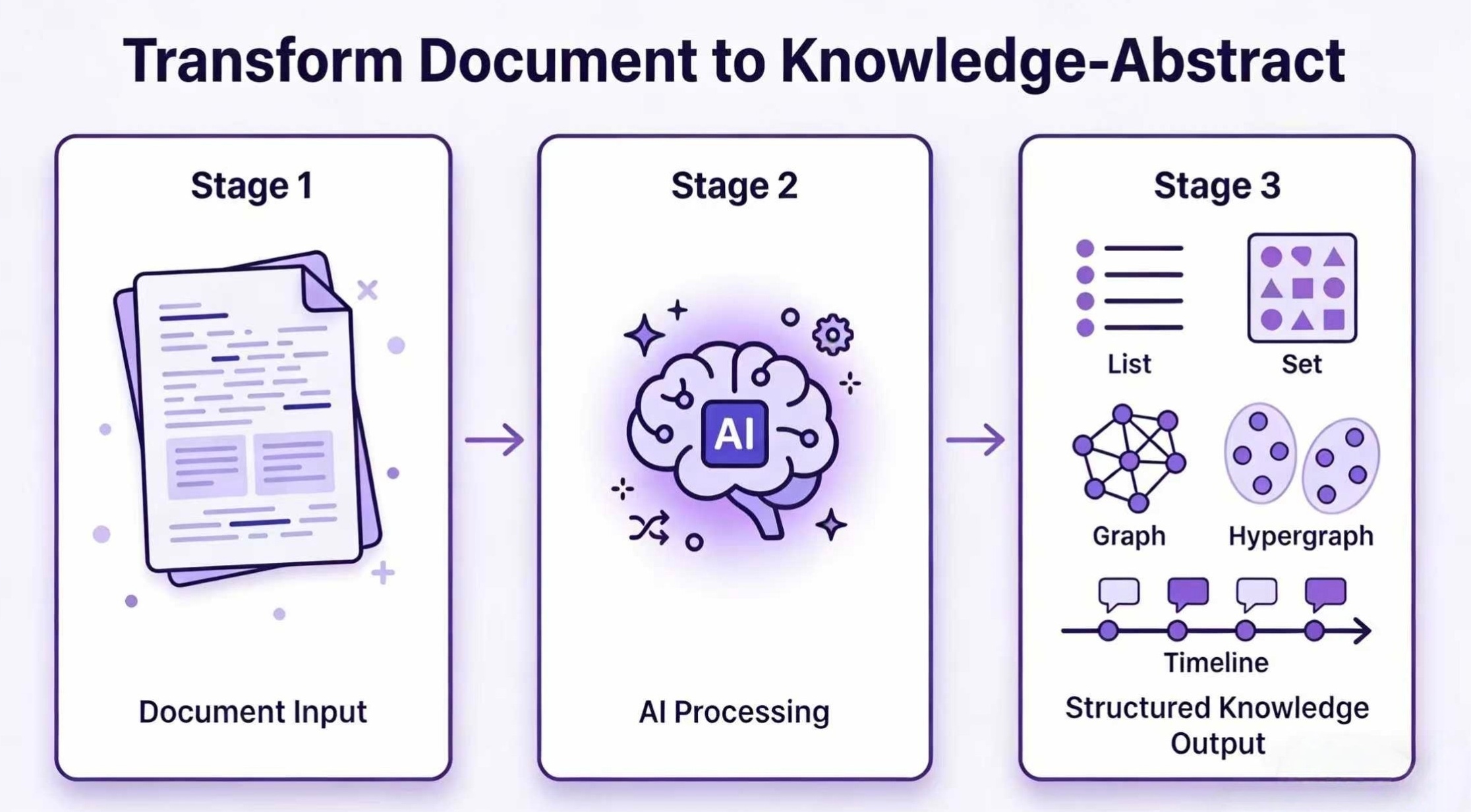
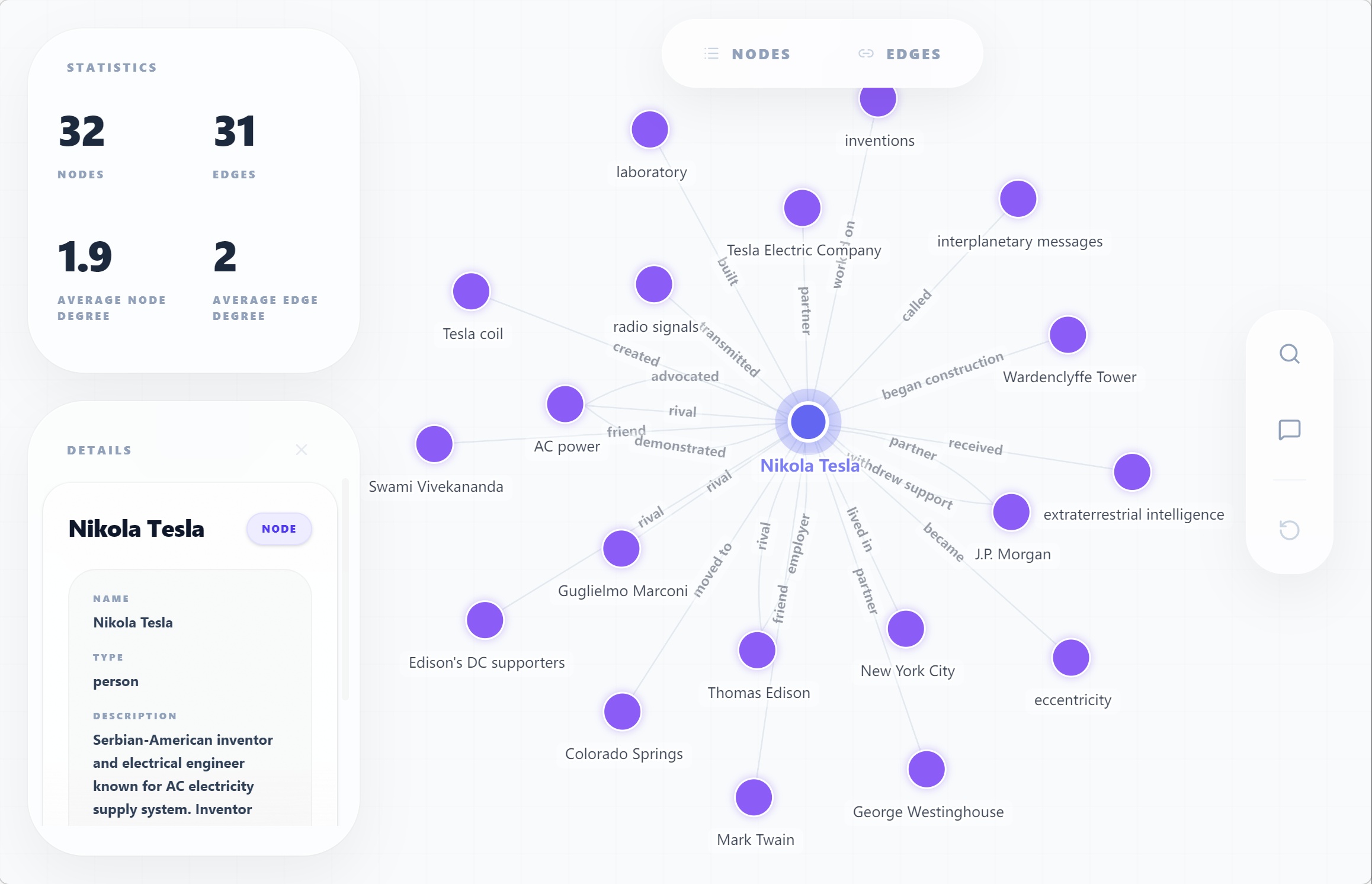
Hypergraph is more powerful. Transform unstructured text into structured knowledge with LLMs. Graphs, hypergraphs, and spatio-temporal extractions — with one command.
3k
Stars
355
Forks
5
Open issues
11
Contributors


AI Analysis
Hyper-Extract is an LLM-powered CLI tool for transforming unstructured text into structured knowledge formats including graphs, hypergraphs, and spatio-temporal extractions. It serves data scientists, knowledge management professionals, and RAG system builders who need to programmatically extract and organize information at scale. Not intended for general-purpose text processing or for users seeking simple keyword extraction.
Inferred from signals mentioned in the README (tests, CI, type safety) — not a review of the actual code.
AI's overall editorial judgment — not an average of the bars above, can weigh other factors too.
Python CLI for extracting structured knowledge from unstructured text via LLM-powered hypergraphs and knowledge graphs
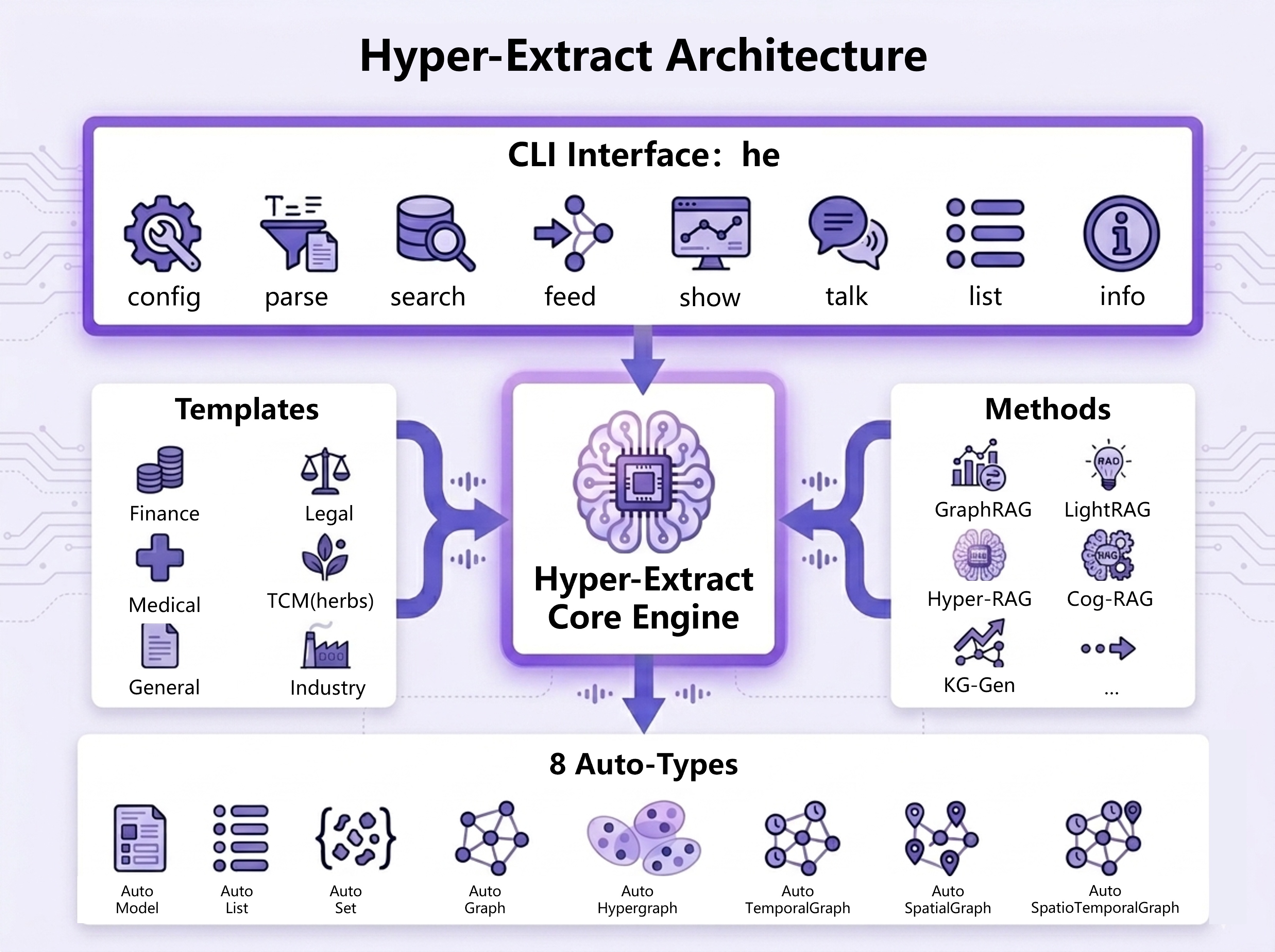
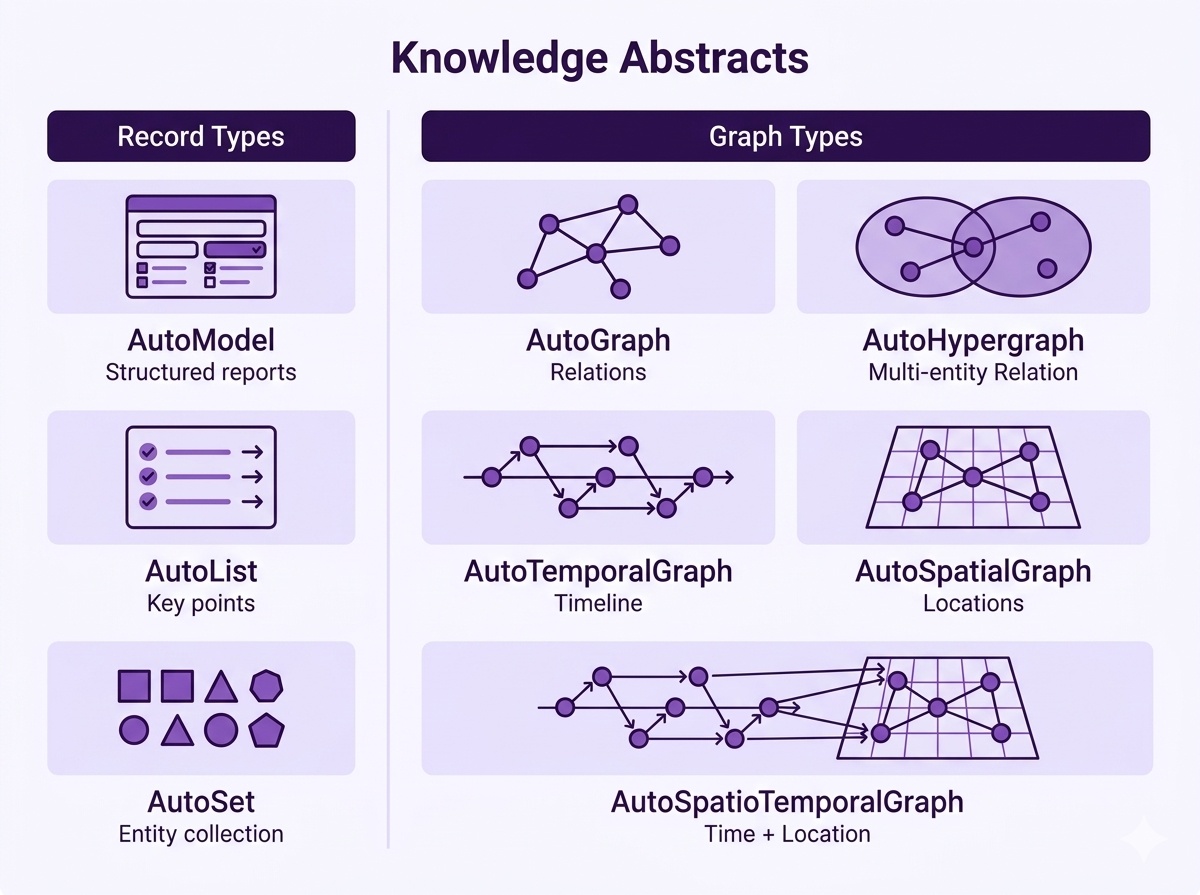
Hyper-Extract is a Python CLI tool that transforms unstructured documents into structured knowledge using LLMs. It supports 8 knowledge structure types (lists, graphs, hypergraphs, spatio-temporal graphs), 10+ extraction engines, and 80+ YAML templates across domains. Built for researchers, analysts, and data teams who need to convert documents into queryable knowledge bases. Recent growth (584 stars in 7 days as of June 2026) suggests emerging interest; adoption remains concentrated and not yet verified at scale.
Project created January 2026, extremely recent entrant to the knowledge extraction category. Positioned against established competitors like LightRAG and graphify but claims to differentiate via hypergraph support and broader structure options. Initial traction appears organic and rapid given the creation-to-current-date timeline.
Very steep adoption curve since launch (2,630 stars in ~6 months, with 584 in the most recent week). Growth trajectory suggests either viral moment, trending visibility on platforms like Hacker News or ProductHunt, or discovery within a specific community. The rapid uptake may reflect pent demand for accessible LLM-powered extraction tooling, or may be volatile/unsustainable early enthusiasm. Comparable projects (LightRAG at 37k, graphify at 72k) suggest the category itself attracts attention.
Adoption not verified in README or metadata. No case studies, company logos, testimonials, or documented production deployments mentioned. PyPI package exists (hyperextract), suggesting intention for distribution. Project is too recent (6 months old) and growth too rapid for reliable production adoption metrics. Rapid star growth may not correlate with actual usage.
Based on README: likely a modular Python CLI with pluggable LLM backends (OpenAI, Anthropic, Alibaba Bailian, local vLLM), embedder support (OpenAI, Bailian, local BGE-M3), and a template engine for domain-specific extraction. Appears to use Pydantic for schema definition and validation. Supports incremental knowledge base evolution and multi-format export (Markdown, wikilinks, Obsidian). Implementation quality cannot be verified from README alone.
Not documented in README. No mention of CI/CD, test suites, or coverage metrics.
Last push June 27, 2026 (current date), indicating active work. Recent PR merges documented in README (MCP Server support, Anthropic Claude integration, Obsidian export, cleanup command, reliability fixes) suggest weekly or bi-weekly release cadence. Early-stage projects often show burst activity; sustained maintenance over 12+ months is a stronger signal. Project is only ~6 months old.
ADOPT IF: you need hypergraph or spatio-temporal extraction from unstructured text, want to avoid reinventing LLM prompt engineering, prefer a CLI-first workflow, and are willing to evaluate a very young (6-month-old) project. AVOID IF: your production system requires battle-tested code, extensive documentation of real-world deployments, or commitment to long-term stability—this project's rapid growth may not reflect production usage. MONITOR IF: you're tracking the knowledge extraction category; Hyper-Extract's fast growth and feature velocity warrant watching for 6–12 months to assess whether adoption translates to production stability and whether the project sustains maintenance.
Independent dimensions
Mainstream potential
4/10
Technical importance
6/10
Adoption evidence
2/10
- Very recent project (January 2026): limited track record of handling edge cases, scaling to large corpora, or surviving in production for extended periods.
- Rapid star growth may be unsustainable or driven by hype; no evidence yet that stars correlate with real usage or retention.
- Dependency on external LLM providers (OpenAI, Anthropic, Alibaba Bailian) means feature parity and cost exposure tied to third-party models; local vLLM support mitigates but adds operational complexity.
- Test coverage and CI/CD practices not documented; early-stage Python CLI projects often have incomplete test suites, raising regression risk.
- Hypergraph and spatio-temporal extraction are advanced features; correctness and practical utility of these structures under real workloads not yet independently verified.
Hyper-Extract will likely experience a slower growth phase over the next 6–12 months as initial enthusiasm plateaus; the project will be adopted by early-adopter researchers and data teams, but will not displace LightRAG or graphify as the default choice unless it achieves significantly stronger real-world validation and documentation. If maintainer sustains activity and adoption accelerates beyond stars (e.g., evident from community discussions, integrations, or contributions), it could become a secondary-tier player in the knowledge extraction space.
Newsletter
Get analyses like this every Monday
Free weekly digest of the most interesting open-source discoveries.
Languages
Information
- Language
- Python
- License
- NOASSERTION
- Last updated
- 3d ago
- Created
- 6mo ago
- Analyzed with
- anthropic/claude-haiku-4-5
Stars over time
Contributors over time
Top 100 contributors only — repos with more will plateau at 100.
Open issues
Open pull requests
No open pull requests.
Top contributors
Similar repos

Graphify-Labs/graphify
Graphify is an AI coding assistant skill (slash-command plugin) that converts...

robert-mcdermott/ai-knowledge-graph
This Python tool extracts structured knowledge from unstructured text by using...
| Repository | Stars | Week Δ | Language | Score | Updated |
|---|---|---|---|---|---|
|
yifanfeng97/Hyper-Extract
this
|
3k | +168 | Python | 8/10 | 3d ago |
 HKUDS/LightRAG HKUDS/LightRAG
|
37.5k | — | Python | 8/10 | 5h ago |
|
Graphify-Labs/graphify
|
81.6k | — | Python | 7/10 | 3h ago |
|
robert-mcdermott/ai-knowledge-graph
|
2.5k | — | Python | 7/10 | 6mo ago |
 google/langextract google/langextract
|
37.1k | — | Python | 8/10 | 1w ago |
More mature, wider adoption; Hyper-Extract claims hypergraph and spatio-temporal structures as differentiation. LightRAG likely has more field-tested implementations.
Larger userbase and longer track record. Hyper-Extract's breadth of extraction templates (80+) and multiple knowledge structures may appeal to users wanting less specialization/more options.
Similar star count to Hyper-Extract despite longer existence, suggesting Hyper-Extract's growth is unusually fast. Both target knowledge graph extraction from unstructured text.
Appears to be Google-backed; Hyper-Extract is independent. Star count differential suggests Hyper-Extract is building momentum but remains significantly behind in absolute adoption.
Closest in scale; both target knowledge graph extraction. Hyper-Extract's multimodal structure support and template breadth differentiate if these are production-quality.






 📋 What's under the hood? (Architecture & Templates)