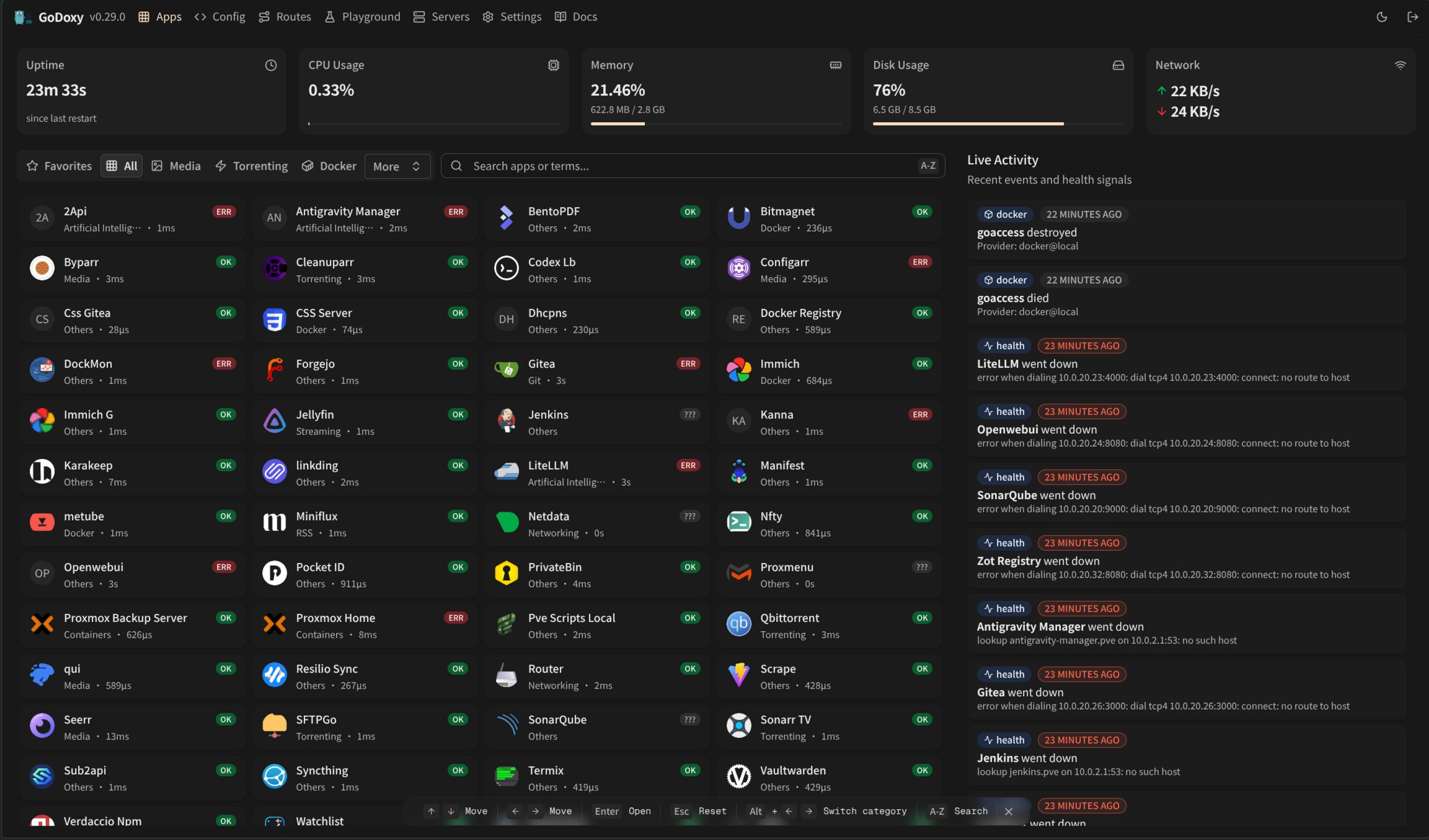
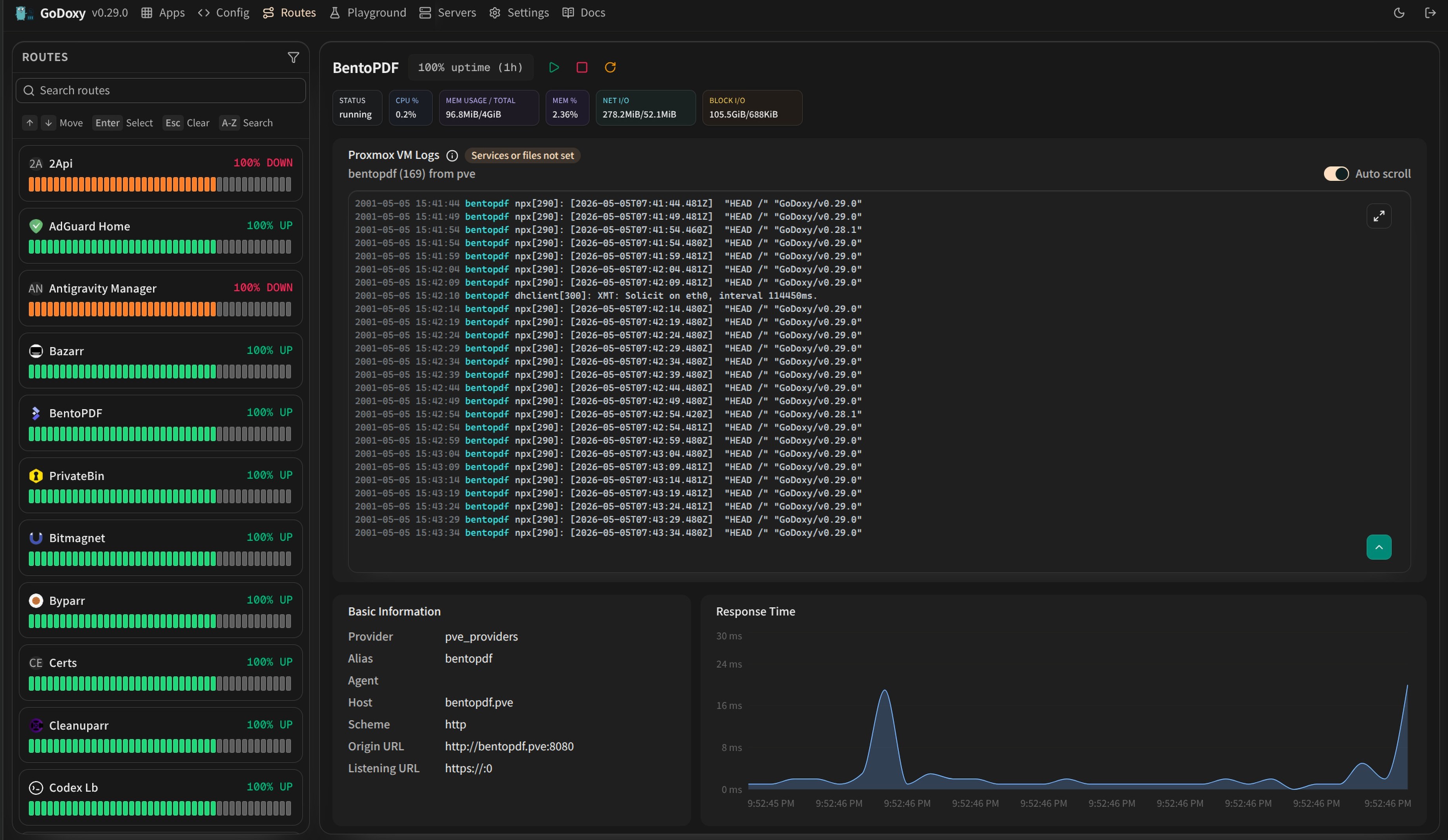
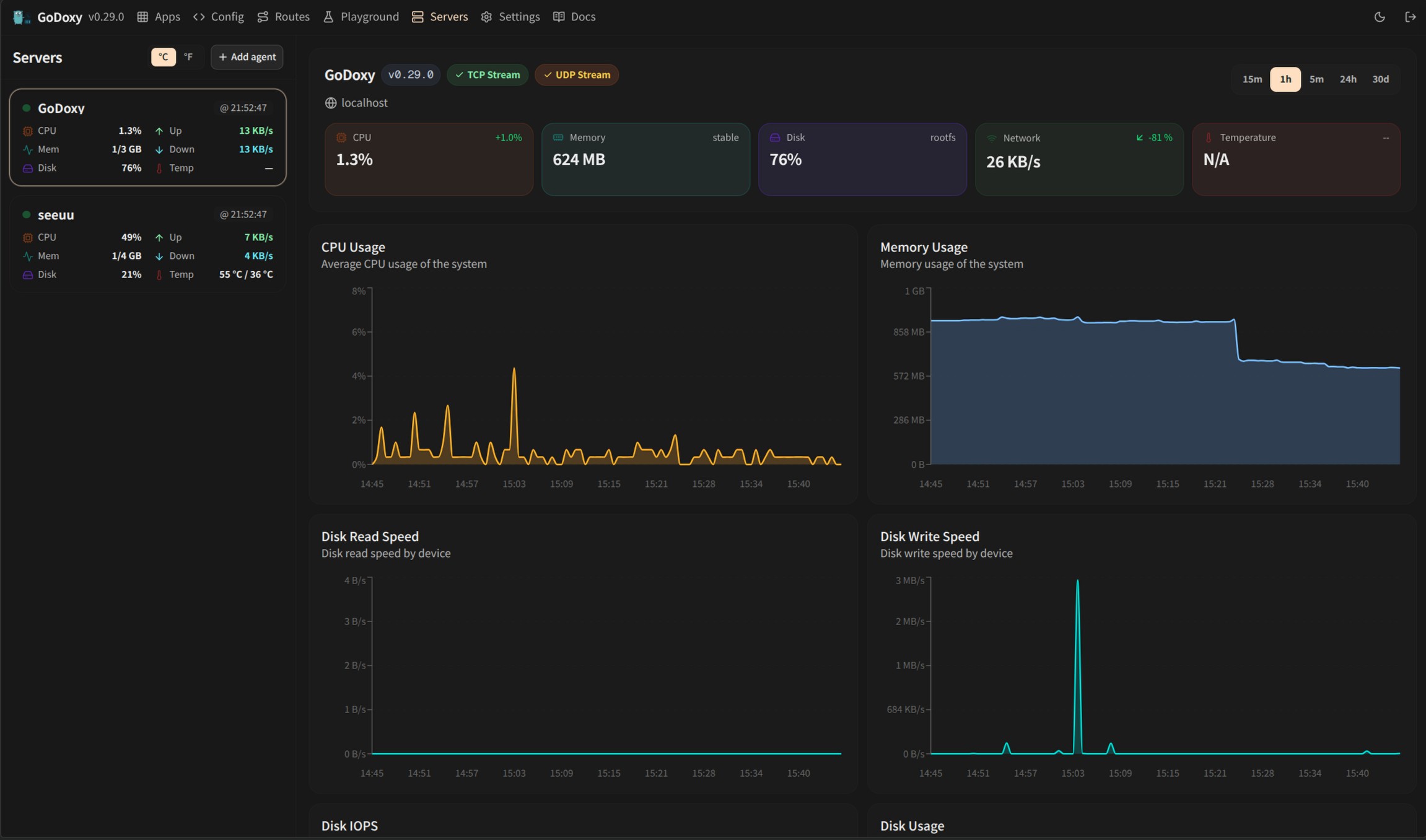
High-performance reverse proxy and container orchestrator for self-hosters
3.5k
Stars
148
Forks
12
Open issues
10
Contributors


AI Analysis
GoDoxy is a lightweight, performant reverse proxy with WebUI designed for self-hosters and home lab operators. It specializes in Docker/Podman container orchestration, automatic routing via container labels, Let's Encrypt certificate management, and traffic control including TCP/UDP forwarding and OpenID Connect SSO. Best suited for self-hosted deployments and small to medium infrastructure; not a general-purpose enterprise reverse proxy like nginx or Traefik.
Inferred from signals mentioned in the README (tests, CI, type safety) — not a review of the actual code.
AI's overall editorial judgment — not an average of the bars above, can weigh other factors too.
Self-hosted reverse proxy with Docker orchestration and Proxmox integration, targeting homelab and small infrastructure operators
GoDoxy is a Go-based reverse proxy designed for self-hosted environments, featuring automatic Docker/Podman container discovery, Let's Encrypt integration, a WebUI, and Proxmox LXC management. It targets operators running multi-service setups who want simplified routing without complexity. The project shows active development (last commit 2026-07-09), a small but engaged user base (~3.5k stars, ~147 forks), and includes niche features like idle sleep for cost reduction. Adoption appears concentrated in the self-hosted/homelab community rather than enterprise environments.
Created February 2024, GoDoxy emerged as a lightweight alternative to larger reverse proxies like Nginx Proxy Manager and Traefik. The project rapidly gained initial traction within the self-hosted community, reaching 3.5k stars within ~28 months. The addition of Proxmox integration and idle-sleep features suggests organic evolution driven by user feedback rather than a predetermined feature roadmap.
Initial growth (Q1-Q3 2024) likely came from discovery within r/selfhosted and similar communities seeking simpler alternatives to heavier orchestrators. Steady addition of features (DNS-01 providers, ForwardAuth, IP/CIDR rules, Proxmox support) maintained momentum. Recent acquisition of 92 stars in the past 7 days (as of 2026-07-09) suggests ongoing visibility, though growth rate appears linear rather than accelerating. The project lacks evidence of major enterprise adoption or media coverage that would indicate explosive growth.
Adoption not verified with publicly available deployment counts or case studies. The live demo (demo.godoxy.dev) and maintained documentation suggest active use, but no evidence of large-scale production deployments, testimonials, or organizational endorsements appears in README or repository metadata. Adoption appears confined to early adopters in self-hosted communities.
Appears to follow a modular design based on README: Docker/Podman integration layer, configuration hot-reload, WebUI backend, Let's Encrypt certificate management, and container lifecycle hooks. Likely uses Go's net/http for proxying and goroutines for concurrent request handling, though actual implementation cannot be verified from README alone. The system agent installer (systemd/OpenRC) and multi-node Docker support suggest distributed architecture capability.
Not documented in README. No mention of test suites, CI/CD pipelines, or code coverage metrics. SonarCloud badges are present (quality gate, lines of code), indicating some form of automated analysis, but test coverage percentage is not disclosed.
Last push 2026-07-09 (current date) indicates active development. The project maintains a Discord community, live demo site, and appears to respond to configuration requests. Presence of installation scripts, setup automation, and multi-platform support (amd64, arm64) suggests mature operational thinking. However, frequency of releases, responsiveness to issues, and PR merge velocity are not visible from metadata.
ADOPT IF: You run a self-hosted homelab with multiple Docker/Podman services and Proxmox LXC containers, need automatic routing with Let's Encrypt, and prefer configuration-over-orchestration. The idle-sleep feature adds cost value in low-traffic scenarios. AVOID IF: You require enterprise SLA support, multi-region high-availability, Kubernetes native integration, or need proven production stability at scale. Adoption remains niche; production incident response and debugging resources are limited. MONITOR IF: You use standard reverse proxies (NPM, Caddy) today but are evaluating Proxmox-aware solutions. GoDoxy's Proxmox integration and idle-sleep are differentiated features worth tracking if your infrastructure profile matches.
Independent dimensions
Mainstream potential
3/10
Technical importance
6/10
Adoption evidence
3/10
- Limited production evidence: Adoption is not verified at scale. Early-stage projects can disappear or stagnate; long-term maintenance is unproven.
- Single maintainer or small team risk: Repository metadata does not confirm team size. Succession planning unclear if primary contributor becomes unavailable.
- Proxmox lock-in: Deep integration with Proxmox may reduce flexibility if infrastructure changes. Feature parity with other orchestrators is not guaranteed.
- Test coverage opacity: No disclosed test suite or CI metrics reduce confidence in edge-case handling and regression prevention.
- Feature velocity vs. stability: Rapid feature additions (Proxmox, idle-sleep, DNS-01) could introduce breaking changes or unforeseen interactions in production environments.
GoDoxy likely remains a specialized tool for the self-hosted/homelab operator niche through 2027, with incremental feature refinement and steady community engagement. Mainstream enterprise adoption appears improbable without significant repositioning or corporate backing. Acquisition or consolidation into a larger infrastructure platform (e.g., Proxmox, TrueNAS) is plausible if the Proxmox integration proves sufficiently valuable.
Newsletter
Get analyses like this every Monday
Free weekly digest of the most interesting open-source discoveries.
Languages
Information
- Website
- https://docs.godoxy.dev
- Language
- Go
- License
- NOASSERTION
- Last updated
- 21h ago
- Created
- 29mo ago
- Analyzed with
- anthropic/claude-haiku-4-5
Stars over time
Contributors over time
Top 100 contributors only — repos with more will plateau at 100.
Open issues
`rewrite` drops POST body when followed by `pass` to proxy backend
client version 1.51 is too new
[Bug Report] Remote Docker providers over mTLS: repeated `unexpected EOF`, route loss, and high CPU usage in v0.29.x
[Feature Request] SNI based Proxy & TLS passthrough
PROXY Protocol support for TCP/UDP streams
Open pull requests
No open pull requests.
Top contributors
Similar repos
| Repository | Stars | Week Δ | Language | Score | Updated |
|---|---|---|---|---|---|
|
yusing/godoxy
this
|
3.5k | +97 | Go | 7/10 | 21h ago |
 sky22333/hubproxy sky22333/hubproxy
|
2.7k | — | Go | 7/10 | 2w ago |
 tobychui/zoraxy tobychui/zoraxy
|
5.3k | — | HTML | 7/10 | 6d ago |
 AdguardTeam/dnsproxy AdguardTeam/dnsproxy
|
3.2k | — | Go | 7/10 | 1d ago |
 digitalocean/godo digitalocean/godo
|
1.5k | — | Go | 8/10 | 3d ago |
 zhenorzz/goploy zhenorzz/goploy
|
1.2k | — | Go | 7/10 | 6d ago |
Traefik is significantly more complex, designed for Kubernetes-scale deployments. GoDoxy targets simpler, single-node or small multi-node setups. Traefik has broader enterprise adoption; GoDoxy focuses on user experience for smaller operators.
NPM offers similar WebUI-driven simplicity. GoDoxy differentiates via Proxmox integration, idle-sleep, and native Docker label discovery. Both serve the self-hosted market; GoDoxy appears more opinionated toward infrastructure operators.
Zoraxy is a simpler reverse proxy with greater adoption. GoDoxy adds container orchestration and Proxmox-specific features, positioning itself as heavier but more integrated for complex homelab setups.
Caddy is more general-purpose, widely adopted, and emphasizes automatic HTTPS. GoDoxy is narrower, with deep integrations for Docker and Proxmox environments, making it less suitable for generic web server use.
Traditional infrastructure load balancers with steep learning curves. GoDoxy prioritizes ease of use and modern container-native design, targeting different user personas entirely.