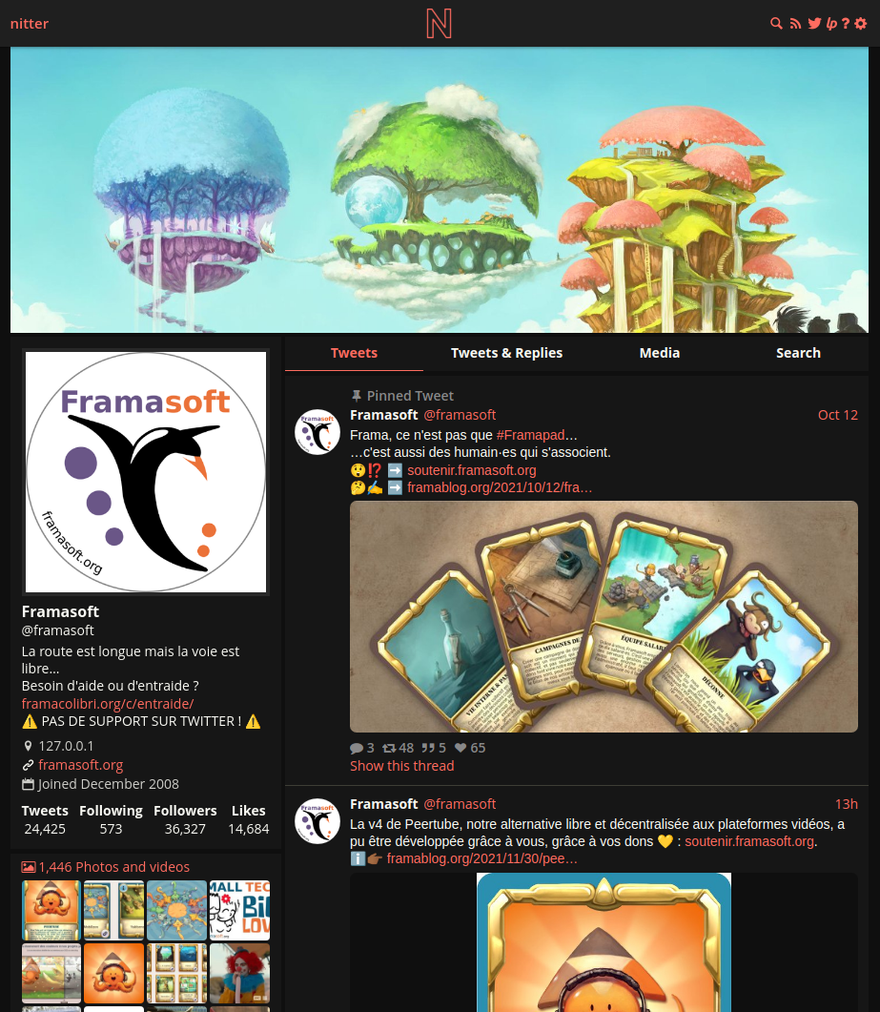
Alternative Twitter front-end
13.2k
Stars
736
Forks
163
Open issues
30
Contributors


AI Analysis
Nitter is a lightweight, privacy-focused alternative front-end for Twitter that eliminates JavaScript, ads, and tracking while serving pages 15x faster than Twitter.com. It is specifically designed for privacy-conscious users who want to browse Twitter without exposing their IP address, browser fingerprint, or personal data to Twitter's analytics infrastructure. It is not suitable for users who need direct Twitter account management, posting, or real-time notifications.
Inferred from signals mentioned in the README (tests, CI, type safety) — not a review of the actual code.
AI's overall editorial judgment — not an average of the bars above, can weigh other factors too.
Nitter: Privacy-focused Twitter front-end built in Nim, now requiring real account tokens
Nitter is a server-side proxy that renders Twitter content without exposing users to Twitter's JavaScript tracking, ads, or mandatory login requirements. It targets privacy-conscious users, journalists, researchers, and anyone wanting lightweight, RSS-accessible Twitter browsing. The project gained significant traction after Twitter restricted API access and mandated logins (2023–2024), becoming a reference tool in the privacy/self-hosting community. As of 2024–2025, operators must supply real Twitter session tokens to keep instances functional, which complicates deployment but has not killed the project.
Launched in June 2019 as an Invidious-inspired project for Twitter, Nitter grew steadily through 2020–2022. A major crisis hit in early 2023 when Twitter shut down guest API access, temporarily breaking all public instances. The project adapted by requiring authenticated session tokens.
Stars grew sharply after Twitter's 2022–2023 policy changes under new ownership, as users sought alternatives. Growth has since moderated to a slow, steady trickle (~37 stars/week as of mid-2026), reflecting a stable niche audience rather than viral expansion. The API restriction crisis caused some public instances to shut down, likely reducing casual discovery while hardening the remaining community.
A community-maintained wiki lists public instances, indicating real-world deployment by third parties at meaningful scale. The project has a Docker Hub image and documented Nginx/Apache integration, consistent with production self-hosting use. Browser extension integrations (redirect Twitter URLs to Nitter) are documented and maintained by the community. Liberapay/Patreon donation links suggest an active user base providing financial support, though exact instance traffic figures are not publicly documented.
Appears to be a Nim-based server application that proxies requests to Twitter's unofficial API, renders HTML server-side, and uses Redis/Valkey for caching. Likely stateless per request beyond the cache layer. Docker support is official and multi-arch (amd64/arm64). Reverse proxy (Nginx/Apache) is recommended in front of the application.
A CI test matrix badge is present in the README and linked to GitHub Actions workflows, suggesting automated tests exist. The extent and quality of coverage are not documented in the README.
Last push was 2026-07-01, the same as the current evaluation date, indicating active, ongoing maintenance. The README has been updated to reflect the session token requirement — a sign the project adapts to upstream changes rather than stagnating. CI badges for both tests and Docker builds are present and active.
ADOPT IF: you self-host or trust a specific instance, are comfortable configuring session tokens, and need privacy-preserving or JavaScript-free read access to Twitter content. AVOID IF: you need posting, DMs, or reliable uptime without ongoing maintenance — the session token requirement means operators must periodically refresh credentials or risk breakage. MONITOR IF: you are watching how Twitter's unofficial API access evolves, since future enforcement could break the core mechanism entirely.
Independent dimensions
Mainstream potential
2/10
Technical importance
7/10
Adoption evidence
6/10
- Twitter can — and has — broken guest/unofficial API access without notice; session token approach may be disrupted again, requiring further adaptation or making the project temporarily non-functional.
- Operators must manage real Twitter accounts as session sources, creating legal ambiguity around Twitter's Terms of Service and potential account suspension risk.
- Nim is a niche language with a smaller contributor pool than Go or Python, which may slow community contributions and increase bus-factor risk if the primary maintainer disengages.
- Public instance operators may shut down if session token management becomes too burdensome, reducing accessibility for non-self-hosters.
- The roadmap features (account system, timeline support) have remained incomplete for several years, suggesting development capacity may be insufficient to reach feature parity with user expectations.
Nitter will likely persist as a maintained niche tool for privacy-focused self-hosters as long as Twitter's unofficial API remains accessible. Its survival depends more on Twitter's enforcement posture than on the project's own trajectory.
Explore similar
Newsletter
Get analyses like this every Monday
Free weekly digest of the most interesting open-source discoveries.
Languages
Information
- Website
- https://nitter.net
- Language
- Nim
- License
- AGPL-3.0
- Last updated
- 1w ago
- Created
- 86mo ago
- Analyzed with
- anthropic/claude-haiku-4-5
Stars over time
Contributors over time
Top 100 contributors only — repos with more will plateau at 100.
Open issues
UNAVAILABLE POST
Trouble Creating Session
Date Issue in the armhf Environment.
x.com/i/article links are not resolved to titles in list view
Tweets & Replies and Media Don't Show Views of User's Posts
Top contributors
Recent releases
No releases published yet.
Similar repos
| Repository | Stars | Week Δ | Language | Score | Updated |
|---|---|---|---|---|---|
|
zedeus/nitter
this
|
13.2k | — | Nim | 8/10 | 1w ago |
 nim-lang/Nim nim-lang/Nim
|
18.1k | — | Nim | 8/10 | 6h ago |
 sinamics/ztnet sinamics/ztnet
|
1.2k | — | TypeScript | 7/10 | 1w ago |
 nymtech/nym nymtech/nym
|
1.8k | — | Rust | 7/10 | 22h ago |
 E-xyza/zigler E-xyza/zigler
|
1.1k | — | Elixir | 7/10 | 1mo ago |
Nitter trades feature completeness (no posting, no DMs, no full account features) for zero JavaScript, no tracking, RSS support, and significantly lower page weight (~15x lighter per README claim).
Direct conceptual sibling — same privacy-proxy model for a different platform. Invidious is more mature with account sync features Nitter still lists as roadmap items.
Most alternatives rely on official API access, which is now paid and restricted. Nitter's use of unofficial session tokens is a different trade-off: more fragile but cheaper to operate.
Nitter provides stronger isolation since the client IP never reaches Twitter at all, but requires trusting the Nitter instance operator instead.
Bridges like Bird.makeup federate Twitter content into ActivityPub but require Twitter API access. Nitter serves read-only browsing without federation complexity.