[ACL 2026] Open-source framework for holistic, structured repository-level documentation across multilingual codebases
1.3k
Stars
202
Forks
7
Open issues
10
Contributors


AI Analysis
CodeWiki is an AI-powered framework for generating holistic, structured documentation for large-scale codebases with multi-language support and architecture-aware analysis. It is designed specifically for AI research and documentation automation use cases, helping developers and researchers understand complex codebases through generated cross-module interaction maps and visual artifacts. Best suited for researchers evaluating LLM documentation capabilities and organizations managing large-sca...
Inferred from signals mentioned in the README (tests, CI, type safety) — not a review of the actual code.
AI's overall editorial judgment — not an average of the bars above, can weigh other factors too.
AI-driven repository documentation generator with hierarchical decomposition for multi-language codebases
CodeWiki is an open-source framework that uses agentic LLM workflows to automatically generate holistic, architecture-aware documentation for large codebases. It targets developers and teams maintaining substantial projects (86K–1.4M LOC) who need comprehensive, cross-module documentation without manual effort. The project emerged from academic research (ACL 2026 paper) and integrates with multiple LLM providers (OpenAI, Anthropic, AWS Bedrock, Azure). Adoption remains limited to early adopters; real-world production usage is not verified.
CodeWiki was created in June 2025 as a research project by FSoft-AI4Code, coinciding with a peer-reviewed paper submission (arXiv 2510.24428). The framework operationalizes academic insights about hierarchical decomposition and agentic systems for documentation generation, positioning itself as a tool to evaluate AI's capability at repository-level documentation tasks.
The project gained ~1,300 stars within 12 months, with 18 stars in the last 7 days (as of 2026-06-29), suggesting sustained but slow adoption. Growth appears driven by novelty in the AI-assisted documentation space and academic publication visibility rather than organic enterprise demand. The codebase remains under active maintenance (last push 2026-06-29), but growth trajectory is modest compared to similar projects (deepwiki-open: 17K stars).
Adoption not verified. No case studies, testimonials, or documented production deployments mentioned in README. The project self-documents using CodeWiki (accessible at fsoft-ai4code.github.io/CodeWiki/docs/), demonstrating internal use but not third-party adoption. 201 forks suggest some experimentation, but fork count alone does not confirm production usage.
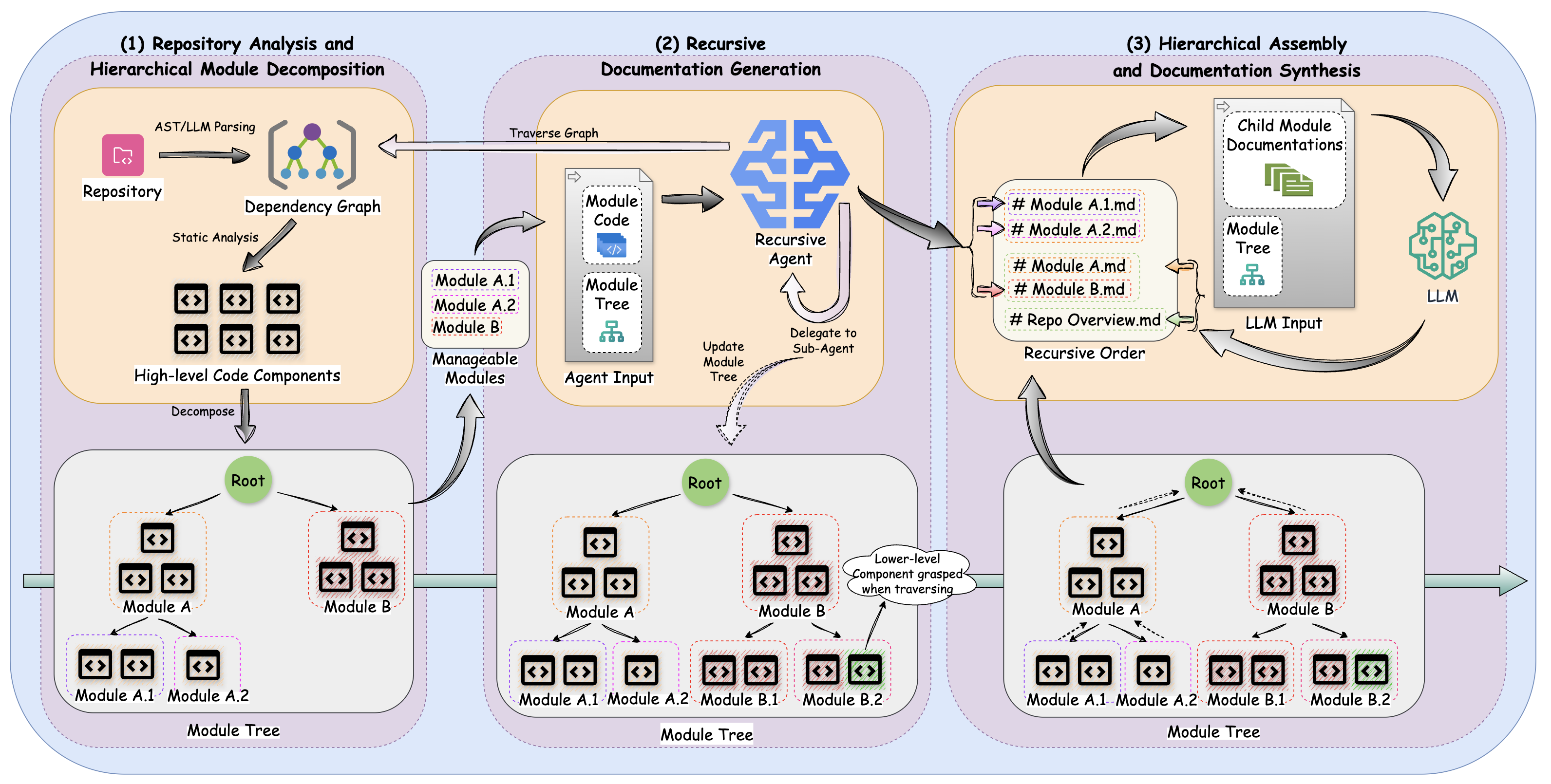
Based on README, CodeWiki appears to employ a multi-agent architecture with hierarchical decomposition, dynamic delegation, and recursive processing. It abstracts multiple LLM providers (OpenAI-compatible, Anthropic, AWS Bedrock, Azure OpenAI, Claude Code CLI, Codex CLI) through a configuration layer. The framework generates structured output including textual documentation, Mermaid diagrams (architecture, data flow, sequence), and HTML for GitHub Pages. Likely supports Python 3.12+; language support documented for Python, Java, JavaScript, though implementation details are not visible in README.
Not documented in README. No mention of test suite, CI/CD pipeline, or validation methodology beyond the academic paper reference.
Last push on 2026-06-29 indicates active maintenance as of the evaluation date. Appears to be maintained by FSoft-AI4Code organization. Frequency of commits and responsiveness to issues not evident from metadata. Project is young (created 2025-06-25), so maintenance pattern is still establishing.
ADOPT IF: your team maintains large, complex Python/Java/JavaScript codebases (>100K LOC) with budget for LLM API calls, needs architecture-aware documentation, and can tolerate experimental tooling. AVOID IF: you require production-grade stability, extensive third-party integration support, documented case studies, or prefer low-cost solutions (LLM usage can be significant for large repos). MONITOR IF: you're exploring LLM-assisted documentation and want to track whether CodeWiki matures into a mainstream standard; adoption velocity and real-world case studies will be key signals.
Independent dimensions
Mainstream potential
4/10
Technical importance
7/10
Adoption evidence
2/10
- Adoption not verified: no documented production deployments, case studies, or enterprise testimonials limit confidence in real-world reliability and ROI.
- LLM cost and latency: documentation generation depends on multiple LLM calls (main model, cluster model, fallback model); costs and generation time for large codebases are not quantified in README.
- Language coverage limited to three languages (Python, Java, JavaScript); many teams use Go, Rust, TypeScript, C#, and other languages not yet supported.
- Research-stage maturity: project emerged from academic work; production support, SLA commitments, and long-term maintenance roadmap are unclear.
- Model dependency: tied to LLM provider availability and API stability; changes to model APIs (pricing, deprecation, rate limits) could impact usability.
CodeWiki will likely remain a specialized tool for research and early-adopter teams interested in AI-assisted documentation, growing modestly as LLM capabilities improve and adoption within academia and forward-thinking enterprises increases. Mainstream enterprise adoption is unlikely unless real-world validation, cost transparency, and support for additional languages emerge.
Newsletter
Get analyses like this every Monday
Free weekly digest of the most interesting open-source discoveries.
Languages
Information
- Language
- Python
- Last updated
- 6d ago
- Created
- 13mo ago
- Analyzed with
- anthropic/claude-haiku-4-5
Stars over time
Contributors over time
Top 100 contributors only — repos with more will plateau at 100.
Open issues
Open pull requests
Top contributors
Recent releases
Similar repos
| Repository | Stars | Week Δ | Language | Score | Updated |
|---|---|---|---|---|---|
|
FSoft-AI4Code/CodeWiki
this
|
1.3k | +19 | Python | 7/10 | 6d ago |
 AsyncFuncAI/deepwiki-open AsyncFuncAI/deepwiki-open
|
17.2k | — | Python | 6/10 | 1mo ago |
 sopaco/deepwiki-rs sopaco/deepwiki-rs
|
1.3k | — | Rust | 7/10 | 2mo ago |
 langchain-ai/openwiki langchain-ai/openwiki
|
10.2k | — | TypeScript | 7/10 | 7h ago |
 skyllwt/AutoSci skyllwt/AutoSci
|
1.5k | — | Python | 7/10 | 23h ago |
|
langchain-ai/open-swe
|
10.1k | — | Python | 8/10 | 11h ago |
Substantially larger user base and ecosystem maturity. CodeWiki appears more focused on architecture-aware, cross-module analysis; deepwiki-open likely emphasizes breadth of language support and integration ease. CodeWiki's hierarchical decomposition may offer deeper structural understanding but at higher computational cost.
Similar star count and creation period. Both likely address AI-assisted documentation generation. Unclear from available metadata whether they compete directly or serve different documentation scopes.
Broader adoption suggests stronger ecosystem traction. CodeWiki's claimed advantage is repository-level holistic analysis rather than point documentation. Direct feature overlap uncertain from README.
Likely emphasizes note-taking and knowledge management integration rather than automated code analysis. Different use case and user base.
Rust implementation suggests language-specific alternative. CodeWiki's Python base and multi-language *code* support (Python, Java, JS) differ from deepwiki-rs's scope.