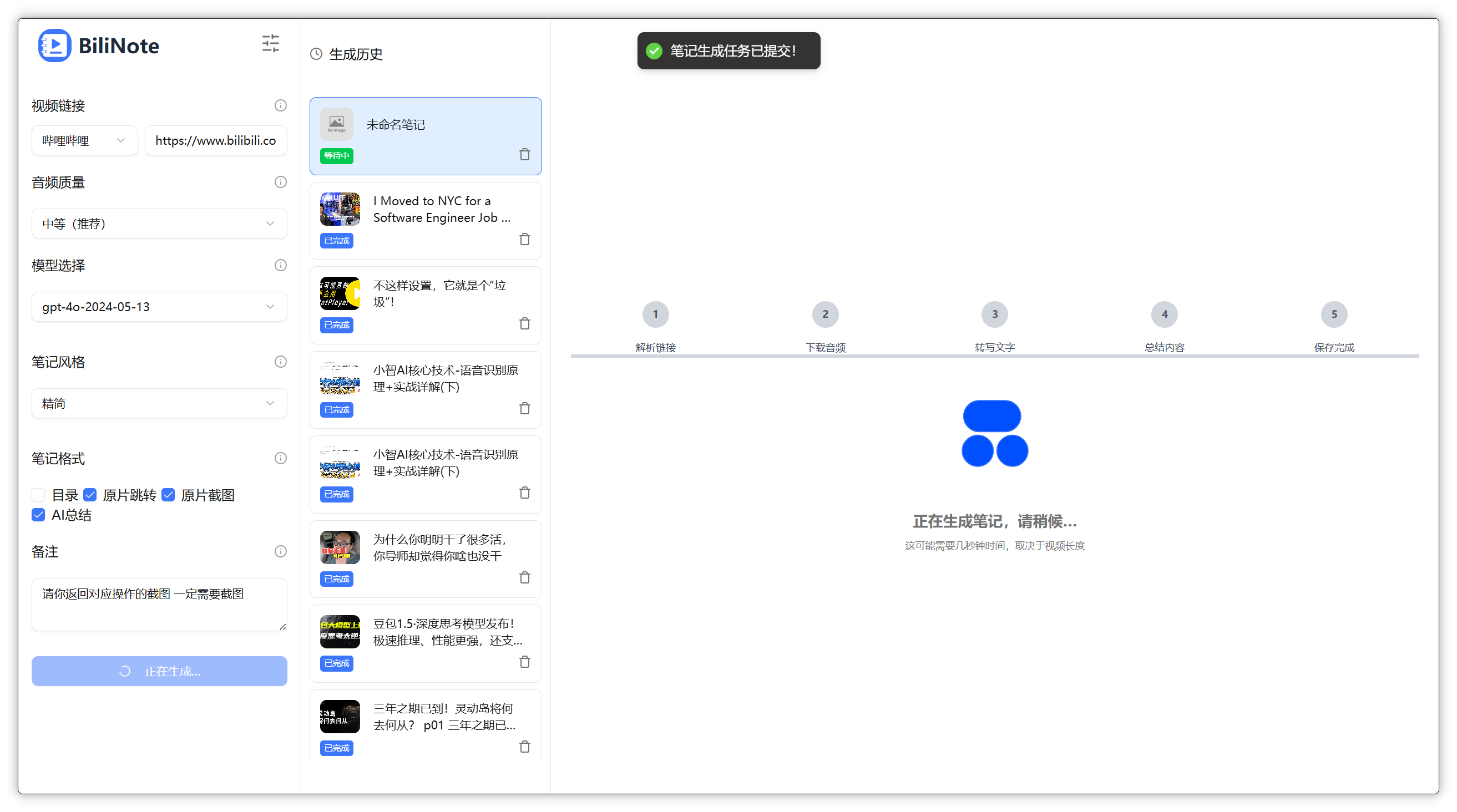
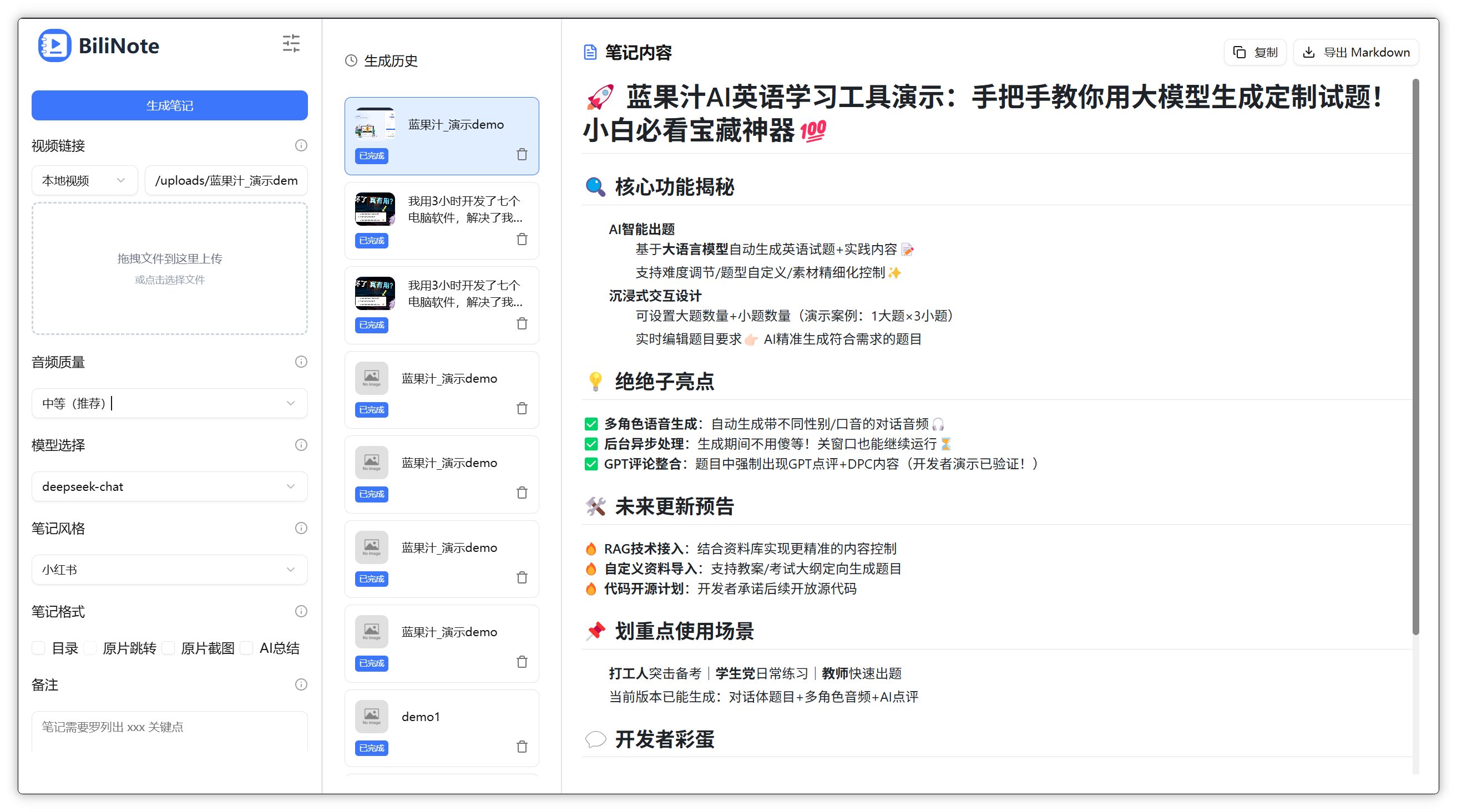
AI 视频笔记生成工具 让 AI 为你的视频做笔记
6.8k
Stars
866
Forks
174
Open issues
18
Contributors


AI Analysis
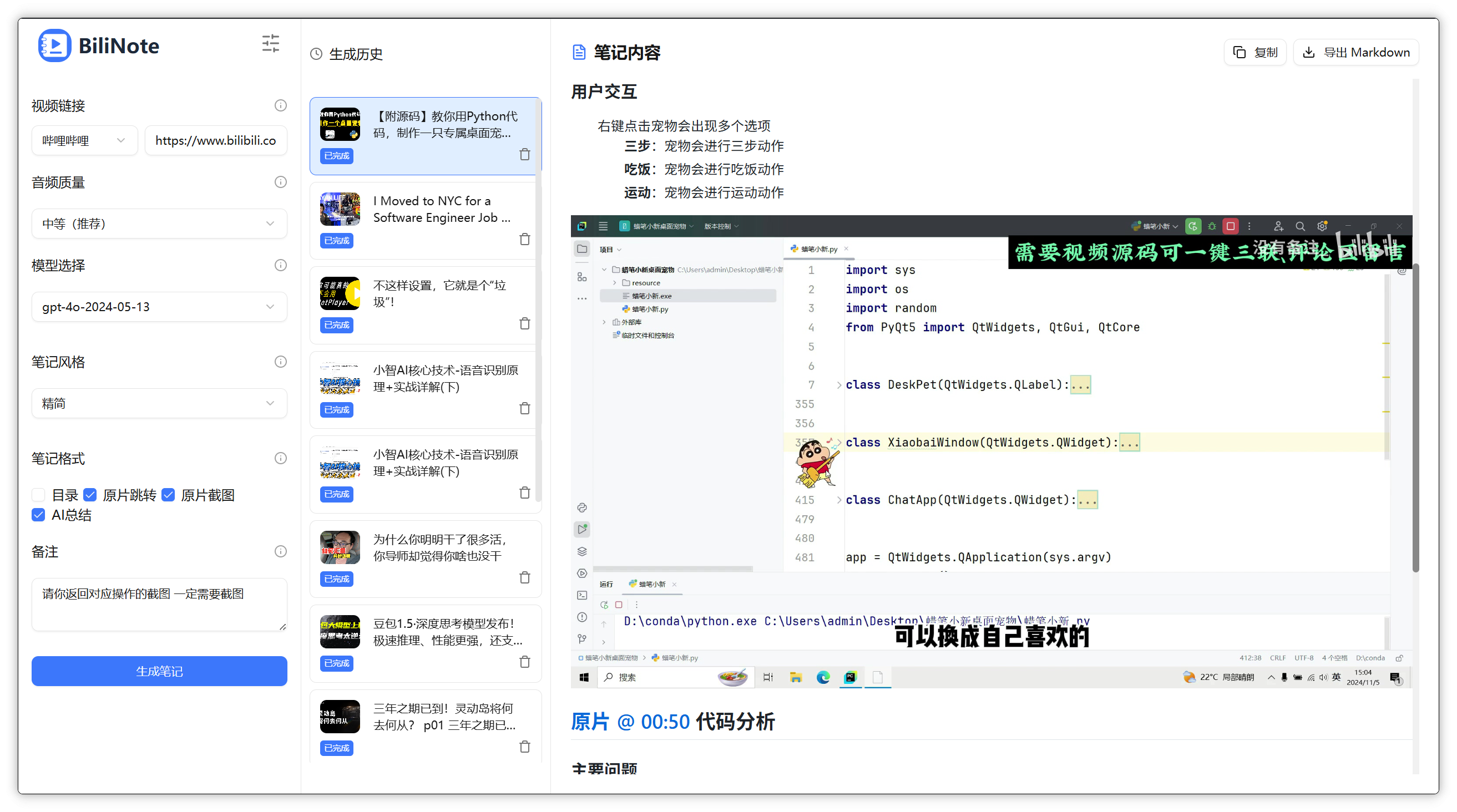
BiliNote is an open-source AI video note-taking assistant that automatically extracts content from Bilibili, YouTube, TikTok, and other video platforms to generate structured Markdown notes with screenshots and timestamps. It serves content creators, students, and knowledge workers who need to convert video content into searchable, organized notes, and is best suited for Chinese-language video platforms (particularly Bilibili) though it supports international platforms as well.
Inferred from signals mentioned in the README (tests, CI, type safety) — not a review of the actual code.
AI's overall editorial judgment — not an average of the bars above, can weigh other factors too.
BiliNote turns Bilibili, YouTube, and short-video links into structured Markdown notes using local or cloud LLMs
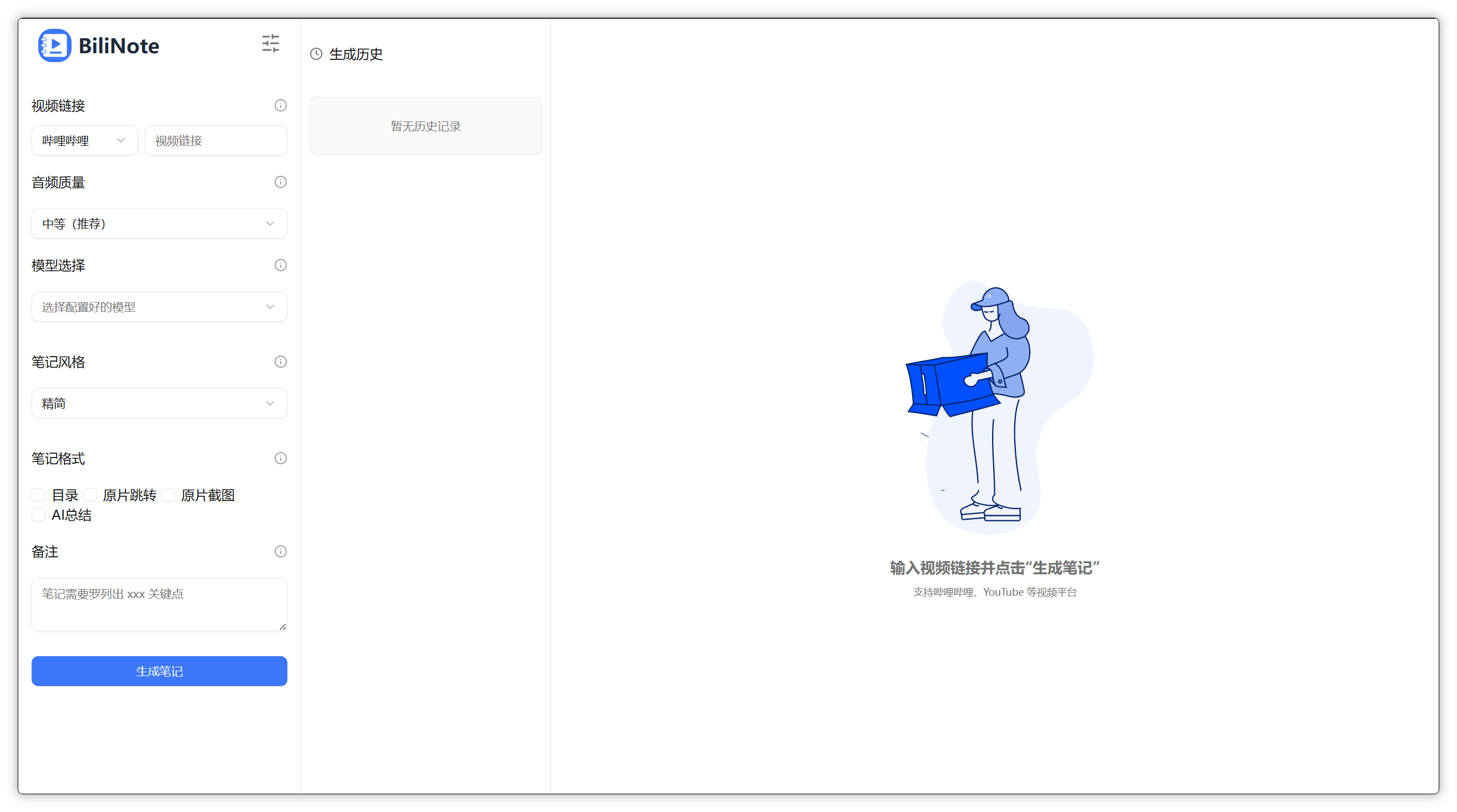
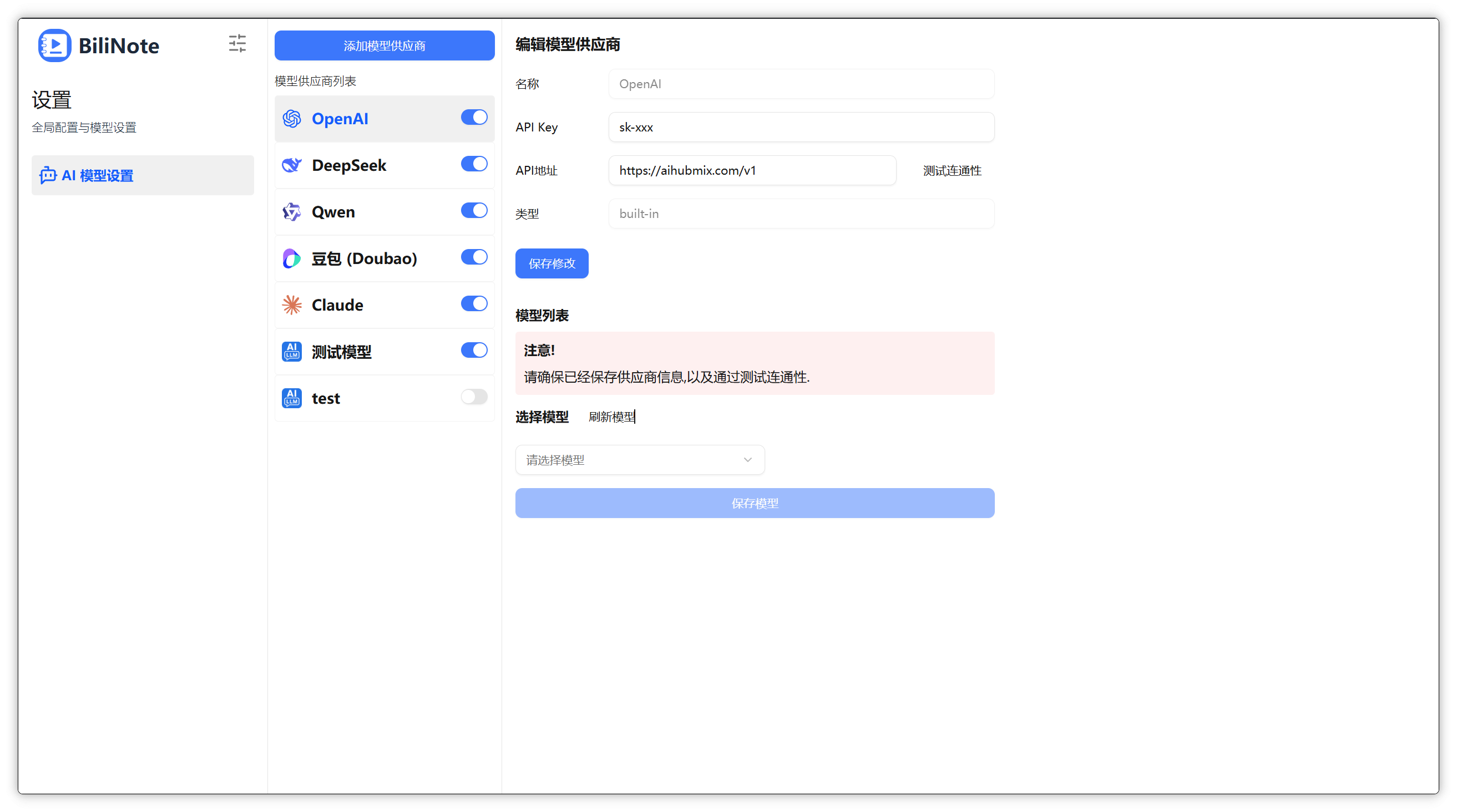
BiliNote is an open-source AI-powered video-to-notes tool targeting Chinese-speaking users who consume content on Bilibili, Douyin, Kuaishou, and YouTube. It transcribes audio via Whisper (local Fast-Whisper, MLX-Whisper, or cloud Groq/BCut), then uses configurable LLMs (OpenAI, DeepSeek, Qwen, etc.) to generate structured Markdown notes with optional screenshots, source jump links, RAG-based Q&A, and a browser extension. A hosted Pro version at bilinote.app lowers the barrier for non-technical users. With 6,500+ stars in roughly 14 months and a companion SaaS offering, it appears to have genuine user traction in the Chinese developer and study community.
Created April 2025, BiliNote grew rapidly by targeting a clear unmet need: Bilibili-first video summarization. It reached version 2.4.4 by June 2026, iterating through browser extension support, desktop Tauri clients, RAG Q&A, and Docker hardening.
Initial traction likely came from Chinese developer communities sharing it as a study-efficiency tool for Bilibili lectures and tutorials. The addition of a hosted SaaS (bilinote.app), a browser extension, and desktop clients broadened the addressable audience beyond self-hosters. 79 stars in the last 7 days (as of June 23, 2026) suggests sustained organic discovery rather than a single viral spike.
A live hosted SaaS product (bilinote.app) implies real users beyond GitHub. The README references community WeChat groups, paid remote-setup consulting, and a browser extension in the Chrome/Edge/Firefox stores — all indirect signals of an active user base. Exact user counts or API call volumes are not publicly disclosed. 844 forks for 6,508 stars is a healthy fork ratio (~13%), suggesting genuine self-deployment interest rather than passive starring.
Appears to follow a Python FastAPI backend paired with a React 19 frontend, packaged together in a single Docker image. Local transcription runs via Fast-Whisper or MLX-Whisper; cloud transcription via Groq or BCut. LLM calls go through what the README calls 'UniversalGPT', an abstraction layer that switches between string and multimodal message formats based on provider capabilities. RAG indexing for Q&A is likely built on a vector store over note content and video metadata. A Tauri-based desktop client wraps the backend as a sidecar process. A browser extension (Chrome/Edge/Firefox MV3) communicates with the local or remote backend.
Not documented in README
Last push was June 23, 2026 — the same day as this evaluation — indicating active, ongoing development. The changelog shows frequent point releases addressing CI breakages, dependency pinning, Docker deployment robustness, and user-reported bugs. CONTRIBUTING.md, RELEASING.md, commitlint CI, and PR/issue templates suggest the project has matured its contribution process. One-on-one paid setup support is offered, indicating the maintainer treats this as a sustained effort.
ADOPT IF: you are a Chinese-speaking user who regularly watches long-form Bilibili, YouTube, or short-video content and wants structured, reusable Markdown notes — especially if you are comfortable with Docker or want a no-setup SaaS. AVOID IF: your video library is primarily in non-CJK languages with no subtitle track, or you need enterprise-grade reliability, audit trails, or team collaboration features. MONITOR IF: you are building a study or knowledge-management workflow and want to evaluate whether the RAG Q&A and browser extension mature into a cohesive personal knowledge base.
Independent dimensions
Mainstream potential
4/10
Technical importance
6/10
Adoption evidence
5/10
- Heavy dependency on third-party video platform APIs (Bilibili, YouTube) means any platform-side anti-scraping change can break core functionality with little notice.
- The SaaS (bilinote.app) is operated by a single maintainer; its long-term availability and pricing stability are unknown, creating lock-in risk for users who migrate from self-hosted to Pro.
- Local Whisper transcription quality and speed vary significantly by hardware; users without a capable GPU may experience slow or low-quality transcription, which directly degrades note quality.
- The project is primarily Chinese-language in documentation and community support; non-Chinese-speaking contributors or users may find it harder to participate or get help.
- Rapid versioning (2.4.4 in ~14 months) with multiple CI and build breakages noted in the changelog suggests deployment stability has occasionally lagged behind feature development.
BiliNote is likely to consolidate into a stable self-hosted + SaaS dual offering for the Chinese personal-productivity market. Mainstream adoption outside the Chinese-speaking developer community appears unlikely given the platform focus and documentation language.
Newsletter
Get analyses like this every Monday
Free weekly digest of the most interesting open-source discoveries.
Languages
Information
- Website
- https://www.bilinote.app/
- Language
- Python
- License
- MIT
- Last updated
- 2w ago
- Created
- 15mo ago
- Analyzed with
- anthropic/claude-haiku-4-5
Stars over time
Contributors over time
Top 100 contributors only — repos with more will plateau at 100.
Open issues
Top contributors
Similar repos

JimmyLv/BibiGPT-v1
BibiGPT is an AI-powered summarization tool designed specifically for video and...

lanbinleo/bili2text
bili2text is a command-line tool that converts Bilibili videos to text by...
| Repository | Stars | Week Δ | Language | Score | Updated |
|---|---|---|---|---|---|
|
JefferyHcool/BiliNote
this
|
6.8k | +87 | Python | 7/10 | 2w ago |
|
JimmyLv/BibiGPT-v1
|
6.1k | — | TypeScript | 7/10 | 2mo ago |
|
lanbinleo/bili2text
|
1.7k | — | Python | 7/10 | 3w ago |
 linyqh/NarratoAI linyqh/NarratoAI
|
10.2k | — | Python | 7/10 | 6d ago |
 difyz9/ytb2bili difyz9/ytb2bili
|
1.6k | — | Go | 7/10 | 2w ago |
 YILS-LIN/short-video-factory YILS-LIN/short-video-factory
|
4.4k | — | TypeScript | 7/10 | 1mo ago |
An earlier TypeScript-based Bilibili GPT summarizer with similar star count. BiliNote adds local Whisper transcription, multi-platform support beyond Bilibili, a desktop client, RAG Q&A, and a maintained SaaS — making it more feature-complete for the same core audience.
Focused narrowly on Bilibili audio-to-text conversion with 1,715 stars. BiliNote is a superset: it adds LLM summarization, multi-platform support, UI, and a browser extension, targeting users who want a finished product rather than a raw transcription pipeline.
Targets AI-assisted video narration and content creation (9,948 stars) rather than personal note-taking. Different primary use case; overlap exists only in the transcription layer.
A much larger project (91,352 stars) focused on automated short-video generation. Not a direct competitor — it represents a different workflow (video output vs. note output), though both rely on LLM + video tooling.
A 23,355-star project oriented toward AI video understanding and generation at a higher API/model level. It operates in a different tier — likely enterprise or model-developer focused — rather than the personal productivity niche BiliNote occupies.