lanbinleo/bili2text
Python MIT Single maintainer riskBilibili视频转文字,一步到位,输入链接即可使用
1.7k
Stars
220
Forks
1
Open issues
11
Contributors


AI Analysis
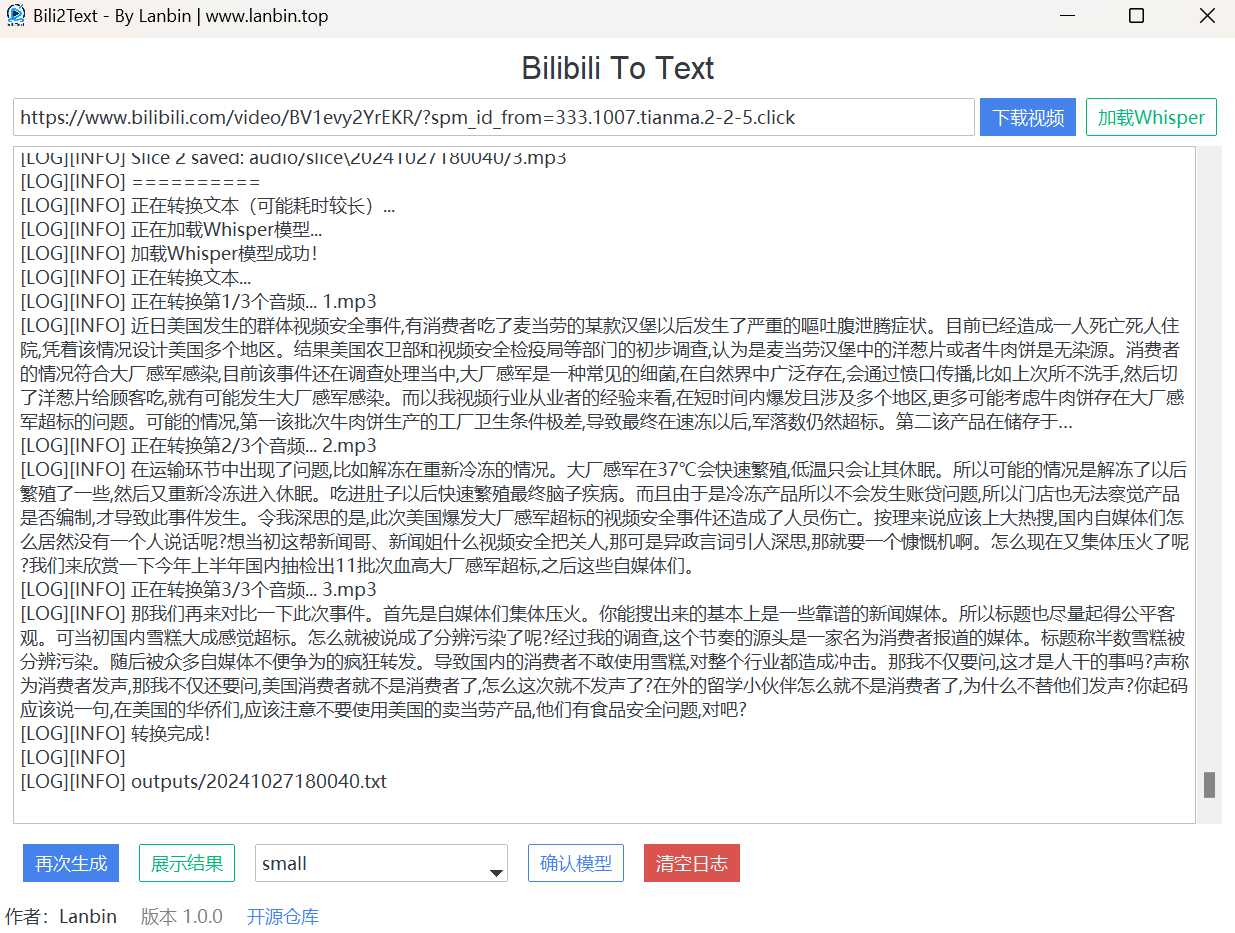
bili2text is a command-line tool that converts Bilibili videos to text by downloading the video, extracting audio, and running speech recognition. It is specifically designed for Bilibili content creators, researchers, and users who need transcripts of Chinese-language videos, supporting multiple transcription engines (Whisper, SenseVoice, and Volcano Engine API) with both local and cloud-based options.
Inferred from signals mentioned in the README (tests, CI, type safety) — not a review of the actual code.
AI's overall editorial judgment — not an average of the bars above, can weigh other factors too.
Bilibili video-to-text CLI tool using local or cloud speech recognition engines
bili2text is a Python command-line utility that downloads Bilibili videos, extracts audio, and transcribes them to text using multiple speech recognition backends (Whisper, SenseVoice, or Volcano Engine API). It targets Chinese-speaking content creators and researchers who need bulk video transcription. The tool provides CLI, web UI, and desktop interfaces. Adoption appears limited to the Bilibili/Chinese-language ecosystem; mainstream adoption signals are modest but the project maintains active development.
Created November 2023, bili2text emerged as a specialized wrapper around open-source and commercial speech-to-text APIs, positioned specifically for Bilibili's massive video platform. It appears to fill a gap for users who need programmatic, batch video transcription within the Chinese internet ecosystem.
The project gained 1,715 stars over ~2.5 years with modest fork activity (220 forks). No star growth in the last 7 days, and recent activity is maintenance-focused (last push June 16, 2026). Growth appears to have plateaued; the project does not show viral adoption trajectory but maintains steady, deliberate development. Similar Bilibili-adjacent projects (BiliNote, BibiGPT, pyvideotrans) have achieved significantly higher star counts, suggesting bili2text occupies a narrower niche.
Adoption not verified. Repository metadata does not contain issue tracker statistics, deployment case studies, or user testimonials. README mentions 'Web 界面' (web UI) and service mode but explicitly warns 'project temporarily has no optimization for Docker or long-running server scenarios.' This suggests the project may not yet be used at scale in production environments. No evidence of enterprise or institutional adoption.
Likely a modular Python application with pluggable speech recognition providers (local models via Whisper/SenseVoice, cloud APIs via Volcano Engine). Based on README, appears to use uv for dependency management (modern choice) and exposes multiple interfaces: CLI, web server, desktop window, and batch processing. Does not appear to handle long-running server workloads optimally per README note.
Not documented in README. No test configuration or CI/CD pipelines mentioned.
Active but not aggressive. Last commit June 16, 2026 (12 days before analysis date) indicates ongoing maintenance. Python 3.10–3.12 support suggests deliberate version pinning. Changelog and development docs exist, indicating structured release process. No evidence of rapid iteration or large contributor base; appears to be primarily single-author or very small team work.
ADOPT IF: you need batch Bilibili video transcription in Chinese, prefer Python, and want to choose between local offline models (Whisper, SenseVoice) or commercial API backends (Volcano Engine). The tool is actively maintained and designed for this specific workflow. AVOID IF: you require production-grade long-running server deployment, need cross-platform video handling beyond Bilibili, or expect enterprise support and documentation. The README explicitly states server scenarios are not yet optimized. MONITOR IF: you are considering it for mission-critical transcription workflows; wait for the project to address its own stated server limitations and demonstrate real-world deployment case studies.
Independent dimensions
Mainstream potential
3/10
Technical importance
5/10
Adoption evidence
2/10
- Server/long-running deployment explicitly unoptimized per README; unsuitable for production SaaS until addressed.
- Bilibili-specific design limits applicability outside Chinese video ecosystem; upstream platform API changes could break functionality.
- No public test coverage or CI/CD signals documented; code quality assurance mechanisms not transparent.
- Adoption not independently verified; project's actual user base and satisfaction signals remain unknown.
- Small contributor base (inferred from low fork count and single-author appearance) may limit maintenance responsiveness and feature velocity.
bili2text will likely remain a specialized, niche tool for Chinese-language video content creators and researchers. Absent major Bilibili API changes or platform shifts, the project should continue light maintenance. Mainstream adoption to rival tools like pyvideotrans appears unlikely unless the project expands beyond Bilibili or adds compelling features (e.g., multilingual support, native server optimizations). Trajectory suggests stable minor-version releases rather than aggressive growth.
Newsletter
Get analyses like this every Monday
Free weekly digest of the most interesting open-source discoveries.
Languages
Information
- Language
- Python
- License
- MIT
- Last updated
- 3w ago
- Created
- 32mo ago
- Analyzed with
- anthropic/claude-haiku-4-5
Stars over time
Contributors over time
Top 100 contributors only — repos with more will plateau at 100.
Open issues
Top contributors
Recent releases
Similar repos

JefferyHcool/BiliNote
BiliNote is an open-source AI video note-taking assistant that automatically...

ScottSloan/Bili23-Downloader
Bili23-Downloader is a cross-platform desktop application for downloading...

JimmyLv/BibiGPT-v1
BibiGPT is an AI-powered summarization tool designed specifically for video and...

jianchang512/pyvideotrans
pyVideoTrans is a comprehensive open-source tool for translating videos across...
| Repository | Stars | Week Δ | Language | Score | Updated |
|---|---|---|---|---|---|
|
lanbinleo/bili2text
this
|
1.7k | — | Python | 7/10 | 3w ago |
|
JefferyHcool/BiliNote
|
6.8k | — | Python | 7/10 | 2w ago |
|
ScottSloan/Bili23-Downloader
|
5.6k | — | Python | 7/10 | 1d ago |
|
JimmyLv/BibiGPT-v1
|
6.1k | — | TypeScript | 7/10 | 2mo ago |
|
jianchang512/pyvideotrans
|
18.3k | — | Python | 7/10 | 2d ago |
 biliup/biliup biliup/biliup
|
5.3k | — | Rust | 7/10 | 5d ago |
Much larger project; broader scope (video translation, not just transcription). Appears to serve a wider use case. bili2text is narrower and transcription-focused.
Bilibili-specific like bili2text but TypeScript-based and likely includes AI summary features (implied by 'GPT' in name). Different tech stack and broader feature scope.
Direct Python competitor in Bilibili automation. bili2text appears more transcription-specialized; adoption significantly lower.
bili2text wraps Whisper as one option; not a replacement. Requires Whisper to work as a backend. Complementary relationship.
Similarly complementary; bili2text provides interface layer for Chinese speech recognition. Not competing but depending on it.