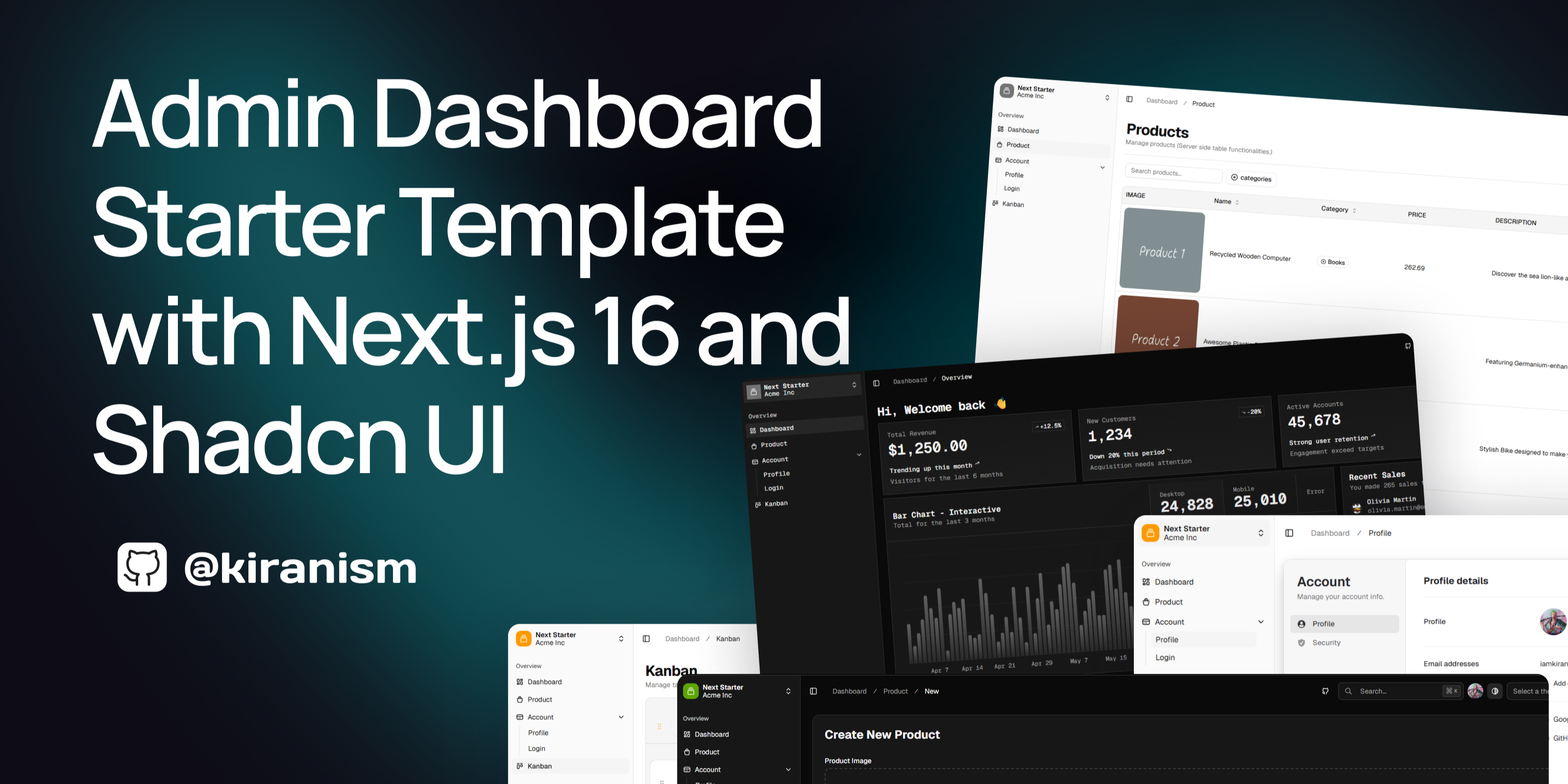
Open source admin dashboard starter built with Next.js 16, shadcn/ui, Tailwind CSS, and TypeScript.
6.7k
Stars
1.6k
Forks
4
Open issues
13
Contributors
AI Analysis
A production-ready admin dashboard starter template built with Next.js 16, shadcn/ui, and TypeScript, designed to accelerate SaaS and internal tool development by eliminating boilerplate setup. It serves developers and product teams who need a polished, feature-complete starting point for admin interfaces, dashboards, and B2B applications. Not suitable for those seeking a headless CMS, a design system library, or applications outside the admin/dashboard domain.
Inferred from signals mentioned in the README (tests, CI, type safety) — not a review of the actual code.
AI's overall editorial judgment — not an average of the bars above, can weigh other factors too.
Next.js 16 admin dashboard starter with shadcn/ui: opinionated boilerplate for SaaS and internal tools
next-shadcn-dashboard-starter is a free, MIT-licensed boilerplate for building admin dashboards and SaaS panels using Next.js 16, shadcn/ui, Tailwind CSS v4, and TypeScript. It targets developers who need a production-ready starting point with auth (Clerk), data tables (TanStack), charts (Recharts), forms (TanStack Form + Zod), RBAC, and multi-tenant workspaces — without assembling these integrations manually. Its 6,600+ stars and 1,545 forks indicate meaningful developer adoption as a scaffold for real projects rather than just a reference demo.
Created in November 2023, shortly after shadcn/ui gained mainstream traction. It evolved from a basic UI scaffold into a fuller-featured SaaS starter, adding Clerk auth, billing, RBAC, TanStack integrations, and Tailwind v4 support over roughly 2.5 years of active iteration.
Growth appears to have been driven by the broader shadcn/ui and Next.js App Router adoption wave. Early stars likely came from developers seeking practical shadcn/ui usage examples. As the template added real features — auth, billing, tables, RBAC — it attracted developers starting SaaS or internal tool projects. The 1,545 forks suggest use as an actual project base rather than passive bookmarking. Recent pace (25 stars/week) is modest but steady, consistent with a maturing utility tool rather than a viral project.
The 1,545 forks provide indirect evidence that developers are using this as a base for actual projects. A live demo is publicly accessible. Sponsorship by Clerk and Sentry suggests commercial interest in the template's reach. However, no documented case studies, production deployments at known companies, or download/usage metrics are available in the README. Adoption appears real but is not independently verified at scale.
Appears to use Next.js App Router with a feature-based folder structure. Likely employs parallel routes for isolated loading/error states per dashboard section. State management is split: Zustand for global state, Nuqs for URL-synced search/filter params, React Query for server-prefetched and client-cached data. Auth is fully delegated to Clerk (including SSO, organizations, billing). Forms use TanStack Form + Zod for schema validation. The toolchain uses OxLint/Oxfmt (Rust-based) and Husky pre-commit hooks — suggests an above-average developer experience focus.
Not documented in README. No mention of unit, integration, or end-to-end tests in the available README excerpt.
Last push was June 22, 2026 — three days before the current date. This indicates active, ongoing maintenance. The README references current-generation tooling (Tailwind v4, Next.js 16, TanStack Form) suggesting the maintainer actively tracks ecosystem updates rather than freezing dependencies.
ADOPT IF: you are starting a SaaS dashboard or internal admin panel on Next.js and are comfortable with Clerk as your auth/billing layer — it will save meaningful setup time. AVOID IF: you need full control over auth providers, want a vendor-neutral stack, or require documented test coverage from day one. MONITOR IF: you are evaluating it for a mid-sized team project — watch whether the Clerk dependency deepens or becomes optional over time.
Independent dimensions
Mainstream potential
4/10
Technical importance
5/10
Adoption evidence
4/10
- Clerk lock-in: auth, billing, and RBAC are tightly coupled to Clerk. Replacing it later would require significant refactoring across auth, middleware, and UI gating logic.
- No documented test coverage: the absence of any testing setup in the README means adopters must add their own testing infrastructure before treating this as production-ready.
- Single-maintainer project: there is no visible evidence of a contributor team. Continued maintenance depends on one person's availability and motivation.
- Rapid dependency churn: the stack includes several cutting-edge libraries (Tailwind v4, Next.js 16, TanStack Form). Keeping up with breaking changes across this many dependencies may create periodic instability.
- Feature scope creep: as more integrations are added (Sentry, kbar, RBAC, billing), the starter becomes more opinionated, which improves convenience but reduces flexibility for projects with different architectural requirements.
Likely to remain a well-maintained reference template with steady but modest growth, closely tied to the shadcn/ui and Next.js App Router ecosystem. Unlikely to displace more generalist SaaS starters but may consolidate its position as a preferred starting point for Clerk-based SaaS dashboards.
Newsletter
Get analyses like this every Monday
Free weekly digest of the most interesting open-source discoveries.
Languages
No language breakdown available.
Information
- Website
- https://dub.sh/shadcn-dashboard
- Language
- TypeScript
- License
- MIT
- Last updated
- 3w ago
- Created
- 33mo ago
- Analyzed with
- anthropic/claude-haiku-4-5
Stars over time
No commit data available.
Contributors over time
Top 100 contributors only — repos with more will plateau at 100.
Open issues
No open issues — clean slate.
Open pull requests
No open pull requests.
Top contributors
Contributor data not available yet.
Recent releases
No releases published yet.
Similar repos

arhamkhnz/next-shadcn-admin-dashboard
A production-ready admin dashboard template built with Next.js 16, TypeScript,...

satnaing/shadcn-admin
Shadcn Admin is a reusable admin dashboard UI component collection built with...

nextjs/saas-starter
A production-ready Next.js SaaS starter template with built-in authentication,...
| Repository | Stars | Week Δ | Language | Score | Updated |
|---|---|---|---|---|---|
|
Kiranism/next-shadcn-dashboard-starter
this
|
6.7k | +38 | TypeScript | 8/10 | 3w ago |
|
arhamkhnz/next-shadcn-admin-dashboard
|
2.7k | — | TypeScript | 8/10 | 2d ago |
|
satnaing/shadcn-admin
|
12.6k | — | TypeScript | 7/10 | 4w ago |
 shadcn-ui/ui shadcn-ui/ui
|
118.7k | — | TypeScript | 9/10 | 1d ago |
|
nextjs/saas-starter
|
16k | — | TypeScript | 8/10 | 7mo ago |
 zerostaticthemes/square-ui zerostaticthemes/square-ui
|
5.9k | — | TypeScript | 7/10 | 4w ago |
Nearly twice the stars (12,437) and also shadcn/ui-based. Appears more focused on pure UI/layout fidelity without opinionated auth or billing integrations. next-shadcn-dashboard-starter differentiates with deeper Clerk-based auth, RBAC, and multi-tenancy out of the box.
Official Vercel/Next.js SaaS starter (15,910 stars) with higher authority signal. Uses different auth/payment choices (Stripe, simple session auth). next-shadcn-dashboard-starter has richer UI components and dashboard structure but lacks the official backing.
Comparable star count (7,213). Covers broader SaaS concerns (i18n, email, testing). next-shadcn-dashboard-starter focuses more narrowly on dashboard UI quality and TanStack integrations, making it potentially faster to reach a working admin panel.
Not a direct competitor — it is the underlying component library. This template is one practical layer above shadcn/ui, showing how to compose those components into a full dashboard with real integrations.
Similar star count (5,899). Appears to be a UI theme/template rather than a full-stack Next.js starter. next-shadcn-dashboard-starter offers deeper backend integration (auth, billing, data fetching) at the cost of more opinionated vendor choices.