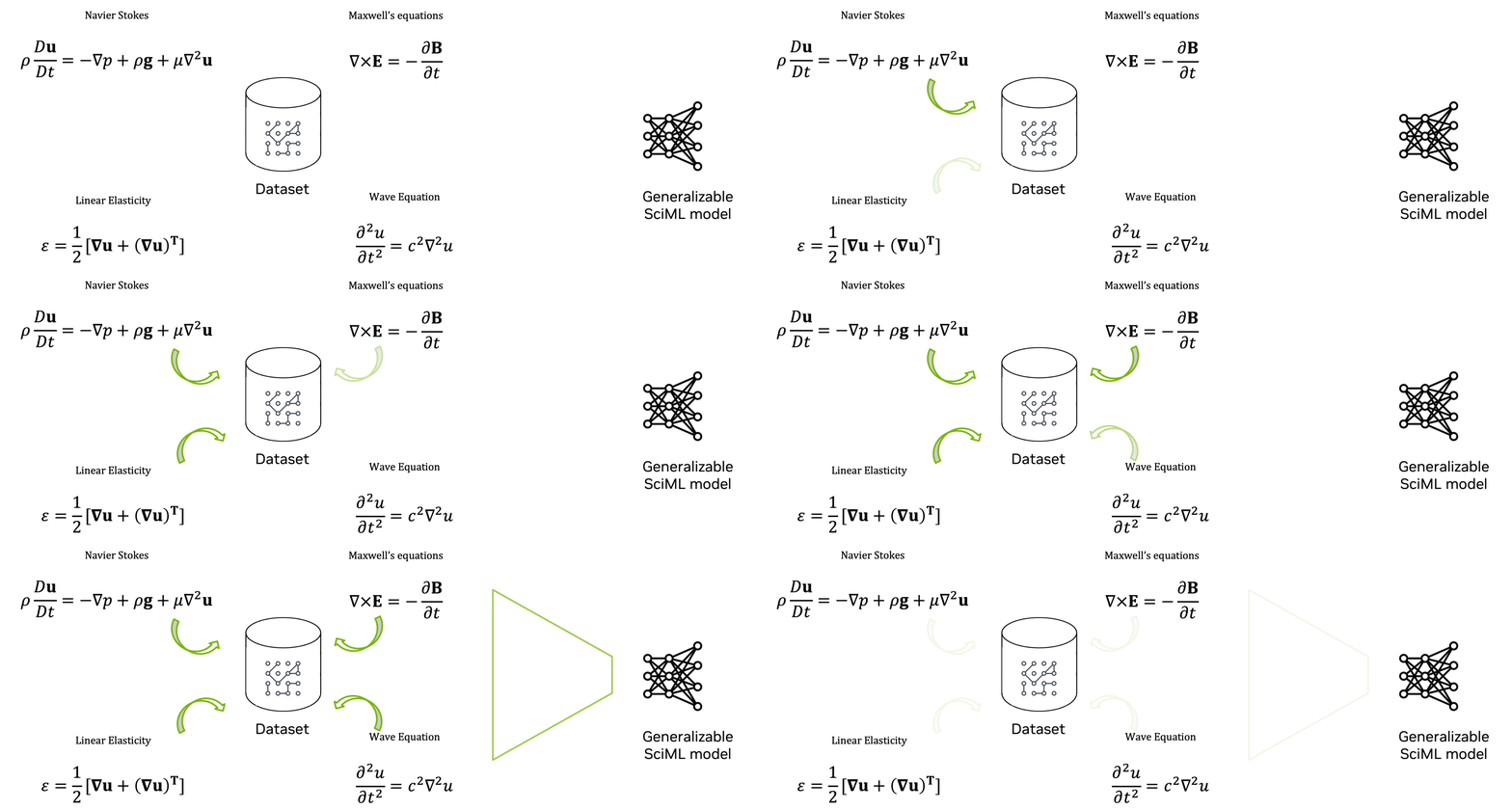
Open-source deep-learning framework for building, training, and fine-tuning deep learning models using state-of-the-art Physics-ML methods
3k
Stars
719
Forks
67
Open issues
30
Contributors


AI Analysis
PhysicsNeMo is NVIDIA's open-source deep-learning framework for building Physics-informed AI models, combining neural operators, GNNs, and transformers with physics knowledge for scientific computing and engineering applications. It serves researchers and engineers developing AI4Science solutions who need GPU-optimized training at scale. This is specialized for physics-informed machine learning, not a general-purpose deep-learning framework.
Inferred from signals mentioned in the README (tests, CI, type safety) — not a review of the actual code.
AI's overall editorial judgment — not an average of the bars above, can weigh other factors too.
NVIDIA's Physics-Informed ML framework for scientific computing, actively maintained with modest niche adoption
PhysicsNeMo is an open-source Python framework designed for training physics-informed neural networks and SciML models, combining domain knowledge with deep learning. Built by NVIDIA and released in early 2023, it targets research scientists and engineers working on computational physics problems (CFD, climate modeling, etc.). Adoption appears concentrated within NVIDIA's ecosystem and specialized academic/research institutions; mainstream adoption beyond this niche is not in evidence.
Launched January 2023, PhysicsNeMo emerged from NVIDIA's broader NeMo suite (which spans speech, language, and reinforcement learning). The project represents NVIDIA's strategic push into Physics-ML, positioning GPU-accelerated scientific computing as a growth area. Currently undergoing v2.0 migration to improve installation and external package integration.
GitHub stars grew from 0 to ~3,000 over ~3.5 years, representing slow-to-moderate adoption for a specialized ML framework. Recent activity (25 stars in 7 days as of July 2026, last push same date) suggests active maintenance but not viral growth. Growth trajectory indicates niche adoption rather than mainstream adoption—typical for domain-specific scientific tools.
README mentions 'Who is Using and Contributing to PhysicsNeMo' section but truncated excerpt does not include actual user/org list. Domain-specific sub-projects exist (PhysicsNeMo-CFD, Earth-2 Studio) suggesting downstream products, implying some real-world deployment. However, adoption not verified from provided materials—cannot confirm user scale, deployment frequency, or production incidents. Adoption appears to be within NVIDIA's controlled ecosystem and academic research rather than independent third-party adoption.
README indicates modular design with composable components: physicsnemo.models (neural operators, GNNs, diffusion, transformers), physicsnemo.datapipes (scientific data handling), physicsnemo.distributed (torch.distributed wrapper), physicsnemo.sym (symbolic PDE residual computation), and physicsnemo.curator (data curation). Appears to be built as a PyTorch extension layer optimized for GPU training. README does not expose implementation details of core algorithms or optimization strategies.
Codecov badge present in README indicating CI/CD pipeline with coverage tracking, but specific coverage percentage not documented in excerpt. Install CI pipeline visible. Test coverage appears to exist but depth not quantifiable from README alone.
Last push 2026-07-08 (same as evaluation date), indicating active development as of this moment. Project status badge explicitly marked 'Active — stable, usable state and actively developed.' Code style enforcement (black) and CI automation present. Migration to v2.0 in progress suggests active maintenance and iteration. No signs of abandonment; appears to be a staffed NVIDIA project.
ADOPT IF: You are training Physics-informed neural networks at scale on NVIDIA GPUs, need production-grade distributed training infrastructure, and operate within NVIDIA's ecosystem (have GPU availability and organizational alignment). AVOID IF: You need cross-framework portability (TensorFlow, JAX), require extensive third-party integration beyond PyTorch, or operate in resource-constrained environments. MONITOR IF: You are exploring SciML/Physics-ML and want to track whether this framework achieves adoption beyond NVIDIA-affiliated users and academic research.
Independent dimensions
Mainstream potential
3/10
Technical importance
6/10
Adoption evidence
3/10
- Vendor lock-in: NVIDIA-maintained project with GPU optimization as core value proposition; portability to non-NVIDIA hardware unclear and likely limited by design.
- Narrow audience: SciML/Physics-ML is specialized niche; adoption ceiling may be fundamentally capped by market size, not technical quality. Mainstream ML adoption unlikely.
- v2.0 migration uncertainty: Active migration in progress; API stability and backward compatibility during transition may affect existing users, though migration guide is documented.
- Competitive fragmentation: PyTorch ecosystem has many Physics-ML micro-libraries; unclear whether PhysicsNeMo consolidates ecosystem or fragments it further.
- Limited evidence of independent third-party adoption: Adoption signals concentrated within NVIDIA ecosystem; limited public case studies or production deployments outside NVIDIA-affiliated organizations.
PhysicsNeMo will likely remain a specialized, well-maintained framework serving NVIDIA's GPU customers in scientific computing. Adoption may grow incrementally within academia and research institutions doing Physics-ML, but mainstream adoption beyond this niche is improbable. Project will continue as a long-tail offering in NVIDIA's broader ML portfolio.
Newsletter
Get analyses like this every Monday
Free weekly digest of the most interesting open-source discoveries.
Languages
Information
- Language
- Python
- License
- Apache-2.0
- Last updated
- 11h ago
- Created
- 42mo ago
- Analyzed with
- anthropic/claude-haiku-4-5
Stars over time
Contributors over time
Top 100 contributors only — repos with more will plateau at 100.
Top contributors
Recent releases
Similar repos

newton-physics/newton
Newton is a GPU-accelerated physics simulation engine built on NVIDIA Warp,...

NVIDIA-NeMo/Nemotron
Nemotron is NVIDIA's developer hub for training, fine-tuning, and deploying the...
| Repository | Stars | Week Δ | Language | Score | Updated |
|---|---|---|---|---|---|
|
NVIDIA/physicsnemo
this
|
3k | +29 | Python | 8/10 | 11h ago |
|
newton-physics/newton
|
5.2k | — | Python | 8/10 | 13h ago |
|
NVIDIA-NeMo/Speech
|
17.7k | — | Python | 8/10 | 9h ago |
|
NVIDIA-NeMo/Nemotron
|
1.7k | — | Jupyter Notebook | 8/10 | 2d ago |
 maziarraissi/PINNs maziarraissi/PINNs
|
6k | — | Python | 7/10 | 5mo ago |
|
NVIDIA-NeMo/RL
|
1.8k | — | Python | 8/10 | 11h ago |
Established PINN reference implementation with larger star count; appears more of an academic reference than production framework. PhysicsNeMo likely targets practitioners seeking production-ready, GPU-optimized infrastructure vs. research prototyping.
Broader physics simulation framework; PhysicsNeMo is narrower, focused on ML-physics integration rather than general-purpose simulation. Different use cases—PhysicsNeMo for AI model training, Newton for physics engines.
Parent ecosystem project for speech/NLP; much higher adoption. PhysicsNeMo is smaller sibling in same organizational family, suggesting resource allocation prioritizes language/speech over Physics-ML in the broader NeMo suite.
Practitioners could build Physics-ML pipelines directly using PyTorch + scientific libraries (SciPy, DeepONet libraries). PhysicsNeMo's value is packaging, GPU optimization, and domain-specific abstractions—not unique algorithmic innovation.
PyTorch-exclusive; does not compete with TensorFlow-based Physics-ML ecosystems. Limits addressable market to PyTorch practitioners in scientific computing.