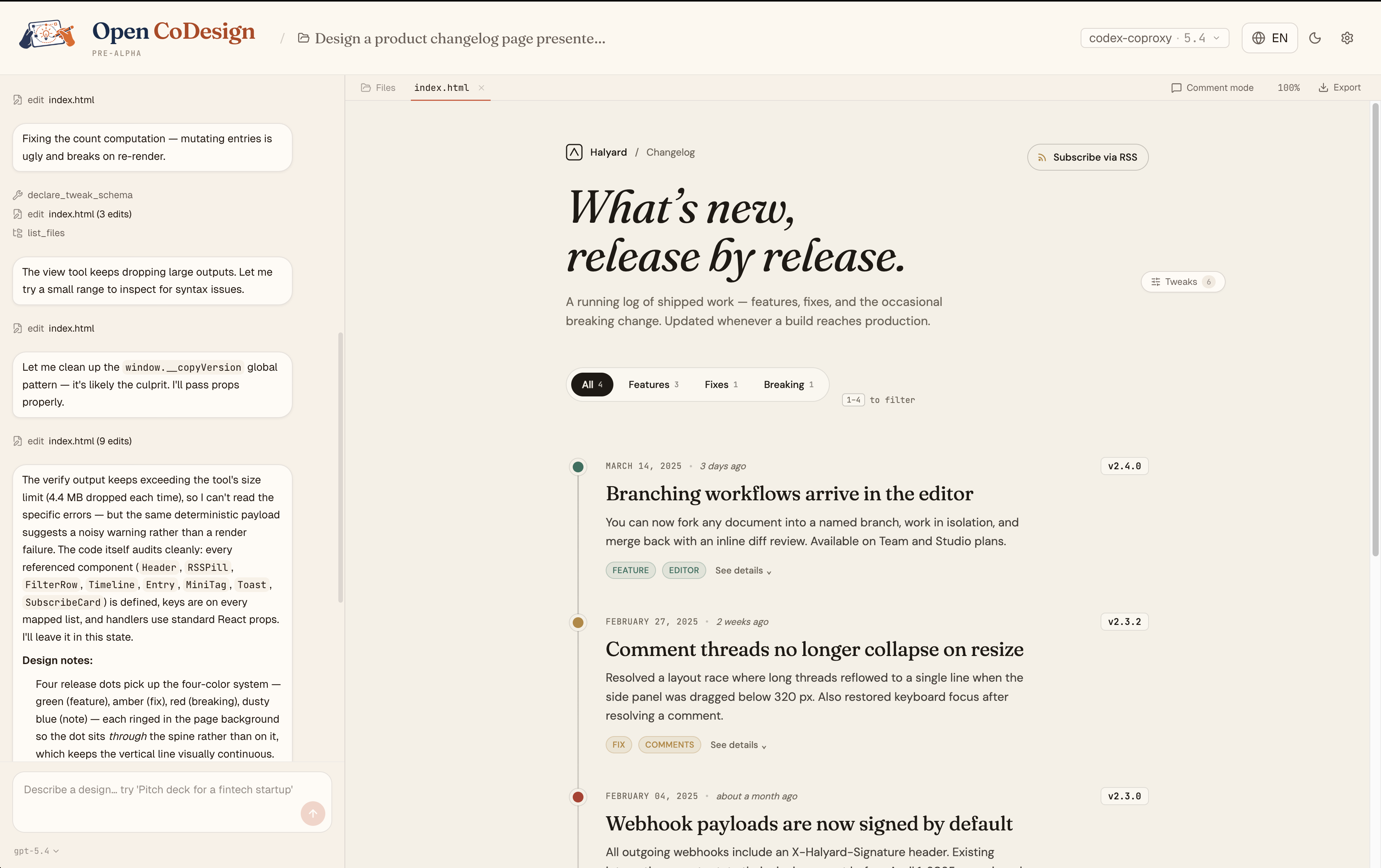
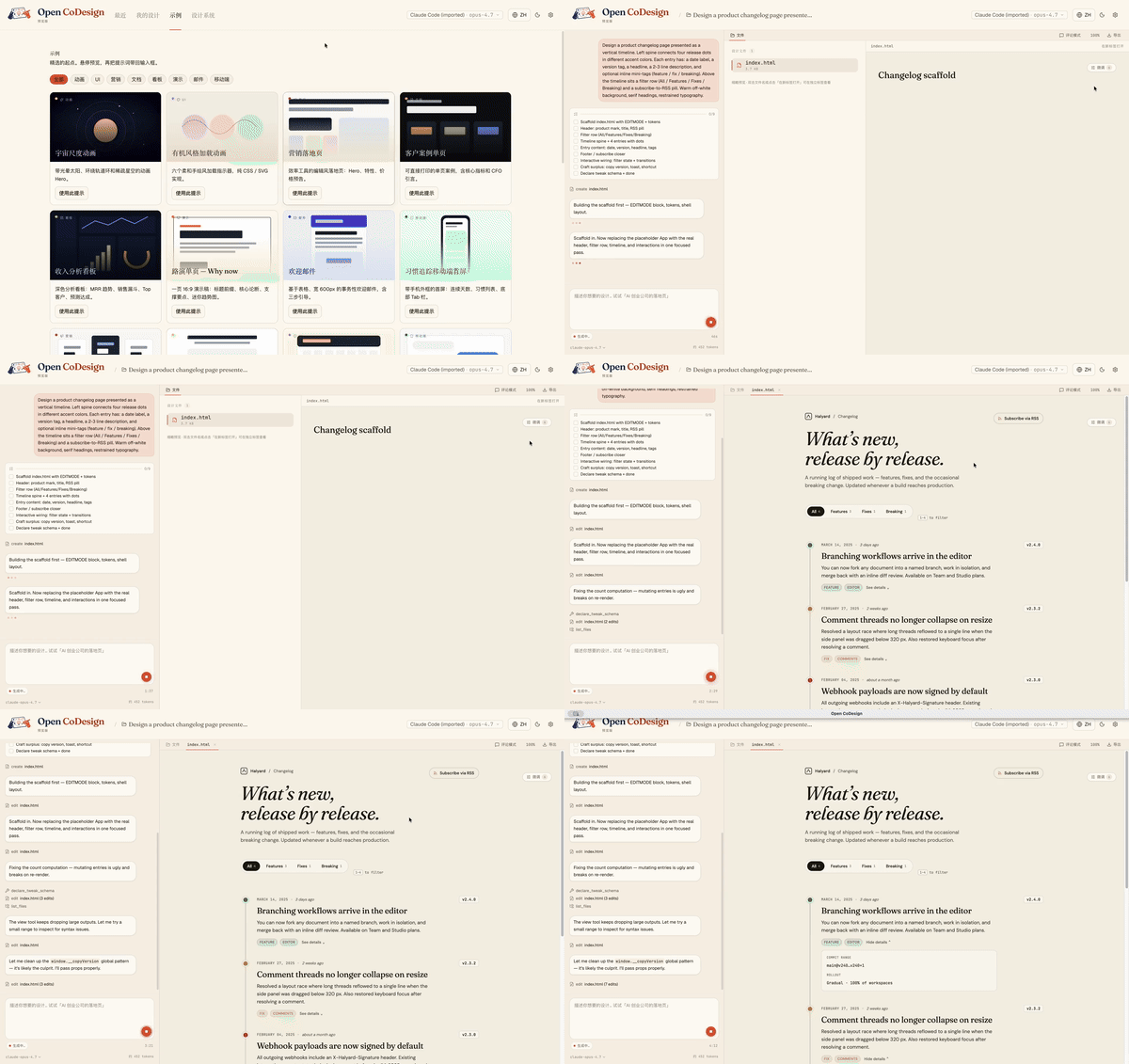
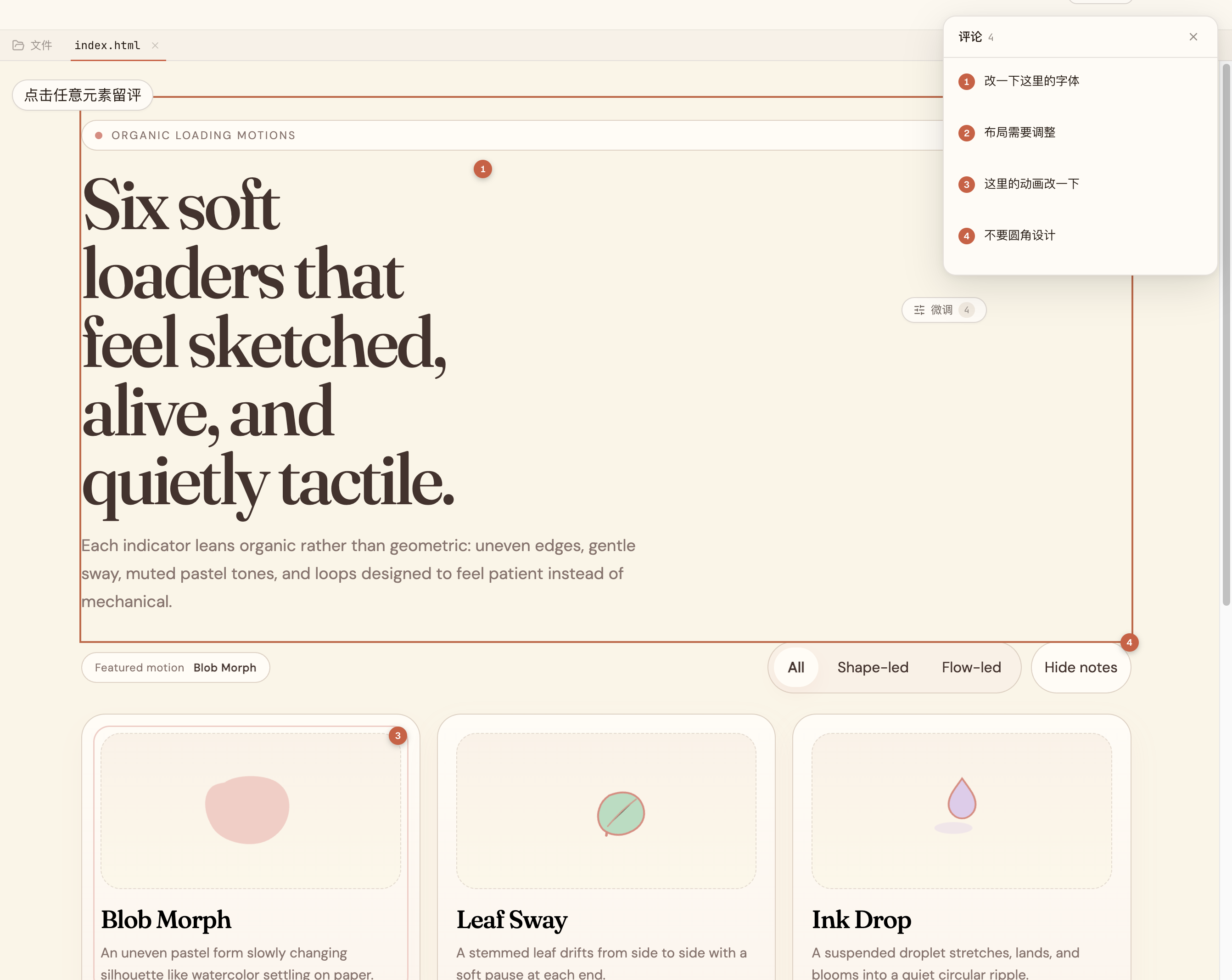
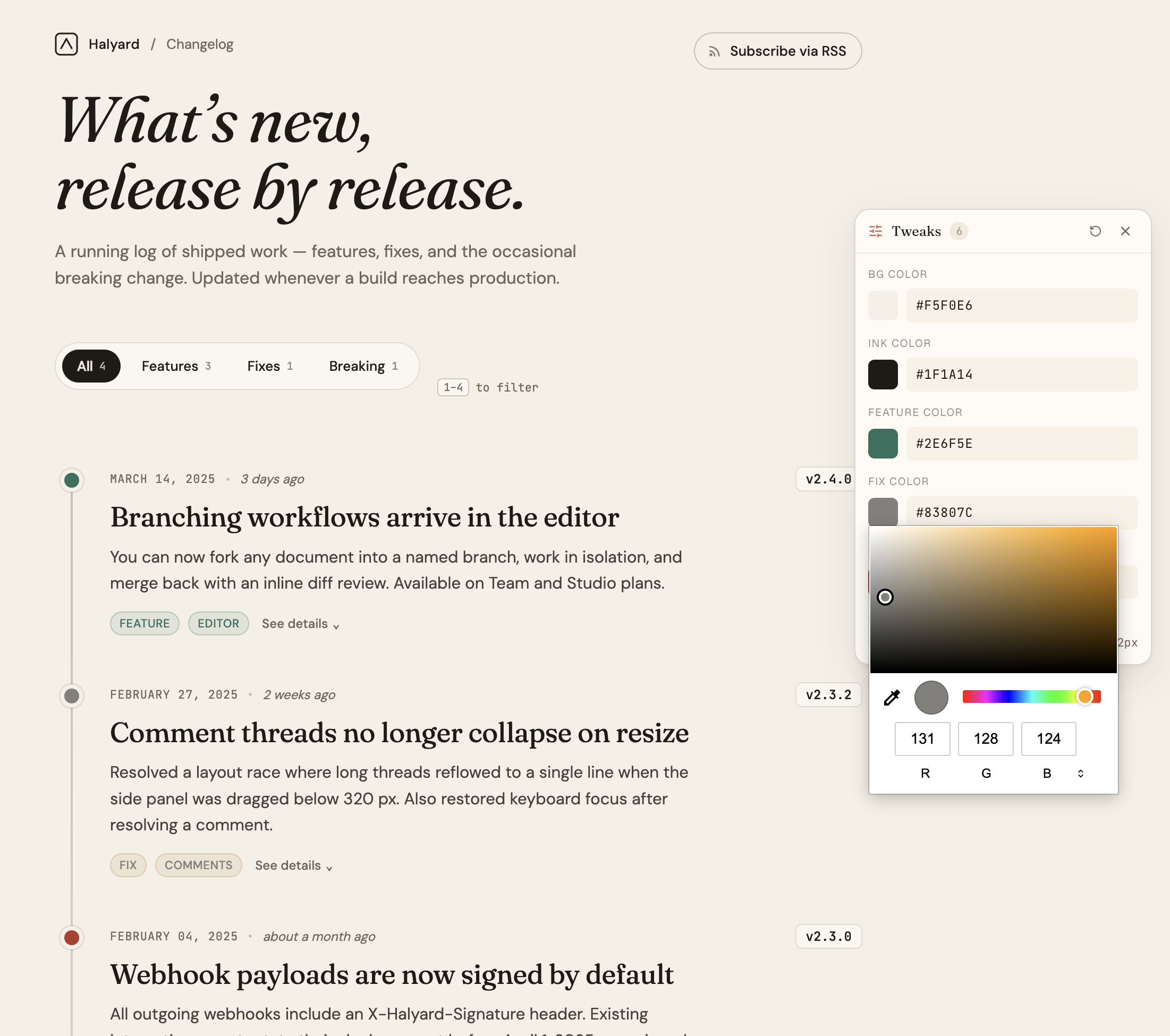
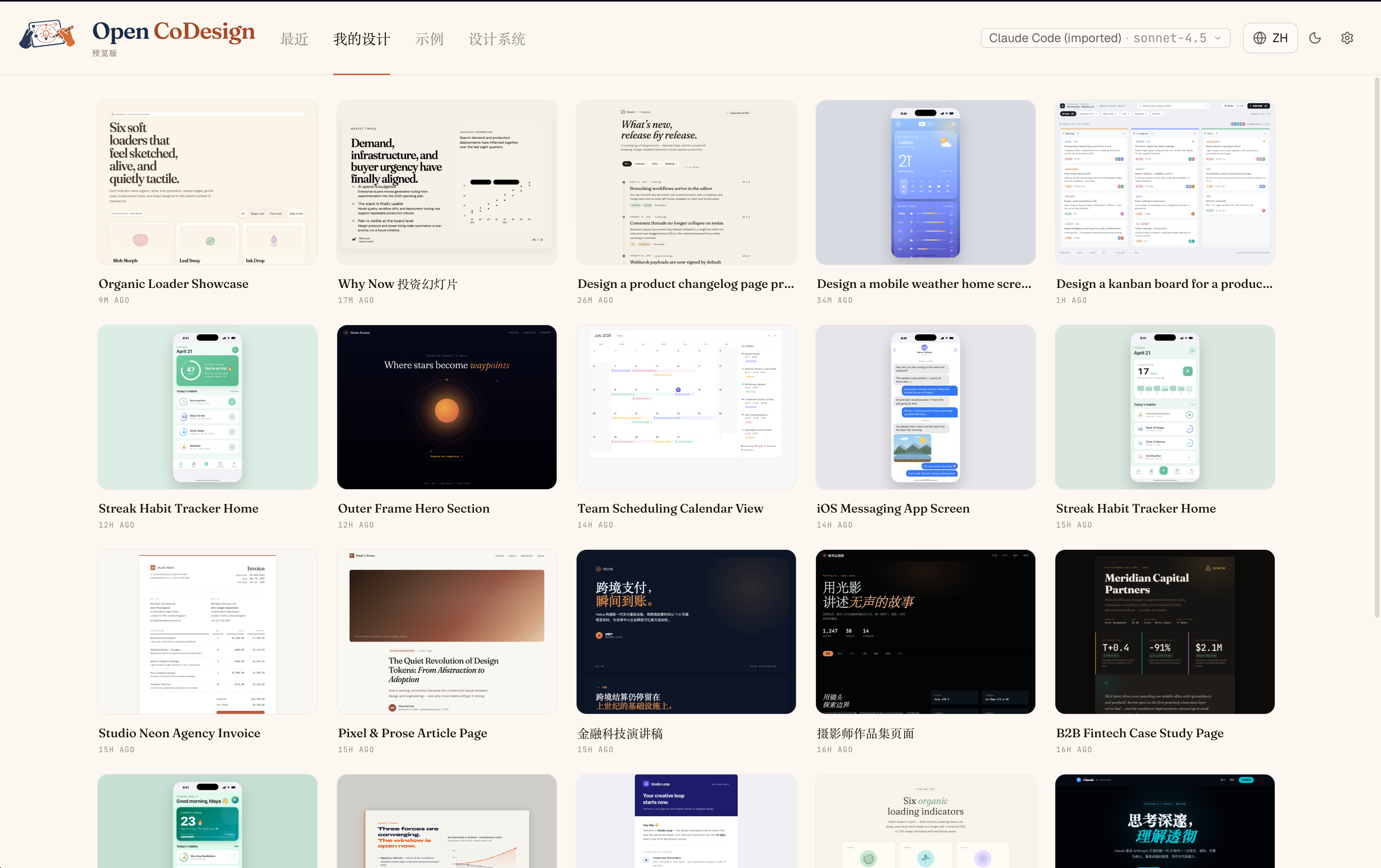
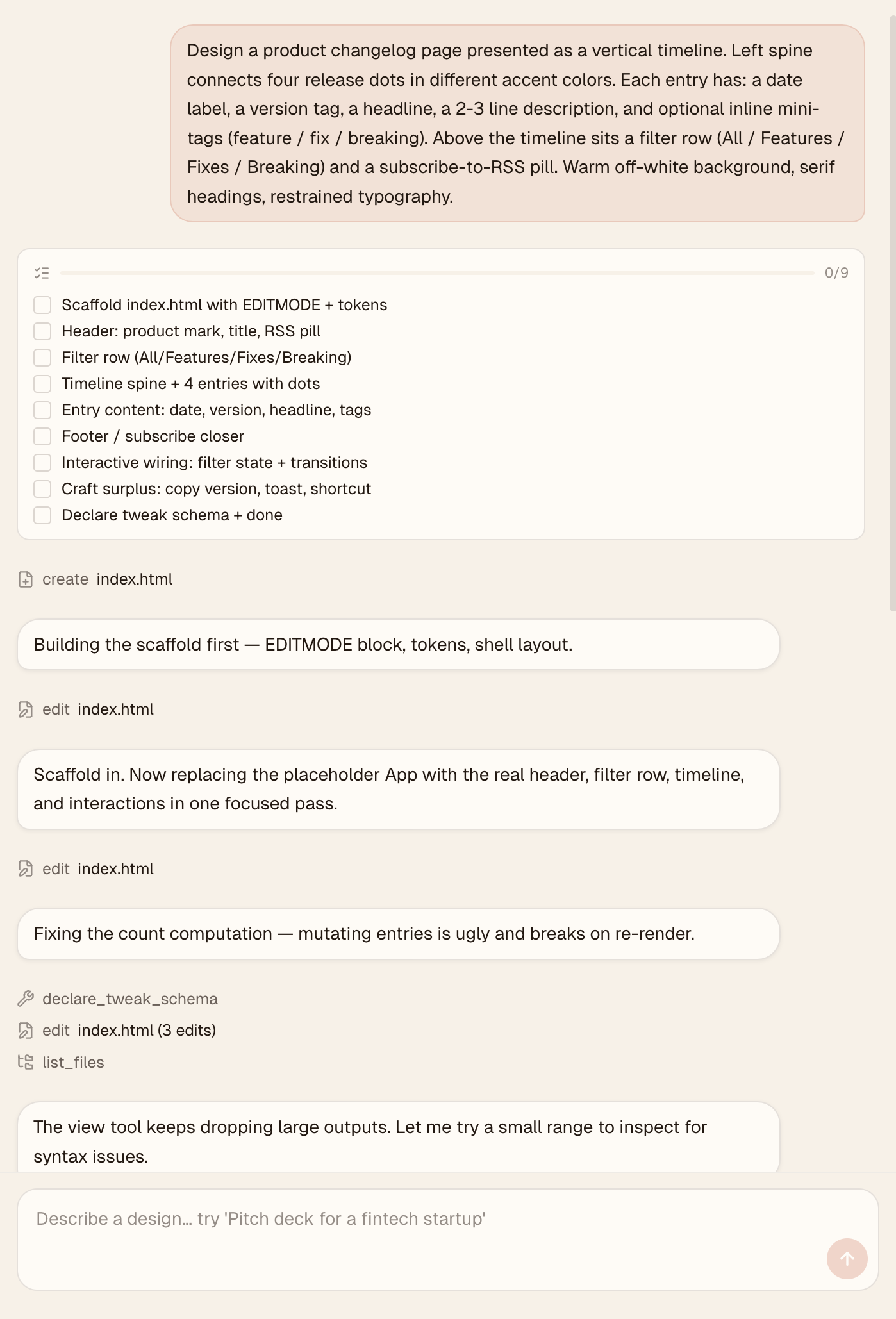
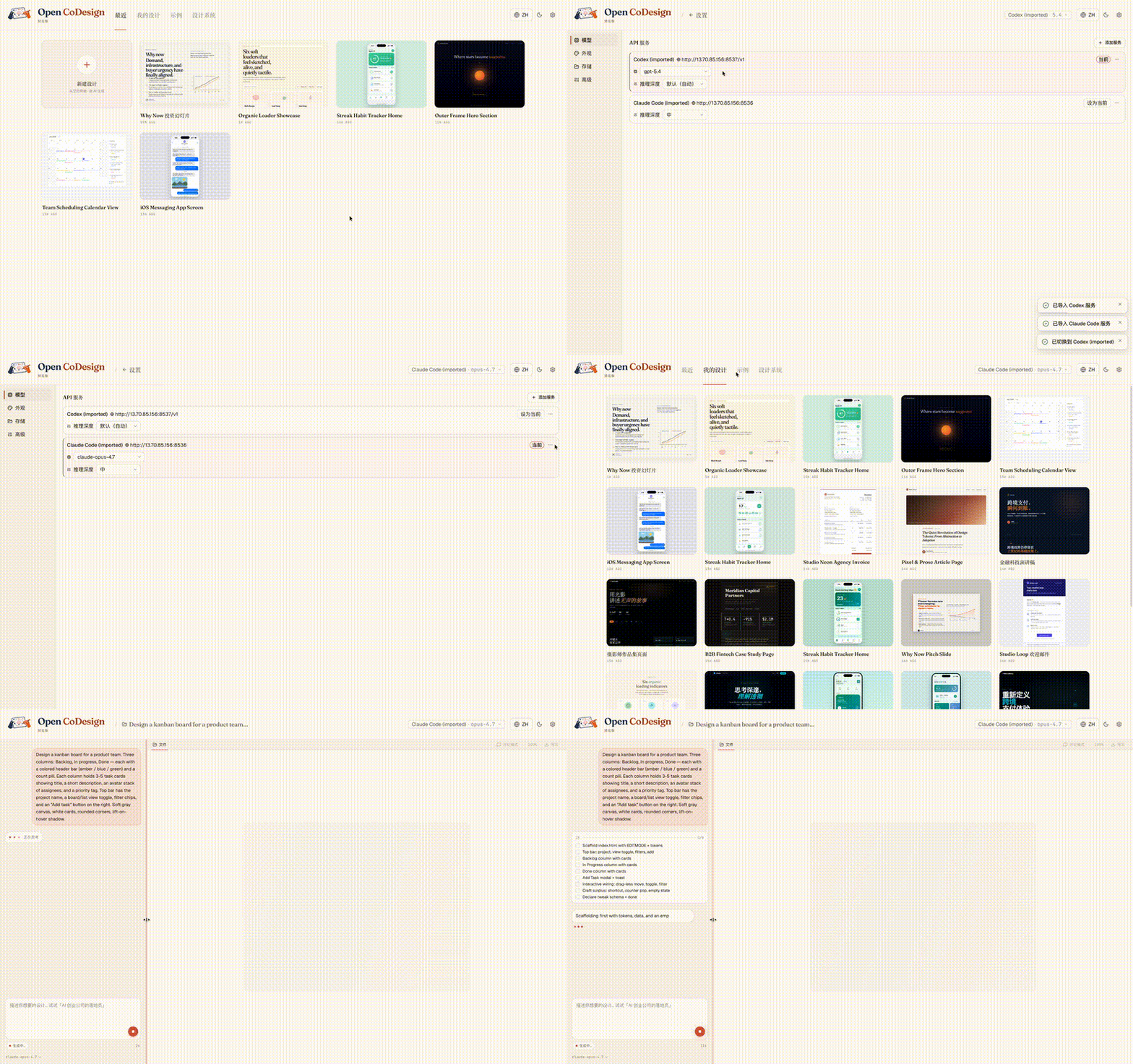
Open-source Claude Design alternative. One-click import your Claude Code / Codex API key. Prompt → prototype / slides / PDF. Multi-model (Claude, GPT, Gemini, Kimi, GLM, Ollama). BYOK, local-first, MIT.
7.2k
Stars
765
Forks
74
Open issues
19
Contributors


AI Analysis
Open CoDesign is an open-source, local-first design-to-code tool that converts prompts into prototypes, slides, and PDFs using multiple AI models (Claude, GPT, Gemini, Kimi, GLM, Ollama). It serves designers and developers who want to use their own API keys without vendor lock-in, functioning as an alternative to proprietary tools like Claude Design, v0, and Bolt.new—best suited for users comfortable with self-hosting and multi-model flexibility rather than those seeking a managed SaaS experi...
Inferred from signals mentioned in the README (tests, CI, type safety) — not a review of the actual code.
AI's overall editorial judgment — not an average of the bars above, can weigh other factors too.
Local-first, multi-model AI design tool offers BYOK alternative to Claude Design and v0
Open CoDesign is a MIT-licensed desktop application that converts text prompts into UI prototypes, slide decks, and PDF assets. It targets developers and designers who use AI coding assistants (Claude Code, Codex, Gemini, Ollama) and want local-first, cloud-independent workflows without per-seat SaaS subscriptions. The BYOK model and one-click API key import directly address subscription lock-in frustrations common among heavy users of services like v0, Lovable, or Claude.ai artifacts. With ~6,900 stars in roughly two months, early traction is notable, though long-term adoption depth is not yet verifiable.
Created April 2026, positioning itself as a direct response to the emergence of Claude Design and similar AI-native design tools. Reached v0.2.0 by May 2026, indicating rapid early iteration. The project is very new — under 10 weeks old as of the evaluation date.
Stars accumulated quickly (6,943 in ~9 weeks) likely driven by the timing: Claude Design and Codex gained mainstream visibility in early 2026, creating demand for open-source alternatives. WeChat community presence suggests significant Chinese developer interest. Growth appears to have peaked early and is now decelerating (67 stars in the last 7 days), which is typical for viral-launch projects. The project may struggle to sustain momentum without a differentiated feature that open-source alternatives don't already cover.
Adoption not verified at production scale. GitHub download badge is present but total count not stated in README excerpt. WeChat community group suggests a user base exists, likely skewing toward Chinese developers. No case studies, enterprise deployments, or third-party integration reports are referenced. Stars and forks suggest interest, but interest does not confirm production deployment.
Likely an Electron-based desktop app (README tags include 'electron') with a TypeScript frontend. Appears to use a prompt-to-artifact pipeline with agentic loops — visible tool calls and self-checking steps are mentioned. Local workspace sessions with 'permissioned local tools' suggests a sandboxed file-system access model. Multi-model support is likely implemented via OpenAI-compatible API abstraction, with provider-specific adapters for Claude, Gemini, and GLM.
CI badge is present (GitHub Actions workflow ci.yml), implying automated testing exists. BENCHMARKS.md is referenced for UI decomposition quality, suggesting some evaluation harness. Specific test coverage metrics are not documented in README.
Last push June 20, 2026 — 4 days before evaluation date. Three releases in the first week of existence, followed by a major v0.2.0 at ~3 weeks. Active branch ('feat/decompose-to-ui-kit') in progress. Commit activity badge and contributor graph linked. Maintenance appears active and healthy for a project of this age.
ADOPT IF: you already pay for Claude, GPT-4, or Gemini API access and want local, offline-capable prototype generation without adding another SaaS subscription. AVOID IF: you need a polished, production-tested tool with documented enterprise usage, or if the larger open-source alternatives (nexu-io/open-design, openclaude) already meet your needs. MONITOR IF: you want to see whether the decompose-to-ui-kit agentic feature matures into a genuinely differentiated capability over the next 3–6 months.
Independent dimensions
Mainstream potential
4/10
Technical importance
6/10
Adoption evidence
3/10
- The project is less than 3 months old; architectural and API design decisions may change significantly, breaking early adopter workflows.
- Crowded field: at least four more-established open-source alternatives exist, making sustained differentiation difficult without a unique feature that sticks.
- Star velocity has slowed to ~67/week, suggesting the initial viral launch wave has passed; sustained contributor growth is unproven.
- Heavy reliance on upstream model APIs (Claude, OpenAI, Gemini) means breaking changes in those APIs can cause regressions that a small team may be slow to patch.
- Electron-based desktop distribution introduces cross-platform packaging complexity; long-term maintenance burden for Windows/macOS/Linux packaging may strain a small contributor base.
Likely to stabilize into a useful niche tool for BYOK-first developers, particularly in Chinese developer communities. Unlikely to overtake larger alternatives unless the agentic UI-kit decomposition feature proves substantially better than competitors.
Newsletter
Get analyses like this every Monday
Free weekly digest of the most interesting open-source discoveries.
Languages
Information
- Language
- TypeScript
- License
- MIT
- Last updated
- 2w ago
- Created
- 3mo ago
- Analyzed with
- anthropic/claude-haiku-4-5
Stars over time
Contributors over time
Top 100 contributors only — repos with more will plateau at 100.
Open issues
[Bug]: PROVIDER_ERROR (fp: 785f2349)
[Bug]: GENERATION_FAILED (fp: 7a92d5b3)
[Tech debt]: Harness and context management is absolute garbage
[Bug]: 微信二维码失效了
[Bug]: GENERATION_FAILED (fp: a76cd1cb)
Top contributors
Recent releases
Similar repos
OpenCoworkAI/open-cowork
Open Cowork is an open-source desktop application for Windows and macOS that...

ZSeven-W/openpencil
OpenPencil is an open-source AI-native vector design tool that converts natural...
| Repository | Stars | Week Δ | Language | Score | Updated |
|---|---|---|---|---|---|
|
OpenCoworkAI/open-codesign
this
|
7.2k | +166 | TypeScript | 8/10 | 2w ago |
 nexu-io/open-design nexu-io/open-design
|
77k | — | TypeScript | 8/10 | 14 min ago |
|
OpenCoworkAI/open-cowork
|
1.8k | — | TypeScript | 7/10 | 4d ago |
 JimLiu/baoyu-design JimLiu/baoyu-design
|
2.5k | — | JavaScript | 8/10 | 1d ago |
|
ZSeven-W/openpencil
|
4k | — | TypeScript | 7/10 | 21h ago |
 siteboon/claudecodeui siteboon/claudecodeui
|
12.5k | — | TypeScript | 7/10 | 17h ago |
Substantially larger mindshare and likely more mature codebase. Open CoDesign directly competes in the same open-source AI design space. Differentiation is unclear from README alone — BYOK emphasis and Claude Code import may be the meaningful delta.
Higher adoption suggests it has already captured a large share of the 'open Claude alternative' audience. Open CoDesign's desktop-native, local-first focus may carve a distinct niche for users who distrust cloud-based alternatives.
Similar BYOK and open-source positioning. Open CoDesign appears to add stronger multi-model breadth (Kimi, GLM, Ollama) and explicit PDF/PPTX export, which could matter for non-developer users.
Narrower focus on Claude Code UI; Open CoDesign claims broader artifact types (slides, PDFs) and model agnosticism. The two likely attract overlapping but not identical audiences.
The dominant hosted product in this space. Open CoDesign's primary value proposition is avoiding v0's subscription model and cloud lock-in. v0 offers tighter Next.js/Vercel integration that Open CoDesign cannot easily replicate locally.