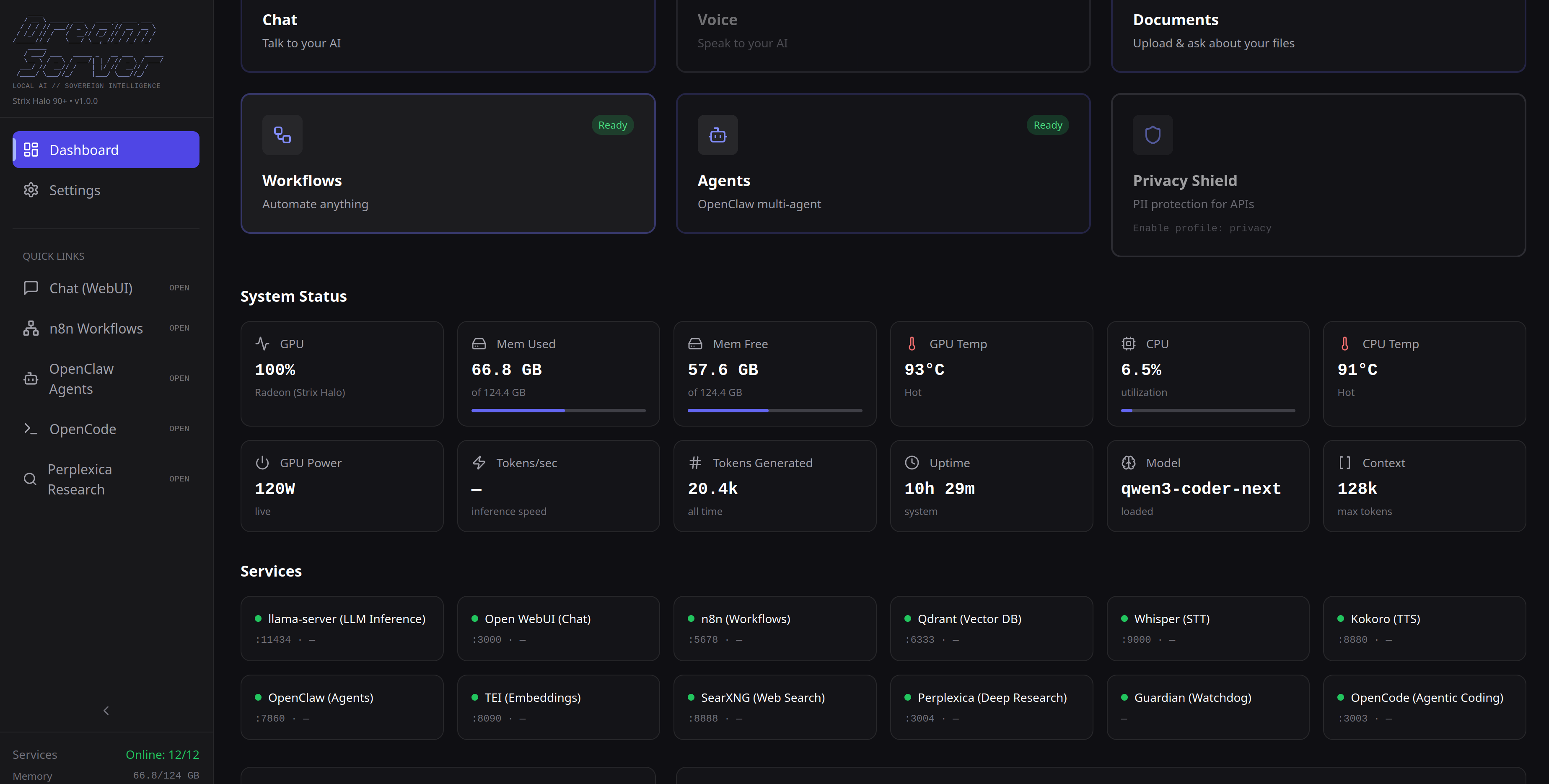
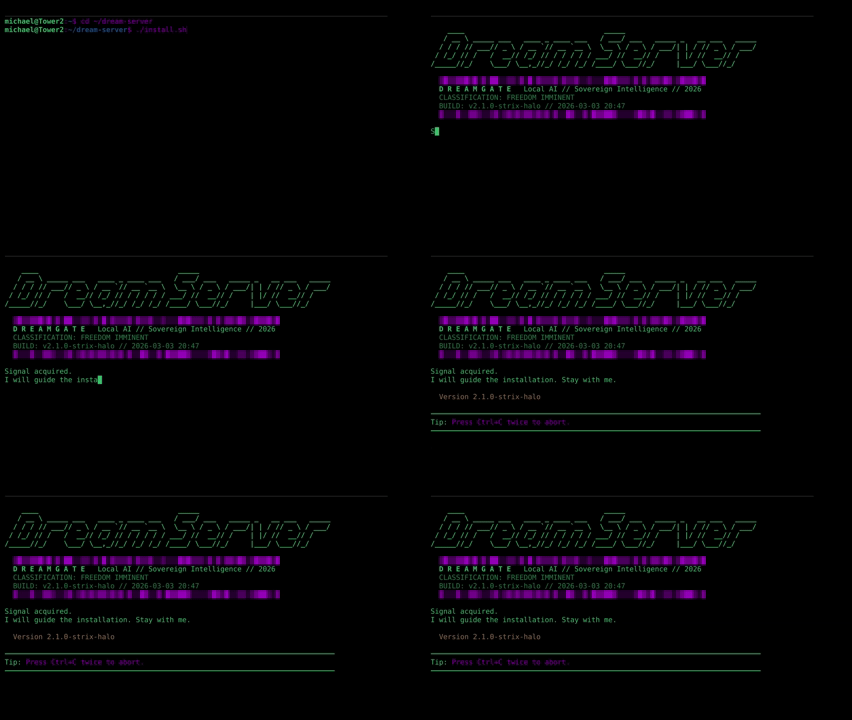
Turn your PC, Mac, or Linux box into an AI server. LLM inference, chat UI, voice, agents, workflows, RAG, and image generation.
2.9k
Stars
413
Forks
87
Open issues
30
Contributors


AI Analysis
ODS is a self-hosted AI server platform that bundles Ollama, Open WebUI, n8n, ComfyUI, and related tools into a single installation for running LLM inference, chat, voice, workflows, RAG, and image generation on personal hardware. It serves individuals and small teams who want complete local AI infrastructure without cloud dependencies or manual component assembly. Not suited for users needing managed cloud services, enterprise infrastructure, or those without dedicated hardware.
Inferred from signals mentioned in the README (tests, CI, type safety) — not a review of the actual code.
AI's overall editorial judgment — not an average of the bars above, can weigh other factors too.
All-in-one local AI server installer bundling inference, chat, voice, and workflows—four months old, gaining traction rapidly.
Dream Server packages a pre-wired stack (Ollama/llama.cpp, Open WebUI, n8n, ComfyUI, and privacy tools) into one-command installers for Linux, macOS, and Windows. Built for homelab users and privacy-conscious developers who want a functional private AI appliance without hand-assembling components. Created February 2026, it has accumulated 2,292 stars and 188 stars in the past week, suggesting early-stage adoption momentum among self-hosted AI enthusiasts.
DreamServer launched in February 2026 as a response to fragmentation in local AI tooling. The README explicitly positions itself as a solution to the assembly problem: instead of separately installing Ollama, Open WebUI, n8n, ComfyUI, and security layers, users get a pre-validated, one-command bootstrap for Linux/macOS/Windows.
The project gained ~2,000 stars in roughly 4.5 months (arriving at 2,292 by late June 2026), with 188 stars in the final week. This acceleration pattern—slow early growth followed by week-to-week momentum—is typical of projects reaching awareness thresholds in niche communities (homelab, self-hosted AI, privacy-conscious developers). No viral event is documented, suggesting organic discovery.
Adoption not verified. README references a YouTube demo and Spotify audio walkthrough, and mentions 'release-grade fleet and distro lab' validation, but provides no publicly documented case studies, user counts, or production deployments. GitHub metrics (stars, forks) exist but do not confirm real-world usage at scale or organizational adoption.
Appears to be a shell-based installer and orchestration layer (primary language: Shell) that downloads and docker-composes multiple services: llama.cpp for inference, Open WebUI for chat, n8n for workflows, ComfyUI for image generation, and unspecified privacy/ops tooling. README emphasizes release validation against a 'fleet and distro lab' including zero-prereq bootstrap, fresh installs, and lifecycle recovery testing. Likely uses environment variables for service configuration and Docker Compose for multi-container orchestration.
README documents 'Release Validation' with operational checks (zero-prereq bootstrap, fresh installs, product flows, full-model capabilities, lifecycle recovery), but scope and automation level of test suite not detailed. Release channels and forkability docs exist, suggesting structured QA workflow, but specific test framework coverage not mentioned.
Last push 2026-06-25 (3 days before analysis date), indicating active development. Current stable release v2.5.2 with maintenance branch (release/2.5.x) and rapid main development. Repository is 4.5 months old; frequent recent commits and documented release process suggest active team engagement rather than maintenance-only mode.
ADOPT IF: you want a pre-configured, validated local AI stack for Linux/macOS/Windows without assembling Ollama, Open WebUI, n8n, and ComfyUI yourself, and you accept that the project is young (4.5 months old) and adoption evidence is limited to early adopter signals. AVOID IF: you need established production support, documented large-scale deployments, or have already built custom orchestration around individual components. MONITOR IF: you are evaluating appliance-style solutions for 2026—DreamServer's rapid star growth and recent activity suggest growing awareness, but it has not yet reached the adoption visibility of AnythingLLM or Open WebUI.
Independent dimensions
Mainstream potential
4/10
Technical importance
6/10
Adoption evidence
2/10
- Very new project (4.5 months)—breaking changes or architectural shifts possible without community feedback yet baked in.
- Adoption not verified—star growth may reflect marketing/discovery rather than retained real-world usage; churn and abandonment rates unknown.
- Dependency lock-in—orchestrates multiple third-party services (Open WebUI, n8n, ComfyUI); breaking changes in upstream projects could cascade.
- Platform support claims (Linux, macOS Apple Silicon, Windows WSL2/Docker) not independently validated outside README—actual user experience on all paths unknown.
- Limited maintainer visibility—team size, funding, and long-term commitment not documented; could transition to maintenance-only or sunset if key contributors depart.
DreamServer likely grows within the self-hosted AI / homelab niche over the next 12–18 months, accumulating users who prefer pre-assembled stacks over component assembly. May reach 5k–10k stars if momentum sustains, but unlikely to rival Open WebUI or AnythingLLM in total adoption unless it becomes the default recommendation in homelab forums or gains backing from a well-known infrastructure vendor.
Newsletter
Get analyses like this every Monday
Free weekly digest of the most interesting open-source discoveries.
Languages
Information
- Website
- https://discord.gg/qGVygYada3
- Language
- Shell
- License
- Apache-2.0
- Last updated
- 7h ago
- Created
- 5mo ago
- Analyzed with
- anthropic/claude-haiku-4-5
Stars over time
Contributors over time
Top 100 contributors only — repos with more will plateau at 100.
Open pull requests
Top contributors
Similar repos

open-webui/open-webui
Open WebUI is a self-hosted, offline-capable web interface for interacting with...

different-ai/openwork
OpenWork is a desktop application (macOS, Windows, Linux) that enables users to...

netease-youdao/LobsterAI
LobsterAI is a desktop AI agent that automates office workflows by executing...
| Repository | Stars | Week Δ | Language | Score | Updated |
|---|---|---|---|---|---|
|
Osmantic/ODS
this
|
2.9k | +391 | Shell | 8/10 | 7h ago |
|
open-webui/open-webui
|
144.9k | — | Python | 9/10 | 14h ago |
 mudler/LocalAI mudler/LocalAI
|
47.5k | — | Go | 8/10 | 5h ago |
|
different-ai/openwork
|
16.8k | — | TypeScript | 7/10 | 7h ago |
|
netease-youdao/LobsterAI
|
5.5k | — | TypeScript | 7/10 | 9h ago |
 onyx-dot-app/onyx onyx-dot-app/onyx
|
30.8k | — | Python | 8/10 | 56 min ago |
Open WebUI is the chat interface layer only; DreamServer bundles it alongside inference, workflows, image generation, and ops. DreamServer targets 'full appliance' users; Open WebUI serves those who already have Ollama running.
AnythingLLM emphasizes RAG and document retrieval; DreamServer includes RAG as one feature alongside voice, agents, workflows, and image generation. DreamServer bundles infrastructure (inference + orchestration); AnythingLLM focuses on the application layer.
LocalAI is a lightweight inference server compatible with OpenAI API; DreamServer is a full-stack appliance installer around inference. LocalAI appeals to developers integrating into existing apps; DreamServer targets homelab/workstation users.
Lemonade is an inference engine (C++); DreamServer is an orchestration and installer layer. DreamServer may optionally use Lemonade as a backend on Windows native paths.
LobsterAI provides distributed inference; DreamServer focuses on single-machine local stacks with optional cloud fallback. Different target—LobsterAI for clusters, DreamServer for laptops and small labs.