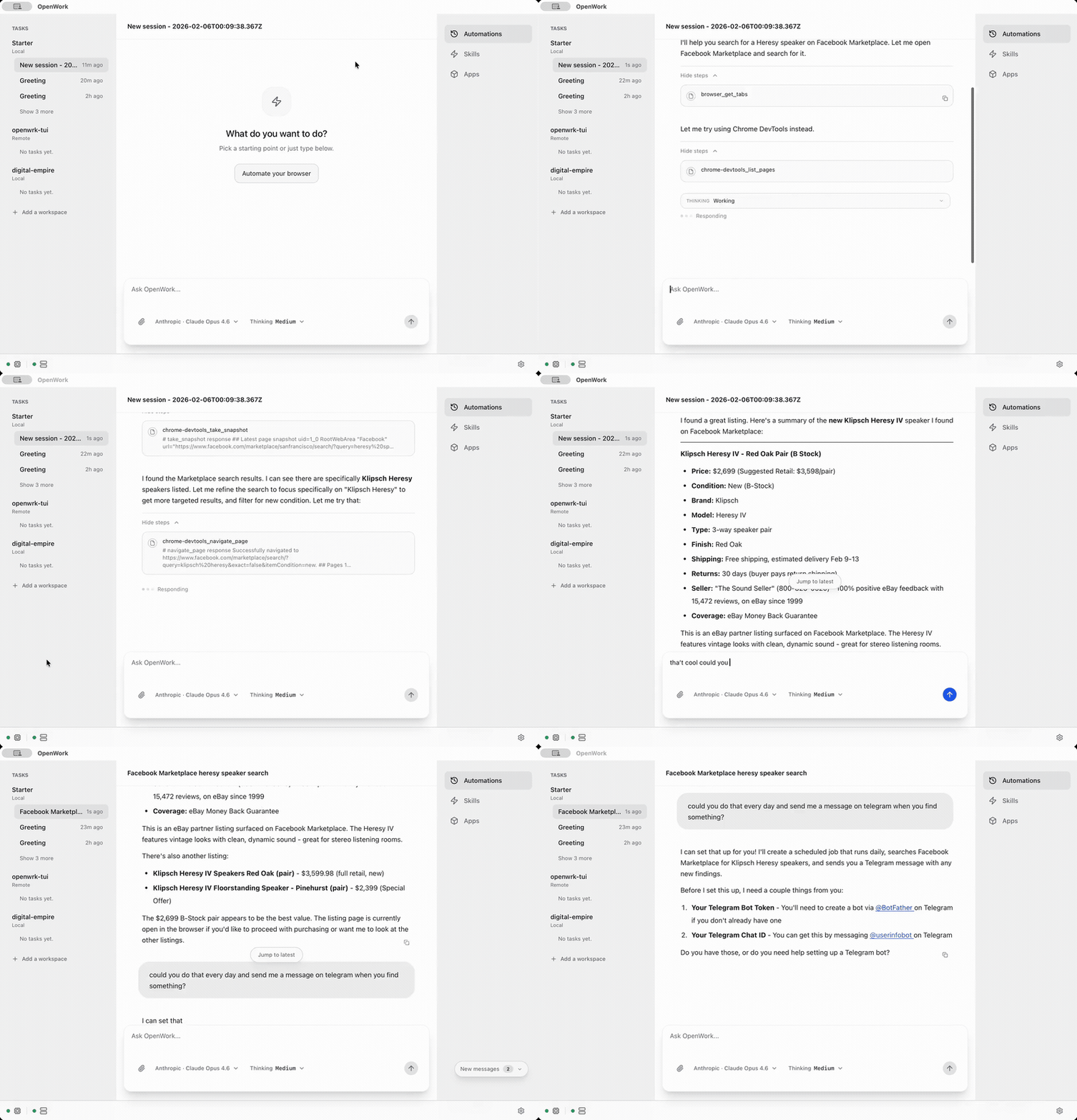
An open-source alternative to Claude Cowork (powered by opencode)
16.8k
Stars
1.7k
Forks
248
Open issues
30
Contributors


AI Analysis
OpenWork is a desktop application (macOS, Windows, Linux) that enables users to build and run AI agent workflows locally using their own LLM provider keys, positioning itself as an open-source alternative to Claude Cowork. It serves knowledge workers and teams who want to automate file-based tasks with AI agents while maintaining local control and the ability to share setups; it is not suitable for users seeking a simple chat interface or those unwilling to manage their own LLM credentials.
Inferred from signals mentioned in the README (tests, CI, type safety) — not a review of the actual code.
AI's overall editorial judgment — not an average of the bars above, can weigh other factors too.
OpenWork brings a local-first, multi-LLM desktop UI to AI agent workflows as an open alternative to Claude Cowork
OpenWork is a Tauri-based desktop application (macOS, Windows, Linux) that wraps the OpenCode CLI with a graphical, team-friendly interface for running AI agents against local files. It targets knowledge workers, small teams, and developers who want agentic AI workflows without vendor lock-in, supporting 50+ LLMs via user-supplied API keys. Its differentiators are composability (skills, plugins, MCP servers), a shareable workflow-link feature, and explicit permission controls. An enterprise plan with SSO and SLA support signals a commercial roadmap alongside the open-source core.
Created in January 2026, OpenWork emerged shortly after Claude Cowork and Codex popularized cloud-based AI agent interfaces, positioning itself explicitly as the self-hostable, bring-your-own-key alternative built on top of the OpenCode CLI engine.
The repo accumulated 16,335 stars in roughly six months, suggesting strong organic traction from developers and teams uncomfortable with proprietary AI-agent platforms. The 170 stars gained in the most recent 7 days reflects steady but not explosive current momentum, likely sustained by ongoing media coverage of the AI-agent space and word-of-mouth among privacy-conscious teams.
An enterprise plan page and a sales calendar link suggest paying customers exist, but no public case studies, deployment numbers, or named production users are referenced in the README. Download link from openworklabs.com implies active distribution beyond GitHub. Adoption not verified at scale via public evidence.
Appears to be a monorepo (pnpm workspaces) with at least two main packages: a web UI layer (apps/app) and a Tauri desktop shell (apps/desktop). The backend logic is delegated to the OpenCode CLI, making OpenWork primarily a UI/orchestration layer. A separate CLI host called openwork-orchestrator is available via npm for headless server use. Likely uses SSE for real-time event streaming from OpenCode. The Rust/Tauri dependency means native desktop packaging is central to the architecture.
not documented in README
Last push was 2026-06-25, the same day as the analysis date, indicating active daily development. The fork count of 1,645 relative to 16,335 stars (~10% ratio) is healthy and suggests genuine contributor engagement. The presence of a dev branch, documented dev-mode isolation, and detailed build prerequisites all point to an actively maintained project with reasonable engineering hygiene.
ADOPT IF: you want a local-first, multi-LLM AI agent desktop app for file-based workflows and need team-sharable setups without cloud lock-in, and you are comfortable with a project that is roughly six months old. AVOID IF: you need a battle-tested, enterprise-supported platform with proven large-scale deployments, or if your team runs entirely on Windows (currently requires a paid support plan). MONITOR IF: you are evaluating open-source AI agent tooling but need more evidence of production stability and community plugin ecosystem maturity before committing.
Independent dimensions
Mainstream potential
6/10
Technical importance
6/10
Adoption evidence
3/10
- Tight architectural dependency on OpenCode CLI means upstream breaking changes or abandonment could significantly disrupt OpenWork's functionality.
- Windows support is currently behind a paid tier, excluding a large segment of potential enterprise users from the free offering.
- The project is approximately six months old; production stability, edge-case handling, and long-term API compatibility are not yet established by public evidence.
- The AI-agent desktop UI space is crowded and fast-moving; sustained differentiation against well-funded or more broadly scoped competitors may be difficult to maintain.
- Enterprise plan and commercial features signal a dual-license or open-core trajectory; future feature restrictions or license changes cannot be ruled out given the NOASSERTION license field.
OpenWork is likely to grow steadily as the AI-agent workflow space matures, particularly if it builds a meaningful plugin/skill ecosystem. Its commercial viability will hinge on enterprise deal velocity and whether OpenCode remains a stable foundation.
Newsletter
Get analyses like this every Monday
Free weekly digest of the most interesting open-source discoveries.
Languages
Information
- Website
- https://openworklabs.com
- Language
- TypeScript
- License
- NOASSERTION
- Last updated
- 6h ago
- Created
- 6mo ago
- Analyzed with
- anthropic/claude-haiku-4-5
Stars over time
Contributors over time
Top 100 contributors only — repos with more will plateau at 100.
Open issues
No open issues — clean slate.
Top contributors
Similar repos

OpenCoworkAI/open-cowork
Open Cowork is an open-source desktop application for Windows and macOS that...

DevAgentForge/Open-Claude-Cowork
Open Claude Cowork is a desktop AI assistant built on TypeScript that provides...
| Repository | Stars | Week Δ | Language | Score | Updated |
|---|---|---|---|---|---|
|
different-ai/openwork
this
|
16.8k | +182 | TypeScript | 7/10 | 6h ago |
|
OpenCoworkAI/open-cowork
|
1.8k | — | TypeScript | 7/10 | 4d ago |
|
DevAgentForge/Open-Claude-Cowork
|
3.4k | — | TypeScript | 6/10 | 4mo ago |
 eigent-ai/eigent eigent-ai/eigent
|
14.5k | — | TypeScript | 7/10 | 2d ago |
 OpenHands/OpenHands OpenHands/OpenHands
|
80.3k | — | Python | 8/10 | -40 min ago |
 openagents-org/openagents openagents-org/openagents
|
3.9k | — | Python | 7/10 | 1d ago |
The explicit inspiration and target replacement. Cowork is cloud-only and Anthropic-model-only; OpenWork counters with local-first operation, multi-provider support, and no mandatory data egress. However, Cowork benefits from deeper Anthropic model integration and a polished, fully supported commercial product.
A close conceptual sibling in the TypeScript/agentic-workflow space. Without detailed coworker README data it is difficult to differentiate precisely, but coworker's lower star count may indicate OpenWork has captured more early mindshare. Both appear to target similar personas.
AionUi has significantly more stars and may address a broader or overlapping AI-UI surface. OpenWork's narrower focus on file-based agent workflows and team-shareable processes may make it more purposeful for its specific use case rather than a general AI chat UI.
Comparable star counts suggest similar market moment. Eigent appears TypeScript-based as well; without further detail, both projects likely compete for the same early-adopter developer and team audience wanting open-source agent orchestration.
Written in Go, suggesting a different architectural philosophy. OpenAgent likely targets backend/server-side agent orchestration more than desktop use. OpenWork's desktop-native, local-first design and team-sharing features are likely more accessible to non-infrastructure users.