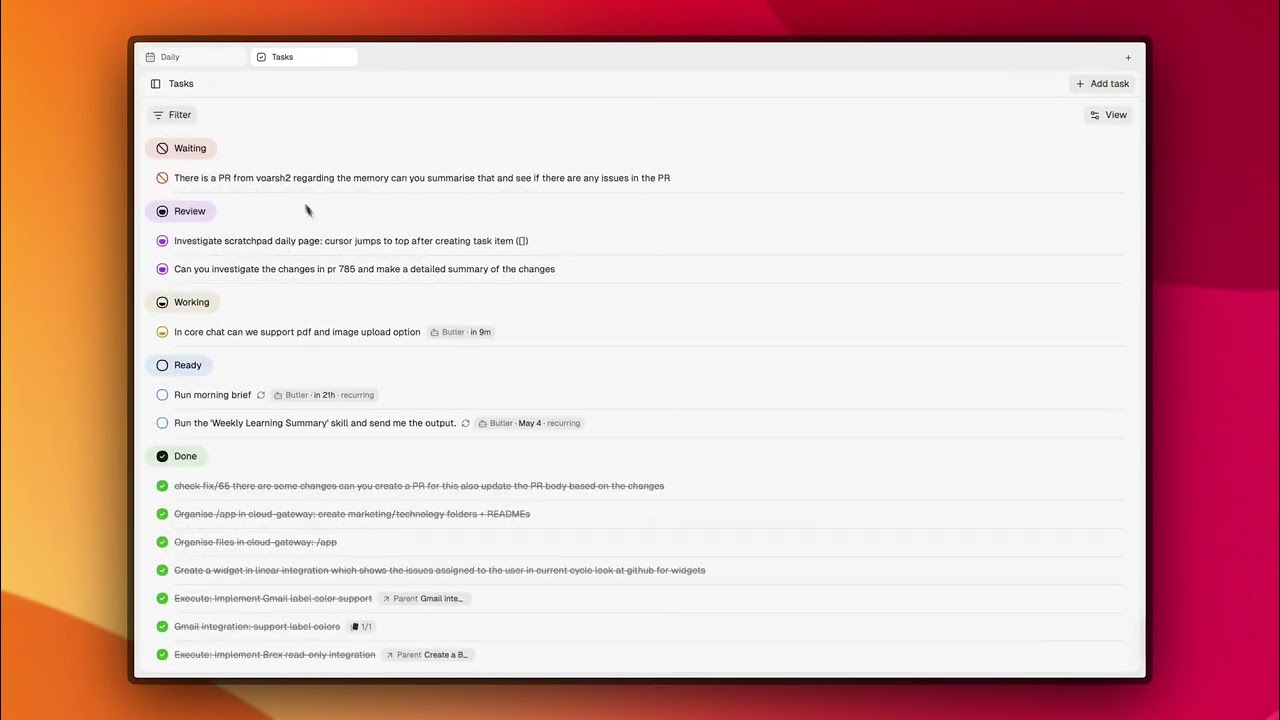
Your Personal AI OS
1.9k
Stars
177
Forks
206
Open issues
19
Contributors


AI Analysis
CORE is a self-hosted personal AI operating system designed to run continuously and autonomously, integrating with multiple tools and platforms through APIs and model connectors (Claude, Ollama, etc.). It serves developers and power users who want a customizable AI assistant that functions as infrastructure rather than a chat interface. It is not suitable for users seeking a simple chatbot or those without self-hosting capability.
Inferred from signals mentioned in the README (tests, CI, type safety) — not a review of the actual code.
AI's overall editorial judgment — not an average of the bars above, can weigh other factors too.
Personal AI OS that monitors apps autonomously and acts across multiple interfaces—TypeScript, 14 months old, modest but active uptake
CORE positions itself as a background AI that watches your apps, email, issues, and alerts rather than waiting to be prompted. Built in TypeScript by RedPlanetHQ, it emphasizes continuous monitoring, multi-interface access (voice, chat, messaging, scratchpad), and integration with Claude and code editors. Adoption appears concentrated among early-stage developers and AI enthusiasts; production usage at significant scale is not documented. The project is actively maintained (last push July 2026) and growing, with 1,886 stars and ~41 new stars weekly.
Created May 2025, CORE emerged during the rapid expansion of autonomous agent frameworks. The project reflects broader interest in AI that operates proactively rather than reactively, positioning itself against traditional chatbots and static automation tools.
Early-stage project showing steady incremental growth (~41 stars/week in early July 2026). Growth rate is modest relative to comparable agent frameworks (e.g., agentmemory at 24.9k stars), suggesting either niche positioning or limited market penetration. No viral adoption pattern evident.
Adoption not verified. README describes vision, demo video, and feature set. No case studies, user testimonials, company deployments, or community-reported production usage are documented. Discord community exists but scale unknown from provided metadata. Website (getcore.me) and documentation exist but are not inspectable here.
Likely event-driven, multi-interface orchestration layer based on README descriptions of monitoring apps, triggering on external signals (email, GitHub, Sentry), and routing to Claude Code or Cursor sessions. Appears to use a knowledge graph for memory and context. Implementation details not verifiable from README alone.
Not documented in README.
Active: last commit July 9, 2026 (as of analysis date July 10, 2026). Suggests ongoing development. Repository created May 2025, so approximately 14 months old at analysis date. No evidence of abandonment or pause. Slow growth trajectory does not indicate staleness—may reflect intentional focus or market constraints rather than technical neglect.
ADOPT IF: you are an early-adopter developer comfortable with self-hosted AI agents, need multi-interface task dispatch (voice, messaging, chat), and want continuous monitoring of your development tools; you accept the risk of a young project with unverified production track record. AVOID IF: you require proven production stability, extensive documentation of real-world deployments, or integration with a large ecosystem of plugins already in use elsewhere. MONITOR IF: you find the vision compelling but want to see evidence of production adoption, larger community feedback, and stability across 6–12 months before committing critical workflows.
Independent dimensions
Mainstream potential
4/10
Technical importance
6/10
Adoption evidence
2/10
- Adoption not verified: no documented production usage at scale; early adopters may encounter instability or abandonment risk.
- Young project: 14 months old; may not have encountered edge cases or long-term operational requirements that would surface in mature systems.
- Competitive crowding: agent frameworks and autonomous AI tools are proliferating rapidly; unclear if CORE's specific positioning (background monitoring, multi-interface) will hold differentiation.
- Integration fragility: depends on third-party API stability (GitHub, Sentry, Linear, Claude Code); any breaking changes upstream could require rapid patches.
- Autonomous action liability: executing tasks across email, repos, and terminals introduces operational risk; unclear how well permission models, audit trails, and rollback capabilities are implemented (not detailed in README).
CORE will likely remain niche-focused on developer automation and AI enthusiasts for the next 12–24 months. If real production adoption (corporate, large open-source projects) surfaces, growth may accelerate; otherwise, it may stabilize as a specialized tool for a small but engaged community. Potential path to consolidation or acquisition if proactive AI monitoring becomes a market standard.
Newsletter
Get analyses like this every Monday
Free weekly digest of the most interesting open-source discoveries.
Languages
Information
- Website
- https://getcore.me
- Language
- TypeScript
- License
- NOASSERTION
- Last updated
- 19h ago
- Created
- 14mo ago
- Analyzed with
- anthropic/claude-haiku-4-5
Stars over time
Contributors over time
Top 100 contributors only — repos with more will plateau at 100.
Open issues
`corebrain setup` fails on Windows: "`docker` not found on PATH" when Docker is installed
OpenAPI specs drift from the runtime API: /oauth/userinfo field names, missing required arrays, and stale Spaces endpoints
BUG: Cannot update recurring task plan/description ("description skipped (recurring task)")
Prompt caching support to cut input token costs for self-hosted users
Bug: Enter key doesn’t insert newline in Court inline terminal during coding session
Top contributors
Recent releases
Similar repos

codeaholicguy/ai-devkit
AI DevKit is a control plane and orchestration layer for multiple AI coding...

DevAgentForge/Open-Claude-Cowork
Open Claude Cowork is a desktop AI assistant built on TypeScript that provides...
| Repository | Stars | Week Δ | Language | Score | Updated |
|---|---|---|---|---|---|
|
RedPlanetHQ/core
this
|
1.9k | +41 | TypeScript | 7/10 | 19h ago |
 rohitg00/agentmemory rohitg00/agentmemory
|
24.9k | — | TypeScript | 8/10 | 4d ago |
|
codeaholicguy/ai-devkit
|
1.6k | — | TypeScript | 7/10 | 3d ago |
 op7418/CodePilot op7418/CodePilot
|
6.1k | — | TypeScript | 8/10 | 3d ago |
|
DevAgentForge/Open-Claude-Cowork
|
3.4k | — | TypeScript | 6/10 | 4mo ago |
 BeehiveInnovations/pal-mcp-server BeehiveInnovations/pal-mcp-server
|
11.6k | — | Python | 7/10 | 7mo ago |
Larger, more-starred agent memory framework; CORE adds multi-interface and proactive monitoring; agentmemory appears to focus on memory as a core primitive rather than autonomous task execution.
Also TypeScript-based agent framework; appears code-generation-focused; CORE broader in scope (messaging, voice, email) but less specialized.
Claude-integrated multi-agent framework; similar integration depth; CORE emphasizes background monitoring and multi-channel access; unclear how much feature overlap.
MCP (Model Context Protocol) server; lower-level infrastructure play; CORE is higher-level orchestration; different layers of the stack.
Similar star count to CORE; both TypeScript; CORE emphasizes background monitoring; ai-devkit positioning unclear from metadata alone.