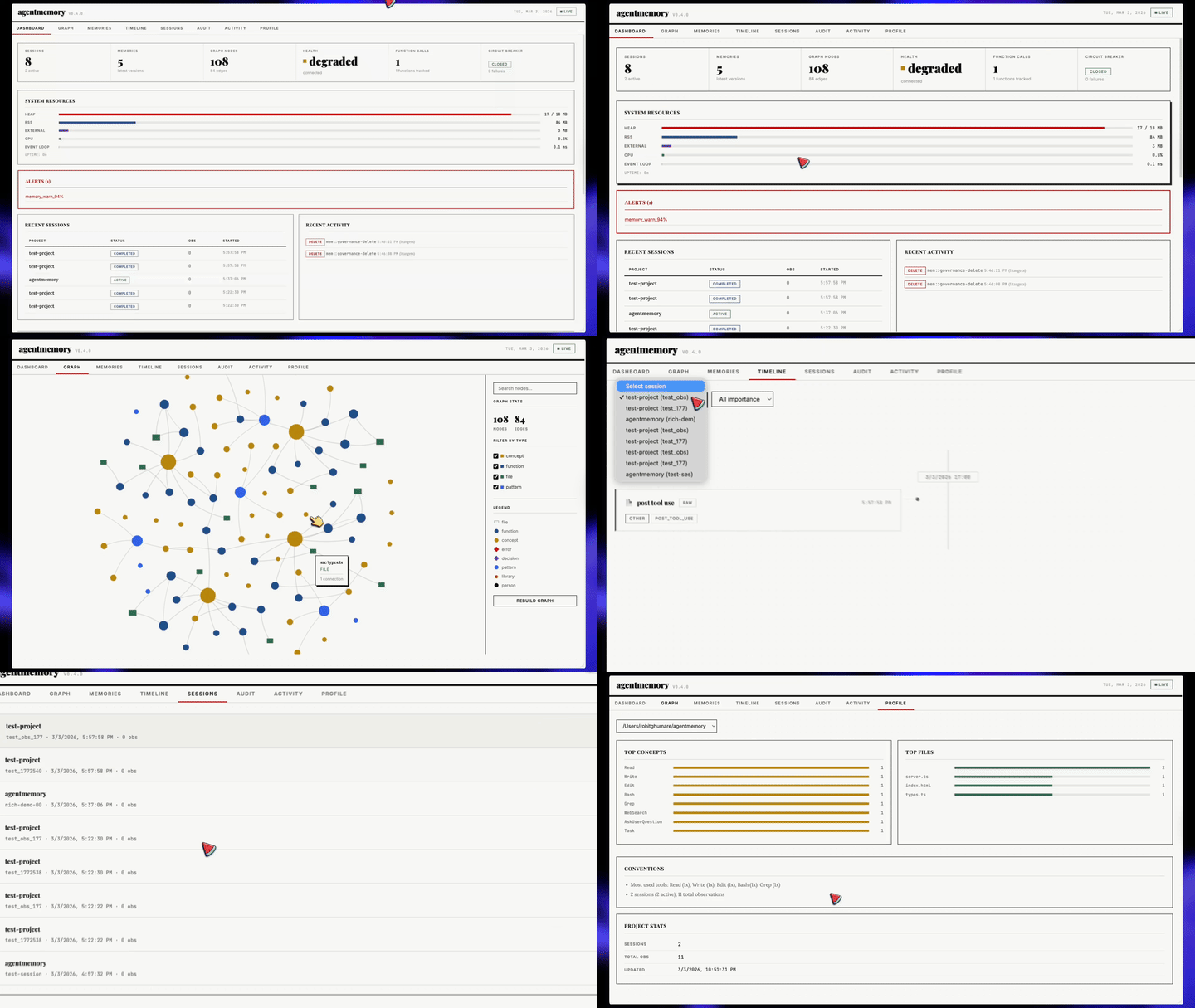
#1 Persistent memory for AI coding agents based on real-world benchmarks
24.9k
Stars
2.1k
Forks
377
Open issues
30
Contributors


AI Analysis
AgentMemory provides persistent memory for AI coding agents (Claude Code, Cursor, GitHub Copilot, etc.) to retain context across sessions, eliminating the need to re-explain code context. It implements a memory system with confidence scoring, knowledge graphs, and hybrid search based on patterns from Karpathy's LLM architecture. This specialized tool is best suited for developers using AI-assisted coding workflows who want their agents to remember project history and context; it is not a gene...
Inferred from signals mentioned in the README (tests, CI, type safety) — not a review of the actual code.
AI's overall editorial judgment — not an average of the bars above, can weigh other factors too.
TypeScript MCP layer giving AI coding agents persistent, searchable memory across sessions
agentmemory provides a persistent memory layer for AI coding agents (Claude Code, Cursor, Copilot CLI, Gemini CLI, etc.) via the Model Context Protocol (MCP). It stores project context, decisions, and code patterns across sessions so agents do not need re-briefing on each run. Built on an external 'iii engine', it claims zero external database dependencies, 53 MCP tools, hybrid search, confidence scoring, and knowledge graph features. Target users are individual developers and teams who rely heavily on AI coding agents and find the stateless nature of each session wasteful. The project is notable for broad multilingual documentation and explicit benchmark claims, though independent verification of those benchmarks is not available.
Created in February 2026, agentmemory emerged alongside the rapid proliferation of MCP-compatible AI coding agents. It appears to have grown quickly from a viral GitHub Gist design document (attributed to extending Karpathy's LLM Wiki pattern) into a full implementation within a few months.
The repository reached ~23,800 stars in roughly 4 months, suggesting a viral launch likely driven by the design-doc gist (1.3k stars, 182 forks) and community traction among AI coding-agent power users. The 459 stars in the last 7 days indicates ongoing but decelerating momentum. Multilingual READMEs suggest deliberate reach toward non-English developer communities. A Trendshift badge signals awareness of trend-surfing positioning.
The npm package @agentmemory/mcp shows a download badge in the README but the actual download count is not visible in provided metadata. No external case studies, enterprise users, or production deployment reports are referenced in the README. The viral gist and broad community discussion suggest real developer interest, but verifiable production usage at scale is not confirmed. Adoption not fully verified beyond download signals.
Based on the README, the system appears to be a TypeScript MCP server that wraps an external 'iii engine' for storage and retrieval. It likely exposes 53 MCP tools to any compatible agent client. Claims of 0 external database dependencies suggest embedded or file-based storage rather than requiring a running database server. Hybrid search (likely vector + keyword) and knowledge graphs are described as features; implementation details are not verifiable from the README alone.
README claims 1,423+ tests passing with a CI badge linking to GitHub Actions. This suggests a meaningful test suite exists, though coverage percentage and test type breakdown (unit vs. integration) are not documented in the README.
Last push was 2026-06-22, two days before the evaluation date — this indicates active, ongoing development. The project is only ~4 months old, so maintenance longevity cannot yet be assessed. CI is configured. Windows support gaps (native setup is manual, 'agentmemory connect' unsupported) suggest some platform coverage debt.
ADOPT IF: you are a heavy daily user of MCP-compatible coding agents (Claude Code, Cursor, etc.) and repeatedly lose context between sessions — this appears to be one of the more feature-complete local solutions for that specific pain point. AVOID IF: you need enterprise-grade reliability guarantees, production battle-testing, or Windows-native support — the project is only 4 months old and has documented Windows limitations. MONITOR IF: you are evaluating persistent agent memory architectures for a team or product — the space is moving fast and the benchmark claims deserve independent verification before committing.
Independent dimensions
Mainstream potential
6/10
Technical importance
7/10
Adoption evidence
3/10
- Benchmark claims ('95.2% retrieval R@5', '92% fewer tokens') are self-reported and not independently verified; real-world performance may differ significantly across codebases and agent configurations.
- Dependency on an external 'iii engine' that is not the agentmemory repo itself introduces an upstream risk — if that project stalls or changes API, agentmemory may break.
- The project is only ~4 months old; long-term maintenance commitment from a single contributor (rohitg00) is unproven — bus-factor risk is unclear from available metadata.
- Windows support is explicitly incomplete (no 'agentmemory connect', manual setup required), limiting adoption for a significant portion of developers.
- Rapid star growth in a trending category can attract attention without reflecting production readiness; the gap between developer interest and verified production deployment appears substantial at this stage.
Likely to maintain relevance as MCP adoption grows through 2026, potentially becoming a reference implementation for local agent memory. Long-term dominance is uncertain given the presence of better-funded competitors and the fast-moving nature of the AI agent tooling space.
Newsletter
Get analyses like this every Monday
Free weekly digest of the most interesting open-source discoveries.
Languages
Information
- Website
- https://agent-memory.dev
- Language
- TypeScript
- License
- Apache-2.0
- Last updated
- 4d ago
- Created
- 5mo ago
- Analyzed with
- anthropic/claude-haiku-4-5
Stars over time
Contributors over time
Top 100 contributors only — repos with more will plateau at 100.
Open issues
Top contributors
Similar repos

TencentCloud/TencentDB-Agent-Memory
TencentDB Agent Memory is a TypeScript library that provides local long-term...
| Repository | Stars | Week Δ | Language | Score | Updated |
|---|---|---|---|---|---|
|
rohitg00/agentmemory
this
|
24.9k | +444 | TypeScript | 8/10 | 4d ago |
 thedotmack/claude-mem thedotmack/claude-mem
|
86.7k | — | JavaScript | 8/10 | 12h ago |
 mem9-ai/mem9 mem9-ai/mem9
|
1.2k | — | TypeScript | 7/10 | 12h ago |
 EverMind-AI/EverOS EverMind-AI/EverOS
|
10.7k | — | Python | 8/10 | 2d ago |
|
TencentCloud/TencentDB-Agent-Memory
|
8k | — | TypeScript | 8/10 | 2w ago |
 zilliztech/memsearch zilliztech/memsearch
|
2.2k | — | Python | 7/10 | 6h ago |
The dominant tool in adjacent space with ~3.5x more stars. Likely serves a broader or simpler use case; agentmemory differentiates on feature depth (knowledge graphs, confidence scoring, 53 MCP tools) rather than simplicity. The large star gap suggests claude-mem has much wider mindshare.
TypeScript-based like agentmemory, likely targets similar agent memory infrastructure. agentmemory has more than twice the stars, suggesting stronger current traction, though MemOS may serve a different architectural philosophy.
Python-based, which may appeal to data-science-oriented agent builders. agentmemory's TypeScript foundation and MCP-first design give it an edge for JavaScript/TypeScript-centric coding agent ecosystems.
Corporate-backed (Tencent), likely optimized for cloud database integration rather than local/zero-dependency setups. agentmemory's zero-external-DB claim is a direct contrast to this approach.
Backed by Zilliz (Milvus creators), likely vector-search focused with enterprise backing. agentmemory has far more stars but memsearch may have stronger production infrastructure credibility for teams already using Milvus/Zilliz.