3.9k
Stars
261
Forks
11
Open issues
2
Contributors


AI Analysis
AutoFigure-Edit generates editable SVG scientific illustrations from method text descriptions in research papers, turning static text into interactive vector graphics that researchers can refine. It serves academic researchers and scientific publishers who need to convert procedural descriptions into visual diagrams efficiently. This is a specialized research tool for the scientific publishing and visualization niche, not a general-purpose graphics application.
Inferred from signals mentioned in the README (tests, CI, type safety) — not a review of the actual code.
AI's overall editorial judgment — not an average of the bars above, can weigh other factors too.
AI-powered scientific figure generator that converts method text to editable SVG diagrams with in-browser editing
AutoFigure-Edit automates the creation of scientific figures by transforming research method descriptions into editable SVG graphics. Built for academic researchers and paper authors, it combines LLM-based figure generation with icon detection and vector output. The project emerged in early 2026 with rapid early adoption (3,878 stars in 4 months), a live web platform, and recent v1.1 release adding user-supplied figure import and official OpenAI model support.
AutoFigure-Edit is the successor to AutoFigure, an earlier ICLR 2026-accepted project from ResearAI. It evolved from raster-based figure generation to editable vector output, shipping a public web interface in February 2026 and formalizing the approach in an arXiv paper (2603.06674) published March 2026.
The project gained 3,878 stars in approximately 4 months (Feb–Jun 2026), with 57 stars in the past 7 days. Growth appears driven by: (1) ICLR 2026 acceptance of the predecessor; (2) live web platform launch reducing friction; (3) academic positioning targeting paper authoring workflows; (4) sister project DeepScientist v1.5 cross-promotion. Growth rate has slowed but remains positive.
Live web platform at deepscientist.cc confirmed operational (announced 2026-02-17). README indicates free access for scholars. GitHub citation badge and HuggingFace dataset (FigureBench) link suggest some community uptake. However, concrete user count, institutional deployment, or citation metrics are not provided. Adoption appears concentrated in early-adopter academic community but scale is not quantified.
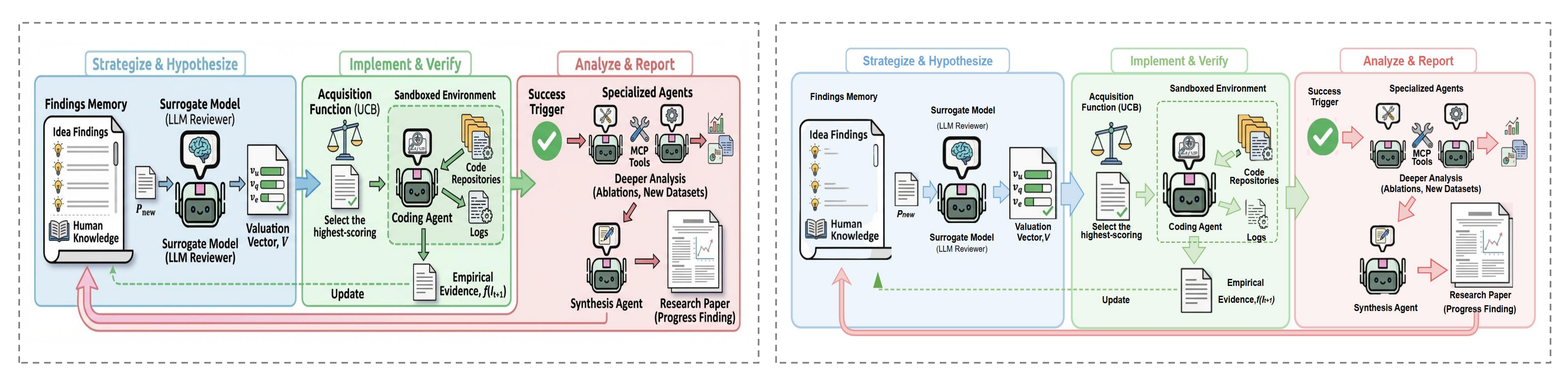
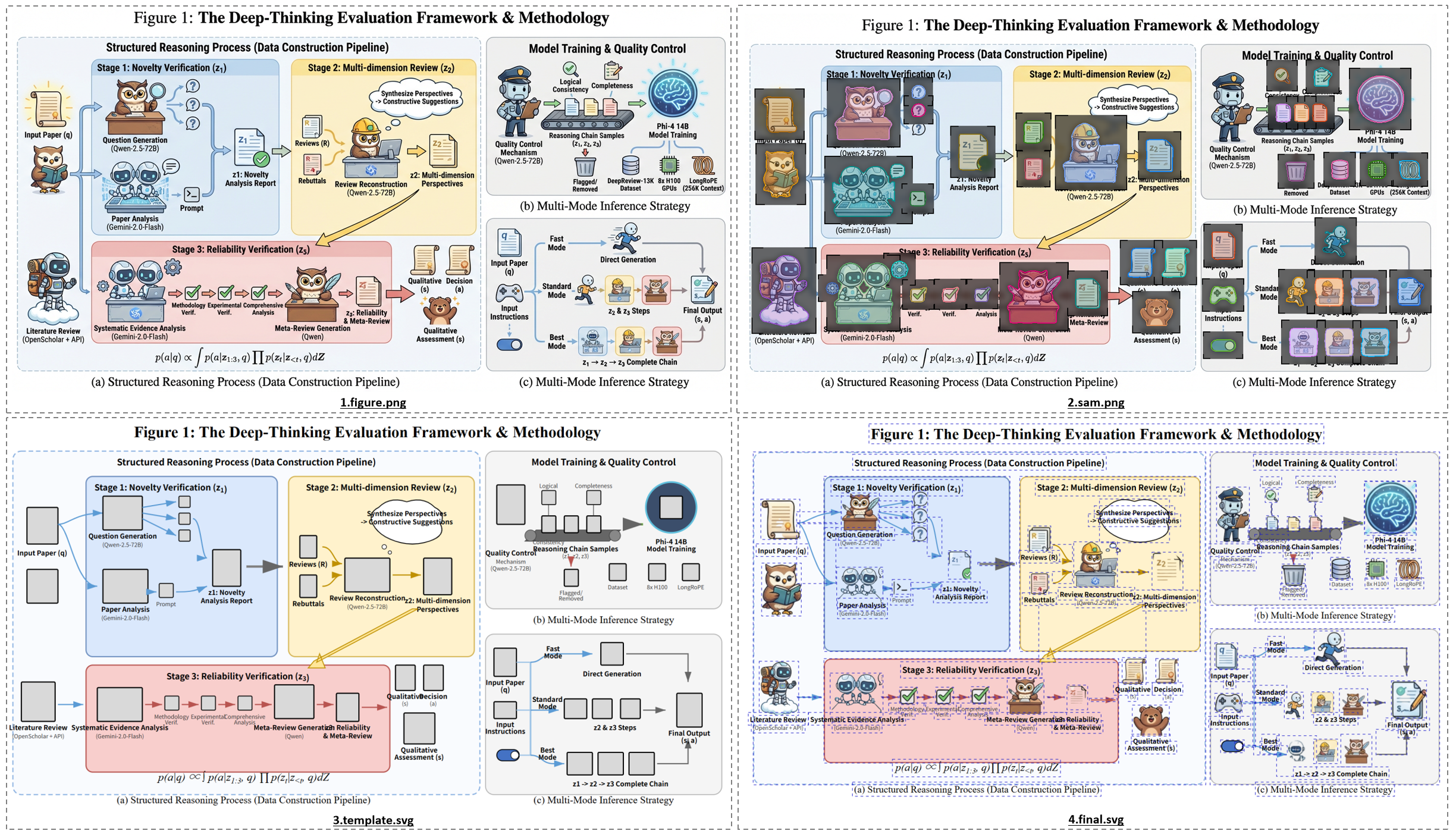
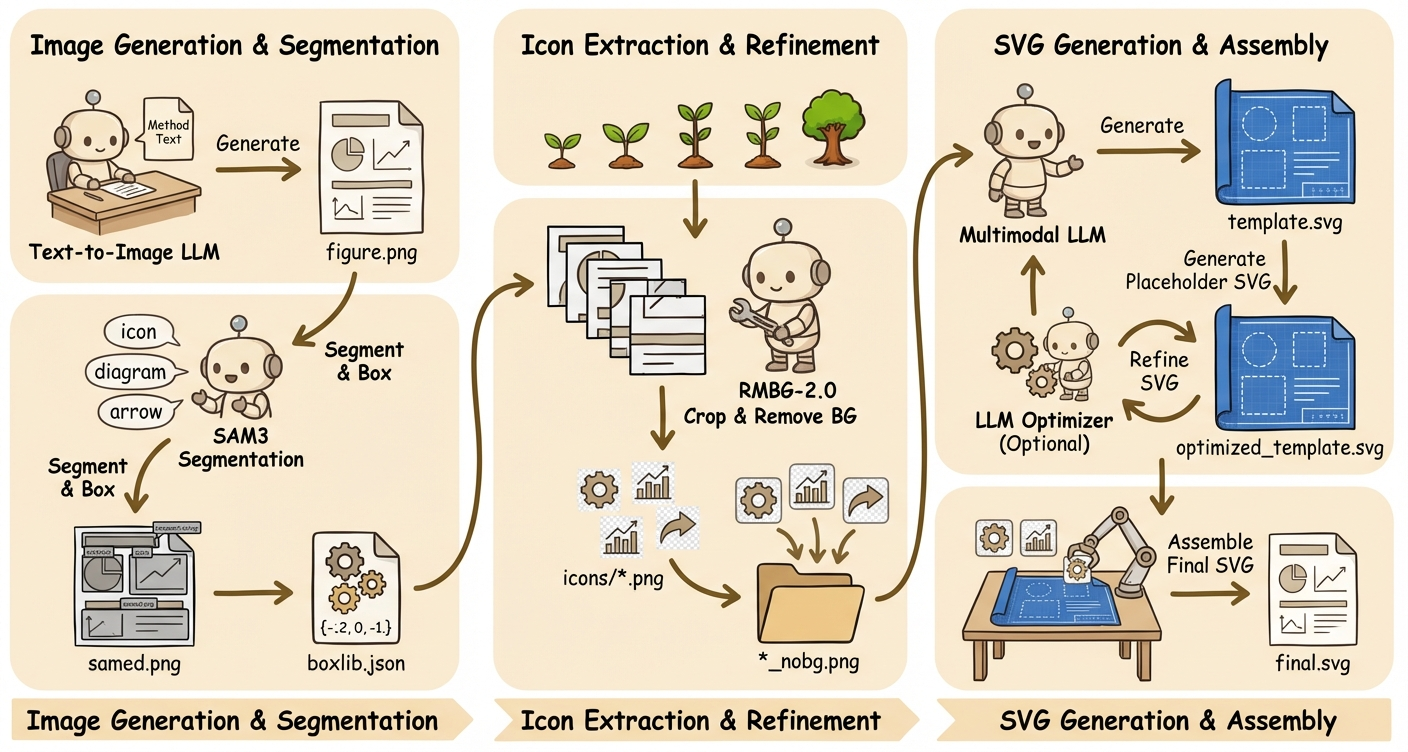
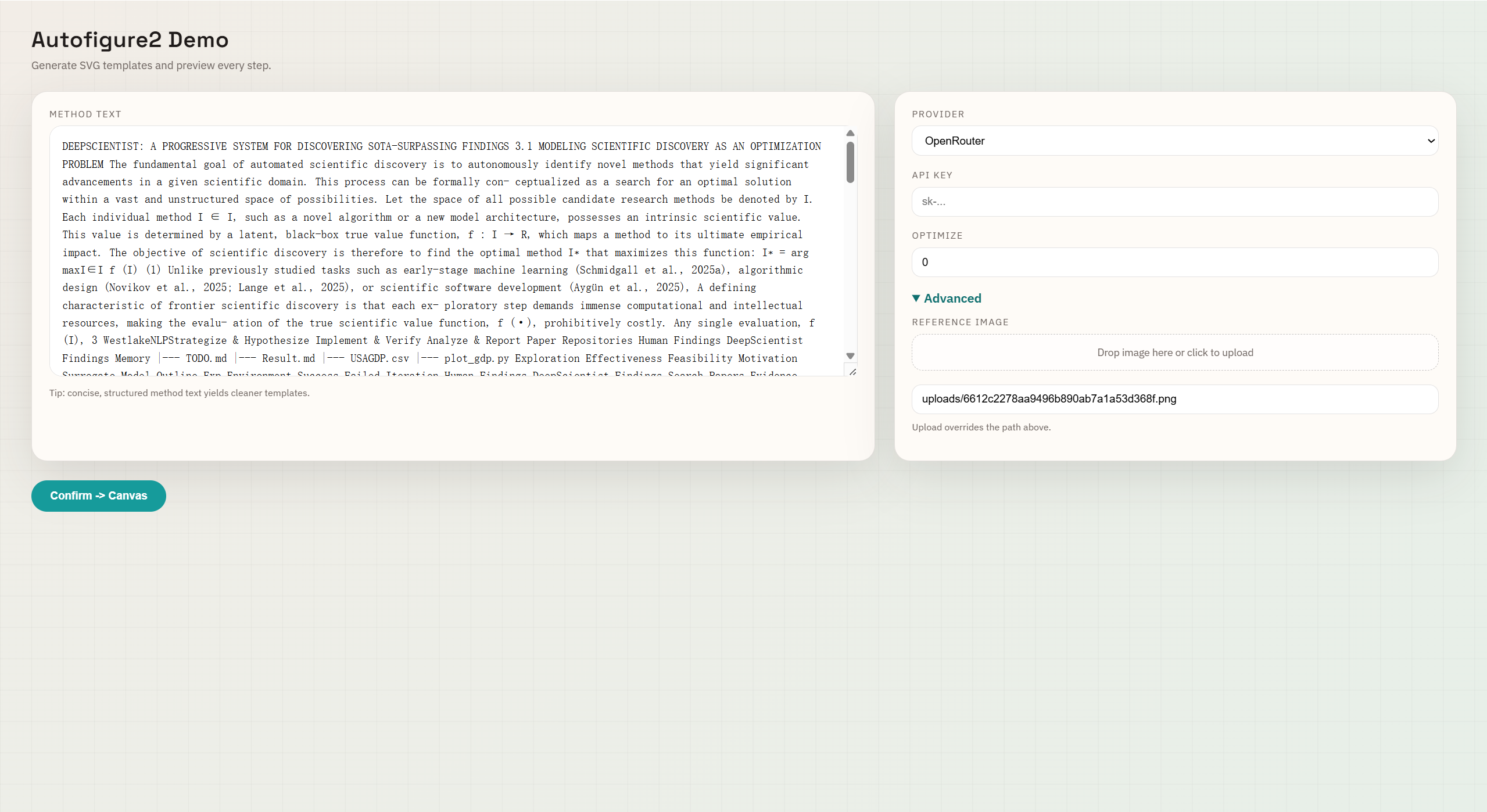
Based on README, the system operates in stages: (1) LLM-based figure draft generation from method text, (2) SAM3 icon detection and merging, (3) placeholder insertion for SVG alignment, (4) SVG template generation, (5) in-browser editing via bundled svg-edit. Appears to support multiple LLM backends (OpenAI, Bianxie AI, custom OpenAI-compatible routes) and multiple SAM backends. Bilingual configuration (English/Chinese) exposed in v1.1. No source code inspection possible; architecture inferred from README feature descriptions.
not documented in README
Last push 2026-06-26 (3 days before analysis date). Recent v1.1 release (2026-04-23) added major features. News section shows 4 significant updates in ~4-month window. Repository created 2026-02-03, so project is ~4 months old at analysis date. Activity level is high for a young project, though trajectory beyond v1.1 is not yet established.
ADOPT IF: you are an academic author seeking to rapidly prototype figures from method descriptions, tolerate LLM-based output quality variation, and value editability and vector output. AVOID IF: you need production-grade figure quality for high-stakes publications, require offline-only operation, or work in non-English languages not yet supported. MONITOR IF: you are evaluating for institutional deployment; the project is young (<5 months), adoption metrics are unquantified, and long-term maintenance trajectory is not yet established.
Independent dimensions
Mainstream potential
3/10
Technical importance
6/10
Adoption evidence
4/10
- Project age: <5 months old at analysis date; insufficient history to evaluate long-term maintenance or stability.
- Adoption unverified at scale: star count suggests interest, but no evidence of deployment beyond early adopters or quantified user base.
- LLM quality dependency: output quality depends on upstream LLM performance (OpenAI, Bianxie) and prompt engineering; no benchmarks provided in README.
- Editability workflow maturity: embedded svg-edit integration may have UX/usability gaps for complex figures; user feedback not documented.
- License/API cost: free web platform is current, but long-term business model and cost of downstream LLM/vision API calls (OpenAI, SAM3) are not discussed.
AutoFigure-Edit will likely remain a specialized tool for academic paper figure prototyping, with adoption concentrated in early-adopter research communities. Growth rate may plateau as the addressable market is narrower than general-purpose AI tools. Sustainability depends on: web platform funding, user feedback integration, and expansion to non-English workflows. Risk of dormancy if ResearAI prioritizes sister projects (e.g., DeepScientist).
Newsletter
Get analyses like this every Monday
Free weekly digest of the most interesting open-source discoveries.
Languages
Information
- Language
- Python
- License
- MIT
- Last updated
- 2w ago
- Created
- 5mo ago
- Analyzed with
- anthropic/claude-haiku-4-5
Stars over time
Contributors over time
Top 100 contributors only — repos with more will plateau at 100.
Open issues
豆包可以胜任吗
Gemini image generation crashes with AttributeError: 'Image' object has no attribute 'size'
Prism Book Spectrum
API
[Question] Is there any plan or possibility to support importing the generated images into PowerPoint or Visio for further editing?
Top contributors
Recent releases
Similar repos

ChenLiu-1996/figures4papers
A curated collection of Python scripts for generating publication-quality...
| Repository | Stars | Week Δ | Language | Score | Updated |
|---|---|---|---|---|---|
|
ResearAI/AutoFigure-Edit
this
|
3.9k | +48 | Python | 8/10 | 2w ago |
|
ResearAI/AutoFigure
|
1.7k | — | TypeScript | 8/10 | 2w ago |
 dwzhu-pku/PaperBanana dwzhu-pku/PaperBanana
|
6.7k | — | Python | 7/10 | 2w ago |
|
ChenLiu-1996/figures4papers
|
2.7k | — | Python | 8/10 | 2w ago |
 OpenDCAI/Paper2Any OpenDCAI/Paper2Any
|
2.7k | — | Python | 7/10 | 3w ago |
 llmsresearch/paperbanana llmsresearch/paperbanana
|
2.1k | — | Python | 7/10 | 3w ago |
More established project with ~70% higher star count. AutoFigure-Edit differentiates via editable SVG output and embedded editor; PaperBanana's scope/focus cannot be determined from this data alone.
Significantly larger codebase with broader research automation scope. AutoFigure-Edit is narrower, focusing specifically on figure generation from method text.
Similar niche (academic figure generation). AutoFigure-Edit's emphasis on editability and SVG output may represent a functional differentiation, but direct capability comparison is not possible from available metadata.
Broader paper conversion focus. AutoFigure-Edit is more specialized.
AutoFigure-Edit competes against workflows where researchers manually create or edit figures. Advantage: automation + editability. Risk: quality and style consistency with domain conventions.