Build your personal knowledge base with Trilium Notes
36.8k
Stars
2.5k
Forks
653
Open issues
30
Contributors




AI Analysis
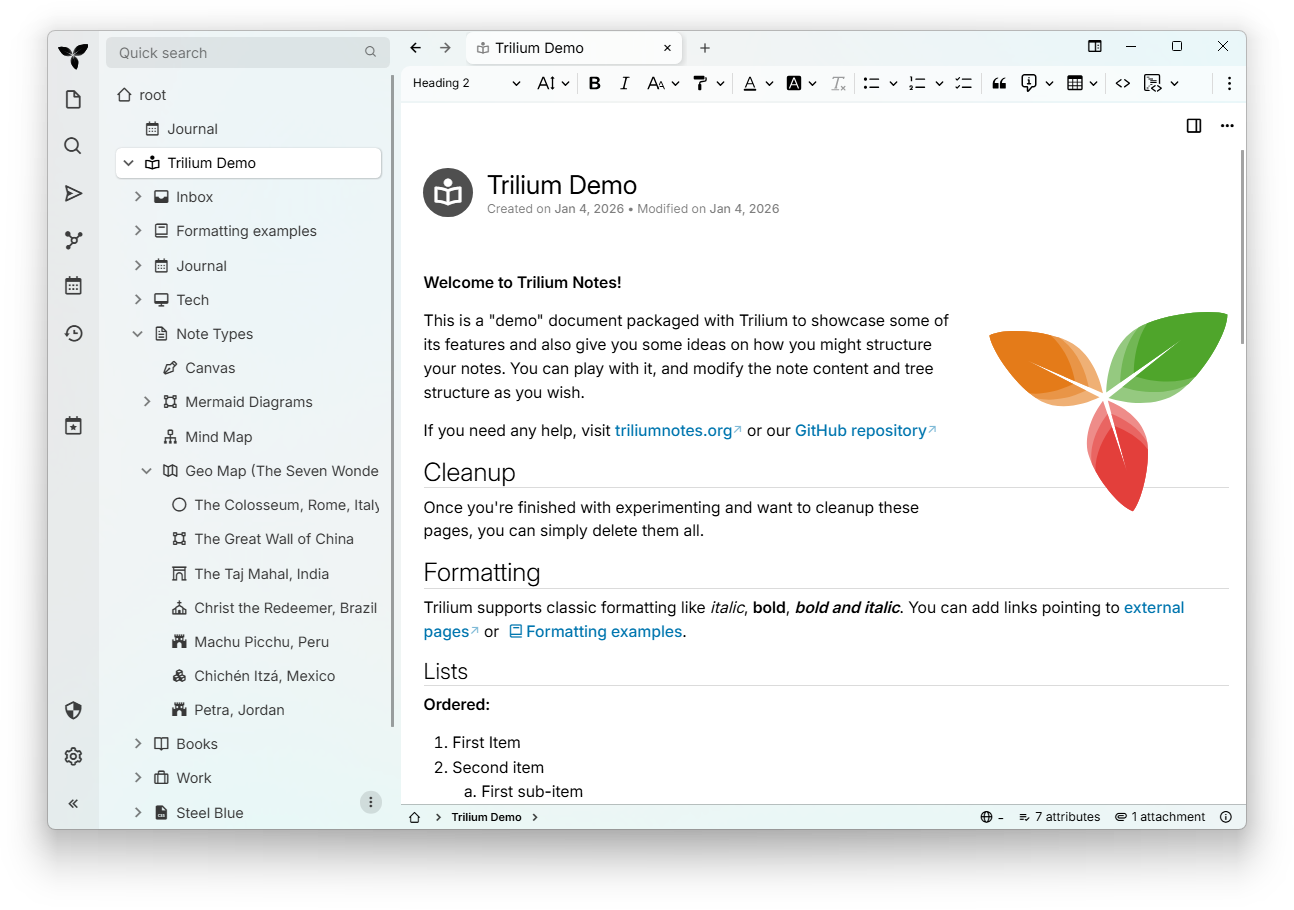
Trilium Notes is a free, open-source, cross-platform hierarchical note-taking application designed to help users build large personal knowledge bases with features like tree-based organization, cloning, rich editing, and scriptability. It serves individuals and teams who want a self-hosted, local-first alternative to commercial note-taking platforms, and is best suited for users comfortable with desktop or server deployment rather than those seeking quick cloud-based convenience.
Inferred from signals mentioned in the README (tests, CI, type safety) — not a review of the actual code.
AI's overall editorial judgment — not an average of the bars above, can weigh other factors too.
TriliumNext keeps a mature self-hosted knowledge base alive after its founder stepped back
Trilium Notes is a self-hosted, hierarchical personal knowledge base targeting power users who want deep customization, scripting, per-note encryption, and full data ownership. Originally built by zadam, TriliumNext is the community-maintained fork that has continued active development since 2023. Its audience is technically inclined individuals — developers, researchers, and privacy-focused users — who want an Obsidian or Notion alternative they fully control. With 36k+ stars and Docker pulls visible in the README, real-world adoption is above average for self-hosted PKM tools.
Started in 2017 by zadam as a solo project; reached wide attention on Hacker News. In mid-2023, the original maintainer archived the repo; TriliumNext (community fork) took over, migrating to TypeScript and continuing active releases.
Initial growth came from HN/Reddit coverage and being a rare open-source alternative to Roam/Notion with scripting power. The TriliumNext fork revived momentum after the archive event; 91 stars in 7 days and a June 24 2026 push date indicate sustained, if modest, organic growth rather than a viral spike.
Docker pull count is surfaced in the README badge, implying non-trivial self-hosted deployment. GitHub download counts are also badged. The project has active third-party cloud hosting providers listed in docs, suggesting a real user ecosystem. Exact user counts are not disclosed, but signals point to an established user base rather than a nascent one.
Appears to be an Electron-based desktop app plus a Node.js/Express server component, using SQLite for local storage. The README references a self-hosted sync server, Docker images, a REST API (ETAPI), and a mobile frontend, suggesting a client-server split with an optional thick client. TypeScript migration from the original JavaScript codebase appears ongoing based on the fork's stated goals.
Not documented in README
Last push was June 24 2026 (same day as evaluation date), indicating active daily development. The README references nightly builds updated daily, active Weblate translations across 19+ languages, and GitHub Sponsors/LiberaPay badges implying ongoing financial support. Maintenance signals are strong for a community-driven project.
ADOPT IF: you are a technically inclined user who wants a self-hosted, deeply scriptable knowledge base with strong encryption and hierarchical organization, and are comfortable running a Node.js/Docker server. AVOID IF: you need a polished mobile-first experience, a large third-party plugin marketplace, or you are unwilling to manage self-hosted infrastructure. MONITOR IF: you are evaluating open-source PKM tools and want to see whether TriliumNext stabilizes its TypeScript rewrite and grows its contributor base enough to reduce bus-factor risk.
Independent dimensions
Mainstream potential
3/10
Technical importance
7/10
Adoption evidence
6/10
- Community-fork bus-factor risk: TriliumNext depends on a small set of volunteers; if key maintainers disengage, momentum could stall again as it did when the original author archived the repo.
- Proprietary data format risk: SQLite-backed storage with a custom schema means data portability requires deliberate export effort, unlike Markdown-file-based tools.
- Mobile experience gap: the README references a touch-optimized mobile frontend, but self-hosted PKM tools historically struggle to match native mobile app quality, potentially limiting appeal to mobile-first users.
- Feature complexity vs. sustainability: the broad feature set (geo maps, mind maps, scripting, ETAPI, Excalidraw, sync server) creates a large surface area for a volunteer-maintained project to keep bug-free across releases.
- Niche ceiling: the self-hosted, power-user PKM category is unlikely to grow to mainstream scale, which may limit contributor inflow and long-term financial support despite current stability.
TriliumNext will likely remain a well-maintained, high-quality option for self-hosted PKM power users. It is unlikely to cross into mainstream adoption but may solidify as the reference implementation for open-source hierarchical knowledge bases over the next 2–3 years.
Newsletter
Get analyses like this every Monday
Free weekly digest of the most interesting open-source discoveries.
Languages
Information
- Website
- https://triliumnotes.org
- Language
- TypeScript
- License
- AGPL-3.0
- Last updated
- 7h ago
- Created
- 111mo ago
- Analyzed with
- anthropic/claude-haiku-4-5
Stars over time
Contributors over time
Top 100 contributors only — repos with more will plateau at 100.
Open issues
Feature request:Add an app lock feature to the desktop version
Allow for disabling 'fancy' math input
Univer Spreadsheet Support for Charts via univer-vchart-plugin
Adding linked notes list should have most recent at top
Top contributors
Similar repos

gamosoft/NoteDiscovery
NoteDiscovery is a self-hosted, open-source note-taking application offering...

giuspen/cherrytree
CherryTree is a hierarchical note-taking application with rich text formatting,...
| Repository | Stars | Week Δ | Language | Score | Updated |
|---|---|---|---|---|---|
|
TriliumNext/Trilium
this
|
36.8k | +141 | TypeScript | 8/10 | 7h ago |
 refactoringhq/tolaria refactoringhq/tolaria
|
18.5k | — | TypeScript | 8/10 | 11h ago |
|
gamosoft/NoteDiscovery
|
2.6k | — | JavaScript | 7/10 | 3d ago |
 ZenNotes/zennotes ZenNotes/zennotes
|
1.9k | — | TypeScript | 8/10 | 17h ago |
|
giuspen/cherrytree
|
3.9k | — | C++ | 7/10 | 6d ago |
 dendronhq/dendron dendronhq/dendron
|
7.5k | — | TypeScript | 6/10 | 8mo ago |
Obsidian is proprietary, file-based (Markdown), and has a vastly larger plugin ecosystem and user base. Trilium uses a database-backed model with scripting and deep hierarchies, appealing to users who find Obsidian's flat-file model limiting. Trilium is fully open-source and self-hostable; Obsidian's sync is paid.
Notesnook (14k stars) is also FOSS and privacy-focused but targets mainstream note-taking rather than power-user PKM with scripting. Notesnook has a polished mobile app and hosted cloud option; Trilium skews toward desktop and self-hosted server setups.
SilverBullet (5.5k stars) is Markdown-based and browser-first, targeting a developer-oriented 'programmable notebook' use case. Both support scripting, but SilverBullet's flat-file approach differs from Trilium's hierarchical database model.
Dendron (7.4k stars) is VS Code-integrated and Markdown-file-based, appealing to developers who live in their editor. It appears less actively maintained than TriliumNext as of 2026. Trilium offers a richer standalone UI and better non-developer UX.
Logseq is outline/graph-based and Markdown-file-backed, with a larger community. Trilium's tree hierarchy and scripting engine serve a different mental model. Logseq has broader mindshare but Trilium has more granular encryption and server sync options.