cherrytree
3.9k
Stars
510
Forks
952
Open issues
30
Contributors


AI Analysis
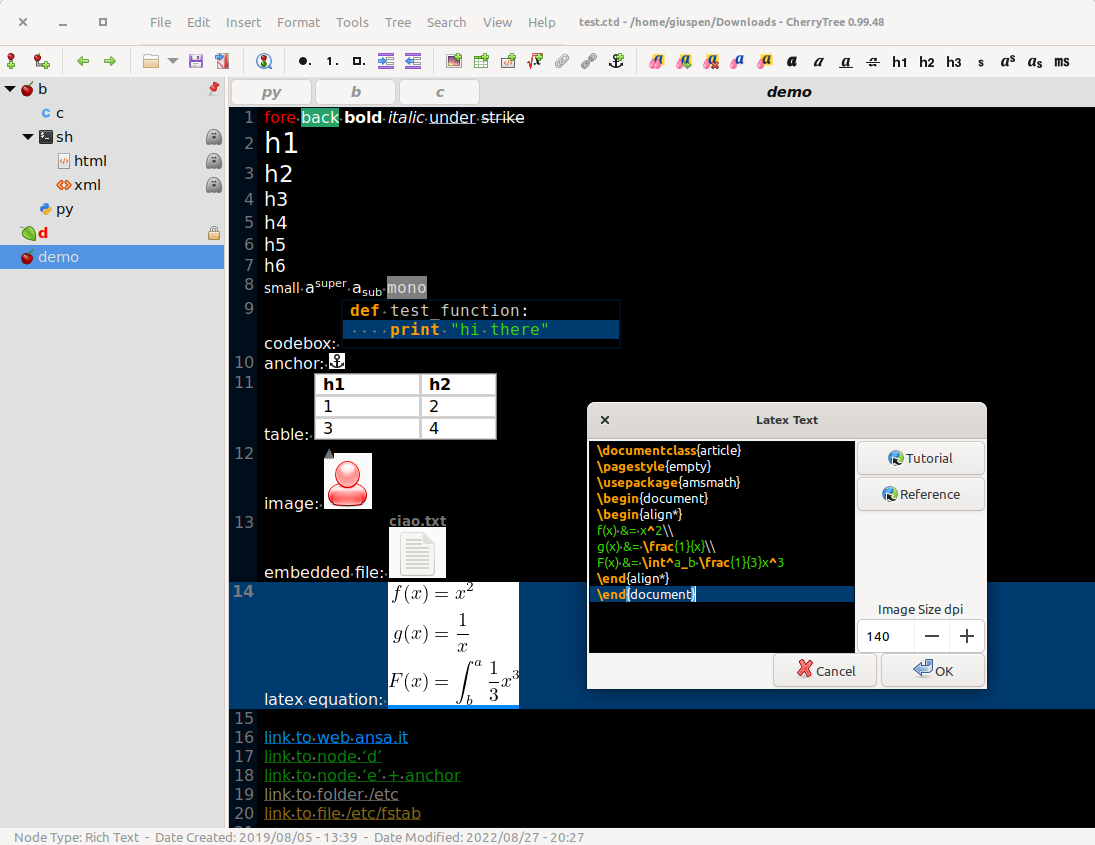
CherryTree is a hierarchical note-taking application with rich text formatting, syntax highlighting, and flexible storage options (single XML/SQLite file or multiple files). It serves individual users, researchers, and developers who need structured note organization with advanced formatting and code execution capabilities, but is not designed for real-time collaboration or team-based knowledge management.
Inferred from signals mentioned in the README (tests, CI, type safety) — not a review of the actual code.
AI's overall editorial judgment — not an average of the bars above, can weigh other factors too.
Mature GTK hierarchical note-taking app with rich text, syntax highlighting, and flexible storage formats
CherryTree is a desktop note-taking application offering hierarchical organization, rich text formatting, syntax highlighting, LaTeX rendering, and multi-format export (HTML, PDF, plain text). Built in C++ with GTK, it stores data in single XML/SQLite files or distributed directory structures. Adoption appears limited to technical users and knowledge management communities; real-world usage metrics are not publicly documented. The project has maintained steady development since 2015 with active recent commits, but growth is incremental rather than accelerating.
Launched in 2015 by Giuseppe Penone, CherryTree evolved from earlier note-taking paradigms. It shifted toward modern C++/GTK architecture while maintaining backward compatibility with legacy XML storage. Community contributions (Evgenii Gurianov joined as co-author) have expanded localization to 30+ languages and feature completeness.
GitHub stars (3,902) grew steadily but show minimal recent acceleration (3 stars in 7 days as of 2026-07-04). Growth appears driven by organic technical community discovery rather than marketing. Last commit timestamp (2026-07-04 13:47:32) confirms active maintenance through current date. No evidence of viral adoption or major feature releases driving spikes in visibility.
Adoption not verified via documented case studies or user surveys. Third-party ecosystem exists (SourCherry Android client, community HTML interface) suggesting non-trivial usage, but scale is unknown. Desktop application distribution (prebuilt binaries on GitHub and official website) indicates functional deployment model, but number of active users is not disclosed.
Likely built on GTK3 (references GTKmm3 documentation in README). Appears to use either libxml2 for XML storage or embedded SQLite for database backend. Image/file handling, syntax highlighting, and LaTeX rendering suggest modular component architecture, though source code cannot be verified from README alone.
Not documented in README. No mention of unit tests, CI/CD pipeline, or test framework.
Active as of 2026-07-04 (same-day commit). Distributed translation effort across 30 languages suggests community engagement. However, star growth (3/week) and fork count (510, suggesting limited ongoing forks) indicate a stable rather than rapidly expanding user base. No evidence of infrastructure churn or abandoned subsystems mentioned in README.
ADOPT IF: You are a technical user on Linux/macOS/Windows desktop who needs offline hierarchical note storage with rich text, syntax highlighting, and LaTeX support, and you value data portability (single-file or distributed directory storage without cloud dependency). AVOID IF: You require mobile access, real-time sync across devices, or collaboration features; also avoid if you need a modern web-based interface or broad ecosystem integrations. MONITOR IF: You are evaluating between CherryTree and Joplin/Trilium and want to confirm whether recent CherryTree updates have added sync capabilities (as of 2026-07-04, none are apparent in README).
Independent dimensions
Mainstream potential
3/10
Technical importance
6/10
Adoption evidence
3/10
- GTK dependency may limit ease of deployment on non-Linux platforms and increases maintenance burden as GTK evolves; GTK3-only suggests potential future porting overhead if GTK4 migration becomes necessary.
- No documented backup/sync mechanism; single-file storage models can be fragile compared to cloud-backed alternatives in disaster recovery scenarios.
- Adoption metrics and user base size are not publicly visible, making it difficult to assess community viability or long-term maintenance commitment beyond single maintainer.
- Password protection via 7-Zip creates temporary unencrypted copies on disk, introducing potential security surface (acknowledged in README but may concern sensitive-data users).
- Narrow ecosystem (primarily desktop GTK; mobile support only via third-party Android project) limits expansion potential compared to cloud-first competitors.
CherryTree will likely remain a stable, actively maintained niche tool for technical desktop users prioritizing offline control and local storage over sync and mobile access. Growth will remain modest unless major architectural changes (web interface, cloud sync, mobile-first redesign) occur, which are not evident in current roadmap signals.
Newsletter
Get analyses like this every Monday
Free weekly digest of the most interesting open-source discoveries.
Languages
Information
- Language
- C++
- License
- NOASSERTION
- Last updated
- 6d ago
- Created
- 138mo ago
- Analyzed with
- anthropic/claude-haiku-4-5
Stars over time
Contributors over time
Top 100 contributors only — repos with more will plateau at 100.
Open issues
Open pull requests
No open pull requests.
Top contributors
Recent releases
Similar repos

aardappel/treesheets
TreeSheets is a free, open-source hierarchical spreadsheet and data organizer...

TriliumNext/Trilium
Trilium Notes is a free, open-source, cross-platform hierarchical note-taking...

alpha-liu-01/SpeedyNote
SpeedyNote is a cross-platform, open-source note-taking app optimized for...
| Repository | Stars | Week Δ | Language | Score | Updated |
|---|---|---|---|---|---|
|
giuspen/cherrytree
this
|
3.9k | +4 | C++ | 7/10 | 6d ago |
|
aardappel/treesheets
|
3.1k | — | C++ | 7/10 | 3d ago |
|
TriliumNext/Trilium
|
36.8k | — | TypeScript | 8/10 | 7h ago |
|
alpha-liu-01/SpeedyNote
|
1.4k | — | C++ | 8/10 | 2d ago |
 laurent22/joplin laurent22/joplin
|
55.5k | — | TypeScript | 9/10 | 20h ago |
 Tencent/cherry-markdown Tencent/cherry-markdown
|
4.7k | — | JavaScript | 7/10 | 10h ago |
Cross-platform web-based architecture vs. CherryTree's desktop GTK focus. Joplin emphasizes sync and mobile support; CherryTree emphasizes rich text formatting and single-file storage. Joplin has ~14x higher visibility but targets different use cases.
Web-based hierarchical notes with stronger collaboration features and end-to-end encryption. Trilium is TypeScript/Node.js; CherryTree is compiled C++. Trilium emphasizes sync; CherryTree emphasizes local control and zero network dependency.
Similar star count but different primary use case (spreadsheet-like data organization vs. text-centric note-taking). Both are C++ desktop apps. CherryTree has richer text formatting; TreeSheets emphasizes tabular data.
JavaScript-based markdown editor, not hierarchical note storage. CherryTree's proprietary XML/SQLite format differs from markdown-centric approach. No direct feature overlap despite similar name recognition.
C++ desktop note-taking with lower adoption. CherryTree has ~3x higher stars, suggesting greater penetration in target audience, though neither achieves mainstream recognition.