
AI-Powered, Non-Intrusive Terminal Assistant
1.9k
Stars
115
Forks
2
Open issues
18
Contributors


AI Analysis
TmuxAI is an AI-powered terminal assistant that integrates directly into tmux sessions, enabling developers to leverage ChatGPT and other LLMs without leaving their terminal environment. It is specifically designed for tmux users who want in-editor AI assistance through features like Watch Mode, Knowledge Bases, and Skills. This tool benefits experienced terminal users and developers who prefer keyboard-driven workflows; it is not for users seeking a general-purpose ChatGPT client or those wo...
Inferred from signals mentioned in the README (tests, CI, type safety) — not a review of the actual code.
AI's overall editorial judgment — not an average of the bars above, can weigh other factors too.
Tmux-native AI assistant that observes terminal context and executes commands with permission
TmuxAI is a Go-based terminal AI assistant designed to operate non-intrusively within tmux sessions. It reads visible pane content, maintains context across multiple windows, and can execute commands in a dedicated execution pane. Targets tmux power users and developers who want AI assistance without leaving their terminal environment. Adoption appears concentrated in early-adopter developer communities; real-world production usage is not verified in README or public documentation.
Project launched April 2025 by Boring Dystopia Development. Created specifically to address the gap between general-purpose CLI AI tools and the workflow needs of developers deeply invested in tmux-based development environments. Positioned as an alternative to tools like tgpt or ChatGPT CLI that don't understand tmux context.
Reached ~1,885 stars in approximately 14 months, with steady month-to-month additions suggesting modest but consistent developer interest. Recent activity shows 9 stars in last 7 days and last push on 2026-06-30, indicating active maintenance. Growth trajectory appears organic and plateau'd relative to larger terminal AI tools (tgpt ~3,200 stars, cmux ~23k), suggesting this occupies a specialized segment rather than mass-market appeal.
adoption not verified. README contains no case studies, testimonials, or documented deployments. No quotes from organizations or well-known developers. Community links (Telegram, X) exist but no subscriber/follower counts provided. GitHub issues and discussions would contain adoption signals but are not accessible from metadata. Star and fork counts suggest awareness among hobbyist/early-adopter circles rather than proven enterprise or team adoption.
Based on README, appears to follow a modular plugin architecture: Observe mode (reads pane content), Prepare mode (context staging), Watch mode (continuous monitoring), Knowledge Bases (custom context injection), Skills (extensible command patterns), and MCP Server Tools integration. Written in Go, suggesting focus on performance and single-binary distribution. Likely implements tmux protocol communication via Go libraries. No source code access limits verification of implementation patterns.
not documented in README
Last push 2026-06-30 (3 days before analysis date) indicates active development. README is thorough, well-organized, and updated regularly. GitHub badges and links to external resources (tmuxai.dev, Telegram channel, X account) suggest ongoing community engagement. Issue templates present, suggesting maintainer responsiveness to bug reports and features. No evidence of abandonment or neglect.
ADOPT IF: you are a tmux power user, spend extended sessions in terminal environments, want AI assistance without context-switching, and have an LLM API key (OpenAI, local, etc.). Configuration complexity is documented but non-trivial. AVOID IF: you don't use tmux regularly, need guaranteed production support, or depend on extensive community ecosystem plugins. Your primary terminal is Windows (WSL not mentioned), or you require offline-only operation. MONITOR IF: you manage teams and want to evaluate whether adoption might improve developer productivity in terminal-native workflows; adoption evidence is currently insufficient for team rollout decisions.
Independent dimensions
Mainstream potential
3/10
Technical importance
6/10
Adoption evidence
2/10
- Adoption not verified in public channels; impossible to assess whether reliability issues or limitations exist at scale
- Single maintainer (Boring Dystopia Development) creates potential bus factor; no evidence of backup maintainers or organizational sponsorship
- tmux dependency limits addressable market to Unix developers; excludes Windows native users and IDEs
- LLM API cost and configuration burden (Skills, Knowledge Bases, model switching) may create friction for casual users
- No formal documentation of security model for command execution; 'with your permission' mechanism not detailed in README
TmuxAI will likely remain a specialized tool with steady but modest adoption among terminal-centric developers. Unlikely to achieve mainstream penetration unless adoption is proven at scale or tmux itself experiences renaissance in developer culture. May grow via word-of-mouth in specific communities (DevOps, systems programming) but faces inherent market ceiling from tmux's declining share of developer mindshare relative to IDE-integrated AI tools.
Explore similar
Newsletter
Get analyses like this every Monday
Free weekly digest of the most interesting open-source discoveries.
Languages
Information
- Website
- https://tmuxai.dev
- Language
- Go
- License
- Apache-2.0
- Last updated
- 4d ago
- Created
- 15mo ago
- Analyzed with
- anthropic/claude-haiku-4-5
Stars over time
Contributors over time
Top 100 contributors only — repos with more will plateau at 100.
Open pull requests
No open pull requests.
Top contributors
Recent releases
Similar repos
| Repository | Stars | Week Δ | Language | Score | Updated |
|---|---|---|---|---|---|
|
alvinunreal/tmuxai
this
|
1.9k | +7 | Go | 8/10 | 4d ago |
 aandrew-me/tgpt aandrew-me/tgpt
|
3.2k | — | Go | 7/10 | 3w ago |
 madox2/vim-ai madox2/vim-ai
|
1.2k | — | Python | 7/10 | 4mo ago |
 can1357/oh-my-pi can1357/oh-my-pi
|
17.1k | — | TypeScript | 8/10 | 36 min ago |
 manaflow-ai/cmux manaflow-ai/cmux
|
24.1k | — | Swift | 8/10 | 7h ago |
 ShawnPana/smux ShawnPana/smux
|
1.5k | — | Shell | 7/10 | 3w ago |
Broader CLI AI tool without tmux integration; TmuxAI's tmux-awareness is a differentiator but limits applicability to tmux users only
Significantly larger user base; appears to serve different use case (likely multiplexing), not direct competition, but different market penetration
Higher adoption; comparable positioning as terminal AI assistant but potentially broader platform support
Similar star count but shell-based; TmuxAI's Go binary distribution may offer better portability
Slightly lower adoption; narrower scope (AI task management); TmuxAI is broader as a general-purpose pair programmer







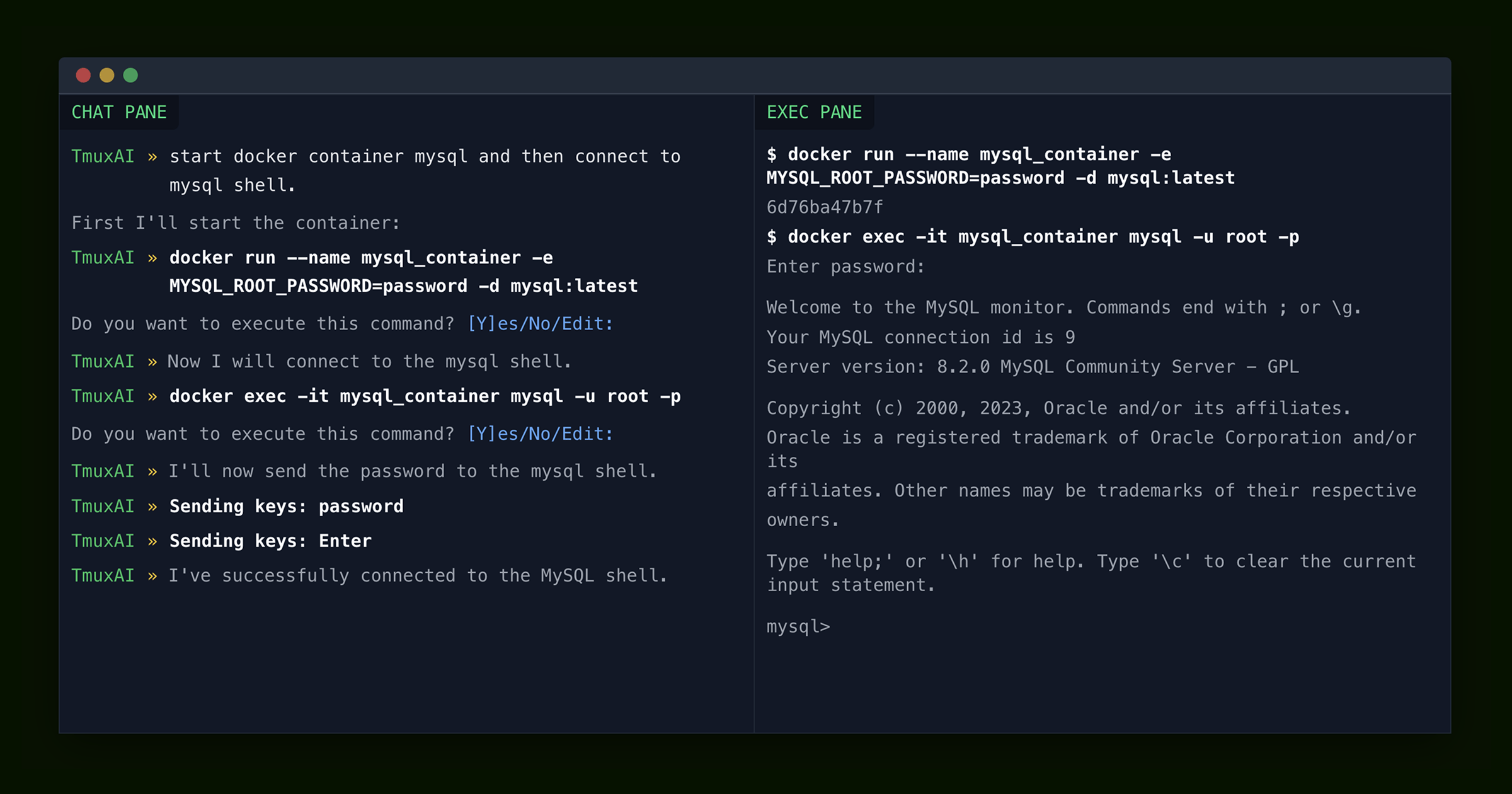

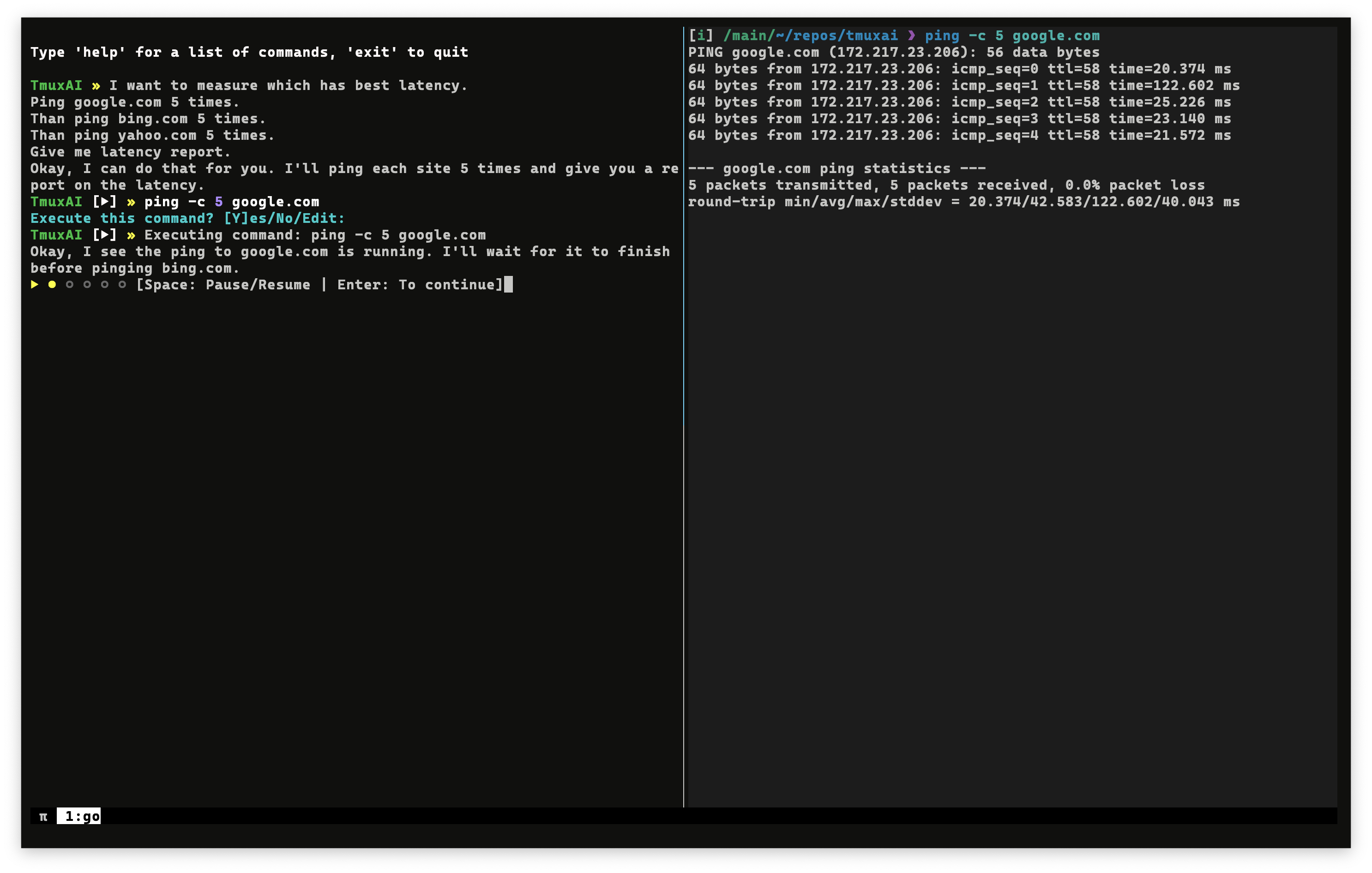 TmuxAI sent the first ping command and is waiting for the countdown to check for the next step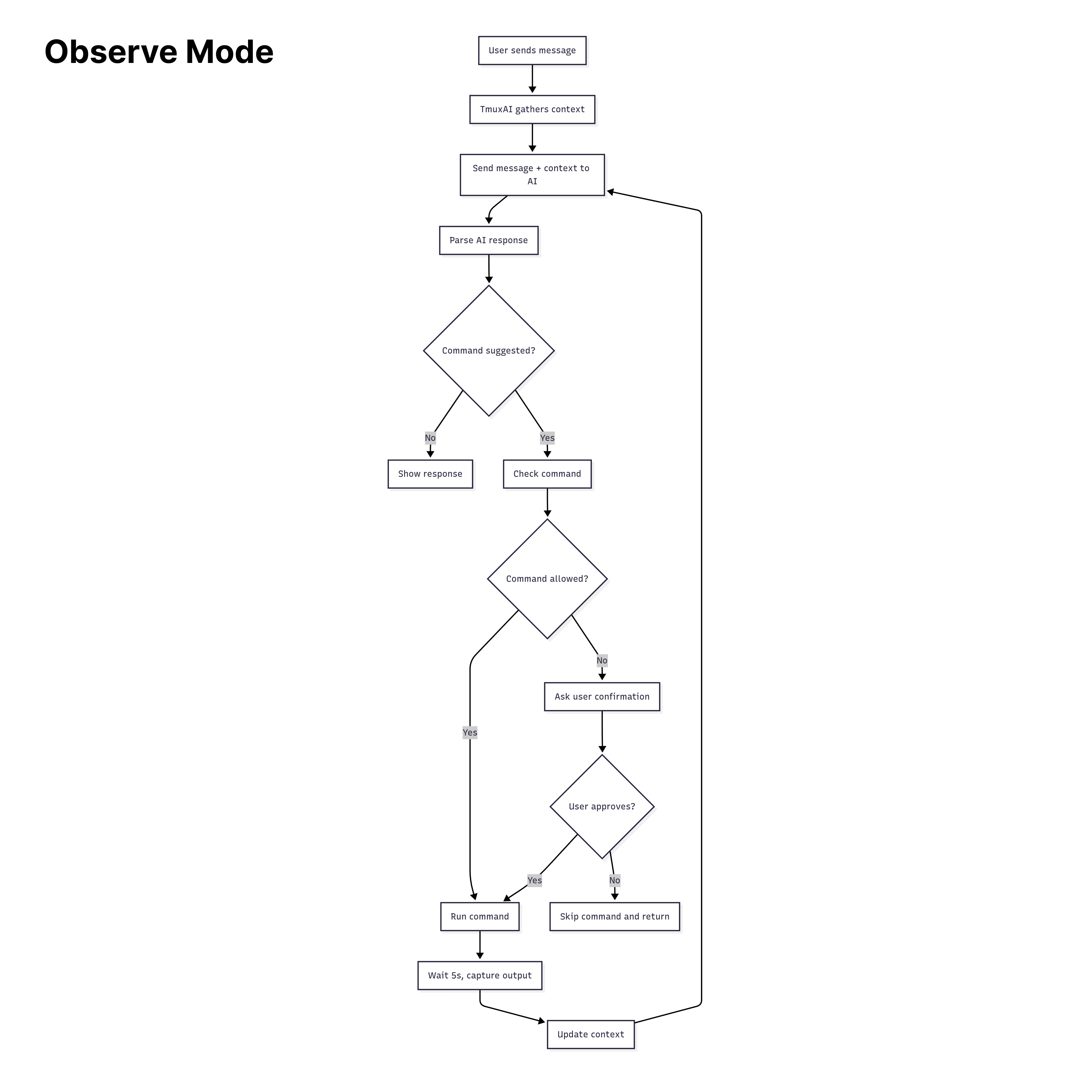
 TmuxAI customized the pane prompt and sent the first ping command. Instead of the countdown, it's waiting for command completion
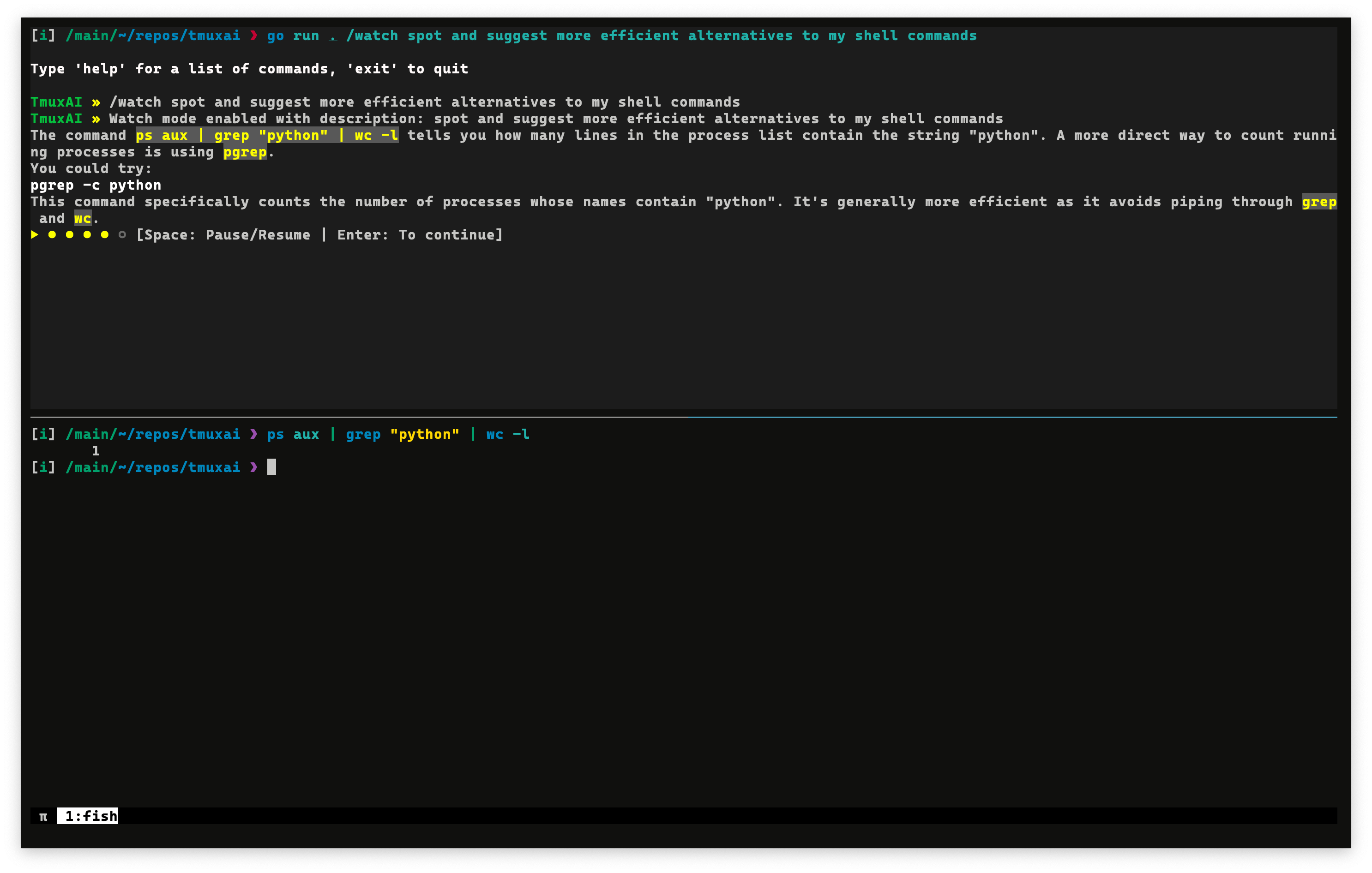 TmuxAI watching user shell commands and better alternatives