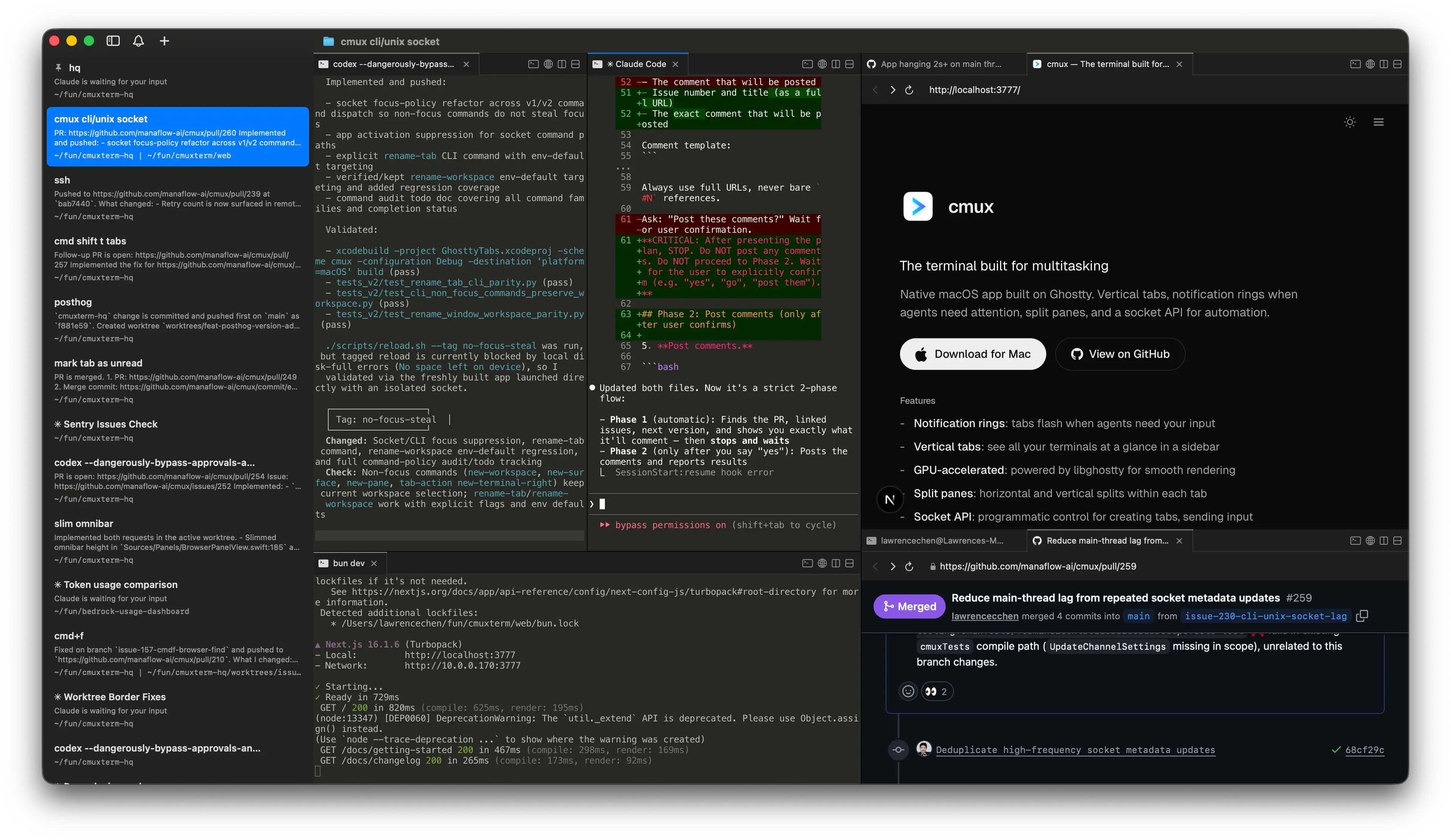
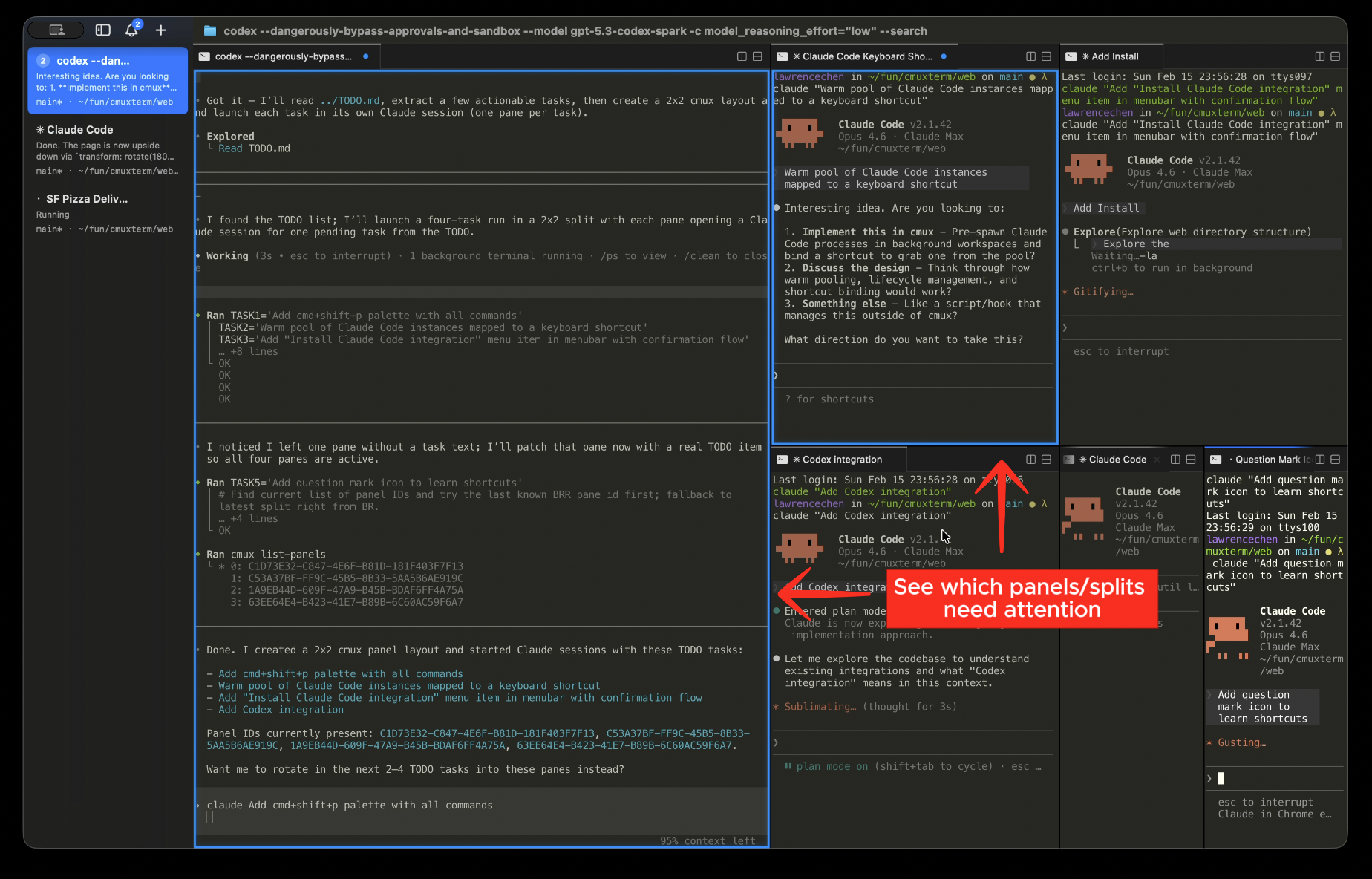
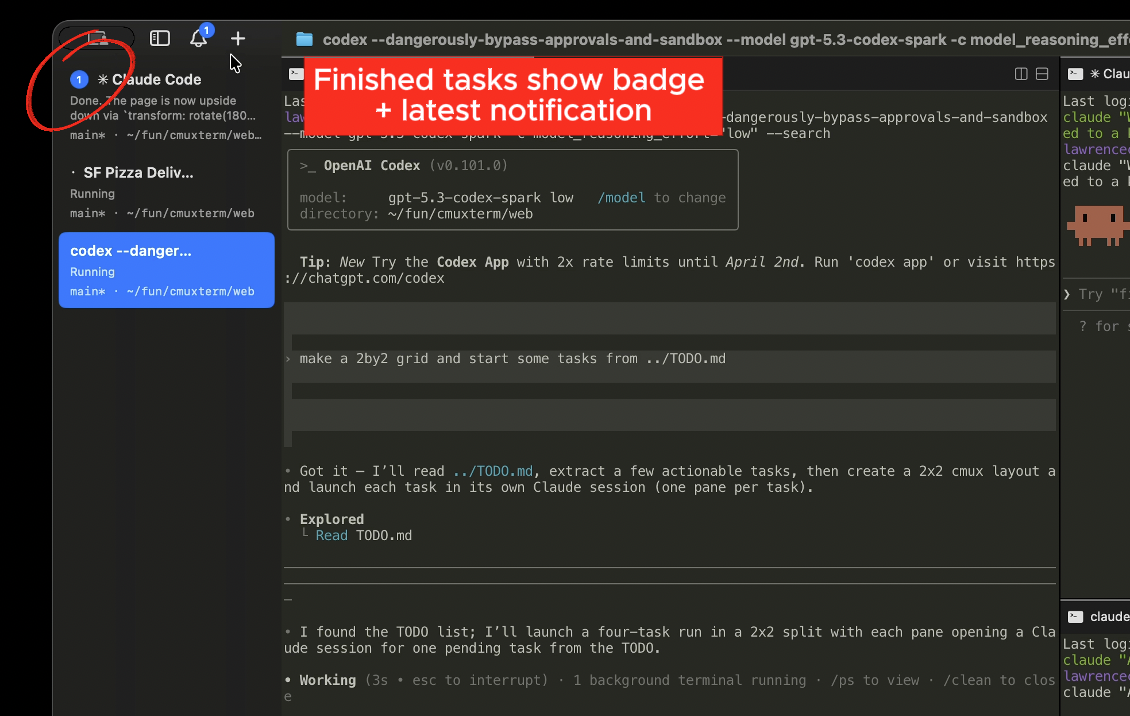
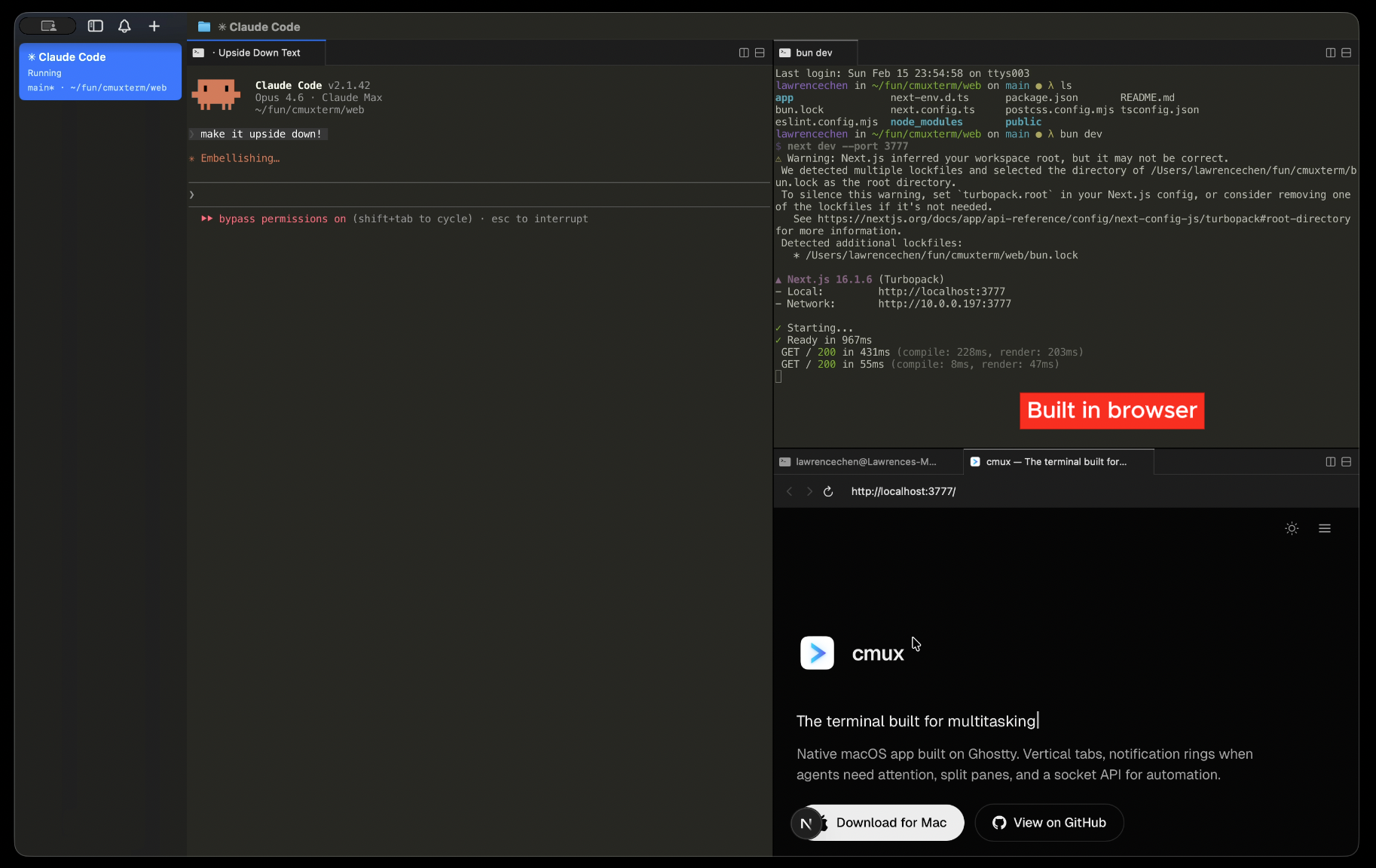
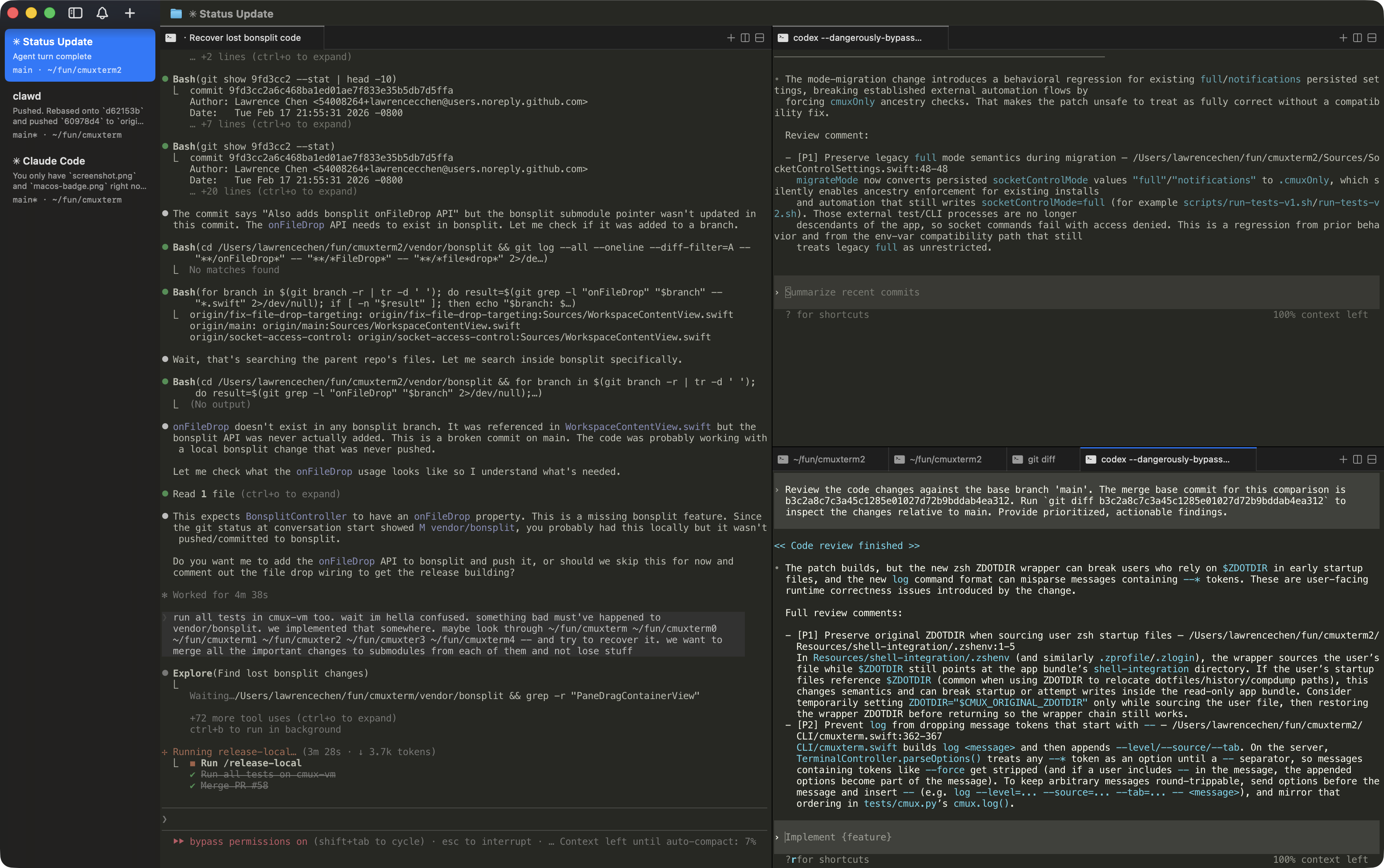
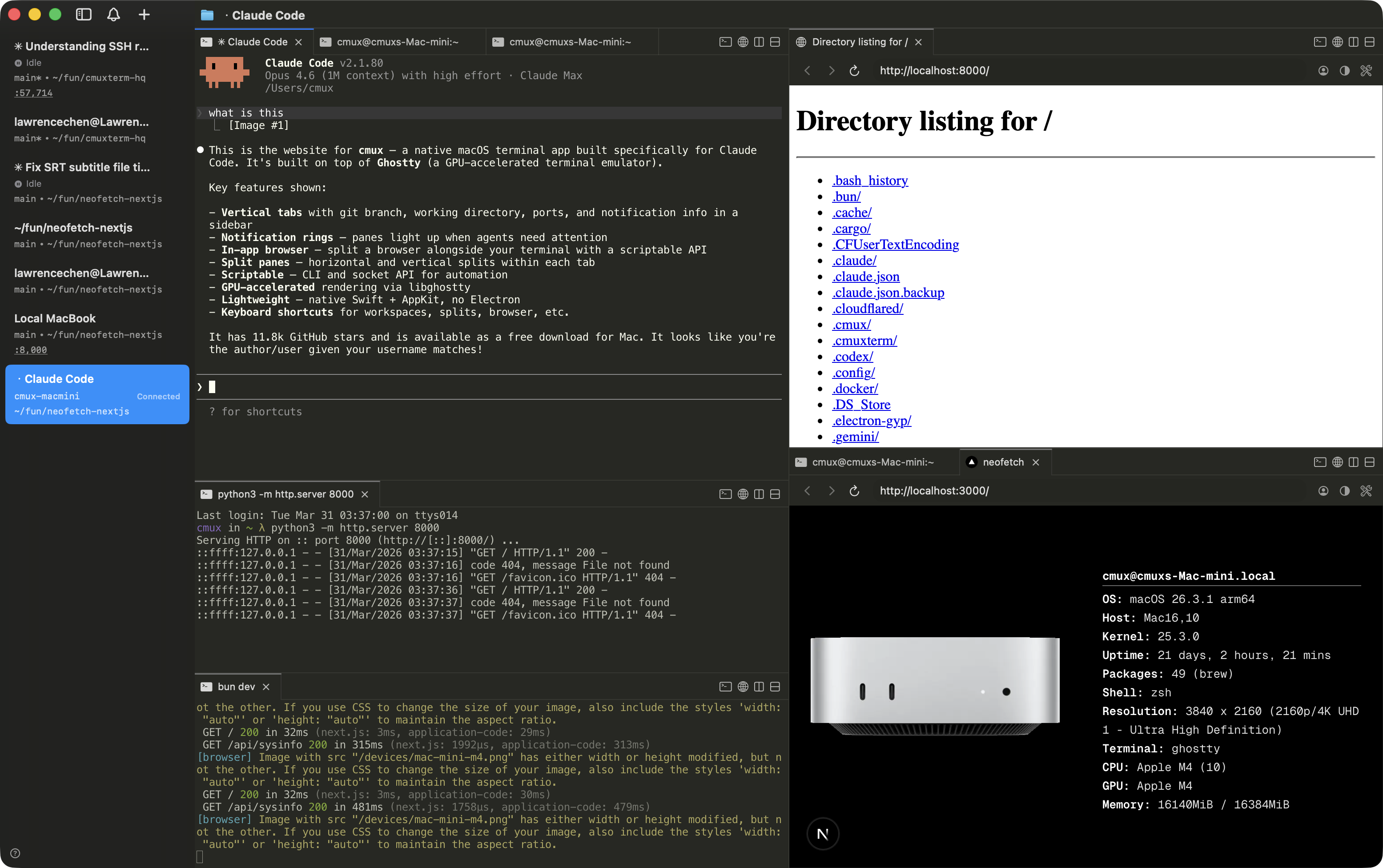
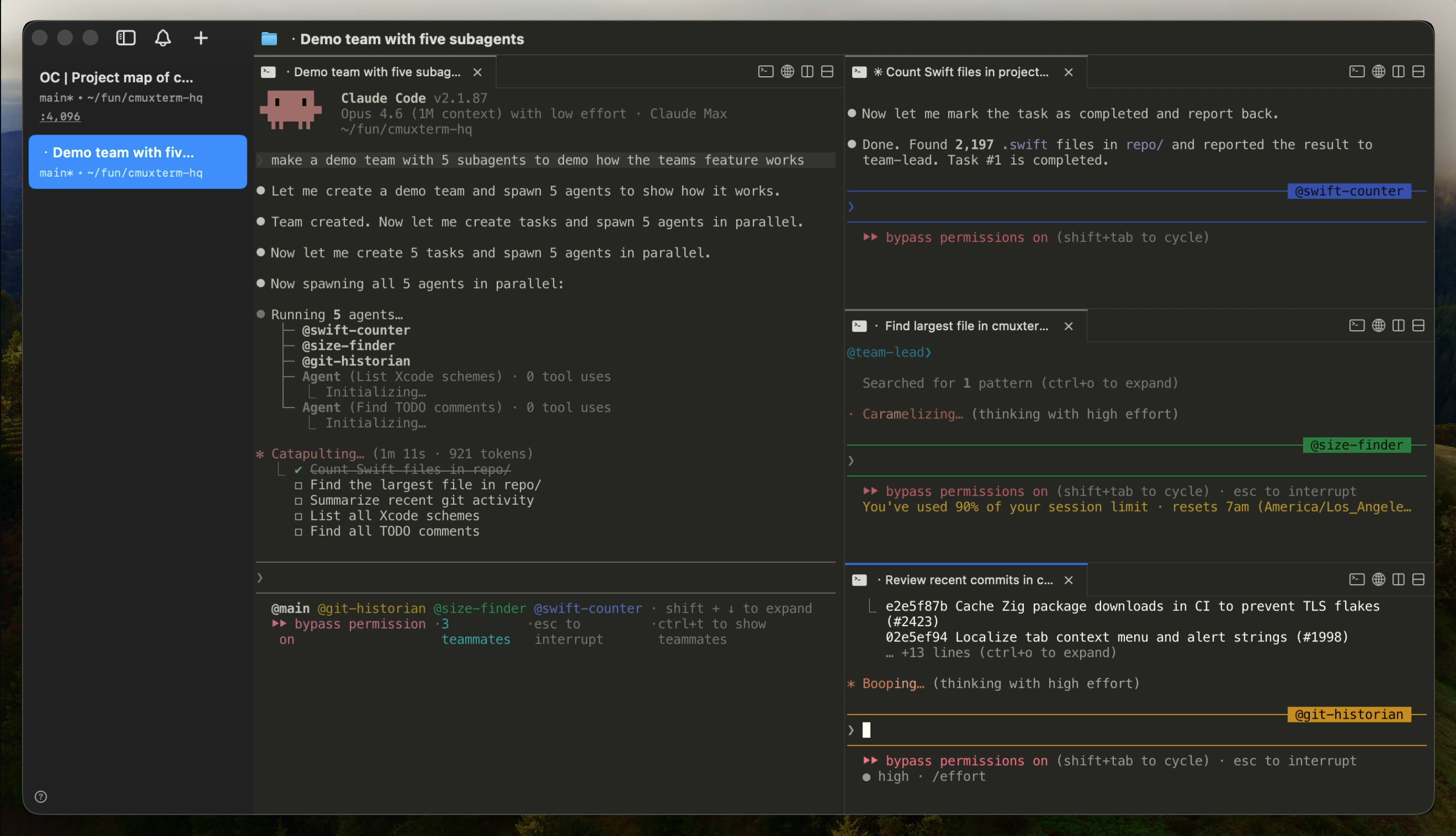
Open source Ghostty-based macOS terminal with vertical tabs and notifications for AI coding agents. Built for multitasking, organization, and programmability.
24.1k
Stars
1.9k
Forks
3.3k
Open issues
30
Contributors


AI Analysis
cmux is a macOS terminal multiplexer built on Ghostty that specializes in supporting AI coding agents through notification rings, vertical tabs, and an integrated browser. It's purpose-built for developers orchestrating multiple parallel AI agents and remote workflows, not a general-purpose terminal replacement; it requires macOS and assumes agent-heavy coding workflows.
Inferred from signals mentioned in the README (tests, CI, type safety) — not a review of the actual code.
AI's overall editorial judgment — not an average of the bars above, can weigh other factors too.
cmux: Native Swift terminal for macOS built around managing parallel AI coding agents
cmux is a macOS-native terminal application built on top of libghostty (the rendering engine from the Ghostty terminal) that adds vertical tabs, pane-level notifications, an integrated browser with scripting API, and a socket/CLI automation layer. Its primary audience is developers running multiple concurrent AI coding agents (Claude Code, Codex, etc.) who need contextual awareness across sessions without switching to Electron-based orchestrators. It is macOS-only, GPL-licensed, and positioned as a terminal-first alternative to GUI agent dashboards.
Created in January 2026, shortly after Ghostty's public release made libghostty accessible. The author built it out of personal frustration with managing many Claude Code sessions in split-pane Ghostty windows with poor notification context.
22,774 stars accumulated since late January 2026 — roughly 5 months — is a strong velocity signal. The AI coding agent wave (Claude Code GA, Codex CLI launch) created a pull market for tools that manage multiple agent sessions. 494 stars in the last 7 days as of June 24, 2026 suggests sustained, not decaying, momentum. Multilingual READMEs (21 languages) indicate intentional internationalization to capture a global audience early.
No third-party case studies or enterprise adoption reports are referenced in the README. The Discord community link and demo video exist, but scale of active users is not documented publicly. Given 22,774 stars and a DMG download with Homebrew cask, some meaningful number of developers are likely running it, but verifiable production adoption at scale is not confirmed. Adoption appears real but not independently verified at volume.
Likely a Swift/AppKit native app that embeds libghostty as a C/Zig library for GPU-accelerated terminal rendering. Appears to layer a custom tab/sidebar UI, notification system, and WebKit-based browser pane on top of the Ghostty rendering core. The socket and CLI API likely exposes IPC endpoints for programmatic control of panes and workspaces. Architecture appears modular based on the described feature surface, but code-level verification is not possible from README alone.
Not documented in README.
Last push was June 24, 2026 — the current date — indicating active daily development. The project is less than 6 months old but appears to be in high-activity phase. 1,786 forks relative to 22,774 stars (roughly 1:13 ratio) is healthy for a GUI app. Auto-update via Sparkle and Homebrew cask support suggest release infrastructure is in place.
ADOPT IF: you are a macOS developer running multiple concurrent AI coding agent sessions (Claude Code, Codex, etc.) and want a native, GPU-accelerated terminal with per-pane notifications and integrated browser tooling without resorting to Electron apps. AVOID IF: you work on Linux, need cross-platform support, run Windows, or want a stable, mature terminal with years of production hardening — this project is under 6 months old. MONITOR IF: you are interested in AI-agent terminal tooling but are not yet heavily using parallel agent workflows — the project's trajectory over the next 6-12 months will clarify whether its feature set stabilizes and whether it attracts community contributions beyond the core team.
Independent dimensions
Mainstream potential
4/10
Technical importance
7/10
Adoption evidence
4/10
- macOS-only by design: permanently excludes Linux and Windows users, which caps the addressable audience and may limit community contribution breadth.
- Dependency on libghostty: if Ghostty's library API changes or the upstream project shifts direction, cmux may face significant maintenance burden to keep up.
- Project is under 6 months old: production edge cases, stability issues, and API breakage are more likely than in mature terminals. The license is listed as NOASSERTION, which may create legal ambiguity for some adopters despite the README claiming GPL.
- Tied to the AI coding agent trend: if workflows shift (e.g., agents become more autonomous and need less human supervision), the notification-centric design may become less relevant.
- Small team origin: built by one person (based on README first-person narrative) and organization appears early-stage, raising questions about long-term maintenance commitment if the project grows significantly or the author's priorities change.
cmux is likely to grow into a recognized niche tool for AI-agent-heavy macOS developers over the next 12 months. Mainstream terminal adoption is unlikely given macOS exclusivity, but it may become a go-to companion app in the Claude Code / Codex ecosystem.
Explore similar
Newsletter
Get analyses like this every Monday
Free weekly digest of the most interesting open-source discoveries.
Languages
Information
- Website
- https://cmux.com
- Language
- Swift
- License
- NOASSERTION
- Last updated
- 6h ago
- Created
- 5mo ago
- Analyzed with
- anthropic/claude-haiku-4-5
Stars over time
Contributors over time
Top 100 contributors only — repos with more will plateau at 100.
Top contributors
Similar repos
| Repository | Stars | Week Δ | Language | Score | Updated |
|---|---|---|---|---|---|
|
manaflow-ai/cmux
this
|
24.1k | +643 | Swift | 8/10 | 6h ago |
 muxy-app/muxy muxy-app/muxy
|
1.9k | — | Swift | 7/10 | 14h ago |
 coder/mux coder/mux
|
1.9k | — | TypeScript | 7/10 | 12h ago |
|
manaflow-ai/manaflow
|
1.1k | — | TypeScript | 7/10 | 18h ago |
 alvinunreal/tmuxai alvinunreal/tmuxai
|
1.9k | — | Go | 8/10 | 4d ago |
 ShawnPana/smux ShawnPana/smux
|
1.5k | — | Shell | 7/10 | 3w ago |
cmux builds directly on Ghostty's libghostty rendering engine and reads Ghostty config files. It is not competing with Ghostty — it extends it with agent-oriented features that upstream Ghostty does not offer. Users who want a plain terminal should use Ghostty directly.
claude-squad is a CLI-based agent orchestration tool (likely tmux-backed) rather than a terminal emulator. cmux offers a full native terminal experience with rendering and browser integration; claude-squad likely focuses narrowly on agent lifecycle management. The two could be complementary rather than competing.
tmuxai appears to integrate AI capabilities into tmux sessions. It is cross-platform and shell-based, whereas cmux is a standalone macOS app with its own rendering. cmux offers richer UI (notifications, vertical tabs, integrated browser) but tmuxai may appeal to Linux/server users and tmux power users.
Warp is a commercial, VC-backed macOS terminal with AI features. It is a closed-source product with a different business model. cmux is GPL, open source, and more narrowly focused on agent management rather than general AI assistance. Warp has significantly larger install base and resources.
iTerm2 is the dominant macOS terminal with broad feature coverage but no native AI agent management. Users currently using iTerm2 for agent sessions would need to switch their entire terminal workflow to adopt cmux, which is a meaningful migration cost.