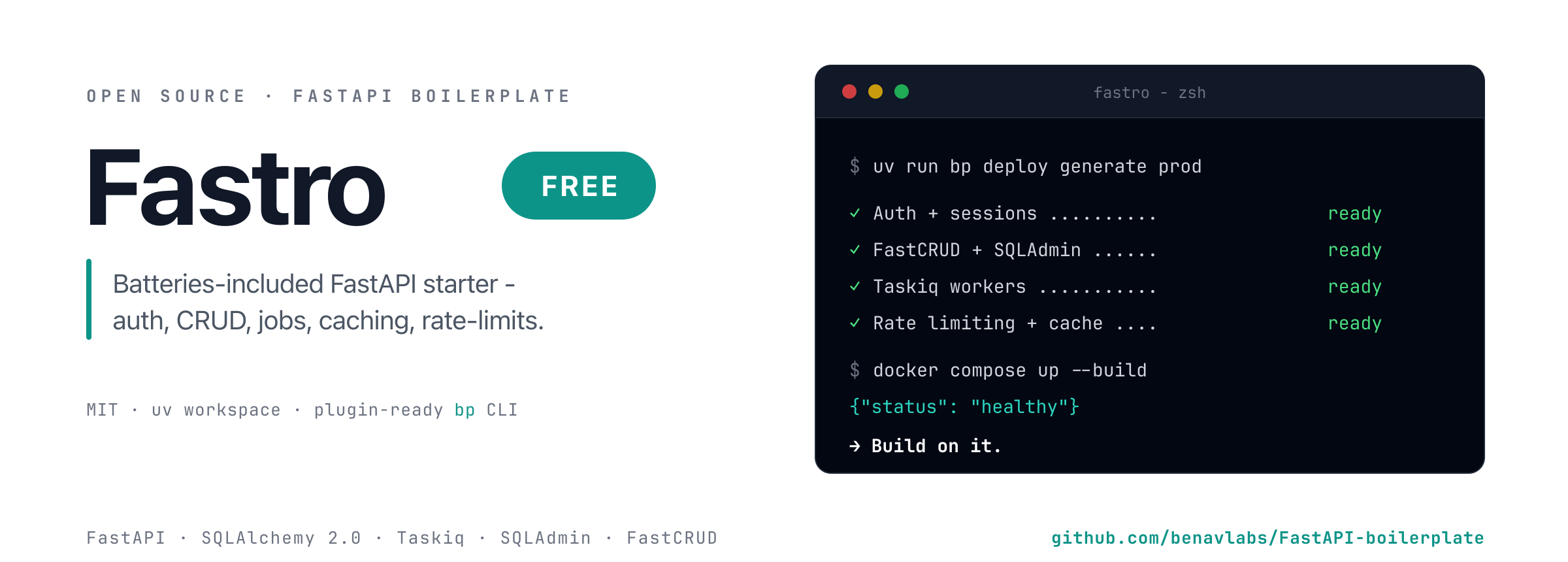
An extendable async API using FastAPI, Pydantic V2, SQLAlchemy 2.0, PostgreSQL and Redis.
2k
Stars
300
Forks
3
Open issues
28
Contributors


AI Analysis
Fastro is a batteries-included FastAPI boilerplate providing async API scaffolding with authentication, CRUD operations, job queues, caching, and rate-limiting built-in. It serves developers building SaaS platforms or API backends who want sensible defaults (Pydantic V2, SQLAlchemy 2.0, PostgreSQL, Redis) with the flexibility to opt-out of modules. Not suitable for microservices monorepos or teams seeking minimal opinions.
Inferred from signals mentioned in the README (tests, CI, type safety) — not a review of the actual code.
AI's overall editorial judgment — not an average of the bars above, can weigh other factors too.
Production-ready FastAPI starter with auth, CRUD, jobs, caching—batteries included but narrow distribution.
Fastro is a modular FastAPI boilerplate combining SQLAlchemy 2.0, Pydantic v2, PostgreSQL, Redis, authentication, CRUD scaffolding, background jobs, caching, rate-limiting, and a CLI tool for Docker Compose generation. Built primarily for small-to-medium SaaS and API backends. Real-world adoption appears concentrated in the Benav Labs ecosystem; broader adoption metrics are not publicly documented.
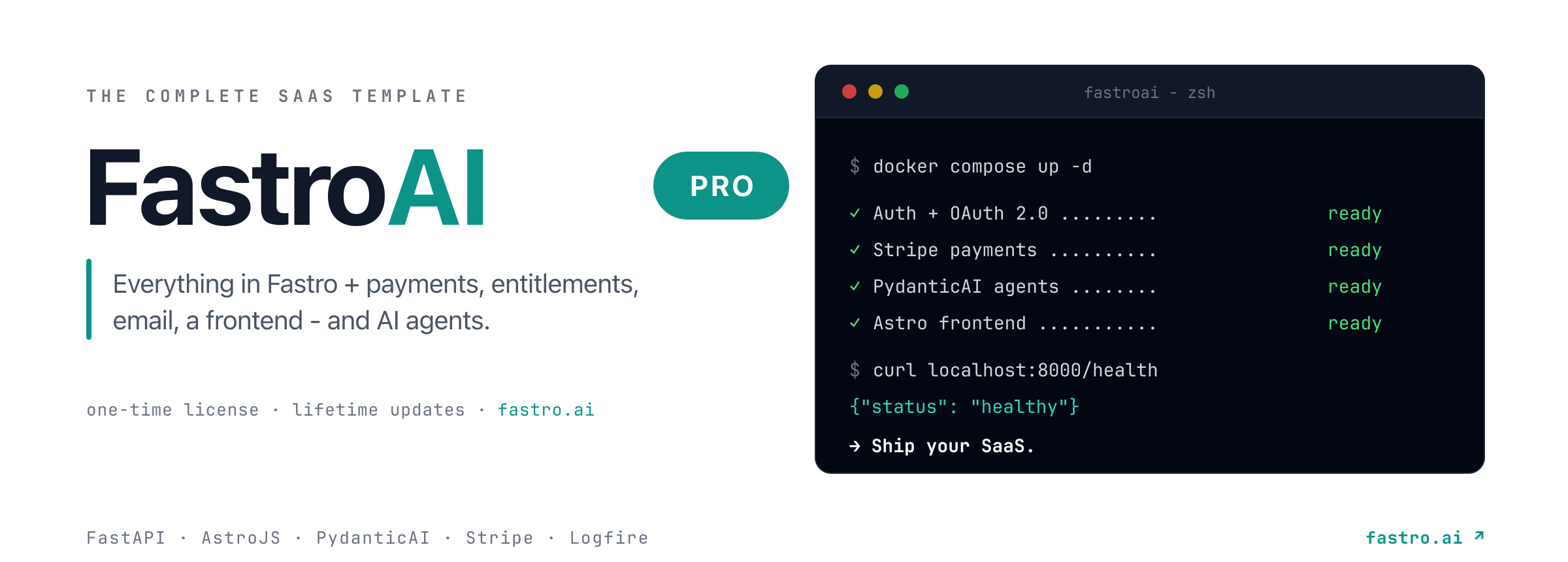
Created September 2023 by Benav Labs. The project emerged alongside FastCRUD, a companion library. The team also maintains FastroAI, a paid SaaS template built on the same foundation. Growth has been steady but modest—approximately 1,980 net stars over ~2 years, with 10 new stars in the final 7 days before the evaluation date.
Initial adoption likely driven by completeness (auth + CRUD + jobs out-of-box) and timing (Pydantic v2 and SQLAlchemy 2.0 maturity in 2023–2024). Growth appears to have plateaued; recent activity is maintenance-focused rather than feature-driven. The paid FastroAI offering may have bifurcated the user base, with cost-sensitive or advanced SaaS developers moving to the commercial product.
Adoption not verified. No documented case studies, deployment counts, or production user testimonials in README or linked docs. Benav Labs operates both free and paid tiers, but real-world usage scope is unclear. Discord community mentioned but size/activity not disclosed. GitHub stars (1,984) and forks (300) suggest modest but real interest; however, these metrics conflate downloads, experiments, and active production use.
Based on README: vertical-slice module structure with pluggable infrastructure. Likely uses FastAPI app factory pattern, dependency injection via Pydantic, and swappable cache/queue providers (Redis/Memcached, Redis/RabbitMQ). Code-level implementation quality cannot be assessed without source inspection.
Not documented in README. No mention of pytest, coverage targets, or CI/CD test reporting.
Last push: 2026-07-02 (current date). Project is actively maintained. Issue/PR velocity not available in provided metadata, so recency alone cannot confirm whether maintenance is routine or substantial. README is detailed and current, suggesting active stewardship.
ADOPT IF: you are building a small-to-medium SaaS or internal API backend and want sensible defaults for auth, CRUD, caching, jobs, and rate-limiting without extensive custom scaffolding. The CLI plugin system and vertical-slice structure offer flexibility for growing projects. Documentation is thorough. AVOID IF: you need a monorepo microservices scaffold, extensive third-party integrations beyond what's provided, or a large ecosystem of community extensions—those exist elsewhere. MONITOR IF: you are considering FastroAI (the paid variant) and want to evaluate feature roadmap alignment; verify the free tier's stability and update cadence before committing to a paid upgrade path.
Independent dimensions
Mainstream potential
4/10
Technical importance
6/10
Adoption evidence
3/10
- Adoption concentration: Limited verified production usage outside Benav Labs ecosystem; ecosystem health difficult to assess.
- Bifurcated user base: Existence of paid FastroAI may fragment community and slow open-source feature velocity.
- CLI plugin maturity: 'Plugin-ready' CLI is mentioned but detailed plugin ecosystem not evident in README or linked docs.
- Dependency lock-in: Tight coupling to Taskiq, FastCRUD, and SQLAdmin; switching any of these later is non-trivial.
- Maintenance bus factor: Single-organization ownership (Benav Labs) with no visible community governance or co-maintainers.
Likely to remain a solid niche choice for mid-market SaaS and API backends seeking pragmatic structure. Growth may plateau or decline if FastroAI (paid) becomes the preferred vector, or if users migrate to smaller, more modular tools. Maintenance will probably continue at current pace (steady, not aggressive) unless adoption accelerates.
Newsletter
Get analyses like this every Monday
Free weekly digest of the most interesting open-source discoveries.
Languages
Information
- Language
- Python
- License
- MIT
- Last updated
- 1w ago
- Created
- 34mo ago
- Analyzed with
- anthropic/claude-haiku-4-5
Stars over time
Contributors over time
Top 100 contributors only — repos with more will plateau at 100.
Open issues
Open pull requests
Top contributors
Similar repos

fastapi-practices/fastapi-best-architecture
FastAPI Best Architecture is an enterprise-grade backend framework template...

fastapi/full-stack-fastapi-template
A production-ready full-stack template combining FastAPI (Python backend),...
| Repository | Stars | Week Δ | Language | Score | Updated |
|---|---|---|---|---|---|
|
benavlabs/FastAPI-boilerplate
this
|
2k | +5 | Python | 8/10 | 1w ago |
|
benavlabs/fastcrud
|
1.5k | — | Python | 8/10 | 3w ago |
|
fastapi/fastapi
|
100.3k | — | Python | 9/10 | 16h ago |
|
fastapi-practices/fastapi-best-architecture
|
2.4k | — | Python | 7/10 | 12h ago |
|
fastapi/full-stack-fastapi-template
|
44.1k | — | TypeScript | 8/10 | 6d ago |
 rednafi/fastapi-nano rednafi/fastapi-nano
|
1k | — | Python | 7/10 | 4d ago |
Significantly larger reach; includes frontend (Vue/React). Fastro is backend-focused with optional SQLAdmin admin panel. Fastro's CLI and plugin system offer structural flexibility; template is more prescriptive.
Similar scope and audience (small-to-medium APIs). Fastro emphasizes swappable infrastructure and a code-generation CLI; best-architecture emphasizes architectural layering. Fastro includes Taskiq; best-architecture does not.
Deliberately minimal; teaches FastAPI patterns. Fastro is opinionated and batteries-included. Opposite design philosophies.
Sibling library (CRUD generics). Fastro embeds FastCRUD as a core feature. FastCRUD is narrower in scope but higher in reusability across projects.
The foundational framework. Fastro is a batteries-included template, not an alternative to FastAPI itself.