Enterprise-level backend architecture solution with fastapi、sqlalchemy,、celery、pydantic、grafana、docker...
2.4k
Stars
359
Forks
15
Open issues
27
Contributors


AI Analysis
FastAPI Best Architecture is an enterprise-grade backend framework template that demonstrates three-tier architecture patterns (API layer, service layer, data access layer) for Python web applications using FastAPI, SQLAlchemy, Celery, and Pydantic. It serves as both a reference implementation for teams building scalable backends and a starter template for FastAPI projects that need structured, maintainable organization beyond basic MVC patterns. Best suited for backend engineers and teams ad...
Inferred from signals mentioned in the README (tests, CI, type safety) — not a review of the actual code.
AI's overall editorial judgment — not an average of the bars above, can weigh other factors too.
Production-ready FastAPI reference architecture template with three-tier patterns and enterprise tooling
FastAPI Best Architecture is a reference implementation and boilerplate template demonstrating enterprise patterns for FastAPI backends: three-tier architecture (API/Schema/Service/CRUD/Model), integrated observability (Grafana), task queuing (Celery), ORM (SQLAlchemy 2.0), validation (Pydantic v2), and containerization (Docker). It targets mid-to-senior Python developers building scalable backends and serves as both a learning resource and starting point for new projects. Adoption appears concentrated among Chinese developers and FastAPI practitioners seeking structured patterns rather than DIY architecture.
Created April 2023 during the Pydantic v2 and FastAPI ecosystem maturation. Likely emerged as a response to fragmented guidance on scaling FastAPI applications beyond simple tutorials. Named to position itself as a best-practices reference in contrast to generic FastAPI starter templates.
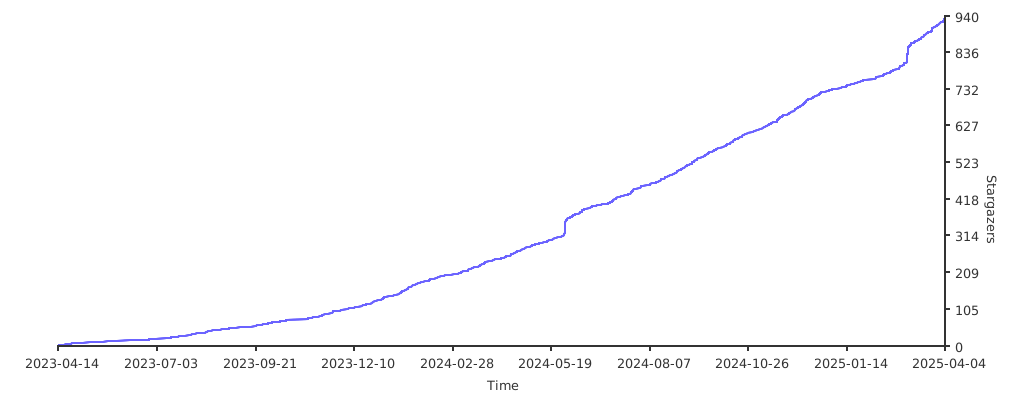
Grew to 2,331 stars over ~3 years with consistent but modest velocity (17 stars in last 7 days as of July 2026). Growth appears driven by keyword relevance ('FastAPI best practices') and Chinese tech community interest (README available in Simplified Chinese). Not exponential adoption, suggesting appeal is specialized: architects needing reference patterns rather than mass-market developers.
Adoption not verified in README. No case studies, production deployment counts, or organizational users documented. Discord community exists but membership size not stated. Appears used by individual developers and small teams adopting the template as a reference, not by large-scale production deployments. Chinese tech community engagement suggested by README translation, but scale unclear.
Based on README, appears to implement layered three-tier architecture: API layer (controllers), Schema layer (DTOs), Service layer (business logic), CRUD layer (data access), and Model layer (ORM entities). Deviates intentionally from microservices directory structure common in Django/Spring. Likely uses dependency injection or similar patterns to decouple layers, though implementation details not visible in README. Stack includes SQLAlchemy 2.0 (sync/async support), Pydantic v2 validation, Celery task queue, and Grafana monitoring integration.
Not documented in README. No testing strategy, framework preference, or coverage targets mentioned.
Last push 2026-07-08 (1 day before analysis date) indicates active maintenance. Repository shows consistent recent activity. Python 3.10+ requirement and support for SQLAlchemy 2.0, PostgreSQL 16.0+, MySQL 8.0+ suggests tracking modern dependency versions. Ruff and uv linting/packaging tools mentioned indicate code quality tooling adoption. Discord community link suggests ongoing user support. However, modest commit frequency relative to star count may indicate maintenance rather than rapid feature development.
ADOPT IF: You are building a mid-to-large Python backend with FastAPI and need a production-ready architectural reference with proven patterns (three-tier layering, async/sync support, observability). Your team values standardized structure over flexibility and wants to minimize architectural decisions. AVOID IF: You need a heavily battle-tested, widely-adopted standard (adoption appears limited to specialized audience). You require extensive case studies or production validation. Your needs are simple enough that framework defaults + custom patterns suffice. MONITOR IF: You are evaluating multiple FastAPI architectures and want to track which emerges as community consensus. Maintenance is active but mainstream adoption growth is slow.
Independent dimensions
Mainstream potential
4/10
Technical importance
6/10
Adoption evidence
2/10
- Adoption not verified at production scale; limited public evidence of real-world deployment success beyond template usage.
- Dependency on Grafana, Celery, and Docker adds complexity; may be overkill for simple projects and harder to adopt incrementally.
- Market fragmentation: multiple competing FastAPI architectures exist at similar maturity; no clear winner emerging.
- Maintenance appears steady but not rapid; feature velocity may not match evolving FastAPI ecosystem (e.g., newer async patterns, Pydantic v3 adoption).
- Language/geographic bias toward Chinese developers; English documentation may lag behind Chinese resources.
Likely to remain a niche but stable reference architecture used by teams already committed to FastAPI and needing structure. Slow steady adoption curve rather than breakthrough growth. May consolidate into a community-maintained standard if FastAPI ecosystem matures further, but unlikely to achieve mainstream dominance given competing templates and fragmented use cases.
Newsletter
Get analyses like this every Monday
Free weekly digest of the most interesting open-source discoveries.
Languages
Information
- Website
- https://docs.fba.wu-clan.cc
- Language
- Python
- License
- MIT
- Last updated
- 10h ago
- Created
- 40mo ago
- Analyzed with
- anthropic/claude-haiku-4-5
Stars over time
Contributors over time
Top 100 contributors only — repos with more will plateau at 100.
Open issues
Top contributors
Similar repos

zhanymkanov/fastapi-best-practices
A curated guide of FastAPI best practices and conventions derived from...

benavlabs/FastAPI-boilerplate
Fastro is a batteries-included FastAPI boilerplate providing async API...

fastapi/full-stack-fastapi-template
A production-ready full-stack template combining FastAPI (Python backend),...
| Repository | Stars | Week Δ | Language | Score | Updated |
|---|---|---|---|---|---|
|
fastapi-practices/fastapi-best-architecture
this
|
2.4k | +56 | Python | 7/10 | 10h ago |
|
zhanymkanov/fastapi-best-practices
|
17.7k | — | — | 8/10 | 2mo ago |
|
fastapi/fastapi
|
100.3k | — | Python | 9/10 | 15h ago |
|
benavlabs/FastAPI-boilerplate
|
2k | — | Python | 8/10 | 1w ago |
|
fastapi/full-stack-fastapi-template
|
44.1k | — | TypeScript | 8/10 | 6d ago |
 atpuxiner/fastapi-scaff atpuxiner/fastapi-scaff
|
1k | — | Python | 6/10 | 3w ago |
7.5× more stars (17,658 vs 2,331). That project is documentation/guide-based; this one is executable template/boilerplate. Different consumption models: guidance vs. scaffolding.
19× more stars (44,134 vs 2,331). Official FastAPI-adjacent template with full frontend/backend stack. Broader scope; this project focuses on backend architecture patterns only.
Similar scale (1,989 vs 2,331 stars). Comparable purpose as starter template. Adoption parity suggests market segmentation rather than one dominating the other.
43× more stars (100,283 vs 2,331). This is the core framework; FBA is a reference architecture layer on top. Complementary, not competitive.