一个直播录制工具
5.6k
Stars
691
Forks
306
Open issues
30
Contributors


AI Analysis
Bililive-go is a specialized live-stream recording tool supporting 18+ Chinese and international streaming platforms (Bilibili, Douyu, Huya, Twitch ecosystem, etc.) via Go. It is purpose-built for content archivists and streamers who need multi-platform recording capability; not suitable for general-purpose video processing or streaming aggregation.
Inferred from signals mentioned in the README (tests, CI, type safety) — not a review of the actual code.
AI's overall editorial judgment — not an average of the bars above, can weigh other factors too.
Multi-platform live stream recorder built in Go, targeting Chinese streaming platforms with a web UI and Docker-first deployment
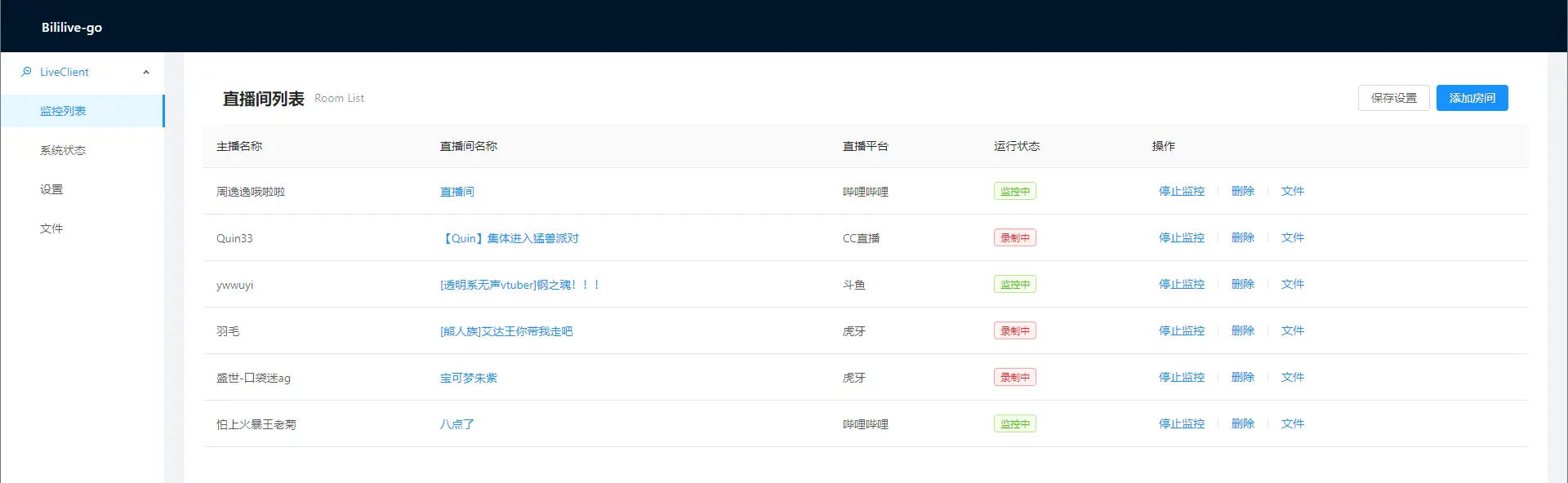
Bililive-go is a self-hosted tool for automatically recording live streams across 17+ Chinese and international platforms (Bilibili, Douyin, Huya, Douyu, SOOP, etc.). It runs as a persistent service, monitors streams, and saves recordings via FFmpeg. It ships with a web UI for configuration and monitoring, Docker/Docker Compose support, Prometheus/Grafana metrics integration, and Telegram/ntfy notifications. Its target audience is Chinese-speaking power users, fan communities, archivists, and NAS/home-server operators who want unattended, multi-platform recording without relying on third-party cloud services.
Created in January 2018, initially focused on Bilibili. Over roughly 8 years it expanded platform support significantly and shifted toward a service-oriented architecture with REST API, web UI, and container-first deployment patterns.
Growth appears largely organic within Chinese live-streaming enthusiast and archival communities. Star accumulation has been steady over 8 years rather than driven by any single viral moment. The Docker pull badge and NAS-specific documentation suggest meaningful adoption among home-server users. Recent star velocity (6 per week as of late June 2026) indicates slow but ongoing organic growth rather than a spike-and-decay pattern.
Docker Hub pull count is displayed as a badge (exact number not available from metadata, but its prominence suggests non-trivial usage). NAS-specific Synology documentation implies real deployment by home-server users. A third-party ecosystem doc exists, suggesting community-built integrations. The Bilibili community group link and associated space indicates an organized user base. Precise download or deployment numbers are not publicly verifiable from available metadata.
Appears to follow a service daemon model: a persistent Go backend monitors configured stream URLs, triggers FFmpeg for recording, and exposes a REST API consumed by an embedded web frontend (Node.js built). Likely uses goroutines for concurrent per-stream monitoring. Configuration is YAML-file-based with live reload for some settings. Docker Compose stack optionally includes Prometheus and Grafana sidecars.
CI badge is present (GitHub Actions tests.yaml), and a Go Report Card badge is shown, suggesting automated testing exists. Specific coverage percentage is not documented in README.
Last push was 2026-06-23, just two days before the evaluation date, indicating active maintenance. The project has been continuously developed for over 8 years. CI pipeline, release automation, and ongoing documentation updates all suggest a healthy, actively maintained project — not stagnant despite modest star growth rate.
ADOPT IF: you need an unattended, self-hosted service to record streams from multiple Chinese platforms (Bilibili, Douyin, Huya, Douyu, etc.) on a NAS, Linux server, or Docker environment, and want a mature, actively maintained Go binary with a web UI. AVOID IF: you need to record Western platforms (Twitch, YouTube, etc.), want a GUI desktop app, or require commercial support and SLAs. MONITOR IF: you depend on specific platform integrations that may break when platforms update their APIs, as maintenance of individual site parsers is an ongoing challenge for all tools in this category.
Independent dimensions
Mainstream potential
3/10
Technical importance
6/10
Adoption evidence
5/10
- Platform API fragility: streaming sites (especially Douyin/Bilibili) frequently change authentication and stream URL extraction, requiring ongoing maintenance that could lag or break specific integrations.
- Dependency on FFmpeg means users must manage FFmpeg versions and codec compatibility, which can be a friction point for non-technical NAS users.
- GPL-3.0 license may limit integration into proprietary or commercial products or services.
- The project appears primarily maintained by a small core team; bus-factor risk is non-trivial for an 8-year-old community tool.
- Cookie-based authentication for some platforms (Douyin, Bilibili) means users must manually extract and rotate session cookies, which can be fragile and non-obvious to manage.
Likely to remain a stable, niche-dominant tool within Chinese live-stream archival communities for the foreseeable future. Mainstream breakout beyond this audience appears unlikely given its platform focus.
Newsletter
Get analyses like this every Monday
Free weekly digest of the most interesting open-source discoveries.
Languages
Information
- Language
- Go
- License
- GPL-3.0
- Last updated
- 2d ago
- Created
- 103mo ago
- Analyzed with
- anthropic/claude-haiku-4-5
Stars over time
Contributors over time
Top 100 contributors only — repos with more will plateau at 100.
Open issues
Top contributors
Similar repos

renmu123/biliLive-tools
A comprehensive one-stop tool for live stream recording and post-processing,...

ihmily/DouyinLiveRecorder
DouyinLiveRecorder is a multi-platform live stream recording tool that monitors...
| Repository | Stars | Week Δ | Language | Score | Updated |
|---|---|---|---|---|---|
|
bililive-go/bililive-go
this
|
5.6k | +16 | Go | 7/10 | 2d ago |
 biliup/biliup biliup/biliup
|
5.3k | — | Rust | 7/10 | 5d ago |
|
renmu123/biliLive-tools
|
1.5k | — | TypeScript | 7/10 | 22h ago |
|
ihmily/DouyinLiveRecorder
|
10.5k | — | Python | 6/10 | 3mo ago |
 gwuhaolin/livego gwuhaolin/livego
|
10.2k | — | Go | 7/10 | 7mo ago |
|
ihmily/StreamCap
|
3.9k | — | Python | 7/10 | 5d ago |
Higher star count and strong focus on Douyin/TikTok-family platforms. Python-based, likely less resource-efficient as a long-running daemon. Bililive-go offers broader multi-platform coverage and a more complete service/web-UI experience for self-hosting.
Overlapping audience; biliup emphasizes upload-to-Bilibili workflows in addition to recording. Rust vs. Go is a deployment tradeoff. Bililive-go is more narrowly focused on recording and monitoring as a persistent service.
Python-based, appears GUI-oriented. Bililive-go targets headless/server deployments more explicitly and offers Docker-first operation, making it more suitable for unattended NAS or server use.
Narrower scope (Bilibili-specific, shadow-replay focused). Bililive-go covers far more platforms and is a more general-purpose recording daemon.
Fundamentally different tool — livego is a live streaming server (RTMP/HLS relay), not a recorder. Not a direct competitor; serves a different workflow entirely.