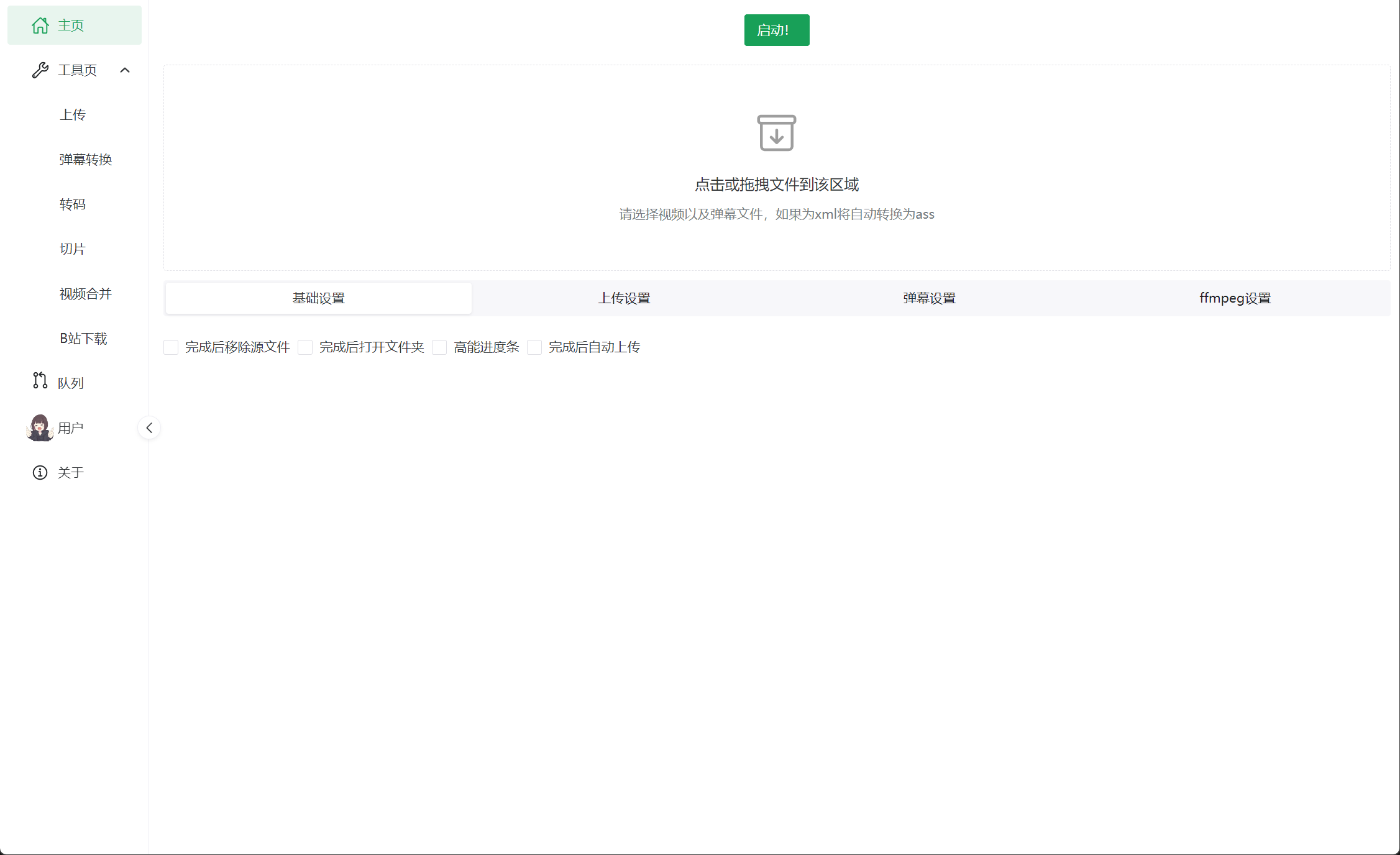
直播一站式处理工具,支持直播录制&视频处理&弹幕处理&录播姬自动上传
1.5k
Stars
108
Forks
58
Open issues
10
Contributors


AI Analysis
A comprehensive one-stop tool for live stream recording and post-processing, specifically designed for Chinese streaming platforms (Bilibili, Douyu, Huya, Douyin). It integrates recording, danmaku (comment) conversion to ASS subtitles, video encoding, and automated upload to Bilibili, serving primarily live-streaming archivists and content creators who need to consolidate fragmented workflows into a single GUI application.
Inferred from signals mentioned in the README (tests, CI, type safety) — not a review of the actual code.
AI's overall editorial judgment — not an average of the bars above, can weigh other factors too.
Chinese livestream recording and processing suite with GUI, targeting archivists and clip creators
biliLive-tools is a TypeScript desktop application designed to consolidate livestream recording, subtitle/danmaku conversion, video processing, and automated upload workflows for Chinese platforms (Bilibili, Douyin, Huya, Douyu). It targets livestream archivists and content slicers frustrated with fragmented tool chains. The project appears to serve a specific, geographically and culturally bounded niche — Chinese livestream content preservation — with modest but genuine adoption among that demographic. It integrates with popular Chinese recording backends (BililiveRecorder, blrec, DDTV) via webhooks and offers GUI simplification over CLI-only alternatives.
Created August 2023 by renmu123, the project emerged to solve perceived tool fragmentation in Chinese livestream workflows. It synthesizes capabilities from established projects like DanmakuFactory, biliup-rs, and BililiveRecorder into a unified desktop interface. The README explicitly states the motivation: reduce friction of multi-tool coordination for recording, danmaku processing, and platform upload.
The project gained 1,430 stars over ~2 years 9 months (as of June 2026), averaging ~530 stars/year — modest growth consistent with niche-audience tooling. Recent activity (17 stars in 7 days, last push 2 days before analysis date) suggests stable, active maintenance rather than explosive adoption. Growth appears driven by word-of-mouth within Chinese livestream archivist communities rather than international discovery. Comparison repos show wider adoption: biliup (5,231), bililive-go (5,607), and ihmily's DouyinLiveRecorder (10,374), all targeting overlapping domains but with larger or older audiences.
Adoption not formally verified. Evidence is indirect: README requests users credit the tool in video descriptions to help author track usage; QQ group for community support (872011161) suggests user base; B站 tutorial series (BV1Hs421M755) suggests documented community. Quark cloud download link (Chinese file hosting) indicates distribution infrastructure. Downloads badge present but count not queryable from metadata. No public case studies or enterprise deployments mentioned. Adoption likely exists but is geographically concentrated and not extensively documented.
Based on README and metadata: TypeScript desktop application with WebUI (separate GitHub project for auto-compilation), FFmpeg/mesio/BililiveRecorder as pluggable recording backends, webhook support for automation, XML-to-ASS danmaku conversion via DanmakuFactory. Appears to follow modular backend + UI pattern. Likely uses Node.js/Electron or similar for desktop. Cannot assess code quality without source inspection.
Not documented in README. No CI/testing strategy mentioned.
Last push 2026-06-26 (2 days before analysis date); repository creation 2023-08-30. Changelog documented. Active issue/PR engagement hinted at by PR guidance in README. Regular release artifacts published. Appears actively maintained, not abandoned, though release frequency not quantified in metadata.
ADOPT IF: you are a Chinese livestream archivist/content slicer who records Bilibili, Douyin, or other Chinese platforms, want a GUI-driven workflow, use BililiveRecorder or similar backends, and need integrated danmaku handling + upload automation. You should value consolidation over CLI flexibility. AVOID IF: you need cross-language documentation, international community support, or are working with Western platforms (Twitch, YouTube Live). MONITOR IF: you want to consolidate multi-tool workflows but are unsure whether the Chinese livestream feature set aligns with your platforms; inspect the platform list and webhook integrations carefully first.
Independent dimensions
Mainstream potential
3/10
Technical importance
5/10
Adoption evidence
4/10
- Adoption limited to Chinese-language livestream community; minimal English documentation suggests poor international onboarding.
- GUI adds complexity and may introduce platform-specific dependencies (likely Electron or similar); desktop-only distribution reduces accessibility vs. CLI tools.
- Dependency on third-party backends (BililiveRecorder, blrec, DDTV) means upstream breakage propagates; project does not control recording reliability.
- AI-powered features mentioned (LLM-based music separation, lyrics recognition) may accumulate licensing/dependency debt and are not detailed in README.
- License is GPLv3, which may restrict use in commercial/proprietary workflows; no clear commercial or enterprise support model.
Project likely remains a sustained niche tool for Chinese livestream archivists rather than expanding mainstream adoption. Growth will remain modest unless international English support and Twitch/YouTube integration are added. Maintenance appears stable enough to avoid abandonment in the medium term.
Newsletter
Get analyses like this every Monday
Free weekly digest of the most interesting open-source discoveries.
Languages
Information
- Website
- https://docs.irenmu.com
- Language
- TypeScript
- License
- GPL-3.0
- Last updated
- 22h ago
- Created
- 35mo ago
- Analyzed with
- anthropic/claude-haiku-4-5
Stars over time
Contributors over time
Top 100 contributors only — repos with more will plateau at 100.
Open issues
Top contributors
Recent releases
Similar repos

bililive-go/bililive-go
Bililive-go is a specialized live-stream recording tool supporting 18+ Chinese...

Xinrea/bili-shadowreplay
BiliBili ShadowReplay is a live stream clipping and editing tool for the...
| Repository | Stars | Week Δ | Language | Score | Updated |
|---|---|---|---|---|---|
|
renmu123/biliLive-tools
this
|
1.5k | +17 | TypeScript | 7/10 | 22h ago |
|
bililive-go/bililive-go
|
5.6k | — | Go | 7/10 | 2d ago |
 biliup/biliup biliup/biliup
|
5.3k | — | Rust | 7/10 | 5d ago |
|
Xinrea/bili-shadowreplay
|
1.1k | — | Rust | 7/10 | 23h ago |
 ihmily/StreamCap ihmily/StreamCap
|
3.9k | — | Python | 7/10 | 5d ago |
|
ihmily/DouyinLiveRecorder
|
10.5k | — | Python | 6/10 | 3mo ago |
Larger, older project focused narrowly on Bilibili upload automation. biliLive-tools is broader (multi-platform recording + processing) with GUI; biliup is CLI-heavy and Rust-based. Complementary rather than direct replacement — biliLive-tools may use biliup-rs internally.
Pure recording tool (Bilibili-focused); biliLive-tools adds video processing, danmaku handling, and cross-platform upload. bililive-go may be faster/lighter; biliLive-tools is more integrated. Different use-case emphasis.
Appears to be a specialized recording backend that biliLive-tools integrates with via webhook. BililiveRecorder is narrower; biliLive-tools orchestrates multiple backends and adds downstream processing.
Focused on Douyin (TikTok) livestream recording. Larger audience. biliLive-tools is broader (4+ platforms). Serves different geographic/cultural primary users.
Appears to be a multi-platform streaming capture tool. biliLive-tools emphasizes post-recording processing (danmaku, upload, slicing) more than pure capture. Different workflow priority.