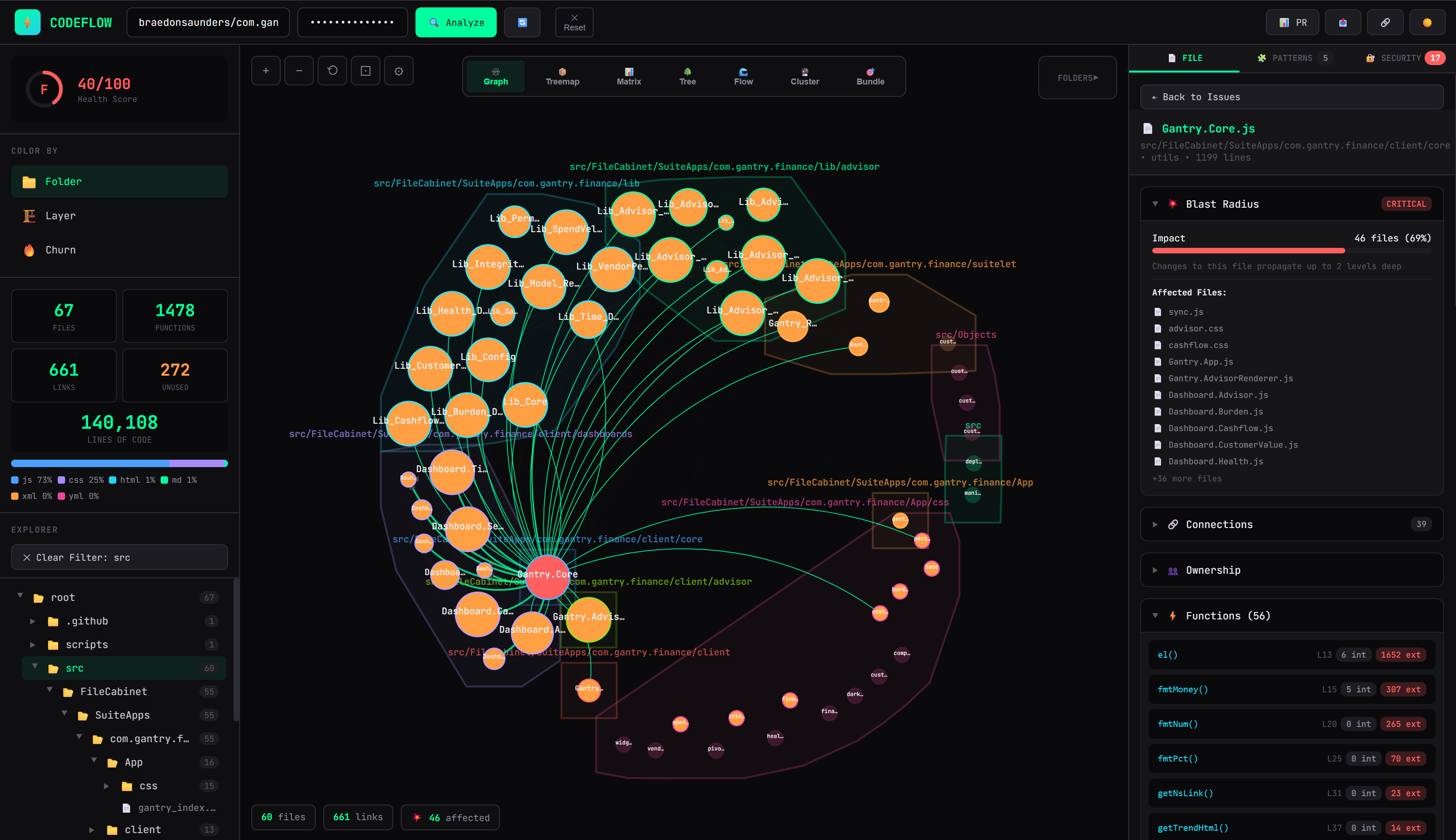
Paste any GitHub URL → interactive architecture map. See how files connect, find what breaks if you change something. No install, no accounts — runs entirely in your browser.
3.9k
Stars
624
Forks
0
Open issues
11
Contributors


AI Analysis
CodeFlow is a browser-based visualization tool that transforms GitHub repository URLs into interactive architecture maps, showing file dependencies, blast radius impacts, and code health metrics. It serves developers who need to quickly understand unfamiliar codebases, identify change impacts, and detect security issues—best suited for teams doing code reviews, onboarding, and architectural analysis rather than continuous deployment pipelines.
Inferred from signals mentioned in the README (tests, CI, type safety) — not a review of the actual code.
AI's overall editorial judgment — not an average of the bars above, can weigh other factors too.
Browser-based codebase visualization tool gaining rapid adoption for architecture discovery and impact analysis
CodeFlow is a zero-setup, browser-based tool that visualizes GitHub repositories or local codebases as interactive architecture maps. It shows file dependencies, blast radius analysis, security issues, code patterns, and health scores. Created in December 2025, it has accumulated 3,891 stars and 250 in the past week alone, suggesting rapid early adoption among developers seeking quick codebase comprehension without installation friction. No organization-level adoption evidence is documented, but the low barrier to entry and privacy-first model (runs entirely client-side) position it for use in onboarding, code review, and security scanning workflows.
CodeFlow was created December 16, 2025, approximately 7 months before evaluation date. This is a very new project entering a category populated by established tools like Gitdiagram (15,790 stars), Flowistry (3,062 stars), and CodeBoarding (2,333 stars). The project appears to have been built by Braedon Saunders and has achieved its star count in a short window, suggesting a successful product-market fit moment or timing advantage.
The project gained 3,891 stars over ~7 months, with 250 stars in the final 7 days before evaluation. This trajectory suggests either accelerating momentum or a recent viral moment. The lack of historical granularity makes it difficult to distinguish between steady growth and recent spike. The zero-friction entry point (paste URL, no account, no install) and privacy-forward messaging likely appeal to developers fatigued by signup walls and data collection. The addition of local file analysis and CodeFlow Card (GitHub Action) indicate active feature development responding to user demand.
Adoption not verified. README mentions a live deployment at codeflow-five.vercel.app, suggesting at least proof-of-concept production hosting. No case studies, enterprise deployments, community testimonials, or documented integration into third-party workflows are mentioned. GitHub stars and forks (624) are the only quantified engagement signals available. The CodeFlow Card GitHub Action feature suggests awareness of CI/CD integration but no evidence of uptake is provided.
Based on README, CodeFlow is a single-page HTML application with no build process, loading dependencies from CDNs. This design choice prioritizes deployment simplicity and browser-first execution. Likely uses a graph visualization library (not specified in README) and JavaScript for dependency parsing. The GitHub Action variant (card/) suggests a secondary Node/backend component, but README does not detail its architecture.
Not documented in README. No mention of testing strategy, CI/CD pipeline, or test suites.
Last push on 2026-07-06, 4 days before evaluation date, indicates active maintenance. Repository is 7 months old, so 'recent' context differs from an established project. Issue and PR welcome badges present. No documented release schedule, changelog, or versioning scheme in provided README excerpt. The addition of features like local file analysis and CodeFlow Card between creation and evaluation suggests responsive development.
ADOPT IF: you need fast codebase visualization for onboarding, code review, or dependency mapping in a low-friction workflow; you prefer privacy-first tools that run locally; you value zero setup. AVOID IF: you require extensive production validation, mature ecosystem integration, or vendor support; you need offline-first analysis with complex monorepo structures and formal testing is critical to your org. MONITOR IF: you are evaluating codebase analysis tools; CodeFlow's recent growth and feature velocity warrant attention, but adoption beyond early adopters remains unverified; enterprise readiness is unclear.
Independent dimensions
Mainstream potential
5/10
Technical importance
6/10
Adoption evidence
3/10
- Adoption not verified beyond GitHub stars — actual production usage at scale is undocumented; project may be in hype phase rather than establishing sticky use.
- Very new project (7 months old) with unknown long-term maintenance capacity — founder-driven projects risk abandonment if priority shifts; no team or roadmap detail provided.
- Test coverage and security audit status unknown — privacy claims (code never leaves browser) require independent verification; no third-party security review mentioned.
- Feature scope creep visible in README (dependency graphs, security scanning, pattern detection, markdown analysis, GitHub Actions) — unclear which features are production-ready, which are experimental, and maintenance burden.
- Competitive pressure from established tools with larger communities (Gitdiagram); CodeFlow's advantage rests on UX and simplicity, both easily replicated if competitors prioritize them.
CodeFlow likely sustains initial adoption among developers prioritizing ease of use and will consolidate a viable niche in lightweight code visualization. Growth will depend on whether it avoids feature bloat, maintains privacy guarantees, and builds integrations with popular development workflows. Likelihood of becoming a market leader similar to Gitdiagram is moderate — it competes on friction reduction, not novel technical capability. Most probable outcome: established as a complementary tool for code review and onboarding, used alongside other analysis tools rather than replacing them.
Newsletter
Get analyses like this every Monday
Free weekly digest of the most interesting open-source discoveries.
Languages
Information
- Website
- https://codeflow-five.vercel.app
- Language
- HTML
- Last updated
- 4d ago
- Created
- 7mo ago
- Analyzed with
- anthropic/claude-haiku-4-5
Stars over time
Contributors over time
Top 100 contributors only — repos with more will plateau at 100.
Open issues
No open issues — clean slate.
Open pull requests
No open pull requests.
Top contributors
Recent releases
No releases published yet.
Similar repos

ahmedkhaleel2004/gitdiagram
GitDiagram converts GitHub repositories into interactive system design diagrams...
| Repository | Stars | Week Δ | Language | Score | Updated |
|---|---|---|---|---|---|
|
braedonsaunders/codeflow
this
|
3.9k | +232 | HTML | 8/10 | 4d ago |
|
ahmedkhaleel2004/gitdiagram
|
15.8k | — | TypeScript | 8/10 | 3d ago |
 patoles/agent-flow patoles/agent-flow
|
1k | — | TypeScript | 8/10 | 4d ago |
 CodeBoarding/CodeBoarding CodeBoarding/CodeBoarding
|
2.3k | — | Python | 7/10 | 13h ago |
 willcrichton/flowistry willcrichton/flowistry
|
3.1k | — | Rust | 8/10 | 2mo ago |
 manaflow-ai/manaflow manaflow-ai/manaflow
|
1.1k | — | TypeScript | 7/10 | 17h ago |
Established market leader; CodeFlow gains share through lower entry friction (no TypeScript build) and privacy guarantees. Gitdiagram likely has deeper feature parity and larger installed base, but CodeFlow's browser-only model may appeal to users avoiding installation.
Similar star count; Flowistry is older and Rust-based (compiled efficiency). CodeFlow targets simplicity; unclear if Flowistry offers comparable privacy or ease of use.
Lower adoption; CodeFlow's growth rate and browser accessibility may position it ahead if momentum sustains. CodeBoarding's Python base may suit different user segments (data scientists, backend teams).
Narrower niche; CodeFlow is more general-purpose. Adoption comparison inconclusive without usage context.
Similar star range; CodeFlow's rapid accumulation in 7 months suggests stronger current momentum, though absolute numbers are comparable.