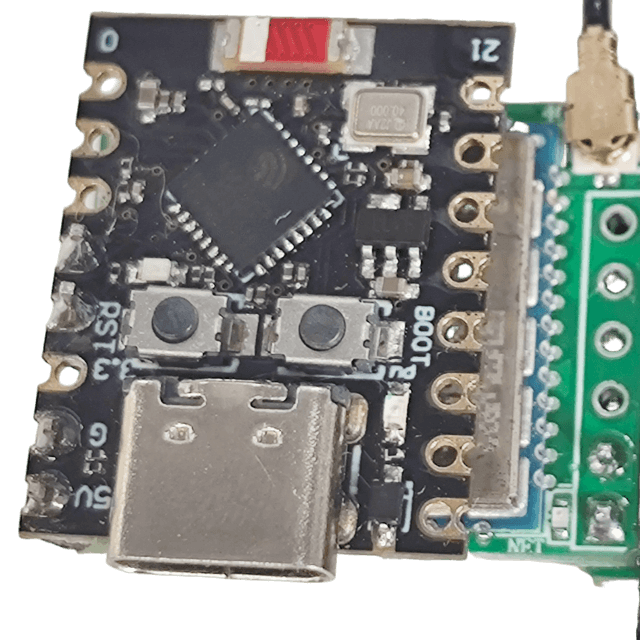
超低成本硬件短信转发器,支持移动联通电信,ML307R+ESP32C3
1.4k
Stars
224
Forks
6
Open issues
8
Contributors



AI Analysis
A low-cost hardware SMS forwarding device built on ESP32C3 and ML307R-DC modules that automatically receives and relays SMS messages to multiple external services (email, Bark, DingTalk, PushPlus, Feishu, etc.). This is a specialized tool for Chinese users needing affordable SMS reception and number-keep-alive functionality; it is not suitable for voice calls, dialing, multi-card control, or users requiring open APIs and automation beyond message forwarding.
Inferred from signals mentioned in the README (tests, CI, type safety) — not a review of the actual code.
AI's overall editorial judgment — not an average of the bars above, can weigh other factors too.
DIY SMS forwarder for cheap IoT devices: niche hardware solution for personal number preservation
sms_forwarding is a minimal embedded project that turns a ~$27 combo of ESP32C3 and ML307R modem into an autonomous SMS-to-HTTP bridge. Built for Chinese users who need cheap ways to forward/preserve phone numbers (keeping SIM cards active without actively using them). Supports 7 push channels and a web UI. Adoption appears confined to hobbyist and small operator communities in China; substantially smaller than the Android-native SmsForwarder (26k+ stars) but more hardware-focused.
Created October 2022, likely in response to rising costs of commercial SMS forwarding services or SIM preservation tools. Replaced an earlier "luatos" branch design. Targets the specific economics of Chinese telcos where cheap IoT modules became viable alternatives to phone-based solutions.
269 stars in last 7 days (as of 2026-06-28) suggests recent viral moment, possibly from blog post or social media in China. Accumulated 1,313 stars over ~3.7 years at modest baseline rate (~1-2 stars/day historically), then accelerated sharply. 203 forks indicate active builder community but not enterprise adoption. Growth appears episodic rather than sustained.
Adoption not verified at enterprise or large institutional scale. Evidence points to hobbyist/maker community: Taobao pre-built kits sold (suggests some end-user interest), B站video tutorial (Chinese DIY platform), demo web page reachable. No public documentation of corporate deployments, government adoption, or ISP/carrier integration. Real-world usage likely exists but is not publicly quantified.
Appears to be an Arduino/C++ firmware for ESP32C3 that communicates with an ML307R modem via UART using AT commands. Acts as a WiFi-connected HTTP client. Likely stateless or minimal-state design (web UI suggests some configuration persistence). README documents hardware wiring and AT protocol handling but does not describe software architecture in detail.
not documented in README. No mention of unit tests, integration tests, or CI/CD pipelines visible in metadata.
Last push 2026-06-23 (5 days before evaluation date) indicates active recent work. MIT license, public demo page, link to B站 video tutorial suggest maintainer is engaged. Frequency of commits/PRs not visible in provided metadata, so cannot assess whether push cadence is typical or accelerating. Project has been continuously available for ~3.7 years without abandonment signals.
ADOPT IF: you need autonomous SMS forwarding on a budget (~$27 hardware cost), can hand-solder or buy pre-assembled kit, have technical comfort with Arduino/ESP32, are in region where ML307R is available (appears to be China-focused supply chain), and accept web-UI-only configuration. AVOID IF: you need multi-device management, call handling, commercial SLA/support, production-grade monitoring, or cross-platform desktop client. MONITOR IF: you want to understand embedded IoT SMS forwarding techniques or are evaluating cost/size/power tradeoffs vs. Android solutions — project is technically sound for its narrow scope.
Independent dimensions
Mainstream potential
2/10
Technical importance
5/10
Adoption evidence
3/10
- Supply chain risk: ESP32C3 and ML307R availability subject to chip shortage or market shifts; project appears dependent on specific cheap modules that may be discontinued or become unavailable in non-China regions.
- Regional/regulatory risk: project is heavily optimized for Chinese telcos (移动/联通/电信) and Taobao supply chain; unclear whether hardware certifications exist for use in other countries.
- Maintenance sustainability: single maintainer visible; no governance or handoff plan documented. Accelerated recent growth (269 stars/week) may increase support burden; risk of contributor burnout or abandonment if popularity exceeds maintainer capacity.
- Software maturity: no documented test coverage, no changelog visible, no versioning strategy described. Bug reports/security issues handling process not public. May pose risk for users operating on older hardware or firmware versions.
- Feature creep risk: README explicitly states 'multiple cards, calls, dialing, APIs, automation — never will be supported', which is a firm boundary. If users demand these, project may face pressure, drift, or community forks that fragment ecosystem.
Project will likely remain a niche but stable tool for hobbyists and small-scale SIM preservation operators in China. Recent growth spike (269 stars/week) may sustain for 3–6 months if media attention persists, then settle to ~2–5 stars/day baseline. Unlikely to achieve mainstream adoption outside DIY/maker communities or non-Chinese markets due to hardware supply constraints and regional focus. May see incremental refinement (bug fixes, UI polish) but substantial feature expansion is unlikely per maintainer's stated philosophy.
Newsletter
Get analyses like this every Monday
Free weekly digest of the most interesting open-source discoveries.
Languages
Information
- Website
- http://sms.j2.cx/
- Language
- C++
- License
- MIT
- Last updated
- 2w ago
- Created
- 45mo ago
- Analyzed with
- anthropic/claude-haiku-4-5
Stars over time
Contributors over time
Top 100 contributors only — repos with more will plateau at 100.
Open issues
Open pull requests
Similar repos

xinnan-tech/xiaozhi-esp32-server
This is a backend service for xiaozhi-esp32, an open-source intelligent...
| Repository | Stars | Week Δ | Language | Score | Updated |
|---|---|---|---|---|---|
|
chenxuuu/sms_forwarding
this
|
1.4k | +60 | C++ | 7/10 | 2w ago |
 pppscn/SmsForwarder pppscn/SmsForwarder
|
27k | — | Kotlin | 7/10 | 4w ago |
 overtrue/easy-sms overtrue/easy-sms
|
3.3k | — | PHP | 7/10 | 2mo ago |
 Lihuanghe/SMSGate Lihuanghe/SMSGate
|
1.2k | — | Java | 7/10 | 6d ago |
|
xinnan-tech/xiaozhi-esp32-server
|
10k | — | JavaScript | 7/10 | 10h ago |
 1technophile/OpenMQTTGateway 1technophile/OpenMQTTGateway
|
4.1k | — | C++ | 7/10 | 3d ago |
Android native app that runs on a spare smartphone. Orders of magnitude more stars; solves same SMS-forwarding problem but via commodity phone hardware instead of dedicated modules. No WiFi router role; requires active Android device. sms_forwarding trades phone dependency for lower power, simpler setup, and headless operation.
Server-side SMS gateway abstraction layer for sending SMS via API. Different problem: sms_forwarding receives and forwards; easy-sms handles dispatch on behalf of apps. Not direct competition.
Broader IoT bridge project for MQTT + RF + 433MHz + BLE. sms_forwarding is narrowly scoped to SMS. OpenMQTTGateway is more modular/extensible; sms_forwarding is more purpose-built and cheaper to deploy for SMS-only use case.
Java SMS gateway framework for application-level SMS sending/receiving abstraction. Similar star count but different tier: SMS4J is library/framework for developers; sms_forwarding is end-user-deployable hardware+firmware solution.