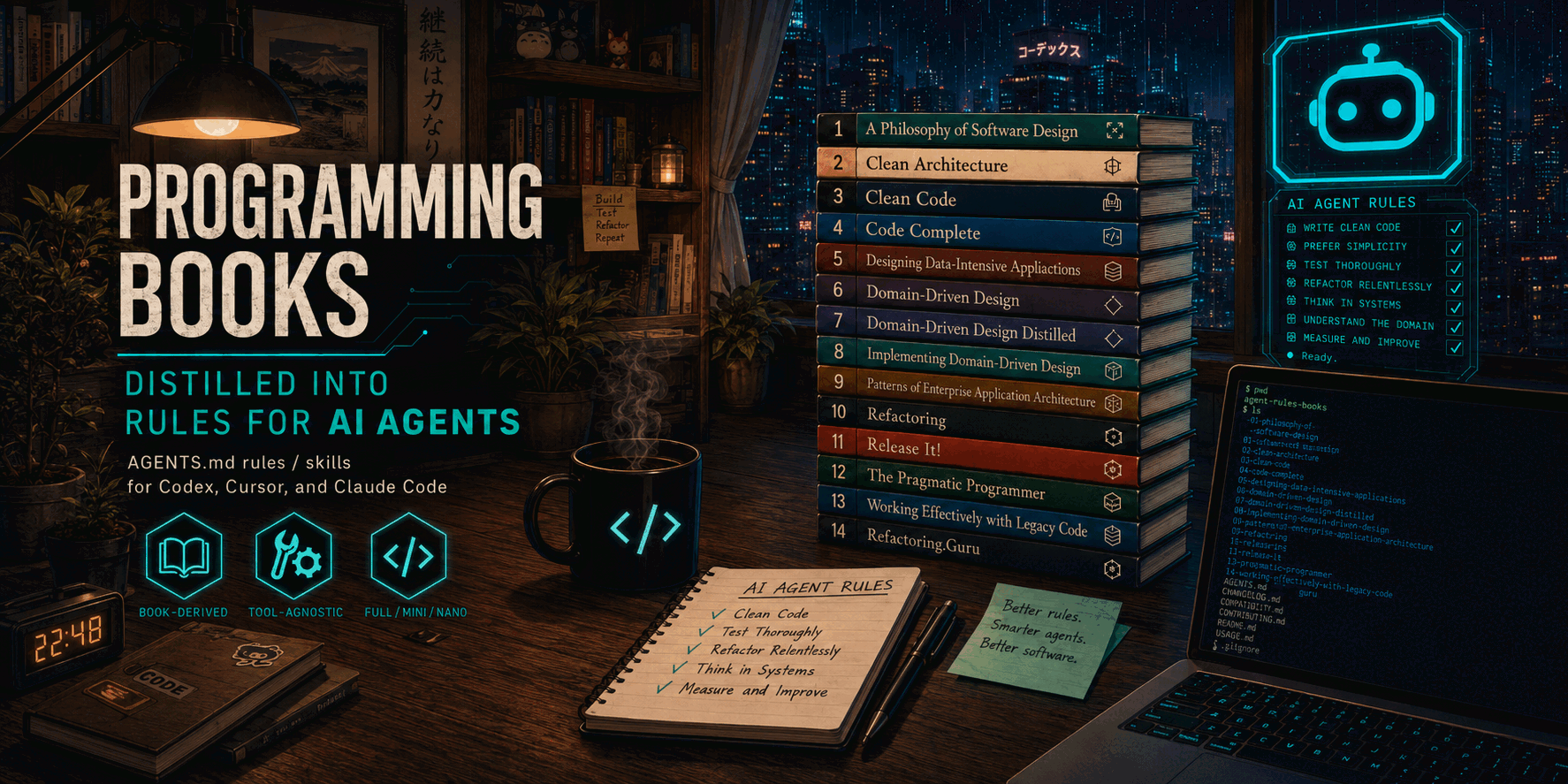
AGENTS.md rules / skills for AI coding agents: Codex, Cursor & Claude Code. Inspired by Clean Code, Refactoring, DDD, Clean Architecture and DDIA programming books.
2.2k
Stars
361
Forks
4
Open issues
1
Contributors
AI Analysis
This repository provides curated rule sets for AI coding agents (Codex, Cursor, Claude Code) distilled from classic software engineering books on refactoring, architecture, DDD, and code quality. It serves developers and AI practitioners who want to guide autonomous coding agents with established best practices, available in three progressively compact formats (full, mini, nano). This is specialized tooling for AI agent users, not a general-purpose library.
Inferred from signals mentioned in the README (tests, CI, type safety) — not a review of the actual code.
AI's overall editorial judgment — not an average of the bars above, can weigh other factors too.
Curated coding rules for AI agents, distilled from classic software engineering books
agent-rules-books is a collection of Markdown rule sets for AI coding agents (Codex, Cursor, Claude Code), extracted from established software engineering books like Clean Code, Domain-Driven Design, and Refactoring. It targets developers who want to inject established architectural and design principles into AI-assisted coding workflows. Adoption appears concentrated among developers using AI coding assistants, with modest but measurable growth since launch in April 2026.
Created April 2026 by ciembor, the project emerged as AI coding assistants became mainstream. It represents an attempt to formalize software engineering wisdom as machine-readable rules rather than relying on agents' implicit training. The project is version 0.5, indicating early stabilization of its core concept.
The project gained ~2,000 stars in ~6 weeks and 125 stars in the past 7 days (as of June 2026), suggesting accelerating interest. This trajectory appears driven by growing adoption of AI coding assistants and the perceived need to constrain their behavior with established principles. Growth is slower than comparable awesome-* compilations, suggesting the use case is still niche.
Adoption not verified through concrete case studies or user testimonials in README. No evidence of enterprise deployment, integration statistics, or documented real-world usage at scale. GitHub stars and forks exist but do not confirm whether rules are actually used in production AI workflows. README mentions tool-specific setup (Codex, Cursor, Claude Code) but does not quantify tool adoption.
Based on README, the project provides three size variants (full/mini/nano) of Markdown rule files for each of 12 source books. Architecture appears to be simple static files without execution or tooling complexity. Likely uses a deterministic convention for counting 'rules' from Markdown list items. No build system or code generation mentioned.
Not documented in README. No evidence of automated validation, test suites, or quality gates for rule accuracy or tool compatibility.
Last push 2026-05-22, ~5 weeks before evaluation date (2026-06-28). Recent commits suggest active maintenance. README mentions version 0.5 and references CHANGELOG, indicating deliberate versioning. Polish Open Source badge suggests community engagement. No evidence of stalled or abandoned state.
ADOPT IF: you use Cursor, Claude Code, or similar AI agents for coding and value explicit design constraints based on established software engineering principles, and you want a curated, portable rule set rather than building your own from scratch. AVOID IF: you need actively maintained tooling with integration tests, comprehensive compatibility documentation across agent versions, or verified production case studies; README provides setup guidance but not evidence that rules reliably work across advertised tools or that they produce measurable improvements to agent output. MONITOR IF: you are considering standardizing AI agent rules across a team — the project appears active but is still version 0.5, compatibility may drift as AI agents evolve, and real-world effectiveness remains unvalidated.
Independent dimensions
Mainstream potential
3/10
Technical importance
5/10
Adoption evidence
2/10
- Rules based on published books may not reflect how modern AI agents actually reason; no evidence that book-derived constraints improve agent code quality or reduce errors
- Project targets rapidly evolving AI agent landscape (Cursor, Claude Code, Codex); compatibility maintenance burden may exceed current update cadence, risking rule degradation
- Version 0.5 indicates incomplete feature set; breaking changes or significant reorganization possible before stabilization
- Adoption signal is weak; cannot confirm whether users actually apply rules or whether adoption is superficial (starred but unused)
- No build/validation tooling mentioned; rules may contain stale references or inaccuracies with no automated way to detect or fix them across 12 book rule sets
If AI coding agents remain popular through 2027–2028, agent-rules-books will likely stabilize and gain incremental adoption among developers who value explicit architectural guidance. However, mainstream dominance is unlikely; most teams will probably rely on agent defaults, vendor-provided rules, or custom rules. Project will probably reach 5,000–10,000 stars and serve as a reference model, but will not become the de facto standard for agent rules.
Newsletter
Get analyses like this every Monday
Free weekly digest of the most interesting open-source discoveries.
Languages
No language breakdown available.
Information
- License
- MIT
- Last updated
- 2mo ago
- Created
- 3mo ago
- Analyzed with
- anthropic/claude-haiku-4-5
Stars over time
Contributors over time
Top 100 contributors only — repos with more will plateau at 100.
Open issues
Open pull requests
Top contributors
Recent releases
Similar repos

VoltAgent/awesome-agent-skills
Awesome Agent Skills is a curated collection of 1,500+ skills for AI agent...

heilcheng/awesome-agent-skills
Awesome Agent Skills is a curated directory of reusable AI agent skill...
| Repository | Stars | Week Δ | Language | Score | Updated |
|---|---|---|---|---|---|
|
ciembor/agent-rules-books
this
|
2.2k | +96 | — | 7/10 | 2mo ago |
|
VoltAgent/awesome-agent-skills
|
27.7k | — | — | 8/10 | 1w ago |
 addyosmani/agent-skills addyosmani/agent-skills
|
76.5k | — | JavaScript | 8/10 | 11h ago |
|
heilcheng/awesome-agent-skills
|
6k | — | TypeScript | 7/10 | 3mo ago |
 alirezarezvani/claude-skills alirezarezvani/claude-skills
|
21.9k | — | Python | 8/10 | 2d ago |
Much larger audience; likely broader scope of agent capabilities beyond code quality rules; agent-rules-books is narrower and book-principled rather than skills-catalog focused
Also appears to be curated agent skills; agent-rules-books differentiates by explicit grounding in published software engineering books rather than generic skill collections
Claude-specific skills library; agent-rules-books claims tool-agnosticism but positions itself for multiple agents (Codex, Cursor, Claude Code)
Individual agents may ship or recommend their own rule sets; agent-rules-books attempts to provide portable, book-derived rules across tools