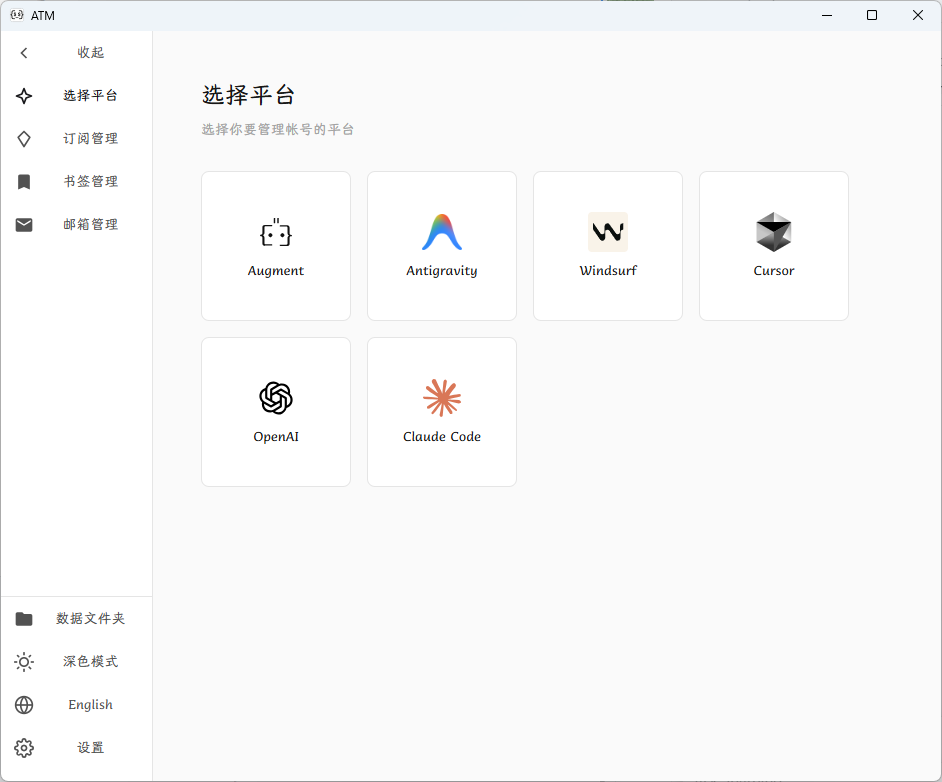
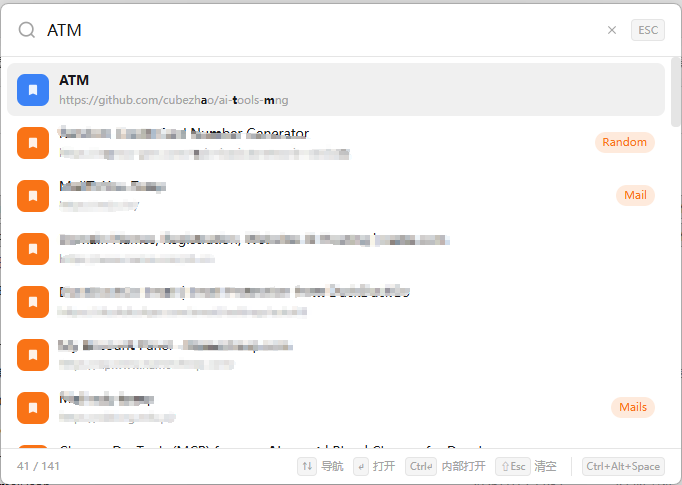
基于 Tauri 的跨平台桌面应用,用于管理多平台 AI 账号 Augment、Antigravity、Windsurf、Cursor、OpenAI(Codex、API)、Claude Code 与 API 账号,以及订阅、书签管理与邮箱管理。A Tauri-based cross-platform desktop app for managing multi-platform AI accounts (Augment, Antigravity, Windsurf, Cursor, OpenAI Codex/API, Claude Code and API), plus subscriptions, bookmarks, and email management.
1.2k
Stars
210
Forks
4
Open issues
9
Contributors


AI Analysis
AI Tools Manager is a Tauri-based desktop application for managing credentials across multiple AI platforms (OpenAI, Claude, Cursor, Windsurf, etc.) along with subscription tracking, bookmark management, and email operations. It serves developers and AI tool power users who juggle numerous platform accounts and need centralized credential management with features like one-click account switching and Telegram subscription alerts. Not suitable for users seeking a general-purpose credential mana...
Inferred from signals mentioned in the README (tests, CI, type safety) — not a review of the actual code.
AI's overall editorial judgment — not an average of the bars above, can weigh other factors too.
Tauri-based desktop app for managing AI platform accounts, subscriptions, and email aliases across 6+ services
AI Tools Manager (ATM) is a Rust/Tauri desktop application designed to centralize management of AI service accounts (OpenAI, Claude, Cursor, Windsurf, etc.), subscription tracking, bookmark sync, and disposable email generation. It targets power users and developers who juggle multiple AI tool subscriptions and need unified credential management. Built with Rust/Tauri and Vue3, it emphasizes cross-platform availability (macOS, Windows, Linux). Real-world adoption appears modest but concentrated; the project gained ~1,173 stars over ~1 year, with 210 forks suggesting some community interest, particularly in Mandarin-speaking regions.
Created July 2025, ATM emerged during rapid expansion of consumer and enterprise AI tools (Cursor, Windsurf, Claude, OpenAI API variants). The proliferation of account types and subscription tiers created friction for power users. The project represents a localized solution to credential fatigue, particularly marketed in Chinese communities initially.
The project grew from zero to ~1,173 stars in approximately 1 year, averaging ~2.3 stars/day. Last 7 days show 4 stars gained—growth has flattened significantly from likely early peaks. High fork-to-star ratio (18%) suggests engaged downstream development, possibly forks for regional customization or private deployments. Growth likely benefited from initial traction in Mandarin tech communities and professional developer networks managing multiple AI subscriptions.
Adoption not verified. No case studies, testimonial quotes, or documented enterprise/large user deployments in README. Homebrew and Scoop package availability suggest some real-world deployment, but scale unknown. GitHub stars and forks alone do not constitute adoption evidence. The presence of language-specific installation guides (Chinese README, WeChat/Alipay sponsorship) indicates regional deployment, likely strongest in China/Mandarin markets, but numbers unavailable.
Rust backend (Tauri 2) with Vue3 + Pinia frontend and Tailwind 4 styling. README indicates modular account/subscription/email management. Likely implements OAuth flows for Outlook and Apple Mail. Appears to use local proxy for OpenAI Codex. No architecture diagrams or module breakdown provided; implementation details inferred from feature list only.
Not documented in README. No mention of testing strategy, CI/CD pipeline, or test infrastructure.
Last push: 2026-07-03 (6 days ago relative to analysis date 2026-07-09) indicates active maintenance. Repository created 2025-07-08, now ~1 year old. Consistent update cadence implied by macOS quarantine fix guidance and versioned release process. Slow recent star growth (4 in 7 days) does not indicate stagnation—typical for mature tool with stable user base. Appears actively maintained, not stagnant.
ADOPT IF: You manage 3+ AI tool accounts with frequent switching, value unified subscription tracking, use macOS/Windows/Linux, and accept beta-quality tooling. AVOID IF: You require enterprise SLA, extensive documentation, large community support, or need production-grade security audit (no security disclosure policy visible). MONITOR IF: You are building credential management for AI developers—this codebase may serve as reference, but adoption trajectory unclear; check back in 6 months for growth signals.
Independent dimensions
Mainstream potential
3/10
Technical importance
5/10
Adoption evidence
2/10
- Security posture not documented: No mention of encryption, secure storage, or credential handling. OAuth token storage method unknown. Credential breach exposure could be high if not properly isolated.
- Single-maintainer risk: Repository appears to be run by one author (cubezhao); no visible team or governance structure. Bus factor = 1.
- API dependency risk: Tool relies on OAuth/API endpoints from OpenAI, Claude, Cursor, etc. Breaking changes upstream could render features non-functional without rapid response.
- Adoption plateau: Growth flatlined (4 stars/7 days). May indicate market saturation within target niche or limited appeal outside Mandarin-speaking regions. Mainstream breakout unlikely.
- Localization barrier: English README present, but primary marketing and community engagement in Chinese. International adoption may lag; non-Chinese users less visible in feedback loops.
Project will likely remain stable niche tool within AI developer communities (particularly China/Asia-Pacific), serving a few hundred to low-thousands of active users. Incremental feature additions (new AI platforms) will drive minor growth; major mainstream adoption unlikely unless acquired or repositioned as general credential management UI. Code may be forked for private enterprise use or regional variants.
Newsletter
Get analyses like this every Monday
Free weekly digest of the most interesting open-source discoveries.
Languages
Information
- Language
- Rust
- License
- MIT
- Last updated
- 11h ago
- Created
- 12mo ago
- Analyzed with
- anthropic/claude-haiku-4-5
Stars over time
Contributors over time
Top 100 contributors only — repos with more will plateau at 100.
Open issues
Open pull requests
No open pull requests.
Top contributors
Similar repos

jlcodes99/cockpit-tools
Cockpit Tools is a specialized multi-account manager for AI IDEs (Cursor,...

lbjlaq/Antigravity-Manager
Antigravity Manager is a desktop application (Tauri v2 + React + Rust) for...

iamzhihuix/skills-manage
skills-manage is a Tauri desktop application that provides a unified central...

miaoxworld/openclaw-manager
OpenClaw Manager is a desktop application for managing AI assistant services...
| Repository | Stars | Week Δ | Language | Score | Updated |
|---|---|---|---|---|---|
|
cubezhao/ai-tools-mng
this
|
1.2k | +4 | Rust | 7/10 | 11h ago |
|
jlcodes99/cockpit-tools
|
13k | — | Rust | 7/10 | 7h ago |
|
lbjlaq/Antigravity-Manager
|
30.1k | — | Rust | 6/10 | 12h ago |
|
iamzhihuix/skills-manage
|
2.1k | — | TypeScript | 7/10 | 2mo ago |
|
miaoxworld/openclaw-manager
|
1.7k | — | TypeScript | 7/10 | 4mo ago |
 borawong/AiMaMi borawong/AiMaMi
|
1.3k | — | TypeScript | 7/10 | 1w ago |
Specialized Antigravity account manager; ATM is broader, covering 6+ platforms. Antigravity-Manager likely has deeper feature depth for that single use case; ATM trades depth for breadth across AI tools.
General-purpose credential vaults; ATM adds AI-specific features (subscription tracking, one-click account switching, Codex proxy). ATM does not replace; fills niche gap for AI tool users unwilling to add another credential layer.
ATM's bookmark search mimics Raycast. However, Raycast + existing credential storage may suffice for some users. ATM consolidates; Raycast is broader but less specialized.
Developers often build ad-hoc account/API key management. ATM provides GUI + cloud sync; CLI tools are lower barrier to entry but fragmented. ATM targets users who want integrated UI without scripting.
Some tools (Cursor, Windsurf) have browser plugins. ATM is OS-level, not browser-bound, enabling cross-app usage and native integrations (iCloud, Outlook OAuth).