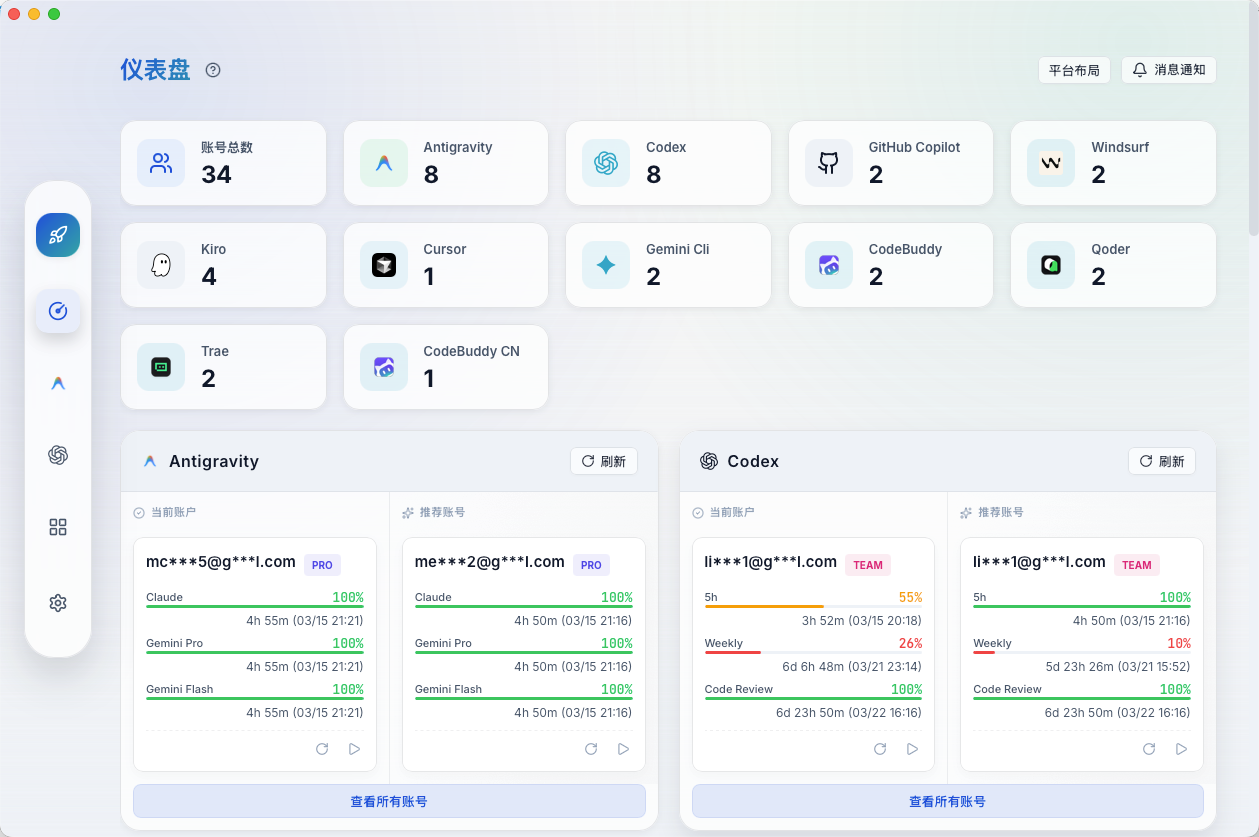
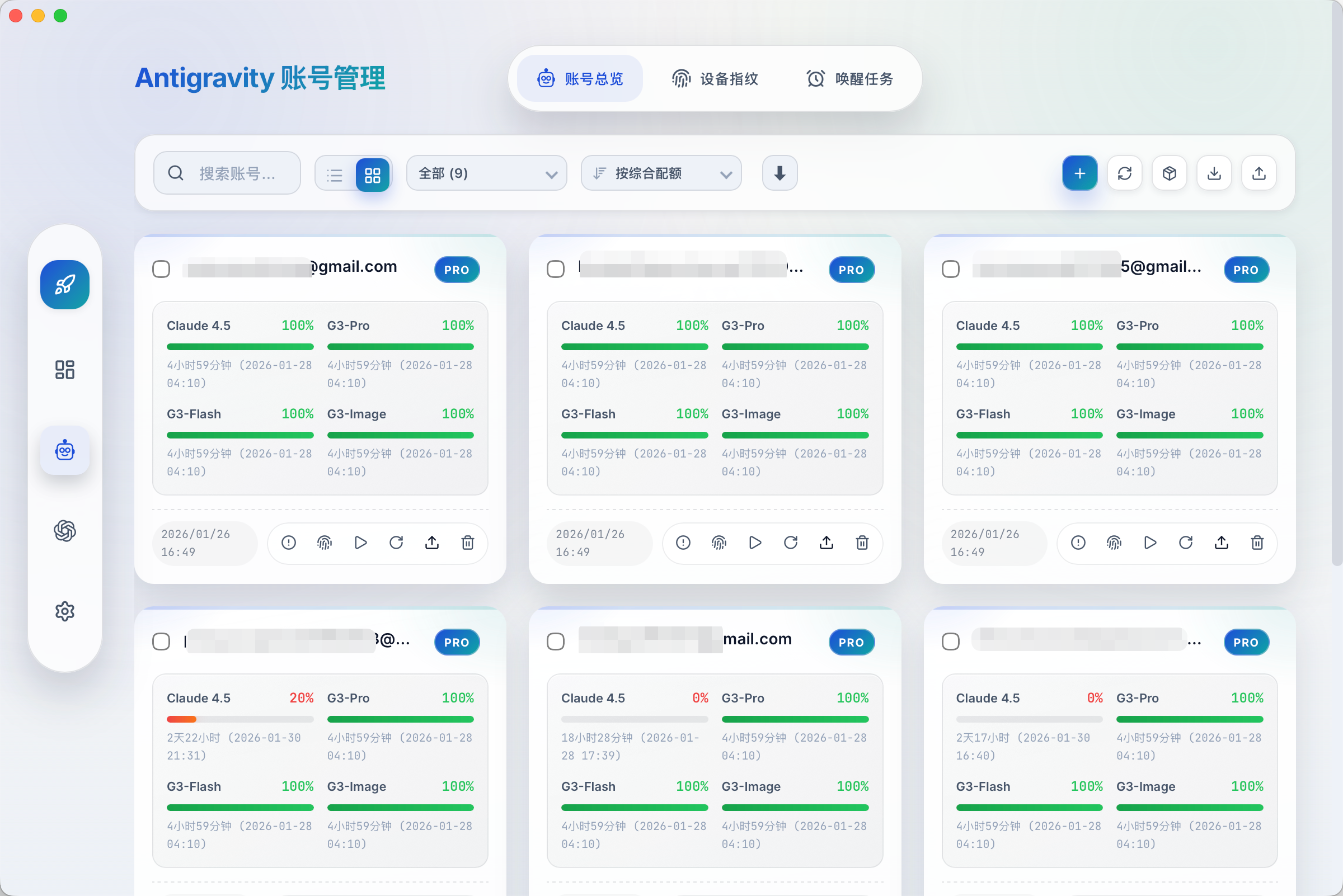
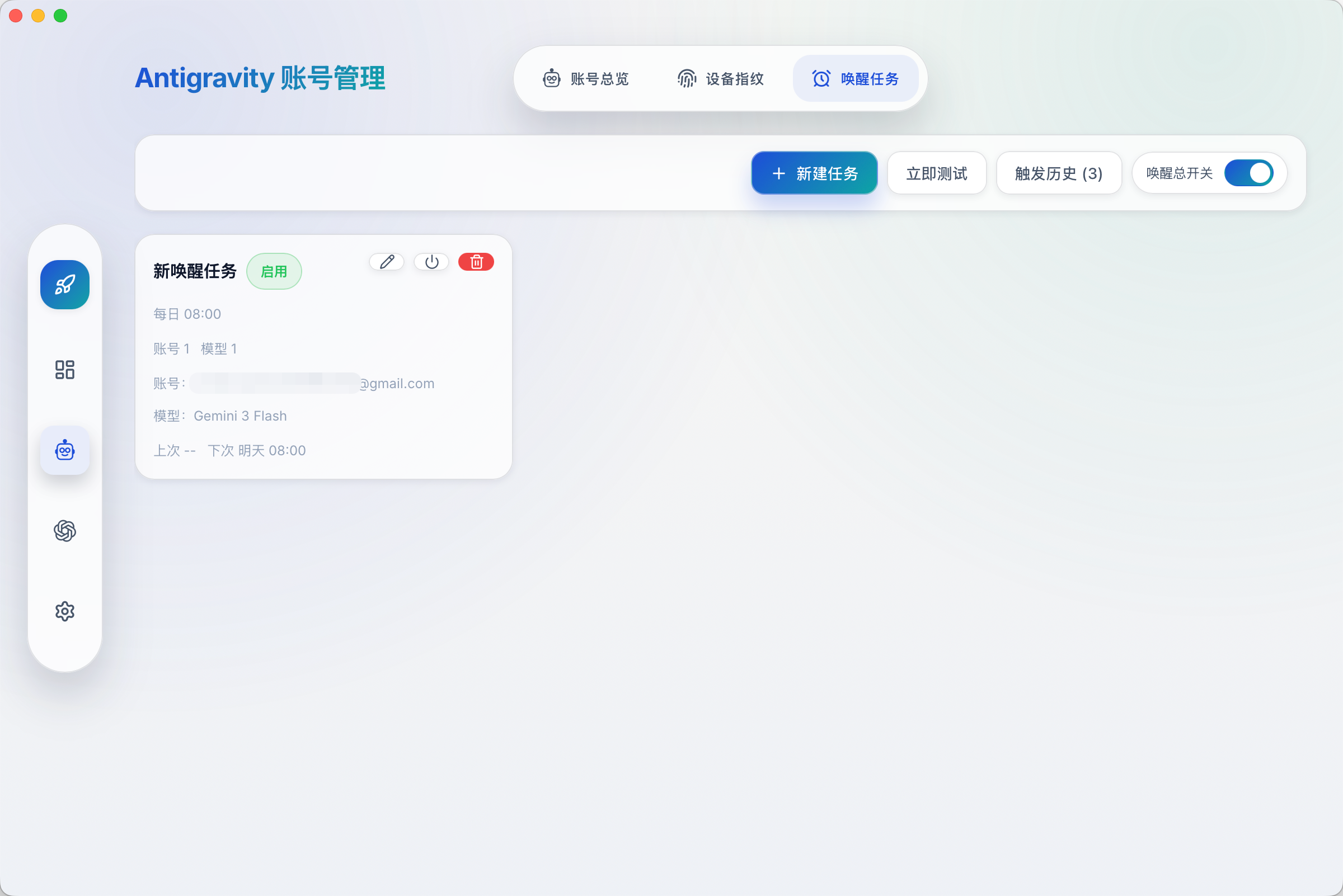
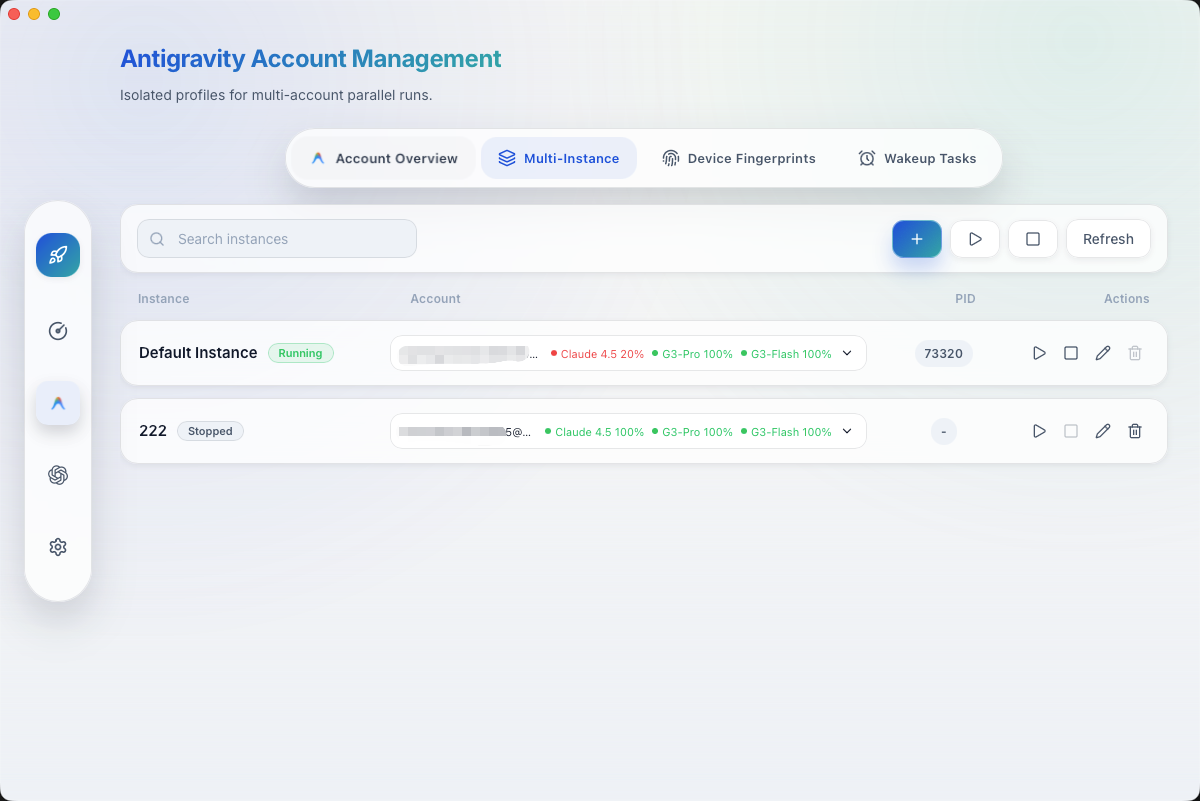
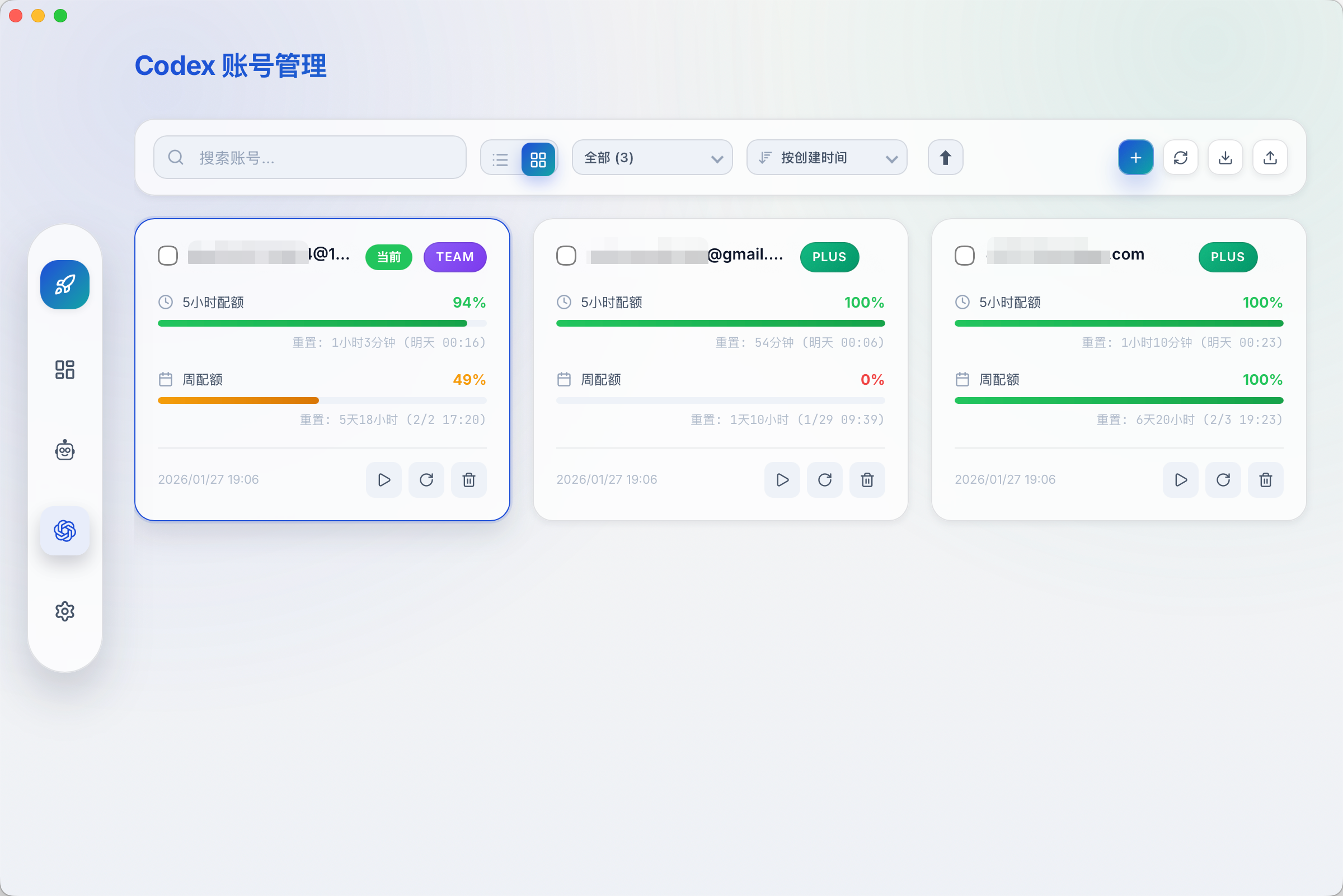
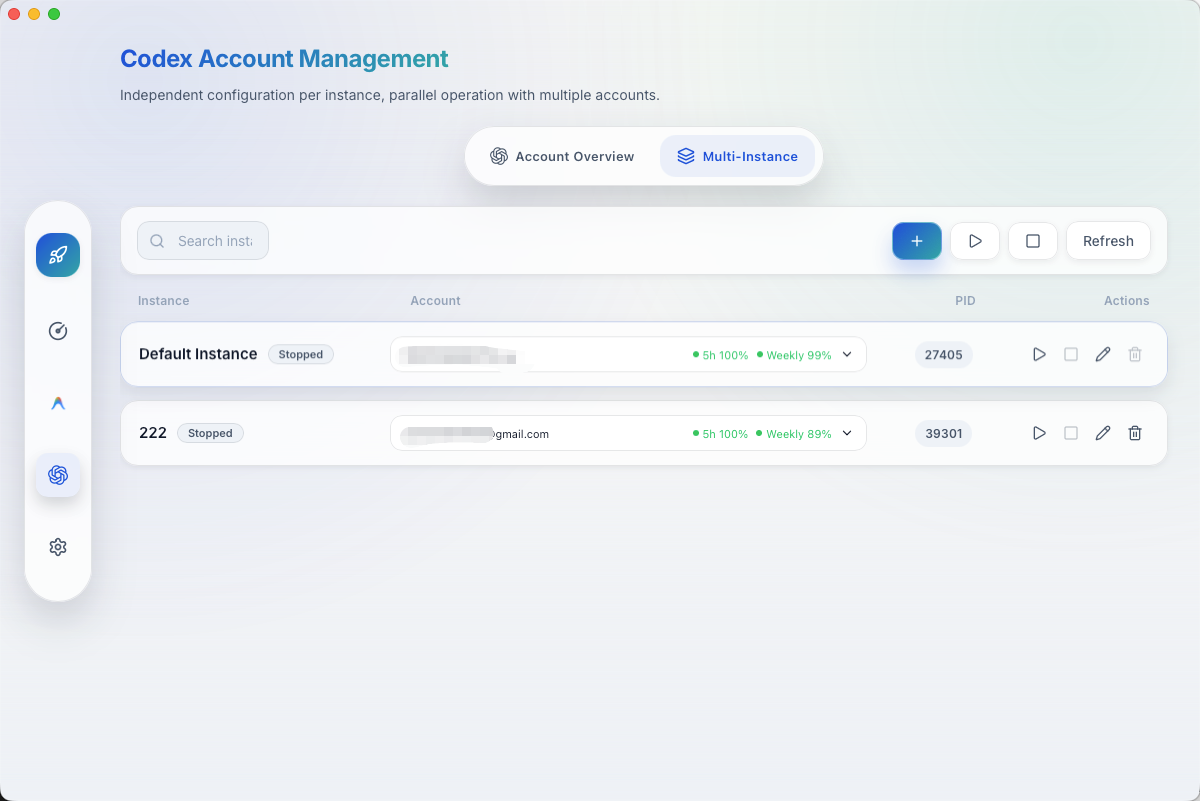
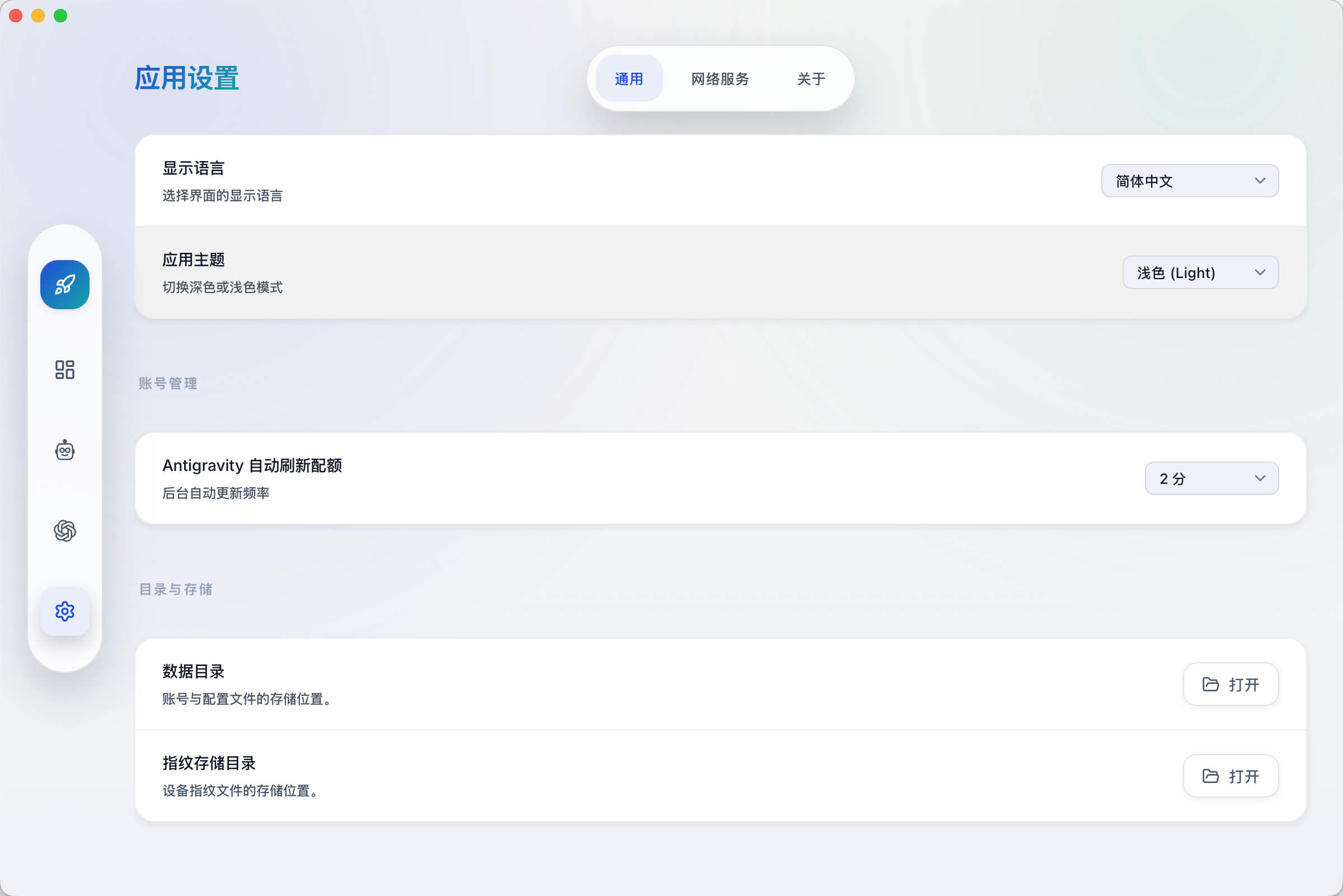
🚀 通用 AI IDE 账号管理工具:支持 Antigravity / Codex / GitHub Copilot / Windsurf / Kiro / Cursor / Gemini-cli / CodeBuddy,多账号切换、配额监控、自动唤醒与多开实例管理。 🚀 Universal AI IDE account manager for Antigravity / Codex / GitHub Copilot / Windsurf / Kiro / Cursor / Gemini-cli / CodeBuddy, with multi-account switching, quota monitoring, wake-up automation, and multi-insta
13k
Stars
1.2k
Forks
400
Open issues
30
Contributors




AI Analysis
Cockpit Tools is a specialized multi-account manager for AI IDEs (Cursor, GitHub Copilot, Windsurf, Gemini CLI, Codex, Antigravity, and 8+ others), enabling rapid account switching, quota monitoring, and parallel instance management. It serves developers and teams who extensively use multiple AI coding assistants and need centralized account orchestration; it is not a general-purpose development tool and offers limited value for users relying on a single AI IDE.
Inferred from signals mentioned in the README (tests, CI, type safety) — not a review of the actual code.
AI's overall editorial judgment — not an average of the bars above, can weigh other factors too.
Rust-built GUI tool manages multiple AI coding assistant accounts across 12 platforms with quota monitoring and multi-instance support
Cockpit Tools is a desktop application (built in Rust) that lets users manage accounts across a dozen AI IDE platforms — Cursor, GitHub Copilot, Windsurf, Kiro, Codex, Gemini CLI, CodeBuddy, Antigravity, and others — from a single dashboard. Its core value proposition is multi-account switching, real-time quota monitoring, automated wake-up scheduling, and running multiple instances of the same IDE with isolated credentials simultaneously. It appears primarily aimed at power users, developers, and teams in China who operate multiple free-tier AI coding accounts to maximize usage limits. With 12,032 stars and 1,115 forks, interest is substantial within this niche.
Created in January 2026, the project emerged alongside a wave of similar Rust-based AI account managers targeting Chinese developers seeking to maximize free-tier AI IDE usage. It rapidly accumulated stars, likely through community sharing and Chinese developer forums.
The project gained significant traction quickly — 12K stars in roughly 5 months — driven by strong demand from developers frustrated by per-account quotas across AI coding tools. The 266 stars in the last 7 days suggests continued organic growth, possibly amplified by adding support for newer platforms like Kiro and Gemini CLI as they launched. The presence of affiliate sponsor links in the README indicates the project has monetization interests, which may also drive promotion.
The project has 12,032 stars and 1,115 forks, which indicates meaningful interest. GitHub download badge is present, suggesting binary releases exist. However, no independent user testimonials, case studies, or third-party mentions are documented in the available metadata. The presence of commercial sponsors (APIKEY.FUN, RoxyBrowser) suggests the tool has a real user base that sponsors find worth reaching, but concrete download numbers or active user counts are not verifiable from available data.
Likely a Tauri-based desktop application (Rust backend + web frontend), based on the Rust language tag and the cross-platform macOS/Windows/Linux support described. The README describes a sidecar pattern for Codex (CLIProxyAPI sidecar), suggesting a multi-process architecture. Account credentials appear to be managed locally. The 18-language i18n support implies a frontend-heavy UI layer.
not documented in README
Last push was 2026-06-23, just 2 days before the evaluation date, indicating active development. The README covers 12 platforms with detailed feature descriptions, suggesting ongoing feature addition. License is listed as unknown, which is a notable gap for an open-source tool handling authentication credentials.
ADOPT IF: you regularly juggle multiple accounts across several AI IDE platforms and need a single tool for quota visibility, automated switching, and parallel instances. AVOID IF: you use only one AI IDE, have concerns about credential security with closed-source or unlicensed tools, or require enterprise audit trails — the unknown license is a meaningful risk for any organizational use. MONITOR IF: you are evaluating this for team deployment and are waiting for a clarified license, security audit, or evidence of sustained maintenance beyond one year.
Independent dimensions
Mainstream potential
3/10
Technical importance
5/10
Adoption evidence
4/10
- Unknown/missing license creates legal ambiguity for organizational or commercial use, and raises questions about redistribution rights.
- Handling authentication tokens and credentials for 12 third-party services in a desktop app creates a significant security attack surface; no security audit or disclosure policy is documented in the README.
- The tool's core utility depends on the behavior of third-party AI IDE authentication systems; any platform changing its token format, credential storage, or TOS could break supported integrations.
- The affiliate sponsorship links (API relay services, fingerprint browser) in the README suggest alignment with account-pooling and multi-identity workflows that may violate the Terms of Service of supported platforms, creating risk for end users.
- As a project less than 6 months old with a single maintainer apparent from the username, long-term sustainability and response to critical bugs is uncertain.
Likely to continue growing within its Chinese developer niche as new AI coding tools launch and free-tier quota frustration persists. Mainstream adoption outside this niche appears unlikely due to TOS concerns and the missing license.
Newsletter
Get analyses like this every Monday
Free weekly digest of the most interesting open-source discoveries.
Languages
Information
- Language
- Rust
- Last updated
- 6h ago
- Created
- 6mo ago
- Analyzed with
- anthropic/claude-haiku-4-5
Stars over time
Contributors over time
Top 100 contributors only — repos with more will plateau at 100.
Open issues
Top contributors
Similar repos

cubezhao/ai-tools-mng
AI Tools Manager is a Tauri-based desktop application for managing credentials...

xingkongliang/skills-manager
Skills Manager is a desktop application written in Rust that provides...

adminlove520/AI-Account-Toolkit
This is a specialized toolkit for automating account registration, token...
| Repository | Stars | Week Δ | Language | Score | Updated |
|---|---|---|---|---|---|
|
jlcodes99/cockpit-tools
this
|
13k | +526 | Rust | 7/10 | 6h ago |
|
cubezhao/ai-tools-mng
|
1.2k | — | Rust | 7/10 | 9h ago |
|
xingkongliang/skills-manager
|
2.9k | — | Rust | 7/10 | 22h ago |
 kbwo/ccmanager kbwo/ccmanager
|
1.2k | — | TypeScript | 7/10 | 3d ago |
|
adminlove520/AI-Account-Toolkit
|
1k | — | Python | 6/10 | 10h ago |
 iamzhihuix/skills-manage iamzhihuix/skills-manage
|
2.1k | — | TypeScript | 7/10 | 2mo ago |
The dominant similar project with ~29,864 stars — nearly 2.5x cockpit-tools. It focuses specifically on Antigravity IDE, while cockpit-tools differentiates by supporting 12 platforms. Antigravity-Manager's lead suggests platform-specific tools may outperform generalist ones in the same niche.
A Swift-based quota monitoring tool with 4,485 stars, likely macOS-focused. Cockpit-tools offers cross-platform support and broader IDE coverage, but quotio may offer tighter macOS integration.
A Rust-based Cursor-focused account tool with 6,149 stars. Cockpit-tools covers Cursor as one of many platforms; single-platform tools may offer deeper functionality for that specific IDE.
A newer, Kiro-specific manager with 1,861 stars. Cockpit-tools added Kiro support, directly competing for this user base with a multi-platform advantage.
A TypeScript-based desktop GUI with 3,268 stars, suggesting an alternative tech stack approach. Rust-based builds likely offer better performance and smaller binaries compared to Electron-style TypeScript apps.