MacOS inside a Docker container.
20.8k
Stars
1.1k
Forks
36
Open issues
15
Contributors



AI Analysis
macOS inside a Docker container enables running macOS virtual machines on Linux hosts (with KVM support) or Windows 11 systems via Docker. This specialized tool serves DevOps engineers, macOS developers, and CI/CD pipeline maintainers who need to run macOS workloads in containerized environments without dedicated Apple hardware. It is NOT a general-purpose container solution; it is specifically designed for the narrow use case of macOS virtualization in Linux/Docker ecosystems.
Inferred from signals mentioned in the README (tests, CI, type safety) — not a review of the actual code.
AI's overall editorial judgment — not an average of the bars above, can weigh other factors too.
Run macOS inside Docker via KVM virtualization, with browser-based access
dockur/macos wraps macOS installation and operation inside a Docker container using KVM acceleration and QEMU, exposing a web-based VNC viewer on port 8006. It targets Linux developers, CI pipeline builders, and hobbyists who want macOS access without dedicated Apple hardware. The project automates macOS image download and installation, supports versions from Big Sur through Sequoia, and integrates with standard Docker tooling including Compose and Kubernetes manifests. It is a sibling project to dockur/windows, which achieved massive adoption.
Created in June 2024 as a natural extension of the dockur/windows project. It follows the same architectural pattern: wrapping a QEMU/KVM virtual machine inside a Docker container with an integrated noVNC web viewer.
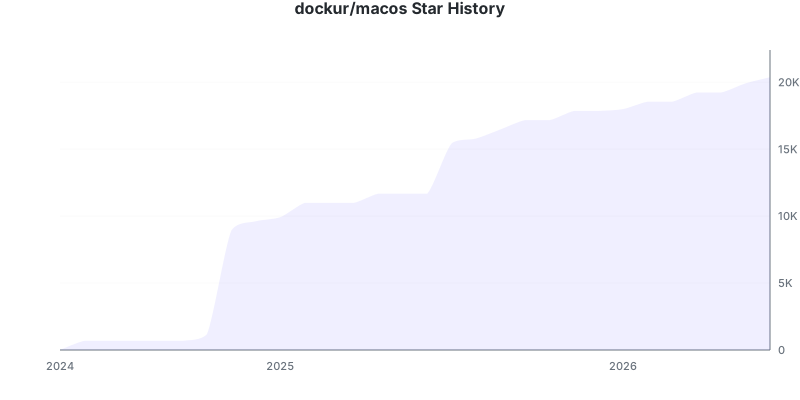
Likely grew rapidly after launch due to the prior reputation of dockur/windows (51k+ stars) and the perennial demand for macOS on non-Apple hardware. With 20k stars in roughly two years, growth appears to have been front-loaded around launch and viral sharing, now settling into steady but slower accumulation (~34 stars/week as of evaluation date).
Docker Hub pull count is referenced in the README badges but exact numbers are not available from provided metadata. The 20k stars and 1,025 forks suggest broad awareness. Real production use is likely limited to development/testing workflows and individual hobbyists rather than enterprise deployments, given Apple's EULA restrictions and KVM hardware requirements. Adoption not verified at production scale.
Appears to use QEMU with KVM acceleration under the hood, consistent with the dockur/windows approach. The container likely wraps a shell-based orchestration layer that downloads macOS recovery images, sets up a virtual disk, and launches QEMU. noVNC is likely used for browser-based display. NET_ADMIN capability and /dev/net/tun suggest a virtual network interface (likely tap-based) for macOS networking. Storage is volume-mounted for persistence.
Not documented in README.
Last push was 2026-06-25, matching the evaluation date — indicating active, current maintenance. The README is detailed with FAQ entries, version tables, and operational guidance, suggesting ongoing attention to user questions.
ADOPT IF: you need a disposable macOS environment on Linux hardware for development or testing, understand the Apple EULA implications, and have KVM-capable hardware available. AVOID IF: you need production-grade macOS reliability, plan to run this on AMD multi-core setups (noted instability), expect Apple-silicon-native performance, or are in a commercial context where EULA compliance is required. MONITOR IF: you are evaluating macOS CI pipelines on Linux and want to track whether the project adds better automation, snapshot, or cloud-native features.
Independent dimensions
Mainstream potential
3/10
Technical importance
6/10
Adoption evidence
4/10
- Apple's EULA prohibits running macOS on non-Apple hardware in most contexts, creating legal risk for commercial use.
- KVM hardware dependency means this cannot run on most cloud VMs or shared hosting environments without nested virtualization support.
- Documented AMD multi-core instability limits performance on a large class of servers.
- macOS performance inside a container/VM adds significant overhead versus native hardware, limiting use for performance-sensitive tasks.
- Dependency on Apple's recovery image distribution infrastructure — changes to Apple's download mechanisms could break automated image fetching.
Likely to maintain a stable niche as a developer convenience tool, growing slowly in parallel with dockur/windows. Unlikely to reach that project's adoption level due to legal friction and hardware requirements.
Newsletter
Get analyses like this every Monday
Free weekly digest of the most interesting open-source discoveries.
Languages
Information
- Language
- Shell
- License
- MIT
- Last updated
- 6d ago
- Created
- 26mo ago
- Analyzed with
- anthropic/claude-haiku-4-5
Stars over time
Contributors over time
Top 100 contributors only — repos with more will plateau at 100.
Open issues
[Question]: How to get audio output working using ALSA /Pulse audio / Pipe wire ?
iMessage suddenly starts failing
Fail to download macOS 15 image with error : "could not resolve host!"
Stuck in onboarding (select region)
Failed to load Boot0080
Open pull requests
Top contributors
Recent releases
Similar repos
| Repository | Stars | Week Δ | Language | Score | Updated |
|---|---|---|---|---|---|
|
dockur/macos
this
|
20.8k | +136 | Shell | 7/10 | 6d ago |
 sickcodes/Docker-OSX sickcodes/Docker-OSX
|
52.6k | — | Shell | 7/10 | 8mo ago |
|
dockur/windows
|
52.4k | — | Shell | 9/10 | 2d ago |
|
dockur/windows-arm
|
2.2k | — | Shell | 7/10 | 2d ago |
 abiosoft/colima abiosoft/colima
|
29.8k | — | Go | 8/10 | 2d ago |
 apple/container apple/container
|
47.4k | — | Swift | 8/10 | 3d ago |
The original and most-starred macOS-in-Docker project (52k stars). Offers more configuration options, GPU passthrough, and IOMMU support. dockur/macos trades breadth for simplicity — faster to get running but less configurable for advanced scenarios.
The sibling project by the same author with 51k stars. Architecturally nearly identical but for Windows. dockur/macos benefits from shared tooling and developer trust but has lower adoption, likely because macOS virtualization on Linux adds more legal and hardware complexity.
Apple's own official container runtime for macOS (42k stars), running Linux containers on Apple Silicon. Solves the opposite problem — Linux workloads on Mac hardware. Not a direct competitor but serves overlapping developer audiences.
Apple's framework for lightweight Linux VMs on macOS. Again addresses the inverse use case. The existence of Apple's official tooling may reduce pressure to run macOS inside Docker for some workflows.
Runs Docker/containers on macOS using Lima VMs. Solves a different direction (Docker on Mac, not Mac in Docker) and is production-oriented. Not a direct substitute but relevant to overlapping audiences.