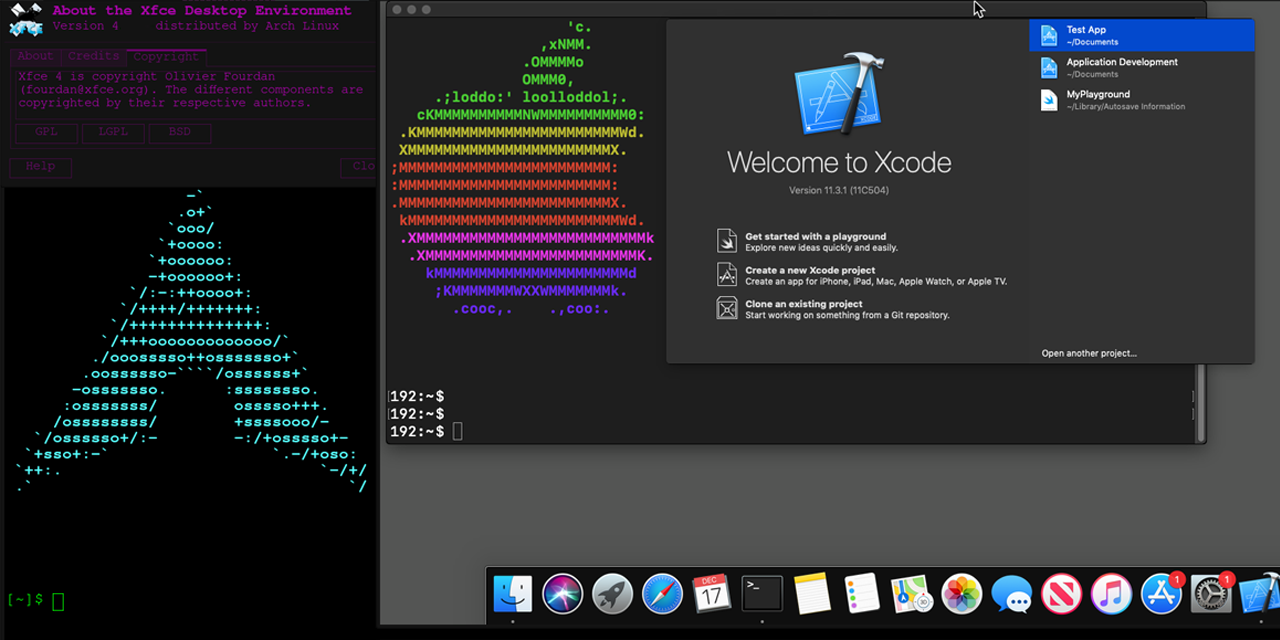
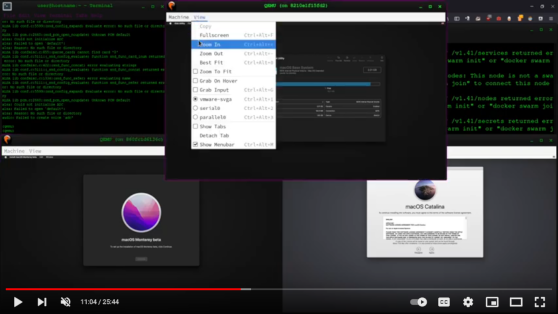
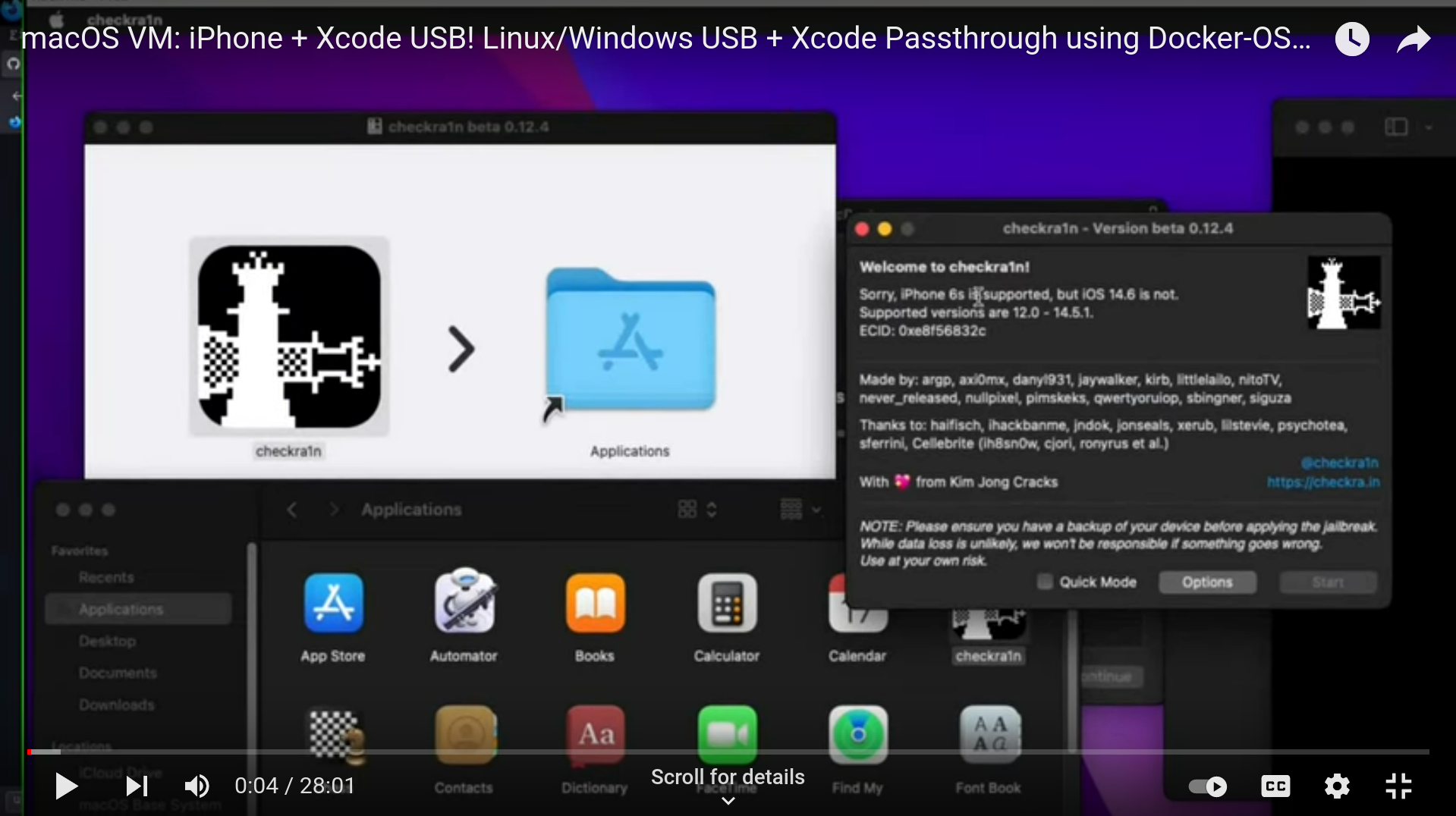
Run macOS VM in a Docker! Run near native OSX-KVM in Docker! X11 Forwarding! CI/CD for OS X Security Research! Docker mac Containers.
52.6k
Stars
2.9k
Forks
417
Open issues
30
Contributors


AI Analysis
Docker-OSX enables running macOS virtual machines inside Docker containers using KVM/QEMU with near-native performance, X11 forwarding, and USB passthrough, primarily targeting security researchers who need macOS environments on Linux or Windows hosts. It is best suited for iOS/macOS security research, CI/CD pipelines requiring macOS, and iMessage/Apple service research — not for general desktop use or production macOS workloads. End users who simply want a macOS desktop and non-technical use...
Inferred from signals mentioned in the README (tests, CI, type safety) — not a review of the actual code.
AI's overall editorial judgment — not an average of the bars above, can weigh other factors too.
Docker-OSX wraps KVM-based macOS VMs in Docker containers for Linux-based security research and CI/CD
Docker-OSX enables running macOS virtual machines inside Docker containers on Linux hosts by combining KVM/QEMU hardware virtualization with OpenCore bootloader support, then surfacing the result through Docker's familiar interface. Its primary audience is security researchers who need macOS environments on Linux or Windows infrastructure, and CI/CD engineers who need automated macOS testing without Apple hardware. It supports multiple macOS versions from Catalina through Sonoma and includes X11 forwarding, iPhone USB passthrough, and serial number generation for iMessage testing. With 52,600 stars it is one of the most visible projects in the macOS-on-Linux space.
Created in June 2020 by Sick.Codes, building directly on kholia/OSX-KVM and thenickdude/KVM-OpenCore. It emerged during a period of high demand for accessible macOS CI/CD alternatives, packaging existing KVM techniques into a Docker-shaped interface.
Initial viral spread was driven by security researchers and DevOps engineers frustrated by Apple hardware lock-in for CI/CD pipelines. GitHub star growth was rapid in 2020-2021 and has since plateaued at a high baseline. The 11 stars gained in the last 7 days (as of June 2026) indicate the project has transitioned from growth to steady-state organic discovery rather than active community expansion.
Docker Hub pull counts are referenced via a badge (dockeri.co) but specific numbers are not surfaced in the README excerpt. The project has 2,883 forks, an active Discord, and a Telegram group, suggesting non-trivial real-world use. Security research teams and hobbyists are the most plausible production users. Formal enterprise CI/CD adoption at scale is unverified — the legal and licensing complexity around running macOS outside Apple hardware creates barriers to documented corporate usage.
Appears to be primarily shell scripting layered over QEMU/KVM, with Docker serving as the packaging and lifecycle management layer. The macOS guest likely boots via OpenCore (from KVM-OpenCore) with OVMF firmware. X11 socket forwarding is passed through volume mounts. Serial number generation for Apple service authentication is handled by a companion project (osx-serial-generator). The project appears to be a glue layer rather than a novel virtualization implementation.
not documented in README
Last push was November 2025, approximately 7 months before the evaluation date. This is within an acceptable maintenance window for a project of this maturity — it is not actively developed daily but is not abandoned. The Discord server and Telegram group suggest community support channels remain active. No evidence of recent release cadence or changelog is visible in the README excerpt.
ADOPT IF: you are a security researcher or CI/CD engineer who needs macOS environments on Linux infrastructure, understand the legal gray area of running macOS outside Apple hardware, and are comfortable with KVM-based setup complexity. AVOID IF: you need Apple-licensed production environments, are on ARM-only infrastructure without x86 KVM support, or need a fully supported and legally clear macOS CI/CD solution — commercial offerings like MacStadium or GitHub's macOS runners are more appropriate. MONITOR IF: you are evaluating macOS-on-Linux tooling and want to see whether dockur/macos or similar newer projects overtake this one in active maintenance and feature parity.
Independent dimensions
Mainstream potential
3/10
Technical importance
7/10
Adoption evidence
5/10
- Legal and licensing risk: Apple's macOS EULA prohibits running the OS on non-Apple hardware in most interpretations. Enterprise or commercial use carries meaningful legal exposure that is not addressed by the project's GPL license.
- Maintenance concentration: The project appears primarily maintained by a single individual (Sick.Codes). A 7-month gap since the last push and single-maintainer structure creates bus-factor risk for future macOS version support.
- Apple Silicon incompatibility: KVM-based macOS virtualization on x86 Linux does not translate to ARM hosts. As cloud infrastructure shifts toward ARM (Graviton, Ampere), this tool's applicability narrows.
- Competing alternatives gaining ground: dockur/macos has accumulated 20k stars and addresses the same problem, suggesting the user base is fragmenting and Docker-OSX may no longer be the default choice in this niche.
- Apple platform changes: Each new macOS release can break OpenCore/KVM compatibility, requiring upstream fixes. If upstream projects (OSX-KVM, KVM-OpenCore) slow down, Docker-OSX loses its foundation.
Docker-OSX will likely remain a useful reference and entry point for macOS-on-Linux research workloads but may gradually cede mindshare to newer, more actively maintained alternatives. It is unlikely to grow substantially beyond its current niche.
Explore similar
Newsletter
Get analyses like this every Monday
Free weekly digest of the most interesting open-source discoveries.
Languages
Information
- Language
- Shell
- License
- GPL-3.0
- Last updated
- 8mo ago
- Created
- 74mo ago
- Analyzed with
- anthropic/claude-sonnet-4-6
Stars over time
Contributors over time
Top 100 contributors only — repos with more will plateau at 100.
Open issues
Top contributors
Recent releases
No releases published yet.
Similar repos
| Repository | Stars | Week Δ | Language | Score | Updated |
|---|---|---|---|---|---|
|
sickcodes/Docker-OSX
this
|
52.6k | +18 | Shell | 7/10 | 8mo ago |
 dockur/macos dockur/macos
|
20.8k | — | Shell | 7/10 | 6d ago |
 kholia/OSX-KVM kholia/OSX-KVM
|
23.4k | — | Shell | 8/10 | 6mo ago |
 abiosoft/colima abiosoft/colima
|
29.8k | — | Go | 8/10 | 2d ago |
 mviereck/x11docker mviereck/x11docker
|
6.3k | — | Shell | 8/10 | 5d ago |
 apple/container apple/container
|
47.4k | — | Swift | 8/10 | 3d ago |
The upstream project Docker-OSX is built on. OSX-KVM targets users comfortable with bare KVM/QEMU configuration; Docker-OSX lowers the barrier by wrapping it in Docker. OSX-KVM has 23k stars and is more actively developed at the virtualization layer.
A newer alternative (20k stars) that also runs macOS in Docker via KVM. Appears to target a similar audience with potentially a more modern setup experience. Direct competitor in the same niche with comparable star count, suggesting Docker-OSX no longer has a monopoly on this approach.
Apple's own containerization framework (8.7k stars) targets running Linux containers on Apple Silicon natively. Solves a different direction of the problem (Linux-on-Mac vs Mac-on-Linux) and is not a direct competitor, but represents Apple's growing investment in container tooling.
Colima (29k stars) runs Linux container runtimes on macOS using lightweight VMs. Solves the inverse problem — it is not relevant for running macOS on Linux. Comparison is misleading if used; these tools address different host/guest combinations.
x11docker (6.2k stars) specializes in X11 forwarding for Docker containers running GUI Linux apps, not macOS VMs. It addresses one sub-feature (X11) that Docker-OSX also supports but for a different use case entirely.