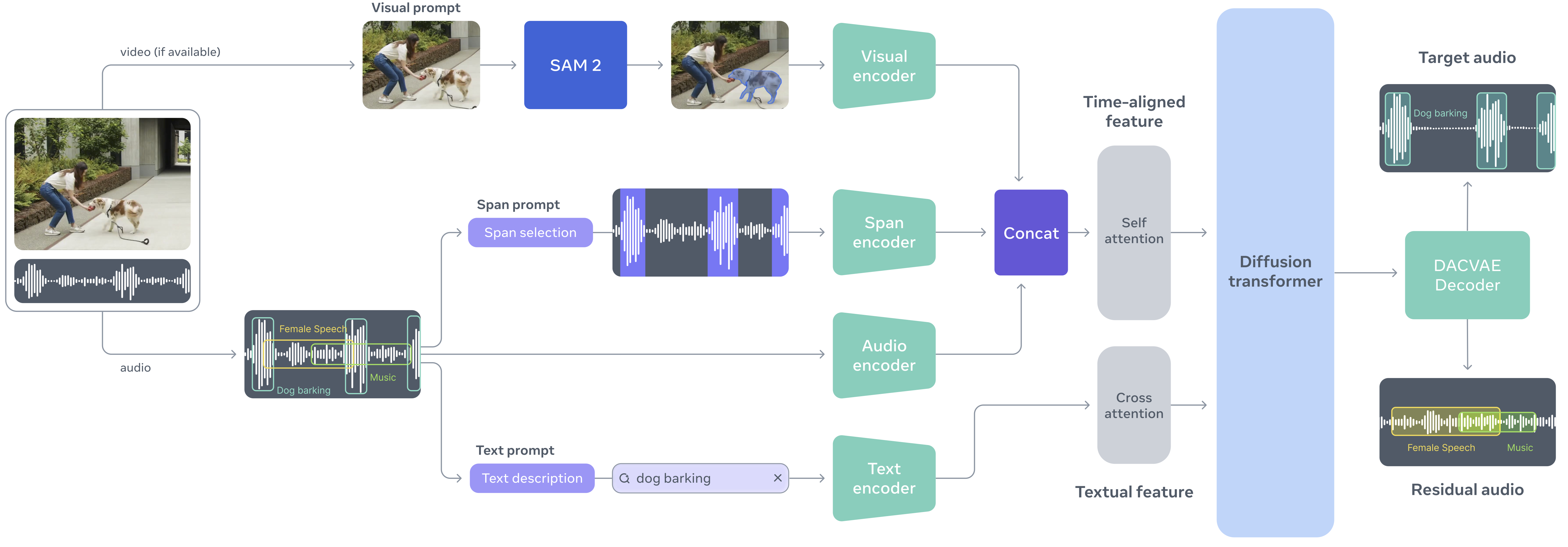
The repository provides code for running inference with the Meta Segment Anything Audio Model (SAM-Audio), links for downloading the trained model checkpoints, and example notebooks that show how to use the model.
3.6k
Stars
324
Forks
50
Open issues
8
Contributors



AI Analysis
SAM-Audio is Meta's foundation model for isolating and separating specific sounds from complex audio mixtures using text, visual, or temporal prompts. It serves researchers, audio engineers, and developers working on audio source separation, audio-visual AI, and sound isolation tasks. This is a specialized research tool for advanced audio processing, not a general-purpose audio library.
Inferred from signals mentioned in the README (tests, CI, type safety) — not a review of the actual code.
AI's overall editorial judgment — not an average of the bars above, can weigh other factors too.
Meta's text/visual/temporal audio source separator for research and specialized workflows
SAM-Audio is a foundation model for isolating specific sounds from complex audio mixtures using text descriptions, video frames with masks, or time-span anchors. Built by Meta Research, it targets audio professionals, researchers, and developers working on sound separation tasks. The model ships in three sizes (small, base, large) with subjective evaluation scores published for six audio categories. Adoption appears concentrated in research settings and specialized production workflows rather than mainstream consumer or general-purpose tools.
Released September 2025 as part of Meta's Segment Anything family (following SAM2 and SAM-3D variants). Extends the foundation-model paradigm from vision to audio, leveraging the Perception-Encoder Audio-Visual (PE-AV) backbone. Represents a year-old project in early maturity within a broader research initiative.
Repository gained ~3,500 stars over 9 months (September 2025 to July 2026), with recent momentum modest (18 stars in final week). Growth tracks lower than sibling SAM projects (SAM2: 19.5k, SAM3: 10.8k) despite similar institutional backing. Pattern suggests niche adoption: enthusiast/researcher interest at launch, stabilizing into specialized use rather than acceleration toward mainstream integration.
Adoption not verified via README or metadata. Project provides inference code, model checkpoints (gated access on Hugging Face), and example notebooks. Meta-hosted demo exists. Evidence of use limited to documentation and promotional materials; real-world deployment scale, production workflows, and user base size not disclosed. GitHub forks (321) and stars indicate engagement but do not quantify production adoption.
Appears to build on PyTorch with transformers-compatible interfaces (SAMAudio, SAMAudioProcessor classes). Likely uses PE-AV (audio-visual multimodal encoder) as backbone with span prediction and re-ranking modules. README references torchaudio integration, CUDA support, and Hugging Face model distribution. Specific architectural details not disclosed; inferred from API surface and model cards.
Not documented in README. CI badge present (GitHub Actions), suggesting automated testing exists, but scope and coverage not specified in provided materials.
Last push 26 May 2026 (~38 days before analysis date), indicating active but infrequent updates. Repository is ~9 months old; lifecycle typical for post-release research project moving into maintenance phase. No sign of dormancy, but update cadence suggests stabilized feature set rather than rapid iteration.
ADOPT IF: you need flexible sound isolation with text/visual/temporal prompts, can handle gated model access and CUDA requirements, and operate in research or specialized audio production. AVOID IF: you require out-of-the-box UI, production support, or real-world validation in your specific domain; adoption proof is sparse and learning curve is non-trivial. MONITOR IF: you work in audio processing or music tech and want to track foundation-model adoption — SAM-Audio's trajectory will signal whether multimodal prompting scales beyond research.
Independent dimensions
Mainstream potential
4/10
Technical importance
7/10
Adoption evidence
2/10
- Gated model access (Hugging Face token required) creates adoption friction; unclear how long restrictions persist or under what conditions they relax.
- Production adoption not verified; unclear whether subjective evaluation scores (3.0–4.5 range) translate to acceptable quality in real workflows, or whether separation artifacts limit practical use.
- Dependency on PE-AV backbone introduces external risk; if PE-AV maintenance stalls or architectural changes break compatibility, SAM-Audio utility degrades.
- Learning curve for prompting strategies (text format, span prediction tuning, re-ranking hyperparameters) may deter non-specialist adoption despite flexible API.
- Slow star growth and modest fork ratio relative to sibling projects (SAM2, SAM3) suggest adoption plateau; may indicate the audio-specific use case is narrower than vision-based variants.
SAM-Audio likely remains a specialized research and professional-audio tool through 2027. If production adoption accelerates (evidence: public user case studies, removal of model gating, or third-party integrations), it signals mainstream potential. More probable: gradual adoption in audio research, niche music-tech workflows, and enterprise speech/sound analytics — but not mainstream consumer or general-software integration.
Newsletter
Get analyses like this every Monday
Free weekly digest of the most interesting open-source discoveries.
Languages
Information
- Language
- Python
- License
- NOASSERTION
- Last updated
- 2mo ago
- Created
- 10mo ago
- Analyzed with
- anthropic/claude-haiku-4-5
Stars over time
Contributors over time
Top 100 contributors only — repos with more will plateau at 100.
Open issues
Meaning of zeros in the align inputs?
Where is multi-diffusion implementation? Currently repo is really weak
trying the sample code on linux, dependencies cause issue.
32gb ram/24gb vram oom
Input to difussion through forward_args does not include span prediction even with predict_spans=True
Top contributors
Recent releases
No releases published yet.
Similar repos
facebookresearch/sam2
SAM 2 is Meta's foundation model for promptable visual segmentation in both...
facebookresearch/sam3
SAM 3 is Meta's foundation model for segmentation in images and videos using...
facebookresearch/sam-3d-body
SAM 3D Body is a promptable model for single-image 3D human mesh recovery that...
| Repository | Stars | Week Δ | Language | Score | Updated |
|---|---|---|---|---|---|
|
facebookresearch/sam-audio
this
|
3.6k | +12 | Python | 8/10 | 2mo ago |
|
facebookresearch/sam2
|
19.5k | — | Jupyter Notebook | 8/10 | 1mo ago |
|
facebookresearch/sam3
|
10.9k | — | Python | 8/10 | 4w ago |
|
facebookresearch/sam-3d-body
|
3.4k | — | Python | 8/10 | 5mo ago |
|
facebookresearch/sam-3d-objects
|
7.1k | — | Python | 8/10 | 1mo ago |
Demucs is a narrower, task-specific model (music source separation). SAM-Audio is broader-scoped foundation model supporting arbitrary sound isolation via natural language. Demucs likely has higher real-world adoption in music production; SAM-Audio more flexible but less proven in production workflows.
Spleeter predates SAM-Audio, focuses on multi-instrument separation, widely adopted in music/podcast workflows. SAM-Audio's text/visual prompting is novel; practical production adoption of SAM-Audio versus Spleeter's established ecosystem unclear.
Isolator serves professional audio engineers with UI-driven workflows. SAM-Audio is API-first, research-oriented, targets developers and researchers rather than end-users; different market positioning and adoption paths.
Open-Unmix is lightweight, reference implementation for music source separation. SAM-Audio is larger, foundation-model-scale, supports broader prompting modalities. Open-Unmix likely lighter-footprint for resource-constrained settings.
Ad-hoc pipeline approach. SAM-Audio offers unified model with multimodal prompting; potential for tighter integration but requires buying into Meta's model ecosystem versus composing tools.