The repository provides code for running inference and finetuning with the Meta Segment Anything Model 3 (SAM 3), links for downloading the trained model checkpoints, and example notebooks that show how to use the model.
10.9k
Stars
1.6k
Forks
343
Open issues
9
Contributors


AI Analysis
SAM 3 is Meta's foundation model for segmentation in images and videos using text or visual prompts, extending SAM 2 with open-vocabulary concept detection across millions of unique object categories. It is purpose-built for researchers and computer vision practitioners working on segmentation tasks; it is not a general-purpose library but a specialized research tool for segmentation and tracking workflows.
Inferred from signals mentioned in the README (tests, CI, type safety) — not a review of the actual code.
AI's overall editorial judgment — not an average of the bars above, can weigh other factors too.
Meta's SAM 3 extends promptable segmentation to open-vocabulary concepts across images and video
SAM 3 (Segment Anything with Concepts) is a foundation model for promptable segmentation that unifies point/box/mask and text/exemplar prompts. It extends SAM 2 by enabling exhaustive instance segmentation of open-vocabulary concepts — e.g., 'all players in red' — across both images and video. Built by Meta Superintelligence Labs, it targets computer vision researchers, ML engineers building perception pipelines, and domain specialists in areas like medical imaging, geospatial analysis, and video understanding who need text-driven, open-vocabulary segmentation at scale.
SAM (2023) established the promptable segmentation paradigm. SAM 2 (2024) extended it to video. SAM 3 (mid-2025) adds open-vocabulary concept grounding via text/exemplar prompts, trained on an automatically annotated dataset of 4M+ unique concepts.
Launched July 2025, reaching ~10.7K stars by mid-2026 — slower than SAM 2's trajectory (~19K stars), likely reflecting a more specialized audience. A SAM 3.1 release in March 2026 with multi-object tracking improvements shows continued momentum. The 81 stars/week in the most recent 7 days suggests steady but not explosive ongoing interest.
Adoption not fully verified in external production environments. A live demo exists at segment-anything.com and the Hugging Face model hub hosts checkpoints (gated behind access request), which are positive deployment signals. The 1,615 forks suggest significant experimentation and integration attempts. No external production case studies or third-party integrations are documented in the README.
Appears to use a transformer-based architecture with several novel components: a 'presence token' for discriminating between closely related text prompts, a decoupled detector-tracker design to reduce task interference, and an Object Multiplex shared-memory system (SAM 3.1) for joint multi-object tracking. Likely builds on SAM 2's video memory architecture, extended with a text/concept encoder pathway. Flash Attention 3 support is optional for faster inference.
Not documented in README
Last push was June 15, 2026 — 11 days before evaluation date — indicating active development. A major update (SAM 3.1) shipped March 27, 2026, roughly 8 months after initial release. Prerequisites require very recent dependencies (PyTorch 2.10, CUDA 12.6), suggesting ongoing alignment with the current ML ecosystem. Project appears actively maintained.
ADOPT IF: you need open-vocabulary, text-prompted segmentation across images and video and can meet the dependency requirements (PyTorch 2.10+, CUDA 12.6+, gated HuggingFace access). AVOID IF: you need a lightweight, easy-to-deploy segmentation tool or are already satisfied with point/box-prompted SAM 2 workflows without concept grounding. MONITOR IF: you are building production perception pipelines that may need concept-level segmentation but are waiting for broader ecosystem support, simplified deployment, or downstream library integration.
Independent dimensions
Mainstream potential
7/10
Technical importance
9/10
Adoption evidence
4/10
- Gated checkpoint access via Hugging Face adds friction for rapid adoption and may slow community integration compared to fully open predecessors.
- Very recent and strict dependency requirements (PyTorch 2.10, CUDA 12.6, Python 3.12) may cause compatibility issues in existing ML infrastructure stacks.
- As a Meta research release, long-term maintenance commitment is uncertain — the SAM lineage has a pattern of new versions superseding rather than maintaining old ones.
- The 270K-concept SA-CO benchmark is internally defined; independent third-party validation of open-vocabulary performance claims is not yet documented in the README.
- Adoption appears concentrated in research settings; production-grade tooling, model optimization (quantization, ONNX export, edge deployment) is not mentioned in the README and may require additional community effort.
SAM 3 will likely become the reference model for open-vocabulary segmentation research in 2026-2027, with growing downstream integration in domain-specific tools (geospatial, medical, video analytics), though broad production adoption will depend on simplified deployment and ecosystem tooling catching up.
Newsletter
Get analyses like this every Monday
Free weekly digest of the most interesting open-source discoveries.
Languages
Information
- Website
- https://ai.meta.com/sam3/
- Language
- Python
- License
- NOASSERTION
- Last updated
- 4w ago
- Created
- 12mo ago
- Analyzed with
- anthropic/claude-haiku-4-5
Stars over time
Contributors over time
Top 100 contributors only — repos with more will plateau at 100.
Open issues
Top contributors
Recent releases
No releases published yet.
Similar repos
facebookresearch/sam2
SAM 2 is Meta's foundation model for promptable visual segmentation in both...
facebookresearch/sam-audio
SAM-Audio is Meta's foundation model for isolating and separating specific...
facebookresearch/sam-3d-body
SAM 3D Body is a promptable model for single-image 3D human mesh recovery that...
facebookresearch/sam-3d-objects
SAM 3D Objects is a foundation model for reconstructing 3D geometry, texture,...
| Repository | Stars | Week Δ | Language | Score | Updated |
|---|---|---|---|---|---|
|
facebookresearch/sam3
this
|
10.9k | +89 | Python | 8/10 | 4w ago |
|
facebookresearch/sam2
|
19.5k | — | Jupyter Notebook | 8/10 | 1mo ago |
|
facebookresearch/sam-audio
|
3.6k | — | Python | 8/10 | 2mo ago |
|
facebookresearch/sam-3d-body
|
3.4k | — | Python | 8/10 | 5mo ago |
|
facebookresearch/sam-3d-objects
|
7.1k | — | Python | 8/10 | 1mo ago |
 opengeos/segment-geospatial opengeos/segment-geospatial
|
4k | — | Python | 8/10 | 4d ago |
SAM 2 is the direct predecessor; SAM 3 supersedes it for open-vocabulary concept segmentation. SAM 2 remains simpler to use for pure point/box/mask prompting and has nearly 2x the stars, suggesting larger installed base. SAM 3 is strictly more capable but has heavier dependencies and a gated checkpoint access model.
Grounded-SAM-2 combines SAM 2 with Grounding DINO for open-vocabulary detection-then-segmentation. SAM 3 integrates text understanding natively rather than as a two-stage pipeline, likely offering tighter consistency but requiring more specialized infrastructure.
Segment-geospatial wraps SAM variants for remote sensing use cases. It may adopt SAM 3 over time but currently likely lags behind; it serves a domain-specific audience rather than being a direct architectural competitor.
SAM-3D-Objects extends segmentation into 3D object domains. It targets a complementary modality (3D vs. 2D/video) and is likely not in direct competition, though both share the SAM lineage and research audience.
For video object tracking and segmentation, TAPIR and similar models address overlapping use cases. SAM 3's decoupled detector-tracker and text prompting may offer advantages for concept-level tracking, but direct benchmarks are not available in the README.
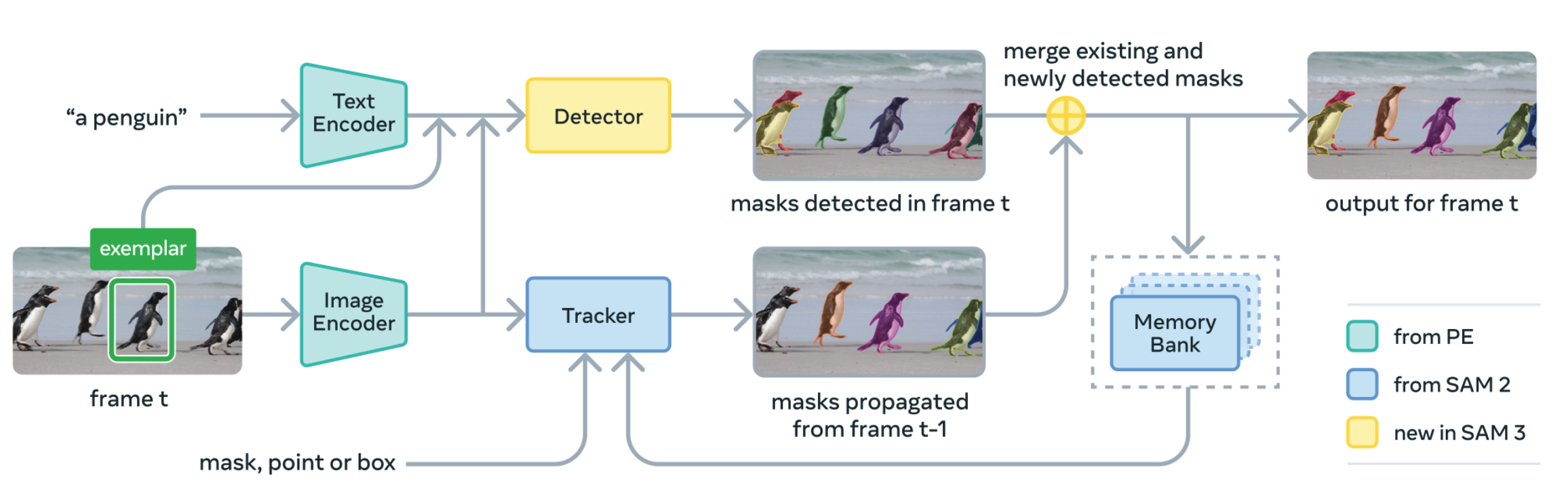 SAM 3 is a unified foundation model for promptable segmentation in images and videos. It can detect, segment, and track objects using text or visual prompts such as points, boxes, and masks. Compared to its predecessor