
Anteon (formerly Ddosify): eBPF-based Kubernetes Monitoring and Performance Testing
8.5k
Stars
388
Forks
19
Open issues
20
Contributors




AI Analysis
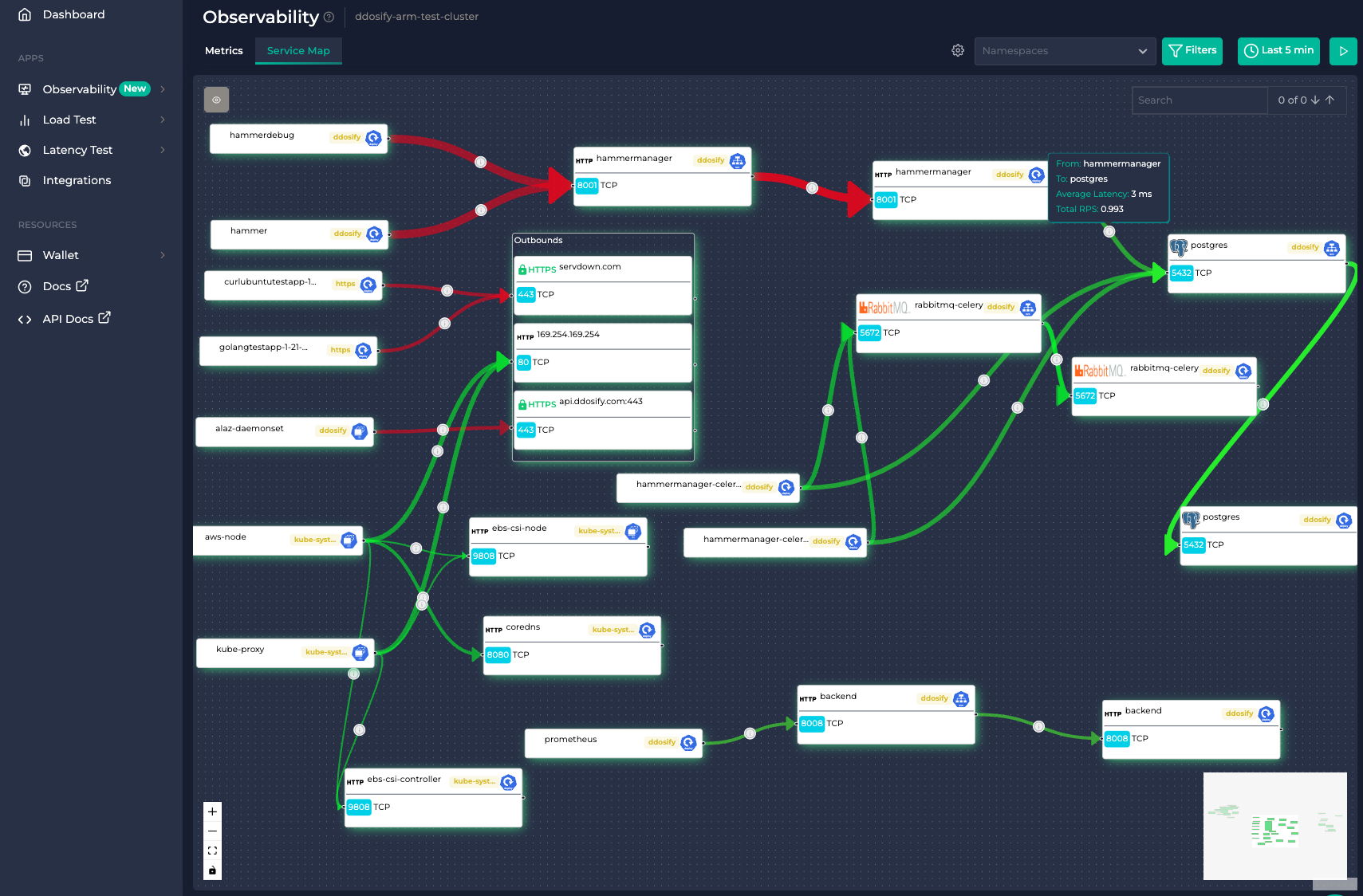
Anteon is an eBPF-based Kubernetes monitoring and performance testing platform that automatically generates service maps without code instrumentation or sidecars, helping teams identify performance bottlenecks and anomalies in their clusters. It serves DevOps engineers, SREs, and platform teams who need observability and load-testing capabilities for Kubernetes environments; it is not a general-purpose monitoring tool for non-Kubernetes workloads.
Inferred from signals mentioned in the README (tests, CI, type safety) — not a review of the actual code.
AI's overall editorial judgment — not an average of the bars above, can weigh other factors too.
Anteon combines eBPF-based Kubernetes observability with load testing in a single open-source platform
Anteon (formerly Ddosify) addresses two related but typically separate problems: understanding service behavior inside a Kubernetes cluster without code instrumentation, and generating load to stress-test those services. Its eBPF agent (Alaz) builds automatic service maps by observing kernel-level traffic, eliminating the need for sidecars or manual instrumentation. Target users are platform engineers and DevOps teams running Kubernetes who want correlated performance testing and observability without heavy agent overhead. It is listed on the CNCF landscape and offers both self-hosted and cloud-hosted options.
Started in August 2021 as Ddosify, a Go-based HTTP load testing tool. Rebranded to Anteon circa 2023-2024 when eBPF-based Kubernetes monitoring was added, significantly expanding scope from a single-purpose load generator to a combined observability and testing platform.
Early growth was driven by the Ddosify load engine gaining traction as a simpler alternative to k6/Locust. The rebrand and addition of eBPF monitoring brought a second wave of attention around 2023-2024, likely contributing to the bulk of the 8,525 stars. Zero stars in the last 7 days and a last push of March 2026 suggest growth has plateaued significantly.
CNCF Landscape inclusion provides some legitimacy signal. A live demo at demo.getanteon.com and Docker Hub 'Verified Publisher' status suggest the company has operational infrastructure. Discord community exists. However, concrete production deployment numbers, case studies, or named enterprise users are not referenced in the available README. Adoption not verified at scale.
Likely a multi-component system: a Go-based load engine (the original Ddosify core), an eBPF agent called Alaz (separate repository), and a self-hosted backend stack. The README references Docker Hub images and a selfhosted folder, suggesting a containerized deployment model. The eBPF approach appears to require privileged kernel access on cluster nodes, which is architecturally standard for this class of tooling.
Not documented in README
Last push was March 4, 2026 — approximately 3.5 months before the evaluation date of June 2026. This indicates the project is not actively releasing, though it is not completely abandoned. The gap between last activity and now, combined with zero recent star momentum, suggests the project may be in a maintenance-only or slow-development phase. No release cadence data is visible from the README excerpt.
ADOPT IF: you run Kubernetes and want zero-instrumentation service map visibility combined with load testing in a single self-hosted tool, and you are comfortable with AGPL-3.0 licensing and a smaller community. AVOID IF: you need enterprise support guarantees, a mature ecosystem with extensive integrations, or if AGPL licensing is incompatible with your commercial use case. MONITOR IF: you are evaluating eBPF-based observability broadly and want to track whether Anteon's development pace recovers or the project finds a stable niche before committing.
Independent dimensions
Mainstream potential
3/10
Technical importance
7/10
Adoption evidence
3/10
- Development activity appears to have slowed significantly — zero star growth in 7 days and a last push 3+ months ago raises questions about whether the project has sufficient commercial backing or contributor momentum to sustain feature development.
- AGPL-3.0 license is a blocker for many commercial and enterprise use cases, limiting potential adoption ceiling.
- The project competes on multiple fronts simultaneously (load testing AND observability), which risks being outperformed by specialists on each axis — tools like k6 for testing and Pixie for eBPF monitoring are more focused.
- eBPF-based agents require privileged kernel access, which may be restricted in managed Kubernetes environments (e.g., some GKE, AKS, EKS configurations), limiting deployment breadth.
- The rebrand from Ddosify to Anteon may have fragmented the existing community and confused discoverability, potentially slowing organic growth.
Anteon is likely to remain a viable niche tool for self-hosted eBPF observability with integrated load testing, but faces difficulty scaling adoption against more focused competitors unless development pace meaningfully resumes.
Newsletter
Get analyses like this every Monday
Free weekly digest of the most interesting open-source discoveries.
Languages
Information
- Website
- https://getanteon.com
- Language
- Go
- License
- AGPL-3.0
- Last updated
- 4mo ago
- Created
- 60mo ago
- Analyzed with
- anthropic/claude-haiku-4-5
Stars over time
Contributors over time
Top 100 contributors only — repos with more will plateau at 100.
Open issues
Baseline comparison across CI builds for load testing
Tests fail with go 1.24.0
5Million requests report not loading
Does ddosify have support to record the application flow using a proxy recorder
Big report not loading
Open pull requests
Bump golang.org/x/net from 0.8.0 to 0.36.0 in /ddosify_engine in the go_modules group across 1 directory
Bump lycheeverse/lychee-action from 1 to 2.0.2 in /.github/workflows in the github_actions group across 1 directory
fix: stabilize go test suite
Top contributors
Similar repos
| Repository | Stars | Week Δ | Language | Score | Updated |
|---|---|---|---|---|---|
|
getanteon/anteon
this
|
8.5k | +1 | Go | 7/10 | 4mo ago |
 antrea-io/antrea antrea-io/antrea
|
1.8k | — | Go | 8/10 | 13h ago |
 agones-dev/agones agones-dev/agones
|
6.9k | — | Go | 8/10 | 14h ago |
 odigos-io/odigos odigos-io/odigos
|
3.7k | — | Go | 8/10 | 12h ago |
 devtron-labs/devtron devtron-labs/devtron
|
5.5k | — | Go | 7/10 | 1d ago |
 thanos-io/thanos thanos-io/thanos
|
14.1k | — | Go | 8/10 | 23h ago |
The de facto Kubernetes monitoring stack. Far more mature and adopted, but requires explicit metric instrumentation. Anteon's eBPF approach requires zero code changes, which is a practical advantage for teams that can't modify services, though Prometheus has a vastly larger ecosystem and community.
The closest architectural peer — also eBPF-based, no-instrumentation Kubernetes observability. Pixie was acquired by New Relic and has deeper scripting capabilities. Anteon differentiates by bundling load testing natively, which Pixie does not offer.
For the load testing component only, k6 is significantly more mature with a large scripting ecosystem, CI/CD integrations, and cloud offering. Anteon's load engine is simpler and lower-friction but less extensible. The integrated K8s monitoring angle is Anteon's differentiator here.
Network traffic analysis tool with similar eBPF/packet-capture underpinnings. ntopng focuses on network-level visibility broadly, not Kubernetes service maps specifically. Different primary use case and audience.
Commercial observability platforms that also offer auto-instrumentation and service maps. They are far more feature-complete and enterprise-supported. Anteon competes on price (open source, self-hostable) and simplicity, not feature breadth.







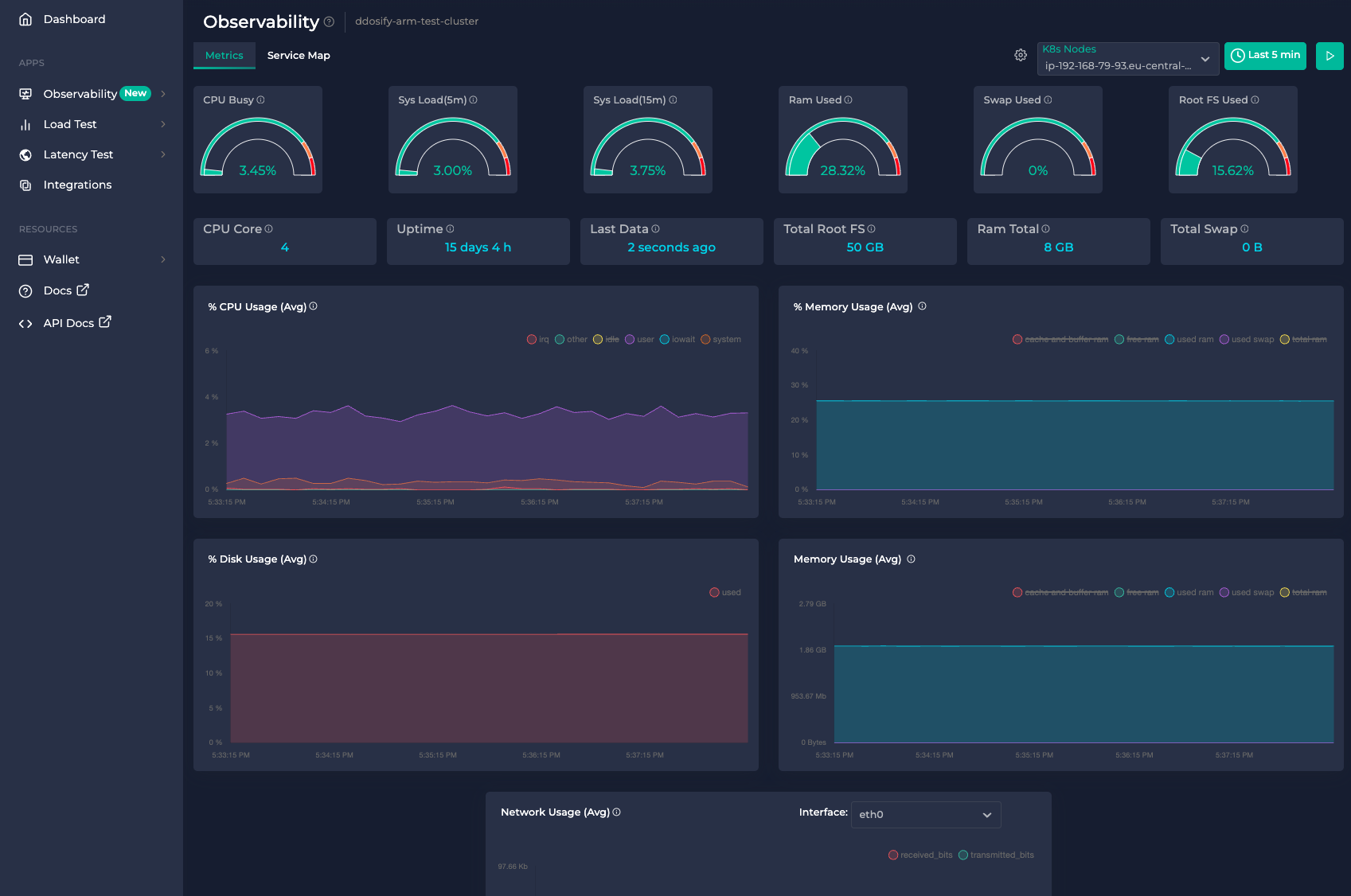 Anteon tracks and displays live data on your cluster instances CPU, memory, disk, and network usage.
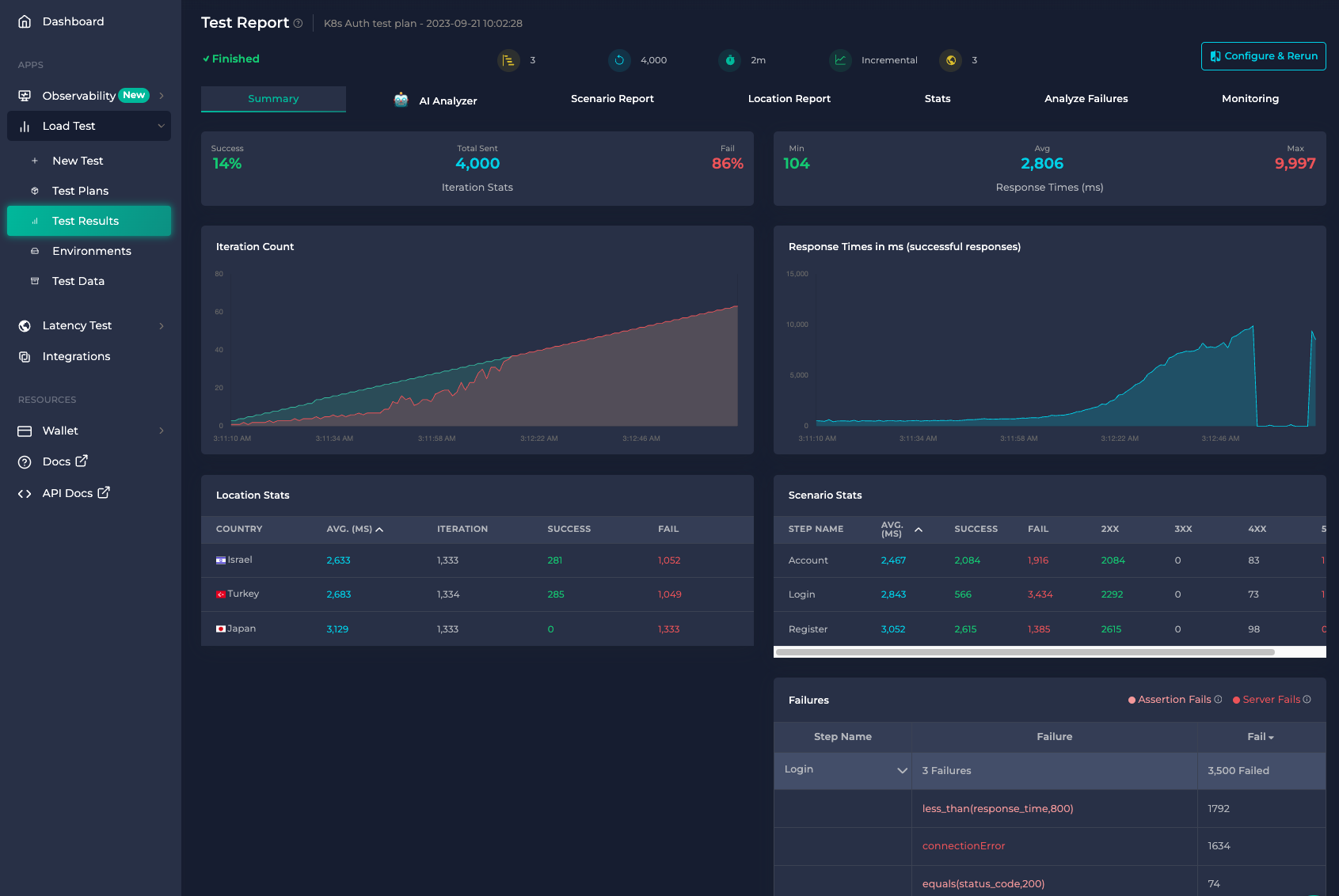 Anteon Performance Testing generates load from worldwide with no-code scenario builder.
