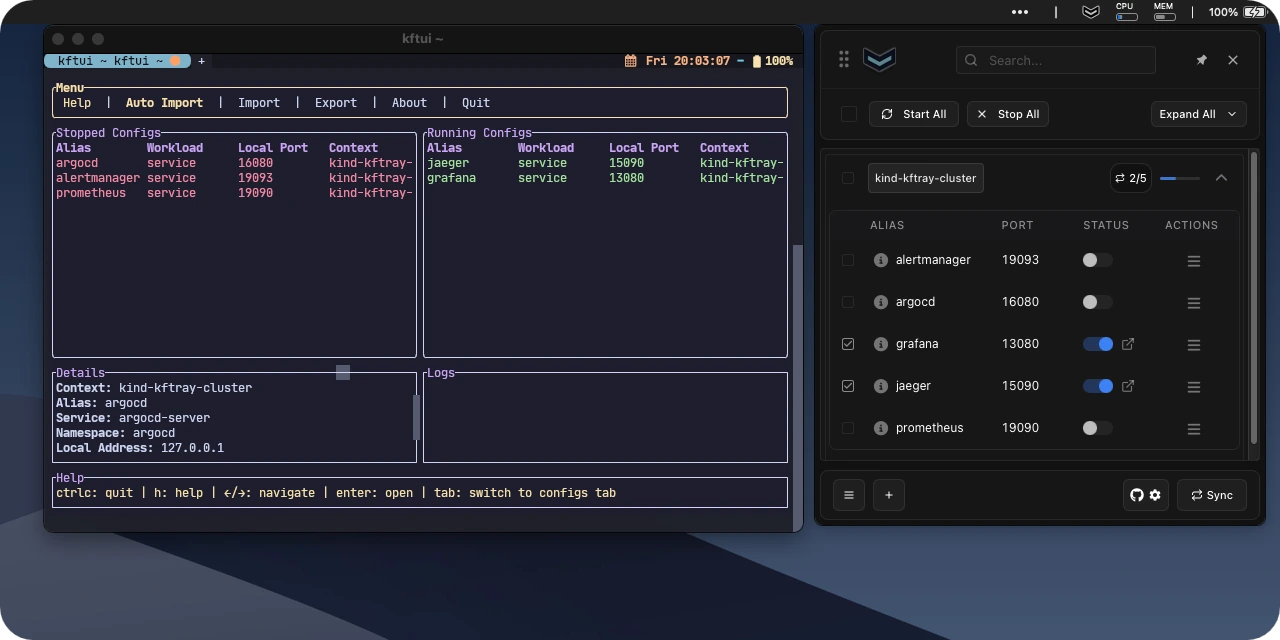
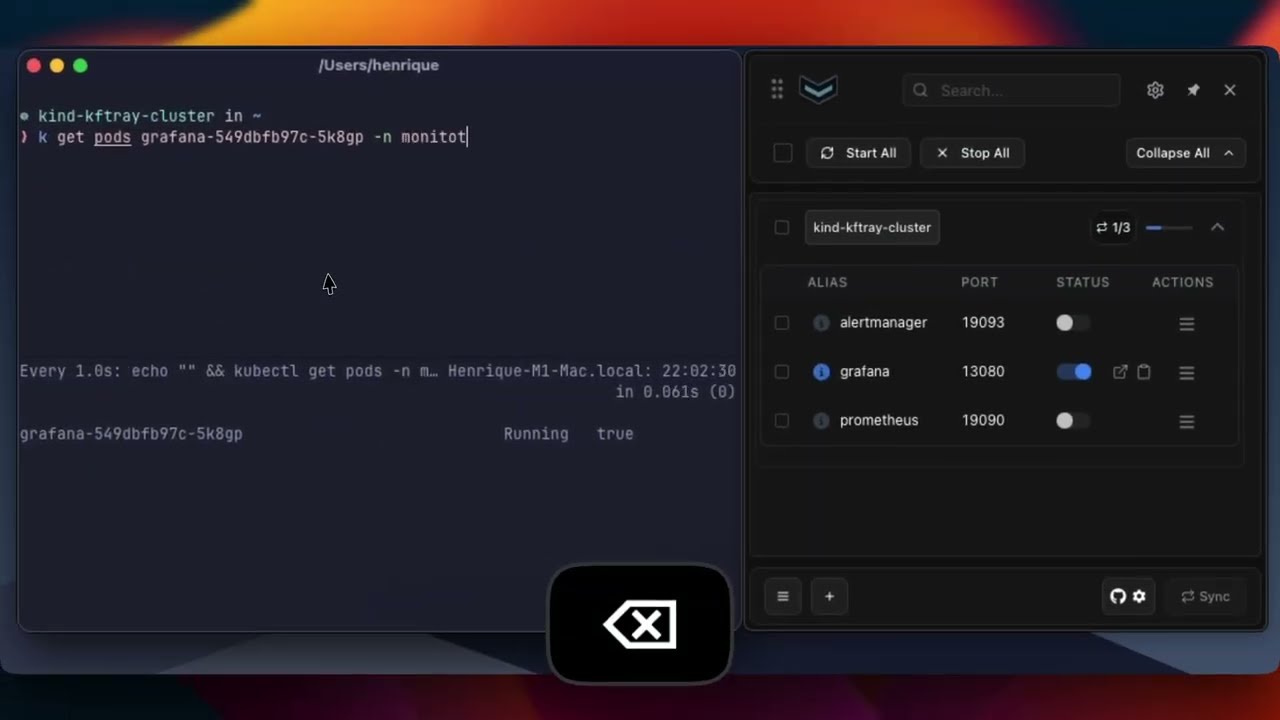
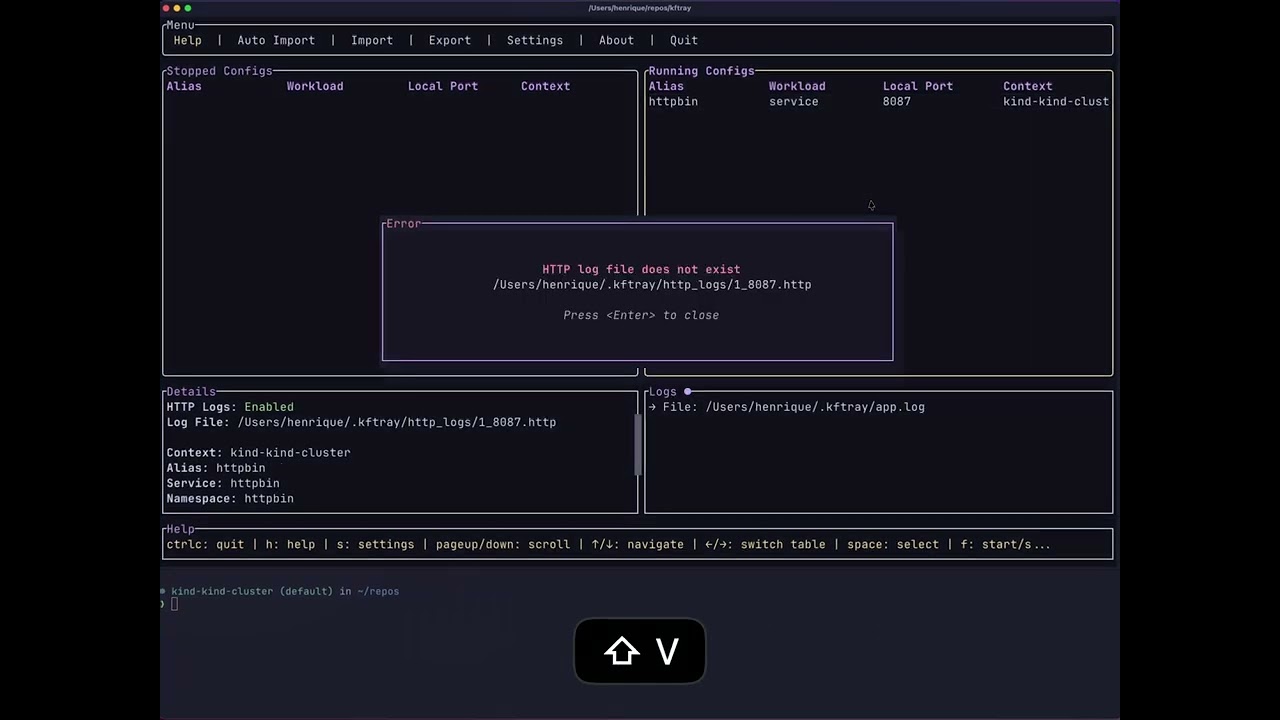
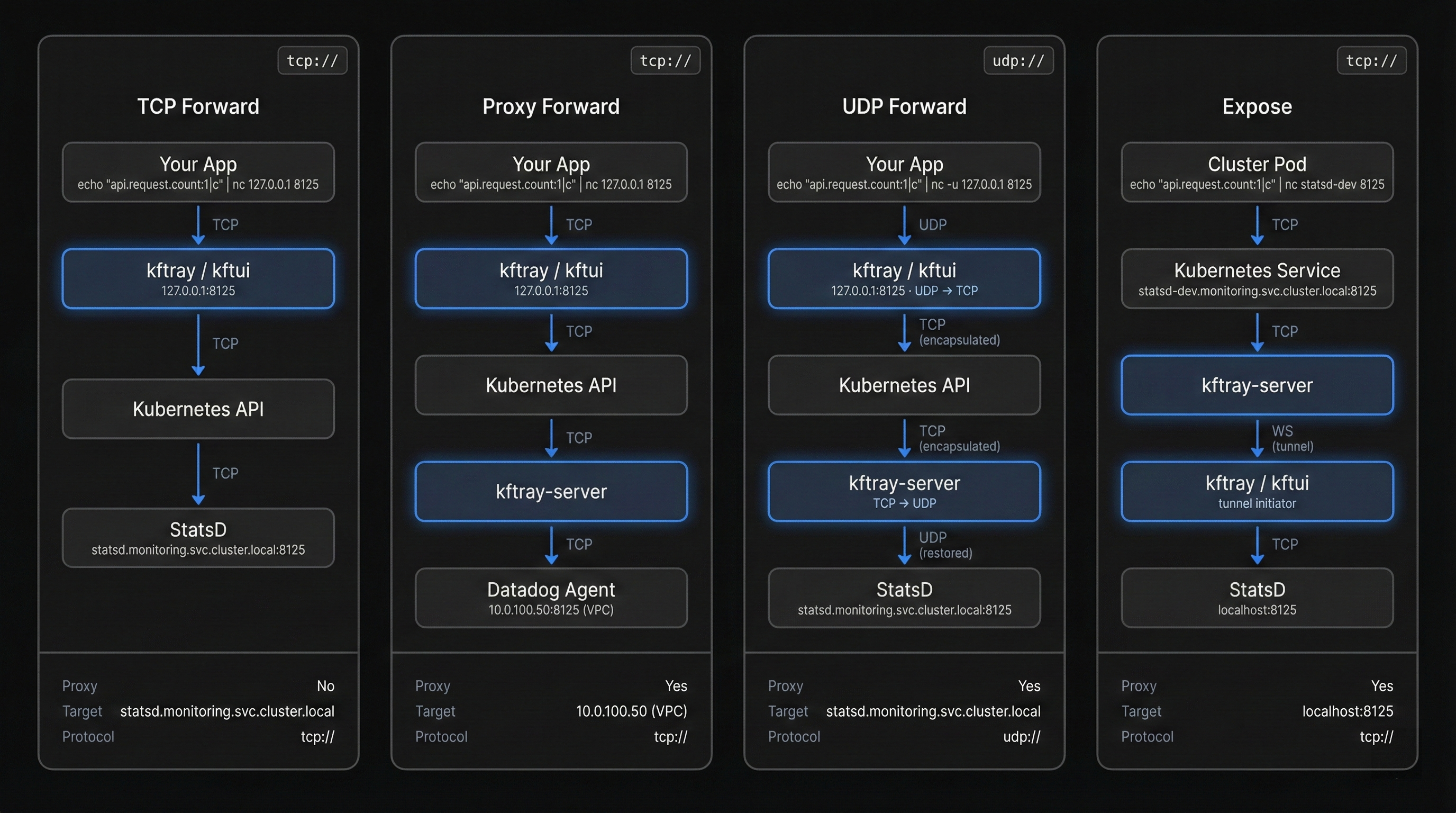
kubectl port-forward manager and reverse tunnel (ngrok-like) for exposing local services publicly, with TLS termination, HTTP traffic inspection, UDP forwarding, multi-hop proxy routing through k8s clusters, stateful config via filesystem or git - GUI and TUI available
1.5k
Stars
73
Forks
27
Open issues
13
Contributors



AI Analysis
kftray and kftui are Kubernetes port-forwarding tools (desktop GUI and TUI variants) that automatically reconnect when pods restart, support TCP/UDP forwarding, HTTP traffic inspection, and multi-hop proxy routing through clusters. Built for Kubernetes platform engineers and developers who need reliable, persistent port forwarding without manual intervention — not for general-purpose networking use.
Inferred from signals mentioned in the README (tests, CI, type safety) — not a review of the actual code.
AI's overall editorial judgment — not an average of the bars above, can weigh other factors too.
Rust-based kubectl port-forward manager with auto-reconnection, UDP support, and reverse tunnel capabilities
kftray and kftui are Kubernetes port forwarding tools that automate reconnection when pods restart, support both TCP and UDP, include HTTP traffic inspection, and offer both desktop (tray) and terminal UI interfaces. Built for Kubernetes operators and developers who find kubectl port-forward fragile for persistent workflows. Adoption appears concentrated in small-to-medium DevOps teams; mainstream adoption relative to kubectl port-forward remains limited but growing modestly.
Project created November 2023, built by hcavarsan as a response to the fragility of native kubectl port-forward behavior when pod lifecycles change. Initial release was single-mode; has since expanded to dual-interface (desktop + TUI) and added reverse tunnel features. Positioned as both a day-to-day improvement over kubectl and a ngrok-like exposing mechanism.
Repository gained 1,530 stars over ~2.5 years with recent trajectory showing 3 stars per week (as of early July 2026), suggesting plateau rather than acceleration. Last commit 2026-07-08 indicates active maintenance. Growth appears driven by organic discovery among Kubernetes-heavy teams rather than viral adoption. Similar-category tools (kubefwd: 4,137 stars; portr: 3,141 stars) have higher absolute adoption, indicating kftray has carved narrower but sustained niche.
Adoption not verified through concrete deployment data. No case studies, customer testimonials, or deployment scale metrics documented in README. GitHub downloads badge referenced but count not visible in excerpt. Presence of OpenSSF Scorecard and Best Practices badges suggests some production scrutiny, but does not confirm widespread real-world usage. Slack community exists but membership/activity level unknown.
Appears to be modular Rust codebase with shared backend between desktop (kftray) and TUI (kftui) frontends. README indicates Kubernetes watch API integration for pod lifecycle detection and proxy relay implementation for UDP/TCP. Likely uses native K8s client libraries; specific architectural decisions not detailed in README.
README displays Codecov badge and references testing infrastructure, but specific coverage percentage and test strategy not documented in excerpt. Presence of codecov integration suggests coverage is measured but degree of rigor unknown.
Last push 2026-07-08 (same-day as evaluation date) indicates active maintenance. Project has published releases, maintains Slack community, and hosts external documentation site (kftray.app). Frequency of updates and issue resolution velocity not visible from metadata alone, but recency of push suggests sustained activity rather than dormancy.
ADOPT IF: your workflow requires persistent, multi-pod port forwarding with automatic reconnection on pod restart, you need UDP forwarding through Kubernetes, or you want centralized HTTP traffic inspection for debugging. Also viable if you prefer Rust-native tooling or need reverse tunnel capabilities. AVOID IF: you only need occasional ad-hoc port forwarding (kubectl is simpler), your organization mandates Go-only tools, or you require commercial support and SLAs (project is community-maintained). MONITOR IF: your team currently uses kubefwd or portr but encounters pain points around pod lifecycle management or multi-forward workflows—kftray may solve those, but adoption is not yet proven at scale.
Independent dimensions
Mainstream potential
3/10
Technical importance
6/10
Adoption evidence
3/10
- Adoption remains limited relative to competitor tools; small user base may mean slower bug discovery and edge-case handling compared to mature alternatives.
- Desktop app GUI relies on system tray integration, which varies significantly across Linux/macOS/Windows—portability and OS-specific bugs likely.
- HTTP traffic logging and request replay features can expose sensitive data if not carefully scoped; README acknowledges this but no automated sanitization described.
- Project is single-maintainer or small-team driven (based on GitHub activity pattern); key-person risk if maintainer becomes unavailable.
- Kubernetes API watch integration may have performance implications at large scale or high pod churn; no performance benchmarks or scaling limits documented.
kftray likely remains a specialized tool for DevOps teams with high pod lifecycle churn, rather than displacing kubectl port-forward or becoming mainstream. May see modest adoption growth in specific niches (e.g., local development shops with microservices heavy on testing). Reverse tunnel feature could differentiate if marketed more; otherwise, trajectory suggests stable niche rather than rapid expansion.
Explore similar
Newsletter
Get analyses like this every Monday
Free weekly digest of the most interesting open-source discoveries.
Languages
Information
- Website
- https://kftray.app/
- Language
- Rust
- License
- GPL-3.0
- Last updated
- 14h ago
- Created
- 32mo ago
- Analyzed with
- anthropic/claude-haiku-4-5
Stars over time
Contributors over time
Top 100 contributors only — repos with more will plateau at 100.
Open issues
Top contributors
Similar repos
| Repository | Stars | Week Δ | Language | Score | Updated |
|---|---|---|---|---|---|
|
hcavarsan/kftray
this
|
1.5k | +2 | Rust | 8/10 | 14h ago |
 txn2/kubefwd txn2/kubefwd
|
4.1k | — | Go | 8/10 | 2d ago |
 devtron-labs/devtron devtron-labs/devtron
|
5.5k | — | Go | 7/10 | 1d ago |
 kdash-rs/kdash kdash-rs/kdash
|
2.5k | — | Rust | 8/10 | 12h ago |
 amalshaji/portr amalshaji/portr
|
3.1k | — | Go | 7/10 | 2d ago |
 kevwan/tproxy kevwan/tproxy
|
3.7k | — | Go | 7/10 | 4w ago |
Broader adoption and Go simplicity; kubefwd is older and more established. kftray offers UDP support and reverse tunnel features kubefwd may lack, but smaller user base likely means less battle-testing in edge cases.
Similar feature set for exposing local services; portr appears to focus more narrowly on that use case. kftray combines kubectl forwarding and local exposure in single tool, which may add or subtract value depending on workflow.
kftray addresses a real problem (fragile reconnection, single pod at a time), but kubectl remains zero-friction for ad-hoc tasks and is pre-installed. kftray requires installation and learning curve, limiting displacement of kubectl for casual use.
Also Rust-based K8s tool but focuses on general cluster dashboard/monitoring. Different problem domain; no direct feature overlap.
Full CI/CD platform; port forwarding is ancillary feature. kftray is specialized tool, not platform competitor.