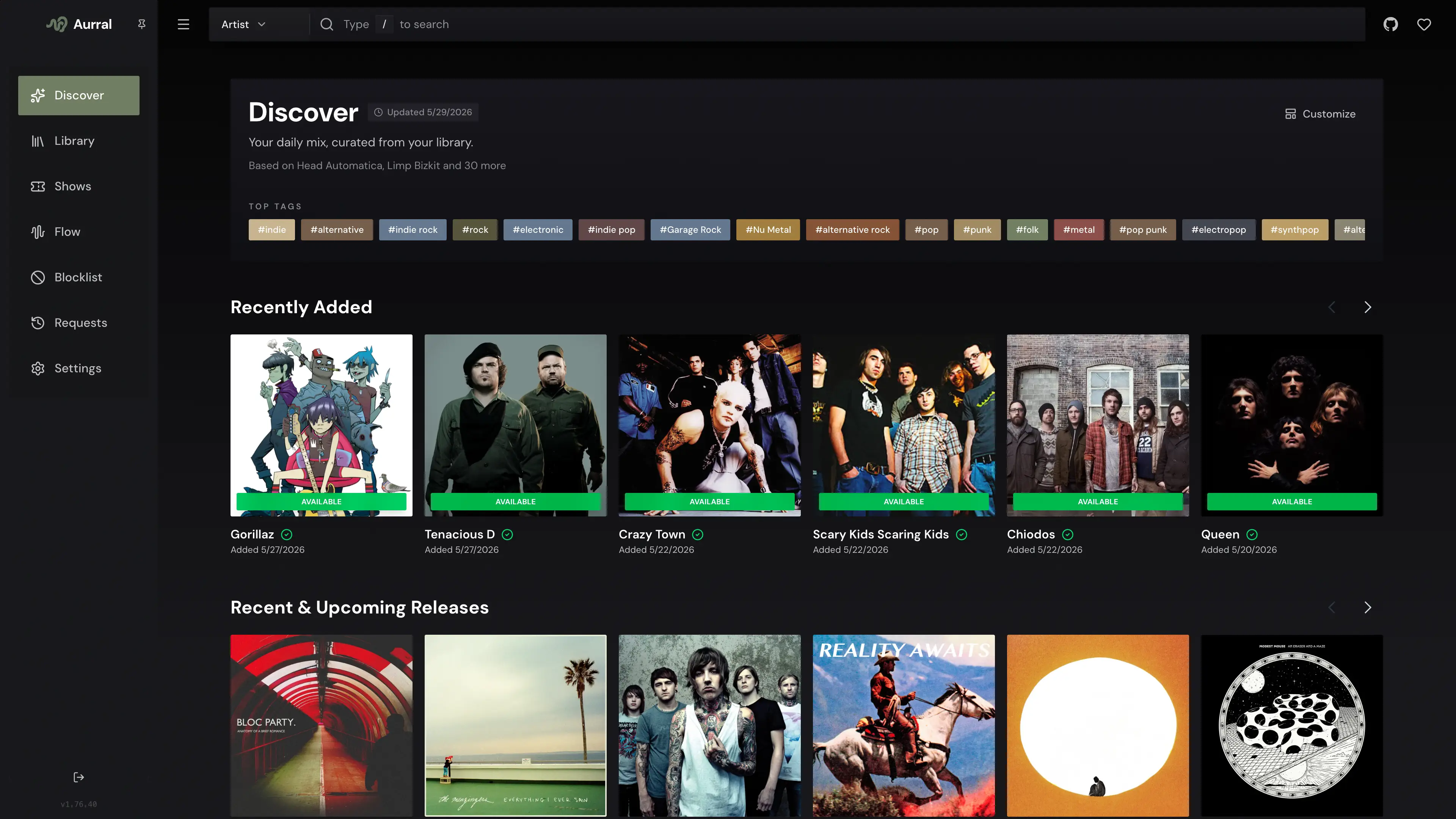
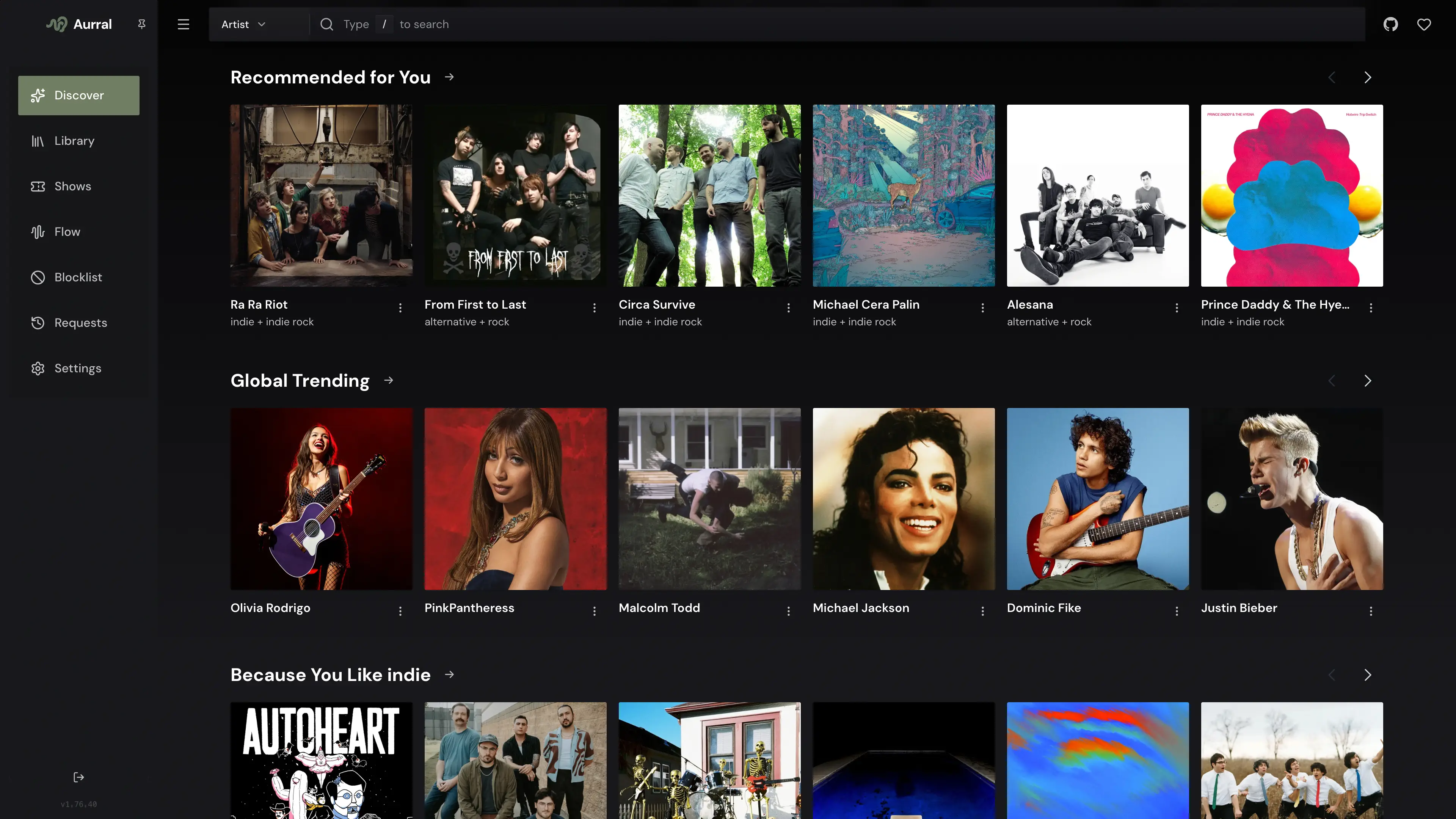
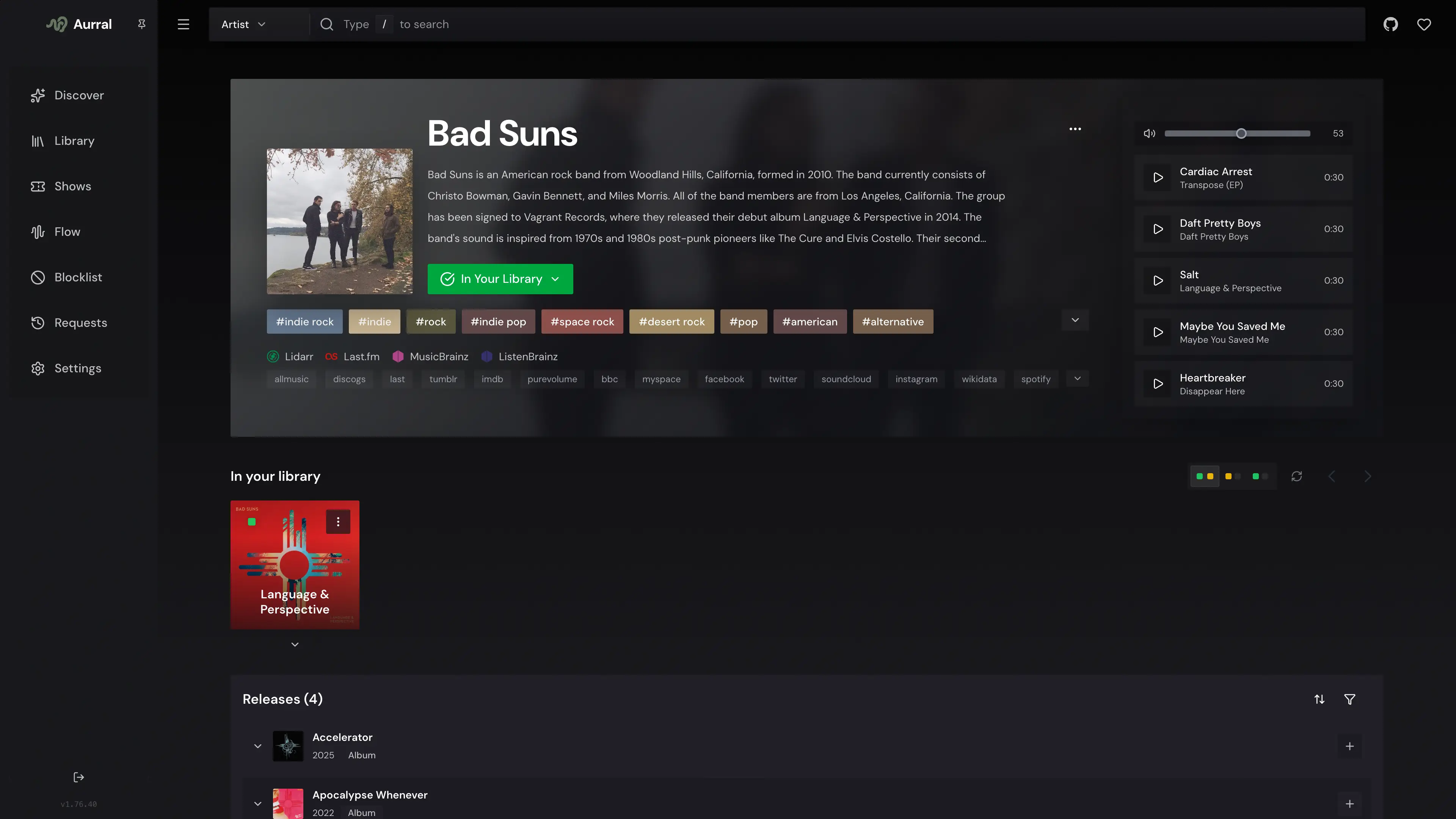
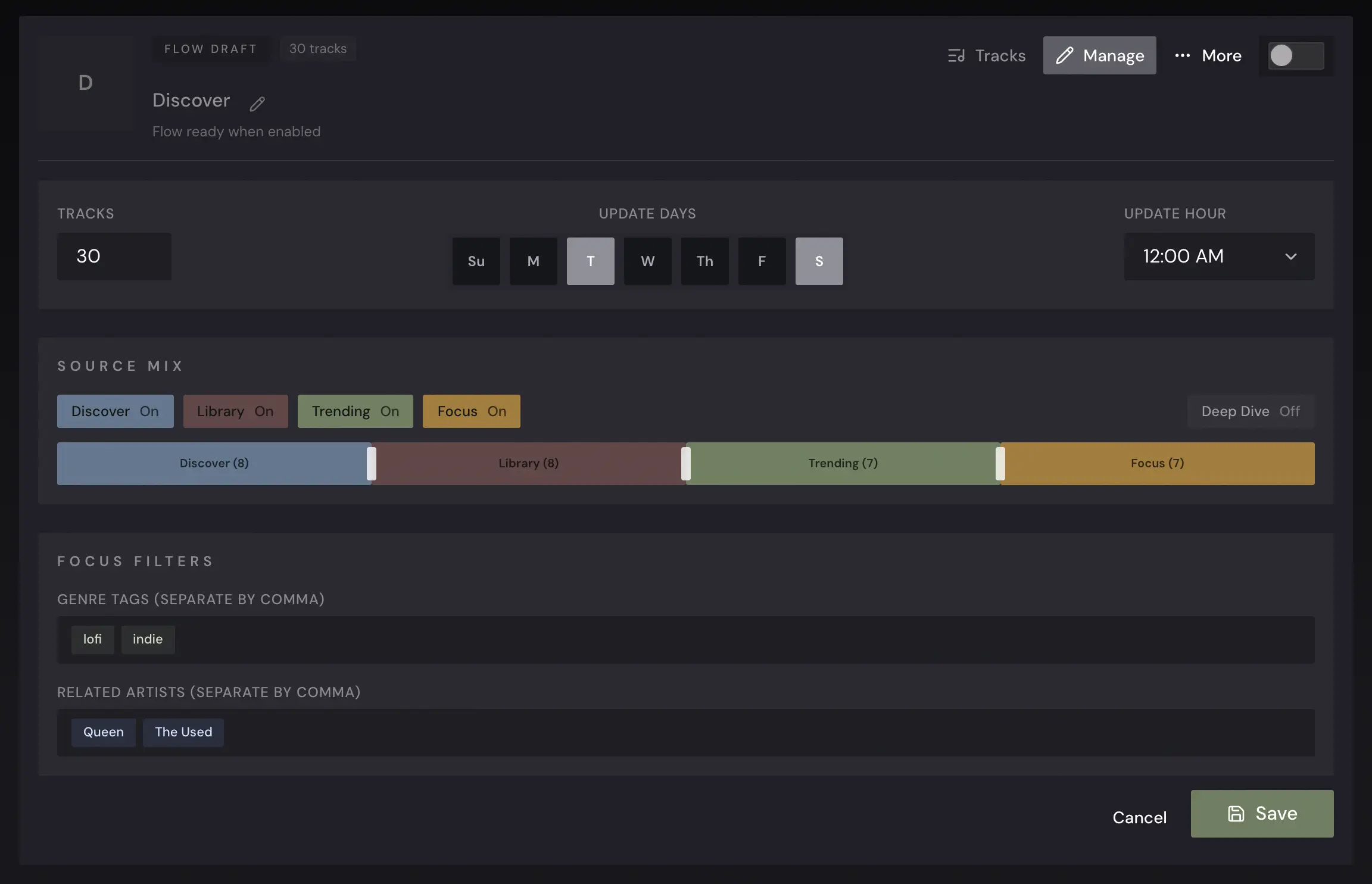
The best in open-source music discovery.
1.2k
Stars
52
Forks
18
Open issues
15
Contributors


AI Analysis
Aurral is a self-hosted music discovery platform designed specifically for Lidarr users, enabling intelligent artist discovery, album requests, and scheduled discovery flows while keeping generated files separate from the main music library. It serves music enthusiasts and home media server operators who want a visual, intentional discovery workflow integrated with their existing Lidarr setup, and is not a general-purpose music streaming or library management tool.
Inferred from signals mentioned in the README (tests, CI, type safety) — not a review of the actual code.
AI's overall editorial judgment — not an average of the bars above, can weigh other factors too.
Self-hosted music discovery companion for Lidarr, six months into active development with steady early adoption.
Aurral is a JavaScript web application designed specifically for Lidarr users who want a structured, visual music discovery workflow. It bridges the gap between music library management (Lidarr) and discovery by offering personalized recommendations, scheduled discovery flows, playlist imports, and integration with Last.fm, Navidrome, and Ticketmaster. The project targets people who actively curate music collections and want discovery to feel intentional rather than algorithmic-only. Early signals suggest adoption within a self-hosted music enthusiast community, though scale remains modest.
Created in January 2026, Aurral is a recently launched project emerging from the self-hosted media server ecosystem. It fills a specific gap: while Lidarr handles library management and Navidrome handles playback, Aurral adds the discovery-to-library workflow layer. The README emphasizes it is purpose-built for this use case rather than a general music app.
The project gained 1,139 stars in approximately five and a half months (January to June 2026), averaging roughly 200 stars per month. The last seven days show 21 new stars, suggesting modest but stable weekly activity. Growth appears driven by organic discovery within the self-hosted/Lidarr community rather than viral adoption. The steady cadence and Docker-ready deployment suggest adoption among technically sophisticated home-lab users.
Adoption not verified through explicit case studies or enterprise deployments in README. However, indirect signals include: (1) Docker image published to GHCR, suggesting production-readiness and recurring use, (2) multi-user and permission system implemented, indicating expectation of household/team deployments, (3) Discord community present, implying real users reporting issues and seeking help, (4) star count (1,139) and fork count (51) consistent with active hobby/enthusiast adoption in the Lidarr ecosystem. Scale of production use remains uncertain.
Appears to be a full-stack JavaScript application (frontend and backend), likely Node.js-based given the JavaScript designation. Based on README, it integrates with multiple external services (Lidarr, Last.fm, Navidrome, Subsonic, Ticketmaster, Soulseek, Gotify) via API. The application manages user accounts, permissions, scheduled tasks (flows), and file management (hardlinks/copies). README mentions Docker support and reverse-proxy auth, suggesting cloud-deployment readiness.
Not documented in README. No test framework, CI/CD details, or coverage metrics mentioned in provided materials.
Last push 2026-06-29, one day before the analysis date, indicates active, ongoing development. Regular releases are published (GitHub Release badge present). Build CI/CD workflow is configured (GitHub Actions). Discord community linked, suggesting active maintainer engagement. Six months into development with consistent pushes suggests the project is not stagnant, though release cadence details are not visible in README.
ADOPT IF: You maintain a Lidarr library, value intentional discovery workflows over algorithmic playlists, and are comfortable running Docker containers in a home-lab environment. Last.fm integration provides meaningful personalization. AVOID IF: You need mature, battle-tested production systems with extensive documentation and support SLAs; you do not use Lidarr; or you prefer all-in-one music platforms over composable self-hosted stacks. MONITOR IF: You are curious about music discovery UX in self-hosted contexts or track the Lidarr ecosystem. The project is actively maintained and appears well-designed for its niche, but real-world scale and long-term viability are not yet fully demonstrated.
Independent dimensions
Mainstream potential
3/10
Technical importance
5/10
Adoption evidence
4/10
- Adoption appears concentrated within Lidarr ecosystem; growth outside that niche is unverified, limiting mainstream visibility.
- Dependency on Last.fm API and optional services (Ticketmaster, Soulseek) creates external brittleness; service outages or API changes could degrade functionality.
- Project is six months old; long-term maintenance commitment by maintainer(s) unverified. Small fork count (51) suggests low community contribution relative to stars.
- Test coverage and CI/CD details not documented, making code quality assessment difficult beyond what README claims.
- User base is likely self-hosted enthusiasts; commercial support, documentation depth, and enterprise hardening are not priorities and may limit adoption beyond hobbies.
Likely to remain a valued, actively maintained tool within the self-hosted Lidarr community. Organic adoption will probably continue at a modest pace (200–300 stars per month) as the self-hosted music ecosystem grows. Mainstream breakthrough to non-Lidarr users appears unlikely unless the project decouples from Lidarr or acquires significantly more marketing. Continued technical improvements and community engagement suggest the project will not be abandoned in the near term.
Newsletter
Get analyses like this every Monday
Free weekly digest of the most interesting open-source discoveries.
Languages
Information
- Website
- https://aurral.org
- Language
- JavaScript
- License
- MIT
- Last updated
- 15h ago
- Created
- 6mo ago
- Analyzed with
- anthropic/claude-haiku-4-5
Stars over time
Contributors over time
Top 100 contributors only — repos with more will plateau at 100.
Open issues
Recommended for You recommendations disappear after page change or browser refresh
[Feature request] Add more lidarr instances
Bug: Auth Proxy session drop causes frontend lockup / WebSocket 401 instead of window redirect
Feature request: per-user Plex connection so each Aurral user's flow playlists land on their own Plex account
Proxy Auth Fails If User Does Not Exist
Top contributors
Similar repos

NeptuneHub/AudioMuse-AI
AudioMuse-AI is a self-hosted tool that analyzes music audio characteristics to...

any-listen/any-listen
any-listen is a cross-platform private music playback service offering both...
| Repository | Stars | Week Δ | Language | Score | Updated |
|---|---|---|---|---|---|
|
lklynet/aurral
this
|
1.2k | +12 | JavaScript | 8/10 | 15h ago |
 Lidarr/Lidarr Lidarr/Lidarr
|
5.5k | — | C# | 7/10 | 4w ago |
|
NeptuneHub/AudioMuse-AI
|
2.2k | — | Python | 7/10 | 15h ago |
 epoupon/lms epoupon/lms
|
1.6k | — | C++ | 7/10 | 2w ago |
|
any-listen/any-listen
|
3.1k | — | TypeScript | 7/10 | 1d ago |
 akudamatata/Solara akudamatata/Solara
|
1.5k | — | JavaScript | 7/10 | 2w ago |
Lidarr handles library management and monitoring. Aurral is complementary, not competitive—it uses Lidarr as a dependency. Aurral adds discovery and flow management on top of Lidarr.
Navidrome is a music streaming server. Aurral integrates with Navidrome to publish flows and playlists for playback, but Aurral's focus is discovery and curation, not streaming infrastructure.
AudioMuse-AI appears AI-focused (Python-based). Aurral emphasizes structured discovery flows and Last.fm integration over algorithmic AI. Different philosophy and user expectations.
Solara is JavaScript-based and music-related but specifics not evident from title alone. Both are self-hosted music tools but likely serve distinct purposes within the ecosystem.
Aurral integrates with Subsonic/Navidrome as playback targets. It is not a playback server itself but a discovery layer feeding into streaming infrastructure.