Isaac Lab API, powered by MuJoCo-Warp, for RL and robotics research
2.7k
Stars
446
Forks
35
Open issues
30
Contributors



AI Analysis
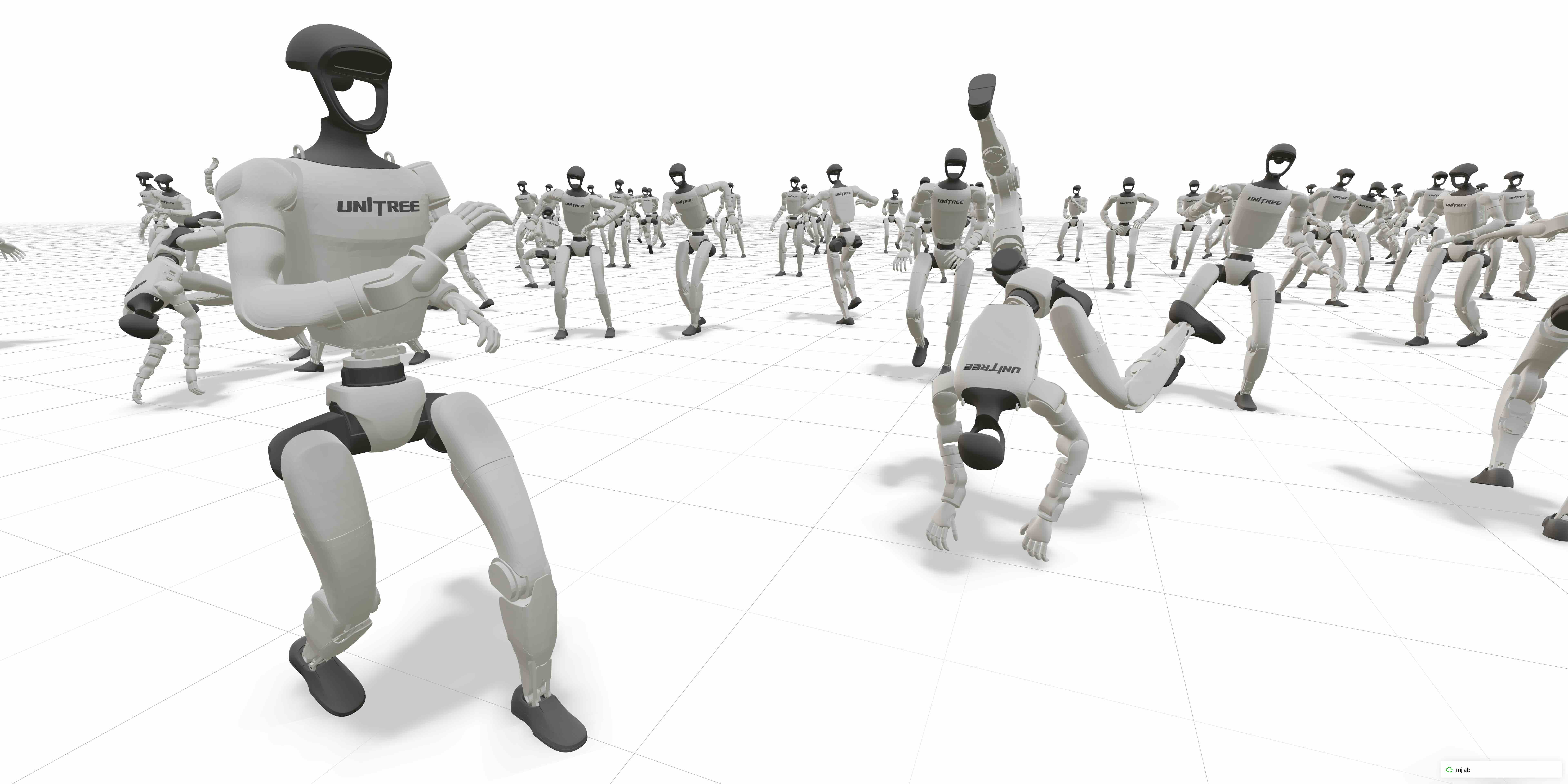
mjlab is a GPU-accelerated reinforcement learning and robotics simulation framework combining Isaac Lab's manager API with MuJoCo-Warp. It specializes in humanoid control tasks (velocity tracking, motion imitation) and is designed for researchers and practitioners building RL agents on high-performance physics simulation, not for general-purpose physics modeling or casual users.
Inferred from signals mentioned in the README (tests, CI, type safety) — not a review of the actual code.
AI's overall editorial judgment — not an average of the bars above, can weigh other factors too.
MuJoCo-powered RL framework combining Isaac Lab's API with GPU-accelerated simulation
mjlab is a Python framework for robot learning and reinforcement learning research that combines Isaac Lab's composable manager API with MuJoCo Warp (GPU-accelerated MuJoCo). Created in June 2025 and actively maintained, it targets robotics researchers seeking faster simulation with simpler dependencies than full physics engines. Appears to serve researchers who need MuJoCo's fidelity but want Isaac Lab's ergonomic abstractions, without requiring heavyweight NVIDIA Omniverse dependencies.
mjlab emerged in June 2025 as a synthesis project: directly borrowing Isaac Lab's API patterns (with BSD-3-Clause attribution) while targeting the newer MuJoCo Warp backend for GPU acceleration. Authors credit both NVIDIA Isaac Lab team and MuJoCo Warp developers. Appears designed to fill a gap between raw MuJoCo performance and the heavier IsaacLab ecosystem.
Repository created mid-June 2025, gained 2,603 GitHub stars by June 2026 (roughly one year). Recent activity shows +85 stars in 7 days (as of 2026-06-29), last push 2026-06-27, suggesting sustained momentum. Growth appears tied to release of research paper (arXiv 2601.22074, cited in README) and active use in published robotics research. PyPI presence and nightly benchmark badges indicate production-grade infrastructure investment.
README cites publication in peer-reviewed robotics research and references 'open-source robotics projects.' PyPI download metrics available (badge present). Google Colab notebook provided for zero-setup trials. No specific adoption numbers disclosed, but citation request in README and research page suggests academic/research adoption. Concrete production adoption metrics not verified.
Appears to be a Python framework providing managers and composable building blocks for environment design, wrapping MuJoCo Warp. README emphasizes 'minimal dependencies and direct access to native MuJoCo data structures.' Likely uses Isaac Lab's manager patterns for scene, task, and agent abstraction. GPU training required; macOS limited to evaluation. Multi-GPU distributed training supported via command-line flags.
Not documented in README. CI badge present (GitHub Actions), suggesting automated testing infrastructure exists, but specific coverage metrics not reported.
Last push 2026-06-27 (2 days before analysis date). Repository is 1 year old. Active CI/CD pipeline, nightly benchmarks, documentation hosting, and PyPI releases indicate sustained maintenance. Make targets for testing and formatting suggest developer-friendly tooling. No indicators of abandonment.
ADOPT IF: you are a robotics/RL researcher needing MuJoCo simulation fidelity with GPU acceleration, prefer Isaac Lab's API design, and want to avoid Omniverse dependencies. ADOPT IF: you value minimal setup (PyPI install, Google Colab support) and reproducible multi-GPU training. AVOID IF: you need NVIDIA Omniverse's advanced rendering, photorealism, or sensor simulation. AVOID IF: you require production stability guarantees or vendor support contracts. MONITOR IF: you are evaluating frameworks; mjlab is actively maintained and research-backed but adoption remains concentrated in academic robotics community; unclear if it will achieve wider industrial adoption.
Independent dimensions
Mainstream potential
4/10
Technical importance
7/10
Adoption evidence
5/10
- Adoption not verified beyond peer-reviewed research; no disclosed enterprise or production deployment cases.
- One-year-old project: API stability and long-term maintenance commitment unproven. Depends on continued MuJoCo Warp development by DeepMind.
- GitHub stars (~2,600) modest relative to IsaacLab (7,547) and comparable frameworks; adoption concentration may limit ecosystem growth and third-party extensions.
- Requires NVIDIA GPU; CPU/hobbyist use unsupported. Limits accessibility for edge deployment or resource-constrained research.
- README-level documentation strong, but codebase inspection impossible from metadata alone; actual code quality and maintainability unverifiable without source review.
mjlab will likely remain a specialized tool for academic robotics research and MuJoCo-focused RL studies. Star growth suggests incremental adoption among researchers, but lacks clear path to mainstream industry adoption. Success depends on continued research publication, stable API, and MuJoCo Warp ecosystem maturity. May establish niche leadership in 'lightweight GPU-accelerated RL' segment without challenging IsaacLab's broader ecosystem.
Newsletter
Get analyses like this every Monday
Free weekly digest of the most interesting open-source discoveries.
Languages
Information
- Language
- Python
- License
- Apache-2.0
- Last updated
- 1d ago
- Created
- 13mo ago
- Analyzed with
- anthropic/claude-haiku-4-5
Stars over time
Contributors over time
Top 100 contributors only — repos with more will plateau at 100.
Open issues
qfrc_constraint seems incorrect with multiple environments
Recommended way to access effort limits in reward functions?
Viser reward bar panel silently drops terms beyond the 20th (max_terms not configurable from setup_tabs)
A100
why RuntimeError: normal expects all elements of std >= 0.0 happens
Top contributors
Similar repos

google-deepmind/mujoco_playground
MuJoCo Playground is a GPU-accelerated simulation environment suite for robot...
google-deepmind/mujoco_warp
MuJoCo Warp (MJWarp) is a GPU-accelerated physics simulator built on NVIDIA...
google-deepmind/mujoco
MuJoCo is a general-purpose physics simulator developed by Google DeepMind that...
google-deepmind/dm_control
dm_control is Google DeepMind's software stack for physics-based simulation and...
| Repository | Stars | Week Δ | Language | Score | Updated |
|---|---|---|---|---|---|
|
mujocolab/mjlab
this
|
2.7k | +37 | Python | 8/10 | 1d ago |
|
google-deepmind/mujoco_playground
|
2.1k | — | Python | 8/10 | 24h ago |
|
google-deepmind/mujoco_warp
|
1.4k | — | Python | 8/10 | 23h ago |
|
google-deepmind/mujoco
|
14.1k | — | C++ | 8/10 | 20h ago |
|
google-deepmind/dm_control
|
4.6k | — | Python | 8/10 | 2d ago |
 isaac-sim/IsaacLab isaac-sim/IsaacLab
|
7.6k | — | Python | 8/10 | 15h ago |
IsaacLab has ~3x more stars (7,547 vs 2,603). mjlab explicitly reuses IsaacLab's manager API but replaces Omniverse backend with MuJoCo Warp. IsaacLab is heavier; mjlab markets 'minimal dependencies.' IsaacLab targets NVIDIA Omniverse workflows; mjlab targets research needing MuJoCo fidelity.
mjlab is a higher-level framework built on MuJoCo Warp. Direct comparison difficult (MuJoCo Warp is lower-level infrastructure). mjlab adds environment managers, training pipelines, and RL abstractions.
Raw MuJoCo is a physics engine; mjlab is a RL training framework. mjlab adds GPU acceleration via Warp wrapper and RL-specific abstractions (environments, agents, tasks).
Similar star count (2,025 vs 2,603). Appears to be a separate MuJoCo-based project. Direct feature comparison not clear from metadata.
mjlab is environment management + training framework; Gym/Gymnasium are core interfaces. mjlab likely compatible or inspired by Gym patterns but focuses on robotics-specific task abstractions.