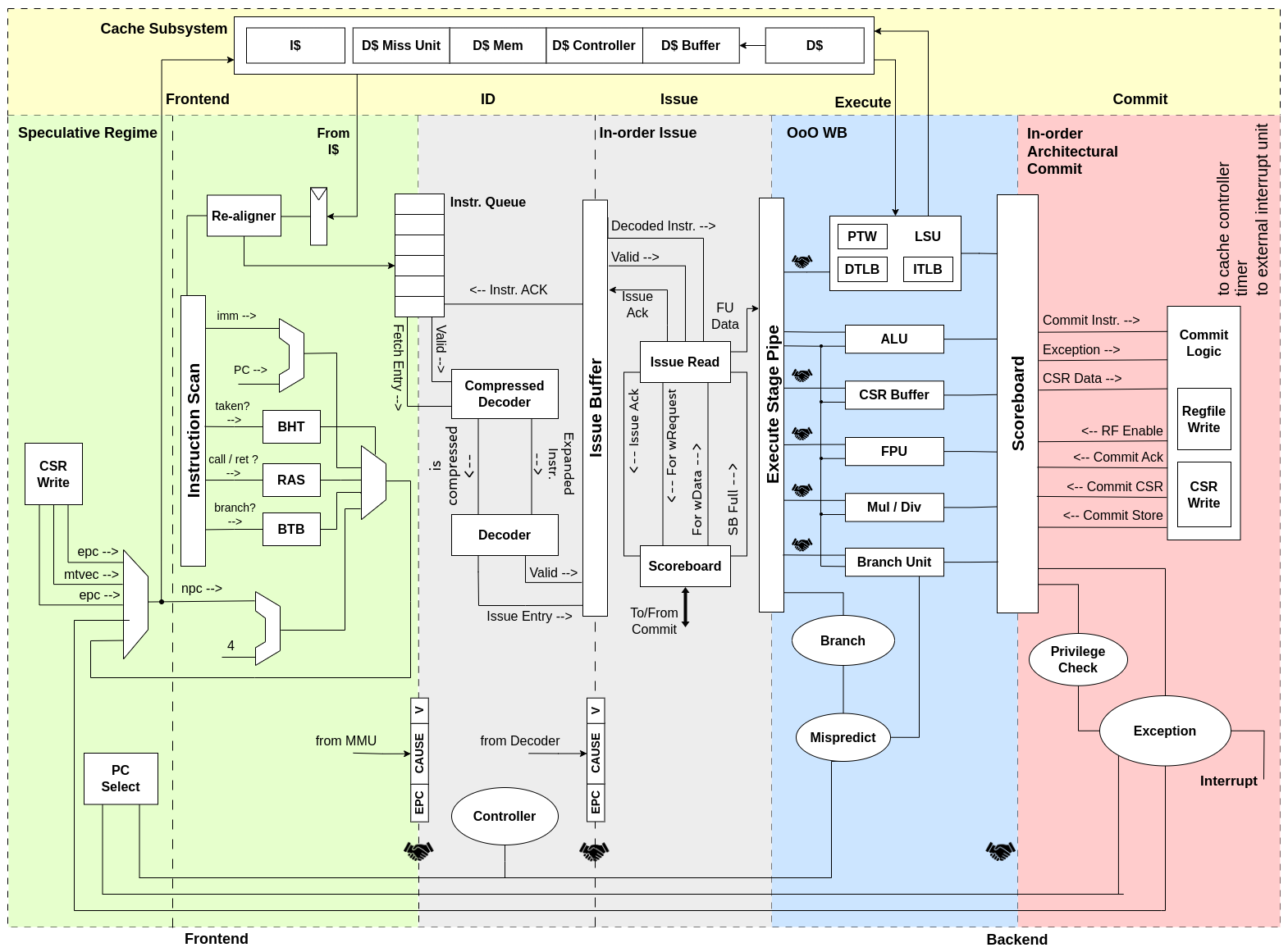
The CORE-V CVA6 is a highly configurable, 6-stage RISC-V core for both application and embedded applications. Application class configurations are capable of booting Linux.
3k
Stars
965
Forks
265
Open issues
30
Contributors


AI Analysis
CVA6 is a configurable, open-source 64-bit RISC-V CPU core designed for both application and embedded use cases, with Linux-capable configurations. It is a specialized hardware design project for CPU architects, FPGA implementers, and ASIC designers—not a general-purpose tool—and benefits organizations building custom processors or learning CPU design.
Inferred from signals mentioned in the README (tests, CI, type safety) — not a review of the actual code.
AI's overall editorial judgment — not an average of the bars above, can weigh other factors too.
Open-source RISC-V CPU core targeting embedded and application-class systems, backed by OpenHW Group
CVA6 is a configurable 6-stage RISC-V CPU core implementing the 64-bit ISA with I, M, A, C extensions and Unix-like OS support. Designed by OpenHW Group with emphasis on reducing critical path length. Used primarily by academic researchers, embedded systems developers, and organizations evaluating RISC-V implementations. Adoption appears concentrated in research institutions and semiconductor partners rather than mass-market products.
CVA6 originated in 2018 as part of OpenHW Group's CORE-V initiative to provide open reference implementations of RISC-V cores. Evolved from earlier internal designs, now maintained as a community-driven project with contributions from multiple organizations in the RISC-V ecosystem.
Repository shows steady, moderate growth: 2,970 stars accumulated over 8+ years with 4 stars in past 7 days (as of 2026-06-28), indicating stable but not accelerating interest. 962 forks suggest active use for derivative designs. Growth appears driven by RISC-V ecosystem maturation and adoption by research/embedded communities rather than viral adoption.
Adoption not verified at scale. Evidence suggests use in: (1) OpenHW Group ecosystem (official backing); (2) academic research and RISC-V validation efforts (inferred from comprehensive documentation and testbenches); (3) FPGA prototyping and ASIC implementation workflows (tutorials provided). No public announcements of shipping products, silicon tape-outs, or major commercial deployments identifiable from repository.
Likely a SystemVerilog-based RTL design (primary language listed as Assembly, but this appears metadata artifact) implementing a 6-stage in-order pipeline. Includes configurable TLB sizes, hardware page table walker, branch prediction (BTB/BHT), and separate instruction/data TLBs. README indicates modular design separating CVA6 core from CORE-V APU platform. Appears to prioritize reduced critical path over peak throughput.
Verification environment documented in verif/ directory with regression suites, riscv-dv integration, UVM testbench (uvmt_cva6), board support package (BSP), and CI pipelines. README indicates smoke tests, but specific test coverage metrics not documented in README.
Last push 2026-06-16 (12 days before evaluation date) indicates active maintenance. CI pipeline badges and ReadTheDocs integration show ongoing infrastructure investment. No evidence of unmaintained status. Maintenance appears steady rather than accelerating — consistent with mature project in stable state rather than under heavy active development.
ADOPT IF: you are building RISC-V research systems, FPGA prototypes, or embedded applications requiring Linux-capable cores with configurable parameters, AND you can commit to integration and validation work. AVOID IF: you need proven production silicon, commercial long-term support, or off-the-shelf SoC integration — use Rocket or SiFive alternatives instead. MONITOR IF: you are tracking RISC-V ecosystem maturity and adoption signals; CVA6 is architecturally sound but market adoption remains narrow.
Independent dimensions
Mainstream potential
3/10
Technical importance
7/10
Adoption evidence
3/10
- Adoption concentrated in research/academic settings with unclear path to commercial production volume
- Limited evidence of real-world silicon deployments or shipping products using CVA6
- Integration complexity: comprehensive toolchain and submodule dependencies may create friction for new adopters
- Niche positioning: single-issue in-order design limits appeal as performance demands increase; may face displacement by higher-performance cores in expanding applications
- Ecosystem concentration: heavily dependent on OpenHW Group resources and organizational stability; community contribution base appears small relative to industry-backed projects
CVA6 will likely remain a stable, actively maintained reference implementation used in research and embedded FPGA workflows. Unlikely to reach mass-market adoption given in-order architecture, but may see gradual growth in academic/automotive embedded sectors as RISC-V gains traction. Risk of stalling if OpenHW Group shifts priorities or funding.
Newsletter
Get analyses like this every Monday
Free weekly digest of the most interesting open-source discoveries.
Languages
Information
- Language
- Assembly
- License
- NOASSERTION
- Last updated
- 1w ago
- Created
- 103mo ago
- Analyzed with
- anthropic/claude-haiku-4-5
Stars over time
Contributors over time
Top 100 contributors only — repos with more will plateau at 100.
Open issues
[BUG] csr_regfile: dcsr.prv is not WARL-legalized on write; dret can set priv_lvl to an unimplemented encoding (2'b10)
[BUG] csr_regfile: mtval zeroing tests ex_i.cause[GPLEN-1] instead of [XLEN-1]; interrupt traps leave instruction bits in mtval/stval
[BUG] Verilator test harness can crash during teardown after terminal result marker
Question about hardware performance counters and Linux `perf stat` support
[BUG] Slot-1 AES can overwrite slot-0 branch one-cycle data and hang superscalar CVA6
Top contributors
Similar repos

OpenXiangShan/XiangShan
XiangShan is an open-source high-performance RISC-V processor design project...
| Repository | Stars | Week Δ | Language | Score | Updated |
|---|---|---|---|---|---|
|
openhwgroup/cva6
this
|
3k | — | Assembly | 8/10 | 1w ago |
 mit-pdos/xv6-riscv mit-pdos/xv6-riscv
|
10k | — | C | 8/10 | 2w ago |
 stnolting/neorv32 stnolting/neorv32
|
2.2k | — | VHDL | 8/10 | 2w ago |
 vortexgpgpu/vortex vortexgpgpu/vortex
|
2.1k | — | Verilog | 7/10 | 2w ago |
|
OpenXiangShan/XiangShan
|
7.1k | — | Scala | 8/10 | 1d ago |
 rcore-os/rCore-Tutorial-v3 rcore-os/rCore-Tutorial-v3
|
2.1k | — | Rust | 7/10 | 7d ago |
Rocket is more widely adopted in industry and has stronger commercial backing. CVA6 emphasizes configurability and critical path reduction vs. Rocket's focus on high performance. Rocket dominates commercial silicon; CVA6 stronger in research/embedded.
SweRV is dual-issue and higher-performance; CVA6 is in-order single-issue. Both OpenHW Group projects; CVA6 better for Unix-like OS support, SweRV better for embedded performance.
Ibex targets ultra-low-power embedded; CVA6 targets application-class with OS support. Different market segments; not direct competitors.
PicoRV32 is simpler, minimal-footprint design. CVA6 offers richer feature set and OS capability. PicoRV32 used more widely in low-end embedded; CVA6 in research/application-class.