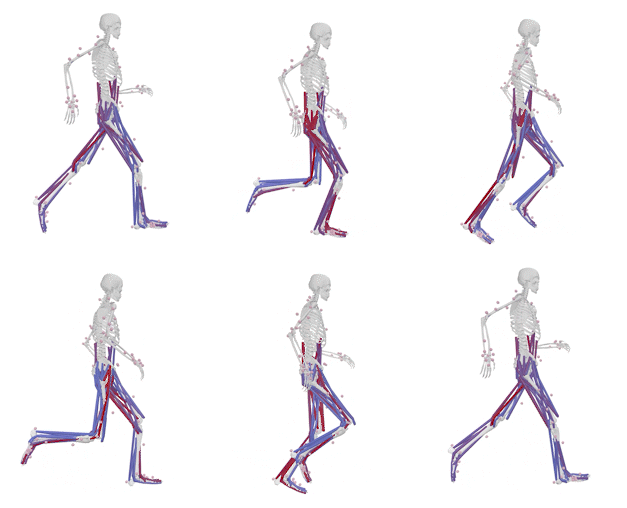
SimTK OpenSim C++ libraries and command-line applications, and Java/Python wrapping.
1.1k
Stars
373
Forks
411
Open issues
30
Contributors




AI Analysis
OpenSim is a specialized software platform for musculoskeletal biomechanics simulation, enabling researchers and clinicians to build anatomical models and conduct dynamic movement simulations. It serves a narrow technical niche: biomechanists, rehabilitation engineers, sports scientists, and computational biologists who need to study human/animal movement mechanics—not a general-purpose tool for broader audiences.
Inferred from signals mentioned in the README (tests, CI, type safety) — not a review of the actual code.
AI's overall editorial judgment — not an average of the bars above, can weigh other factors too.
Stanford's musculoskeletal simulation engine, widely adopted in biomechanics research but domain-specific and institutionally-centered
OpenSim is a C++ library and cross-platform toolkit for modeling and simulating human and animal movement biomechanics. Built and maintained by Stanford's Bioengineering department, it serves researchers, clinicians, and biomechanists who need to study musculoskeletal dynamics, gait analysis, and movement control. Used in published research, clinical gait labs, and university courses. Not a general-purpose physics engine—highly specialized for musculoskeletal systems with domain-specific APIs and workflows.
OpenSim originated from Stanford's Biomedical Simulation Laboratory around 2006, released as open source to serve the biomechanics research community. The core 4.x branch (this repository) represents a major refactor from earlier versions, stabilizing the C++ API and improving language bindings. Maintained continuously by Stanford with institutional backing.
Steady, niche adoption within academic biomechanics and clinical gait analysis. Growth appears driven by institutional use (university courses, research labs) and peer-review publication cycles rather than rapid viral adoption. 1,069 GitHub stars reflect specialized demand rather than mainstream software adoption. Last 7 days show +7 stars, consistent with slow but stable baseline interest. Multiple release channels (GUI, Python/MATLAB, Conda) suggest mature packaging for existing user base rather than expanding outreach.
Academic research adoption is documented indirectly: README cites published study (Hamner 2010) and references integration into 'Biomechanics of Movement classroom site' at Stanford. Mention of clinical gait labs in broader OpenSim ecosystem (GUI download page). Conda package availability suggests scripting-based workflow adoption. However, specific deployment numbers, user counts, or institutional census not provided. Adoption not quantified but adoption not verified as absent—appears real but limited to specialized domain.
Appears to use modular C++ architecture with bindings to Java and Python via SWIG. README indicates C++ libraries for kinematics, dynamics, inverse problems, and command-line tools. Likely organized around musculoskeletal-specific concepts (bodies, joints, muscles, controllers) rather than generic physics primitives. Specific architectural details not verifiable from README alone.
Not documented in README. Presence of continuous-integration badge suggests automated testing exists, but scope and coverage not specified.
Last push 2026-07-05 (same day as evaluation date). Active CI/CD pipeline indicated by badge. Multiple supported platforms (Windows, macOS, Linux) maintained. Repository shows consistent release cadence (implicit from 'Releases' page reference). Recent maintenance: actively current. No evidence of abandonment or backlog bloat.
ADOPT IF: you are conducting musculoskeletal biomechanics research or gait analysis and need an open, reproducible, well-documented simulation framework integrated with academic infrastructure; you require inverse kinematics, computed muscle control, or similar specialized biomechanics solvers; your lab or institution already uses OpenSim and needs to extend or integrate the core engine. AVOID IF: you need a general-purpose physics engine for non-biomechanics applications; you require commercial support and licensing; your team has no prior musculoskeletal modeling expertise and lacks institutional support to learn the domain-specific workflows. MONITOR IF: you are building medical device simulation software and considering whether to use OpenSim as a component versus building custom solver; you are evaluating open-source alternatives to commercial biomechanics software and need to assess long-term maintenance risk.
Independent dimensions
Mainstream potential
2/10
Technical importance
7/10
Adoption evidence
5/10
- Institutional dependency: maintenance relies primarily on Stanford Biomedical Simulation Laboratory; departure of key maintainers could reduce responsiveness, though open-source license mitigates abandonment risk
- Adoption ceiling in niche: unlikely to expand far beyond academic biomechanics and clinical gait labs; market size inherently limited by domain specificity, not by project quality
- Learning curve and domain expertise: requires understanding of musculoskeletal modeling concepts; not intuitive for developers unfamiliar with biomechanics, limiting contributor base
- Fragmented interface ecosystem: GUI, Python, MATLAB, and C++ APIs maintained separately (GUI in different repo), creating maintenance surface area and potential version skew
- Documentation and examples primarily academic: tutorials geared toward university courses and research papers; limited coverage of industrial or clinical deployment patterns
OpenSim will likely remain a specialized, stable tool for academic biomechanics research and clinical gait analysis. Gradual adoption in new academic programs and potential expansion into clinical decision-support software plausible. Unlikely to achieve mainstream software adoption outside biomechanics domain. Maintenance risk is low given institutional backing, but growth rate will remain slow. Python/Conda packaging may moderately increase accessibility to researchers unfamiliar with C++.
Newsletter
Get analyses like this every Monday
Free weekly digest of the most interesting open-source discoveries.
Languages
Information
- Website
- https://opensim.stanford.edu
- Language
- C++
- License
- Apache-2.0
- Last updated
- 13h ago
- Created
- 147mo ago
- Analyzed with
- anthropic/claude-haiku-4-5
Stars over time
Contributors over time
Top 100 contributors only — repos with more will plateau at 100.
Open issues
`PolynomialPathFitter`: use topology-based moment arm detection
Add `AbstractGeometryPath` utility for detecting dependent coordinates
Improvements to `PolynomialPathFitter`
Knee angle range and SimmSpline in `squatToStand_3dof9musc.osim` are inconsistent
Installing reference files for scripting example requires enabling `BUILD_API_EXAMPLES` CMake flag
Top contributors
Similar repos
| Repository | Stars | Week Δ | Language | Score | Updated |
|---|---|---|---|---|---|
|
opensim-org/opensim-core
this
|
1.1k | +9 | C++ | 8/10 | 13h ago |
 simbody/simbody simbody/simbody
|
2.5k | — | C++ | 8/10 | 3d ago |
 JSBSim-Team/jsbsim JSBSim-Team/jsbsim
|
2.1k | — | C++ | 8/10 | 1w ago |
 sofa-framework/sofa sofa-framework/sofa
|
1.2k | — | C++ | 7/10 | 21h ago |
 orbitersim/orbiter orbitersim/orbiter
|
1.9k | — | C++ | 7/10 | 1w ago |
 OpenFOAM/OpenFOAM-dev OpenFOAM/OpenFOAM-dev
|
2.2k | — | C++ | 8/10 | 22h ago |
Underlying physics engine for OpenSim (simbody/simbody repo cited as related). Lower-level, general-purpose rigid-body dynamics; OpenSim layers musculoskeletal-specific semantics on top. Different positioning: Simbody is tool for physics, OpenSim is tool for biomechanics.
Broader medical simulation framework (1227 stars). Supports soft tissue, deformable objects, multi-physics. OpenSim is narrower and domain-specific; SOFA is more general-purpose. SOFA adoption likely spans more use cases (surgery, device design); OpenSim dominates musculoskeletal analysis.
Physics engine with muscle modeling (closed-source until recent open release). More general-purpose; OpenSim has stronger integration into biomechanics pipelines (inverse kinematics, gait analysis tools). Different markets: MuJoCo expanding to RL/robotics, OpenSim entrenched in clinical/research biomechanics.
Commercial musculoskeletal modeling software. OpenSim is free/open-source alternative with lower barrier to entry. AnyBody has stronger industrial/clinical adoption; OpenSim stronger in academic research and reproducibility. Different positioning rather than direct replacement.
OpenSim's own multi-interface ecosystem (GUI for interactive use, scripting for automation). This core repository is the engine; GUI is separate (opensim-gui repo). Positioning: users can choose interface layer based on workflow.