TencentDB Agent Memory delivers fully local long-term memory for AI Agents via a 4-tier progressive pipeline, with zero external API dependencies.
8k
Stars
740
Forks
253
Open issues
19
Contributors


AI Analysis
TencentDB Agent Memory is a TypeScript library that provides local long-term memory for AI agents through a 4-tier progressive pipeline with symbolic short-term memory and layered long-term memory, eliminating external API dependencies. It is purpose-built for AI agent developers and teams running long-horizon agent tasks who need to reduce token usage and improve task success rates without reshaping their infrastructure. It is not a general-purpose memory solution and is most valuable for or...
Inferred from signals mentioned in the README (tests, CI, type safety) — not a review of the actual code.
AI's overall editorial judgment — not an average of the bars above, can weigh other factors too.
TencentCloud's local-first AI agent memory layer uses a 4-tier symbolic pipeline to cut token use and improve recall across sessions
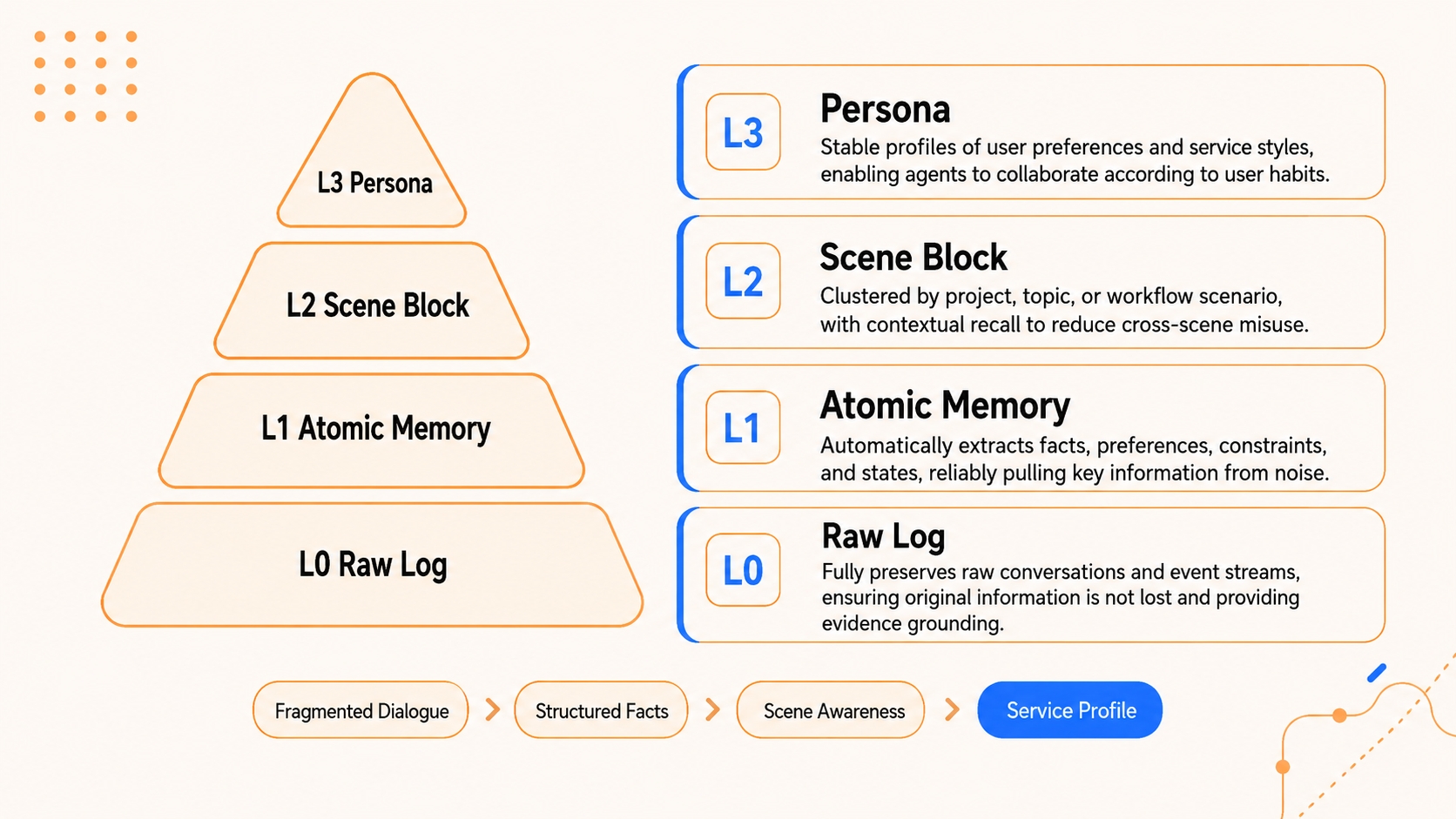
TencentDB Agent Memory is a TypeScript library that provides structured, hierarchical long-term memory for AI agents — entirely locally, with no external API calls. It targets developers building agents in Node.js environments who need persistent cross-session context without leaking data to third-party memory services. Its core design distinguishes it from flat-vector approaches by using a four-layer semantic pyramid (raw conversation → atomic facts → scenarios → persona) combined with symbolic short-term memory using Mermaid diagrams to compress tool outputs. Benchmark claims suggest meaningful token reduction and task success improvements when paired with the OpenClaw agent framework.
Created in April 2026 by TencentCloud, this project appears to be a relatively new open-source release tied to Tencent's TencentDB infrastructure and the OpenClaw agent framework. It likely emerged from internal agent tooling work at Tencent rather than a community-initiated project.
The repo gained ~5,968 stars in roughly 10 weeks since creation — a fast initial spike consistent with a corporate open-source launch backed by Tencent's brand. The recent 7-day rate of 72 stars suggests the launch momentum has normalized significantly. Growth now appears organic rather than launch-driven, which may stabilize or gradually decline unless the OpenClaw ecosystem expands.
Adoption not verified. No public case studies, production deployments, or third-party blog posts are referenced in the README. The benchmarks cited (WideSearch, SWE-bench, AA-LCR, PersonaMem) are internal measurements against the OpenClaw framework, not independently reproduced results. The Discord link and npm package existence indicate some user engagement, but scale of usage cannot be determined from available data.
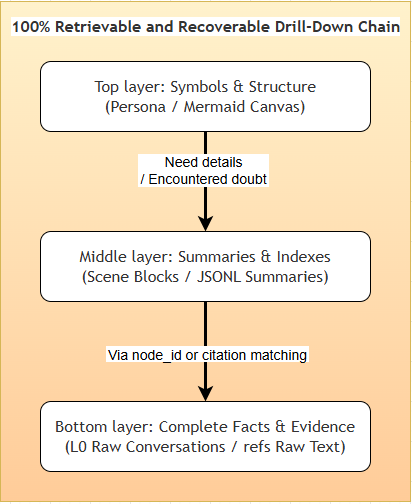
Based on the README, the system appears to use a dual-storage strategy: a database layer (likely SQLite or a compatible local DB given the 'zero external API' claim) for raw facts and logs, and Markdown files for high-level structured outputs. Short-term memory likely serializes tool outputs into tiered JSONL and Mermaid canvas files. The L0–L3 semantic pyramid for long-term memory is described in detail and appears to be a genuine architectural commitment, not just marketing framing. Integration appears to be via an npm package (@tencentdb-agent-memory/memory-tencentdb) with explicit coupling to the OpenClaw and Hermes agent frameworks.
Not documented in README
Last push was June 17, 2026 — five days before the evaluation date — indicating active ongoing development. The repository is approximately 10 weeks old with regular pushes, a Discord community, bilingual README, and npm packaging, all suggesting organized maintenance. No issue tracker activity or PR volume is visible from metadata alone.
ADOPT IF: you are building TypeScript/Node.js agents with the OpenClaw or Hermes frameworks, have privacy or data-locality requirements that rule out cloud memory services, and want a structured hierarchical memory system rather than a flat vector store. AVOID IF: your agent stack is Python-first, you need broadly verified third-party integrations, or you require independently validated production reliability evidence before adopting a library that is under 3 months old. MONITOR IF: you are evaluating TypeScript agent memory solutions generally — if the OpenClaw ecosystem grows and the benchmarks hold up under independent scrutiny, this project could become a meaningful option within 6–12 months.
Independent dimensions
Mainstream potential
4/10
Technical importance
7/10
Adoption evidence
2/10
- Strong coupling to Tencent's OpenClaw framework may limit portability and community breadth outside that specific ecosystem.
- All published benchmark results are self-reported by the project authors against internal workloads; independent reproduction has not been documented.
- The license field is listed as NOASSERTION in metadata despite the README showing MIT badge — potential licensing ambiguity that could be a concern for enterprise adoption.
- At under 3 months old, the project has limited track record for API stability; breaking changes or pivots in design remain probable.
- Corporate open-source projects from large tech vendors can see reduced maintenance investment if internal priorities shift, especially for libraries with limited external contributor bases.
Likely to remain a useful but specialized tool within the OpenClaw/TencentCloud agent ecosystem. Broader adoption will depend on whether OpenClaw itself gains traction outside China-based developer communities and whether the TypeScript agent memory space consolidates around any single approach.
Newsletter
Get analyses like this every Monday
Free weekly digest of the most interesting open-source discoveries.
Languages
Information
- Language
- TypeScript
- License
- NOASSERTION
- Last updated
- 2w ago
- Created
- 3mo ago
- Analyzed with
- anthropic/claude-haiku-4-5
Stars over time
Contributors over time
Top 100 contributors only — repos with more will plateau at 100.
Open issues
Top contributors
Similar repos

Dataojitori/nocturne_memory
Nocturne Memory is a long-term memory server for MCP (Model Context Protocol)...

supermemoryai/supermemory
Supermemory is a memory and context engine for AI systems that persists...
| Repository | Stars | Week Δ | Language | Score | Updated |
|---|---|---|---|---|---|
|
TencentCloud/TencentDB-Agent-Memory
this
|
8k | +1.6k | TypeScript | 8/10 | 2w ago |
 rohitg00/agentmemory rohitg00/agentmemory
|
24.9k | — | TypeScript | 8/10 | 4d ago |
|
Dataojitori/nocturne_memory
|
1.3k | — | Python | 7/10 | 2w ago |
|
supermemoryai/supermemory
|
28.3k | — | TypeScript | 8/10 | 16h ago |
 moorcheh-ai/memanto moorcheh-ai/memanto
|
1.6k | — | Python | 7/10 | 17h ago |
 mem9-ai/mem9 mem9-ai/mem9
|
1.2k | — | TypeScript | 7/10 | 12h ago |
Supermemory is the current star-count leader and focuses on cloud-hosted memory with broad LLM integrations. TencentDB Agent Memory differentiates on fully local execution and the structured pyramid approach, though supermemory's ecosystem breadth and adoption appear significantly larger.
agentmemory is a Python-centric flat vector store approach. TencentDB Agent Memory rejects flat vector storage explicitly, targeting TypeScript/Node.js stacks — a different language ecosystem with a different architectural philosophy.
Memori is Python-based with higher adoption signals. TencentDB Agent Memory's TypeScript-first stance may appeal to frontend or full-stack developers working in Node.js agent frameworks, where Memori is less native.
MemOS also uses TypeScript and is closer in language ecosystem. Relative to MemOS's 9,953 stars, TencentDB Agent Memory at 5,968 is newer but growing in the same space. MemOS's maturity and adoption data are better established.
Memanto is a smaller Python project. TencentDB Agent Memory has substantially more stars and a corporate backer, giving it more resources for sustained development — though star counts alone do not confirm deeper adoption.