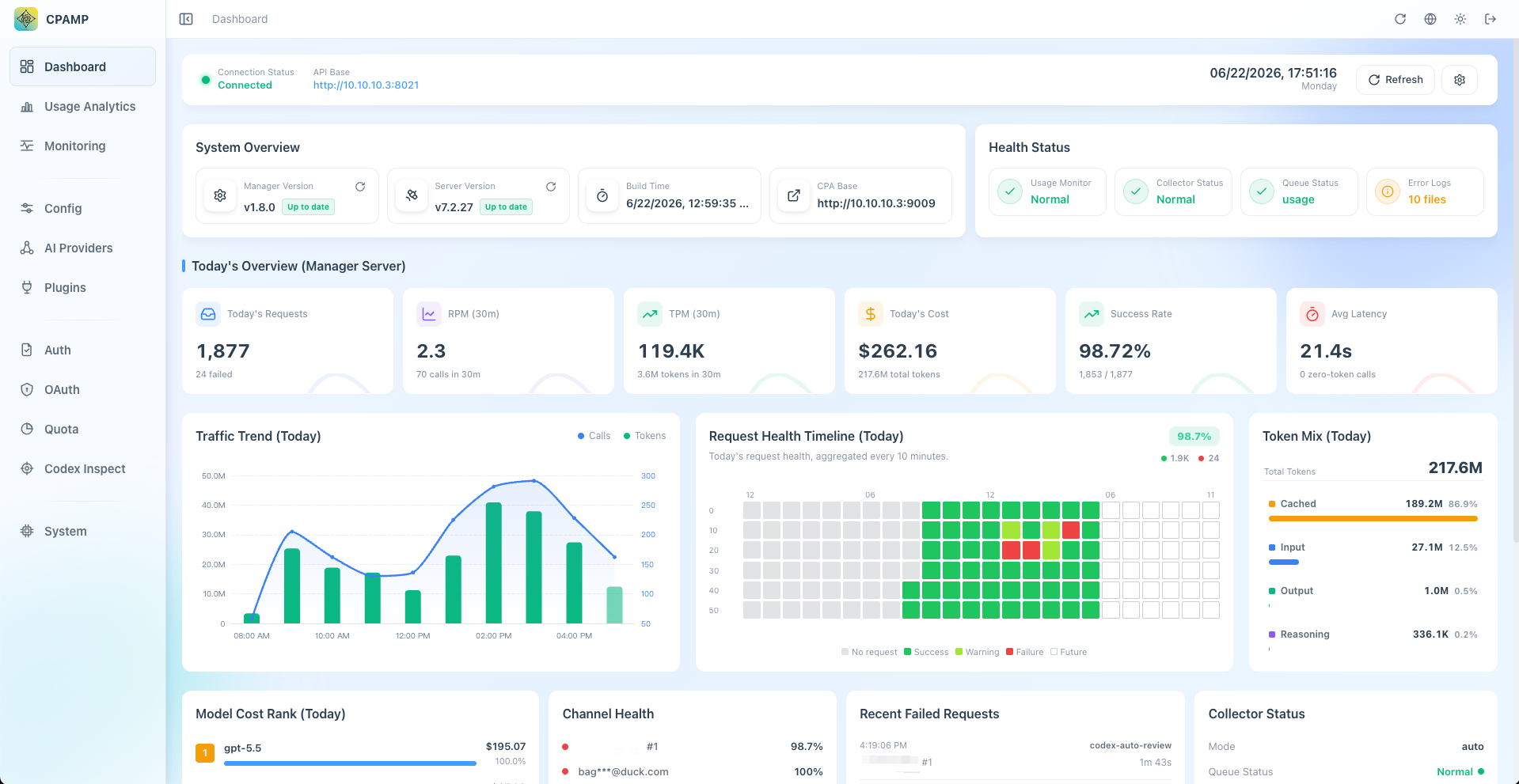
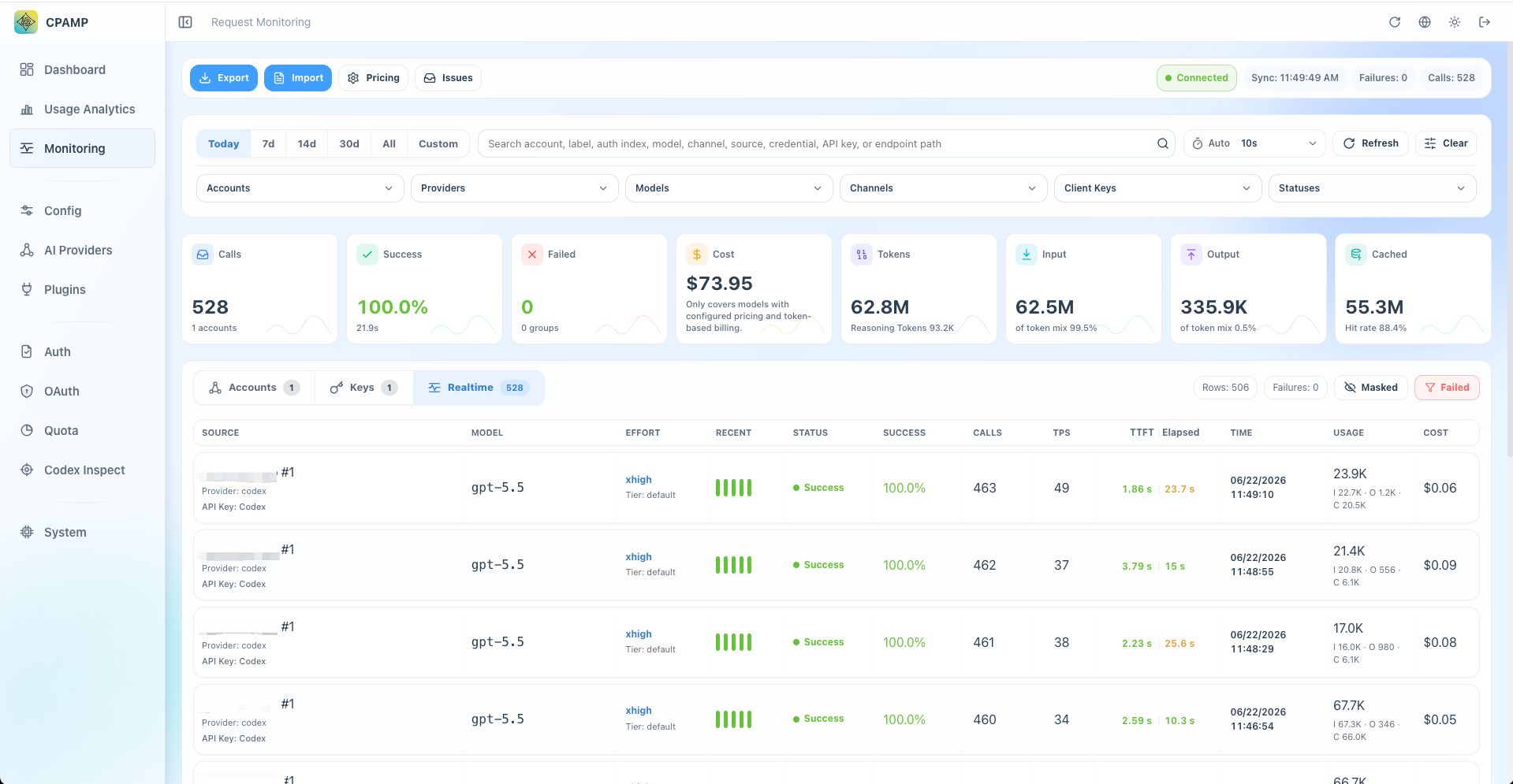
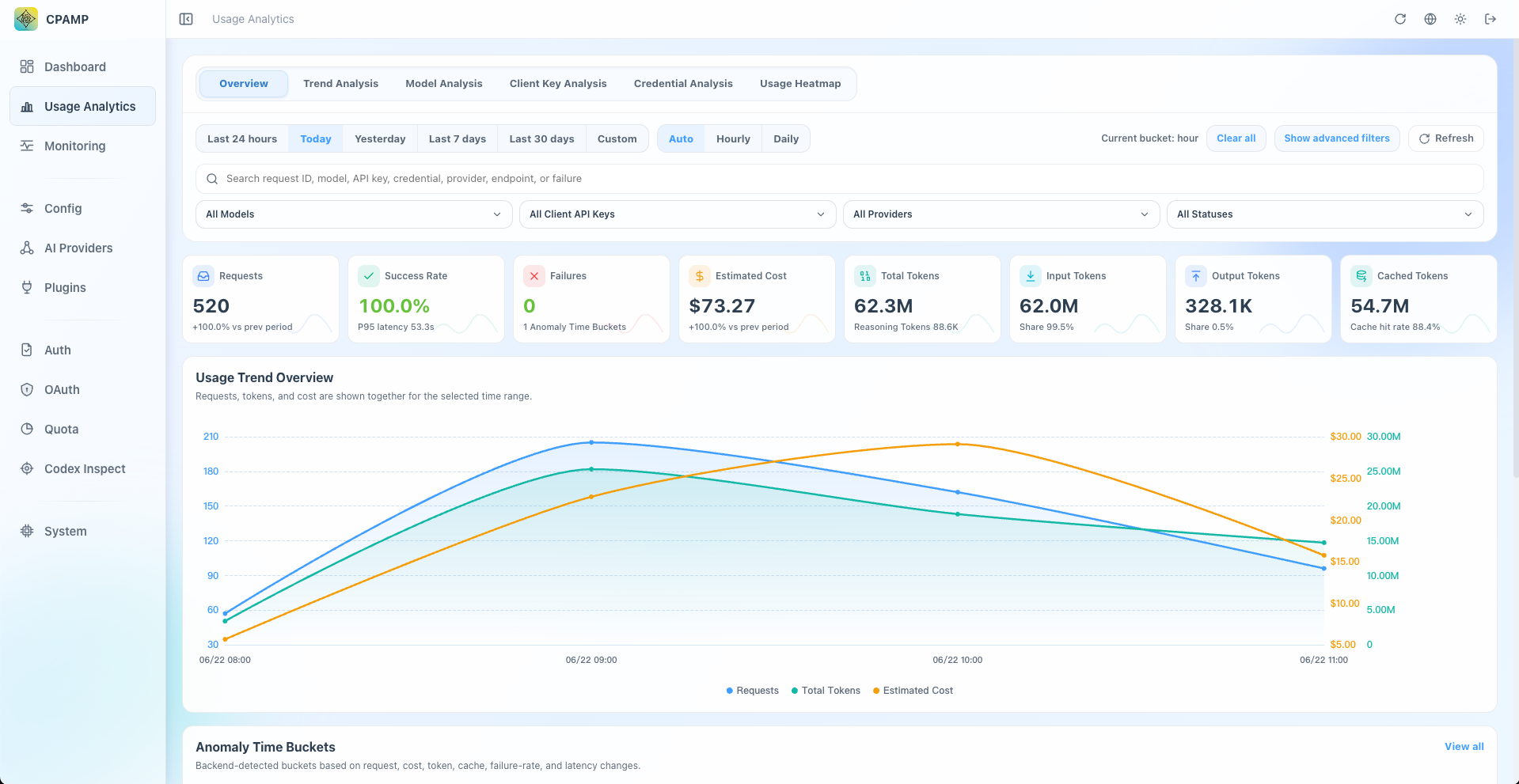
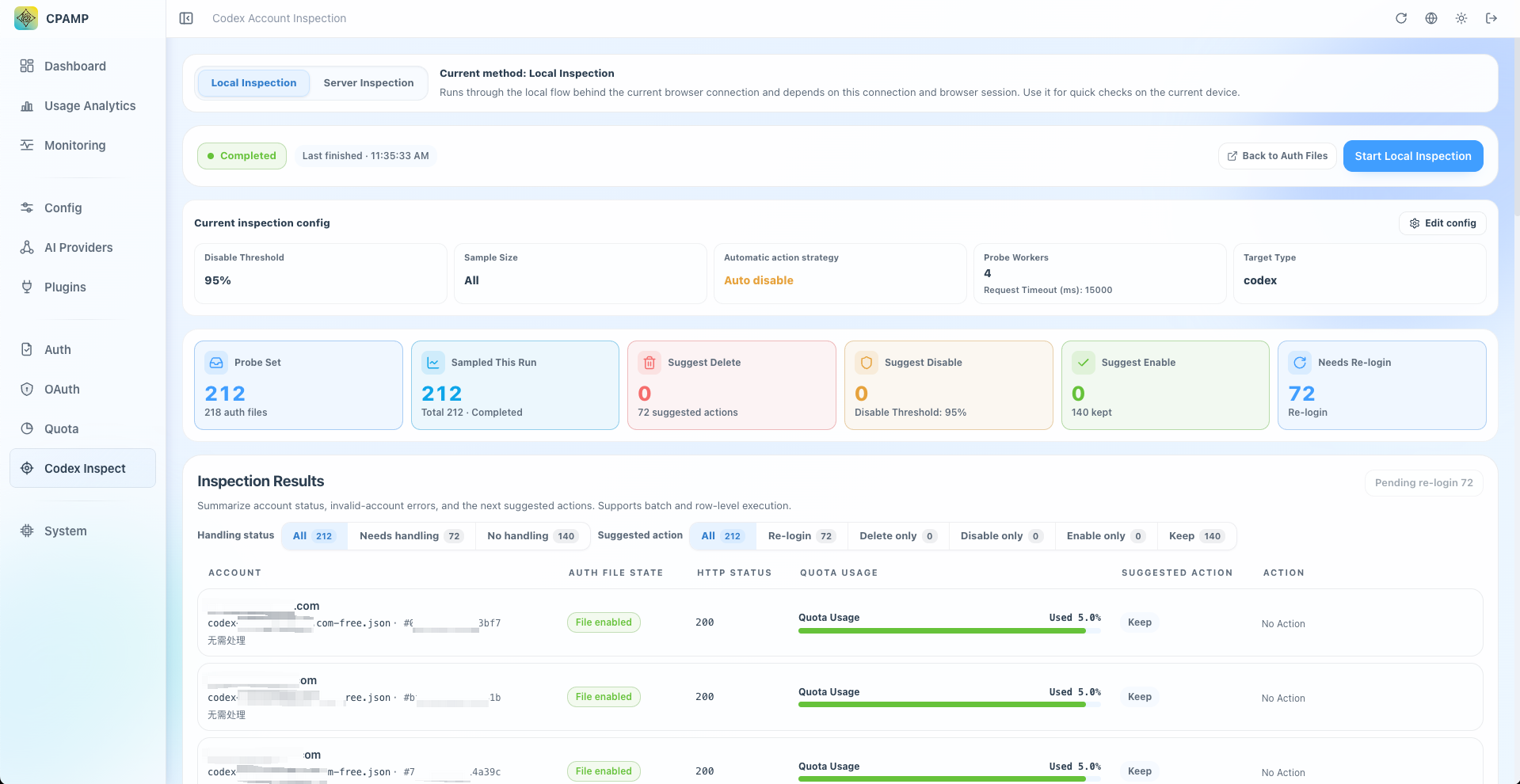
Self-hosted AI gateway monitoring — track requests, cost, failures, quota, and account health for CPA / CLIProxyAPI and OpenAI-compatible gateways.
1.4k
Stars
155
Forks
32
Open issues
30
Contributors


AI Analysis
CPA Manager Plus is a self-hosted observability and management platform for AI gateway operations, specifically designed for CPA/CLIProxyAPI and OpenAI-compatible gateways. It tracks request metrics, cost analytics, quota management, and account health with a focus on Codex and Claude Code deployments. This tool is built for platform operators and DevOps engineers managing multi-tenant or cost-sensitive AI infrastructure, not for general end-users or those using standard OpenAI APIs directly.
Inferred from signals mentioned in the README (tests, CI, type safety) — not a review of the actual code.
AI's overall editorial judgment — not an average of the bars above, can weigh other factors too.
Self-hosted monitoring dashboard for AI gateway traffic, cost tracking, and account health
CPA Manager Plus is a self-hosted TypeScript dashboard for monitoring requests, costs, failures, and quota across CPA/CLIProxyAPI and OpenAI-compatible AI gateways. It targets teams running private AI infrastructure who need real-time visibility into Codex account health, per-model cost breakdown, and automated quota management. The project emphasizes privacy (no telemetry, local storage only) and operational automation (scheduled account inspection, auto-pause on quota limits).
Project created 2026-05-17, making it approximately 1.5 months old at evaluation date. Appears to have emerged from operational needs around managing CLIProxyAPI instances and Codex account fleets. Limited public history available; no evidence of prior versions or major predecessor projects.
Steady early adoption with 1,131 stars and 128 forks acquired in ~6 weeks. However, zero stars gained in the 7 days before evaluation suggests growth has plateaued or stabilized. Docker pull count tracked on Docker Hub, but specific number not visible from metadata. Growth pattern suggests initial interest spike among CPA/CLIProxyAPI users, followed by settling into core user base rather than exponential expansion.
Adoption not verified. README includes screenshots and deployment documentation, suggesting authors expect real usage, but no public case studies, testimonials, production deployment counts, or company endorsements are documented. Docker Pulls badge present but count not visible. GitHub stars (1,131) and forks (128) indicate interest, but do not confirm active production usage. The narrow niche (CPA/CLIProxyAPI users) limits pool of potential adopters.
Based on README, appears to be a full-stack TypeScript application (frontend + backend) packaged as a single Docker container with local file storage. Likely uses a web dashboard for UI, connects to CPA gateway via configured endpoints, and runs scheduled inspection jobs. No telemetry or cloud dependencies mentioned. Architecture appears pragmatic for self-hosted deployment rather than highly modular.
Not documented in README. No CI/CD pipeline, test strategy, or quality assurance approach mentioned. Assessment of code reliability cannot be made from available information.
Last push 2026-07-02 (current date), indicating active maintenance as of evaluation moment. Project is only ~1.5 months old, so interpretation of maintenance patterns is limited. Regular release badges and Docker image availability suggest organized release process. Insufficient history to assess long-term maintenance trajectory.
ADOPT IF: you operate a CPA/CLIProxyAPI gateway with multiple Codex accounts, need local cost visibility and privacy, and want automated quota management without additional infrastructure. AVOID IF: you need multi-cloud observability, rely on third-party SaaS analytics, or do not use CPA/CLIProxyAPI as your gateway. MONITOR IF: you are a CPA user evaluating operational tools and want to see if this project sustains maintenance and adoption beyond its current early stage.
Independent dimensions
Mainstream potential
2/10
Technical importance
5/10
Adoption evidence
2/10
- Project is very new (~1.5 months old); long-term maintenance and stability unknown. Single primary maintainer apparent from commit history.
- Adoption appears limited to CPA/CLIProxyAPI niche; risk that project becomes stale if that ecosystem contracts or if author reduces involvement.
- No public test coverage or code review evidence documented; quality assurance approach unclear.
- Tightly coupled to CPA and Codex workflows; low portability if you switch gateways or discontinue Codex.
- Docker Hub pull statistics not publicly visible in metadata; cannot verify actual deployment scale or real-world usage volume.
CPA Manager Plus is likely to remain a specialized tool for the CPA/CLIProxyAPI community. It may gain modest adoption within that niche over the next 6–12 months, but faces limited mainstream potential due to narrow scope. Trajectory depends heavily on continued CPA ecosystem health and whether the author(s) maintain engagement.
Newsletter
Get analyses like this every Monday
Free weekly digest of the most interesting open-source discoveries.
Languages
Information
- Language
- TypeScript
- License
- MIT
- Last updated
- 1d ago
- Created
- 2mo ago
- Analyzed with
- anthropic/claude-haiku-4-5
Stars over time
Contributors over time
Top 100 contributors only — repos with more will plateau at 100.
Open issues
[Bug]:前端面板 认证文件页面 UI优先级错位 超字换行错位
[Bug]: 用量分析选择「最近 7 天 / 30 天」时卡片与图表全为 0,但 analytics 接口已返回完整数据
[Feature] 按账号分配 API Key:限制订阅账号只被指定 API Key 使用 / Bind subscription account to specific API keys
[Bug]: 在AI提供商codex界面可以看到提供商调用的记录,但是在请求监控页面看不到
Top contributors
Similar repos

ding113/claude-code-hub
Claude Code Hub is an API proxy and gateway service built with Next.js 15,...
| Repository | Stars | Week Δ | Language | Score | Updated |
|---|---|---|---|---|---|
|
seakee/CPA-Manager-Plus
this
|
1.4k | +269 | TypeScript | 7/10 | 1d ago |
 kaitranntt/ccs kaitranntt/ccs
|
2.7k | — | TypeScript | 7/10 | 2d ago |
 steipete/CodexBar steipete/CodexBar
|
17.4k | — | Swift | 8/10 | 8h ago |
|
ding113/claude-code-hub
|
3.2k | — | TypeScript | 7/10 | 4d ago |
 APIParkLab/APIPark APIParkLab/APIPark
|
1.8k | — | TypeScript | 7/10 | 2mo ago |
 Portkey-AI/gateway Portkey-AI/gateway
|
12.4k | — | TypeScript | 8/10 | 2mo ago |
LiteLLM Proxy offers gateway functionality and basic cost tracking, but CPAMP focuses exclusively on monitoring and account health for existing CPA deployments. CPAMP provides deeper Codex-specific automation (quota inspection, auto-pause). Not a direct replacement; different scope.
Helicone is a cloud-hosted LLM observability platform. CPAMP is self-hosted and designed for private CPA gateways only. Helicone works with multiple providers; CPAMP is tightly coupled to CPA. Different deployment model and privacy posture.
General-purpose LLM observability with cloud or self-hosted options. CPAMP is specialized for CPA/Codex workflows and includes automated quota management. Broader platform vs. focused tooling.
OpenRouter provides native cost and usage analytics for its own platform. CPAMP integrates with OpenRouter as one provider option but operates as an independent layer across multiple gateways. Different positioning: multi-gateway aggregator vs. single-platform native.
Teams can build monitoring with ELK or Prometheus. CPAMP offers pre-built Codex-aware logic (quota checks, auto-pause), pre-configured dashboards, and lower operational burden. Trade-off: flexibility vs. convenience.