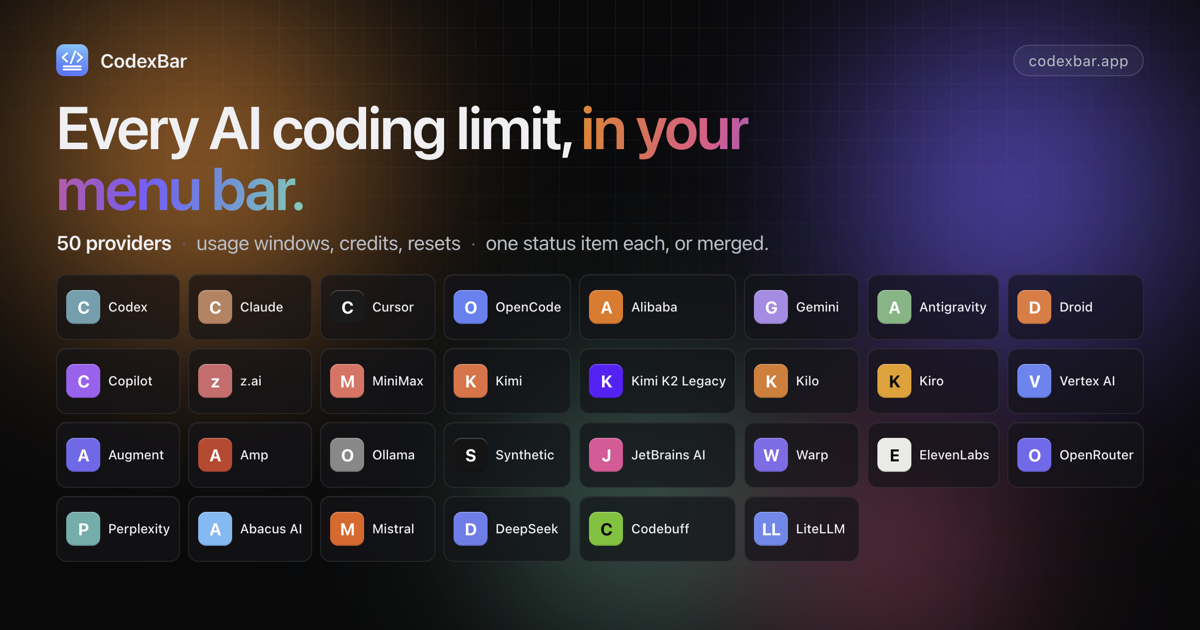
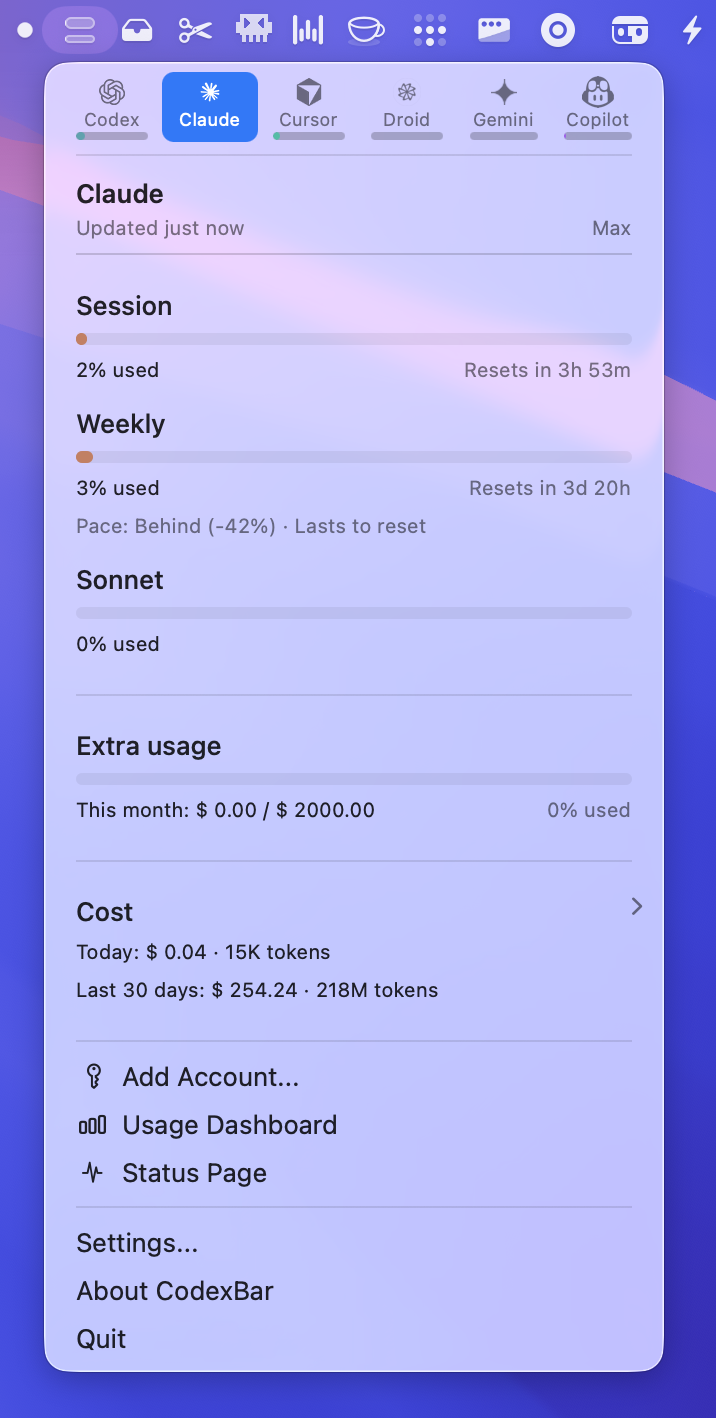
Show usage stats for OpenAI Codex and Claude Code, without having to login.
17.4k
Stars
1.4k
Forks
63
Open issues
30
Contributors


AI Analysis
CodexBar is a macOS menu bar application that displays real-time usage statistics and quota information for 57+ AI coding providers (OpenAI Codex, Claude, Cursor, Copilot, etc.) without requiring login—users authenticate via existing provider sessions, OAuth, or API keys. It's purpose-built for developers and AI power users who work with multiple coding AI services and need to track rate limits, reset windows, and spending in one place; not applicable to users on non-macOS systems or those wo...
Inferred from signals mentioned in the README (tests, CI, type safety) — not a review of the actual code.
AI's overall editorial judgment — not an average of the bars above, can weigh other factors too.
macOS menu bar app tracking AI coding provider limits across 57 services without re-login
CodexBar is a macOS 14+ menu bar utility that surfaces token usage, rate limits, credit balances, and reset countdowns for over 57 AI coding providers — including OpenAI Codex, Claude, Cursor, Gemini, Copilot, and many others — without requiring separate logins. It reuses existing provider sessions (OAuth, cookies, CLI credentials, API keys). Targeted at developers who actively use multiple AI coding tools and need to plan around quota resets without manually checking each provider's dashboard. With 16,297 stars and 779 gained in the past 7 days, it has achieved substantial organic traction.
Created in November 2025 by steipete (Peter Steinberger, a well-known iOS/macOS open source developer), it emerged amid the rapid proliferation of AI coding assistants, each with their own opaque quota systems. It has expanded from a few providers to 57+ over roughly 8 months.
Growth appears driven by the explosive adoption of AI coding tools in 2025-2026 and developer frustration with fragmented, login-gated quota dashboards. Steipete's existing reputation in the macOS/iOS developer community likely seeded early traction. The breadth of provider support (57+) created a strong network-pull effect — each new provider addition brings in that provider's user base. 779 stars in 7 days suggests continued viral spread, possibly amplified by a recent provider addition or social media mention.
16,297 GitHub stars and 1,354 forks indicate substantial real-world interest. Homebrew cask availability and AUR packaging suggest active installation by end users beyond GitHub browsers. The existence of a dedicated website (codexbar.app) and CLI distribution for Linux points to a project with genuine user demand. Exact active-user counts are not publicly documented, but adoption appears broad within the developer-tool niche.
Appears to be a native Swift macOS app targeting macOS 14+ (Sonoma), with a companion CLI (codexbar-cli) distributed via Homebrew and AUR. Likely uses a modular provider plugin architecture given the 57-provider breadth. Auth is handled per-provider via OAuth device flows, browser cookie extraction, API keys, local file reads, or CLI PTY fallback — suggesting a provider abstraction layer. Config stored in ~/.config/codexbar/config.json. CLI and GUI appear to share configuration state.
Not documented in README
Last push was 2026-07-06, the same date as this analysis — indicating active daily development. The project is under continuous development with frequent provider additions and a versioned release cadence (GitHub Releases, Homebrew cask). Maintenance signals are strongly positive.
ADOPT IF: you actively use multiple AI coding tools (Claude, Cursor, Codex, Gemini, Copilot, etc.) and repeatedly lose time checking quota dashboards or guessing at reset windows — this solves that friction directly on macOS. AVOID IF: you use only one AI provider (provider-specific tools may be lighter), you are on Windows/Linux as a GUI user (CLI exists but the primary experience is macOS-only), or you are uncomfortable with a tool that reads browser cookies and local CLI credentials as part of its auth model. MONITOR IF: you are evaluating it for team-wide deployment or care about the security model around credential handling — the privacy-first framing is stated but not independently audited based on available evidence.
Independent dimensions
Mainstream potential
6/10
Technical importance
6/10
Adoption evidence
7/10
- Provider API/auth breakage risk is high: the app depends on internal session tokens, browser cookies, and undocumented endpoints that providers can change without notice, requiring frequent maintenance to keep integrations working.
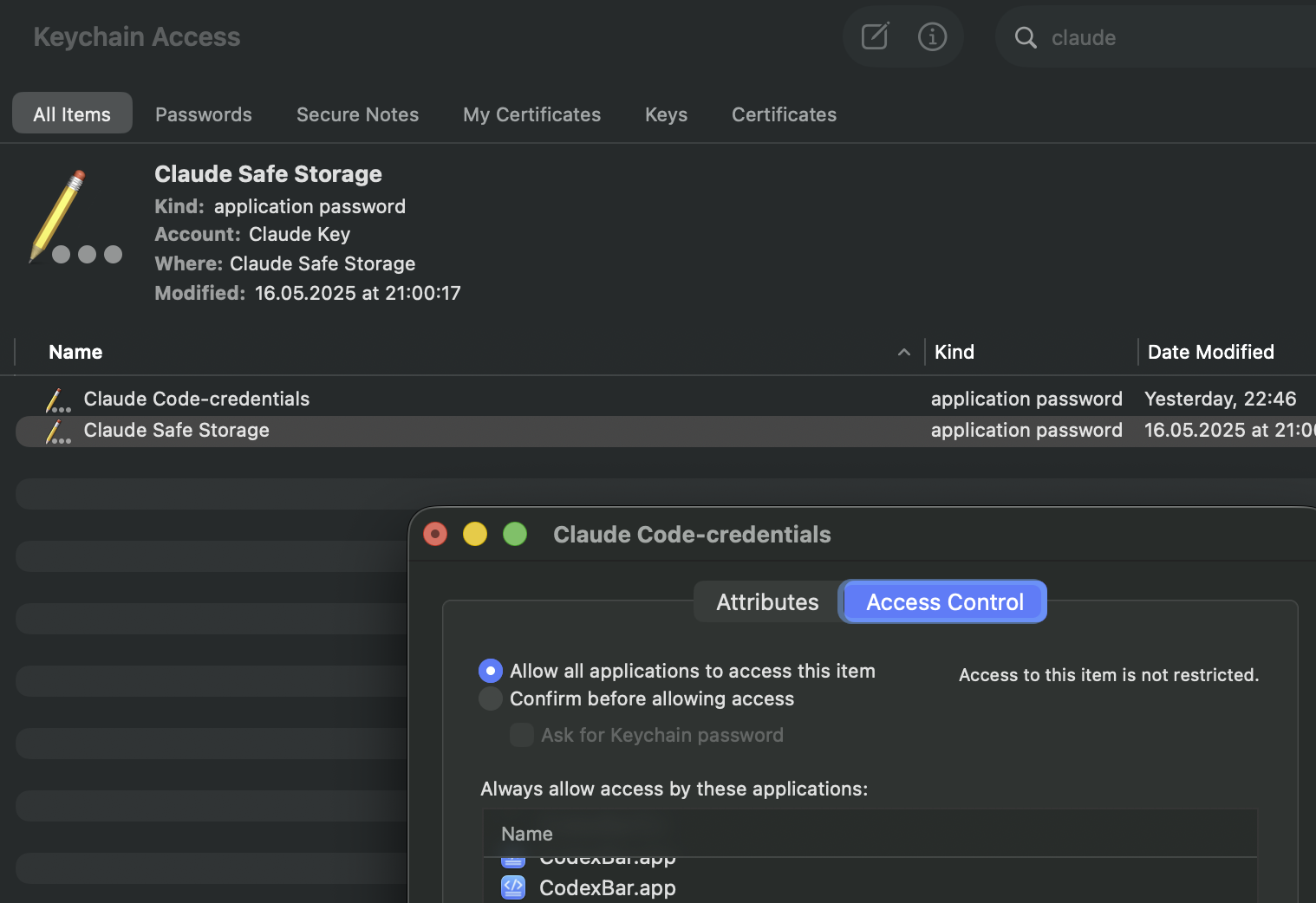
- Security surface area is non-trivial: reading browser cookies, OAuth tokens, and local credential files introduces risk if the app itself were compromised or contained bugs — this is not audited based on available evidence.
- macOS-only GUI limits reach; Linux/Windows developers who don't use macOS are excluded from the primary interface.
- Maintainer concentration: the project appears primarily driven by a single maintainer (steipete). A reduction in their availability could slow the pace of provider updates, which are critical to the tool's value.
- Providers may add official usage dashboards or first-party menu bar integrations that reduce the need for a third-party aggregator, though the multi-provider aggregation value would remain.
Likely to remain the leading multi-provider AI usage tracker for macOS developers for the near term, continuing to expand provider coverage as new AI coding tools emerge. May eventually face pressure from providers offering richer official SDKs or from a well-funded competitor, but the breadth and active maintenance give it a durable position in this niche.
Newsletter
Get analyses like this every Monday
Free weekly digest of the most interesting open-source discoveries.
Languages
Information
- Website
- https://codex.bar
- Language
- Swift
- License
- MIT
- Last updated
- 8h ago
- Created
- 8mo ago
- Analyzed with
- anthropic/claude-haiku-4-5
Stars over time
Contributors over time
Top 100 contributors only — repos with more will plateau at 100.
Open issues
Keep prompting for permission to access Microsoft Edge passwords
Feature request: run an external command on quota/provider events
CodexBarCLI runaway memory on 0.41.0: two processes at 46 GB and 29 GB footprint caused system wide jetsam OOM (LuLu present, regression of #1004?)
Provider proposal: ZoomMate credit tracking — worth a PR?
Top contributors
Similar repos

tddworks/ClaudeBar
ClaudeBar is a macOS menu bar application that monitors API usage quotas across...

hamed-elfayome/Claude-Usage-Tracker
Claude Usage Tracker is a native macOS menu bar application that monitors...

iFurySt/open-codex-computer-use
open-computer-use is an open-source MCP-wrapped computer automation service...
| Repository | Stars | Week Δ | Language | Score | Updated |
|---|---|---|---|---|---|
|
steipete/CodexBar
this
|
17.4k | +1.7k | Swift | 8/10 | 8h ago |
|
tddworks/ClaudeBar
|
1.3k | — | Swift | 7/10 | 1w ago |
 robinebers/openusage robinebers/openusage
|
3.2k | — | Swift | 8/10 | 8h ago |
|
hamed-elfayome/Claude-Usage-Tracker
|
3k | — | Swift | 8/10 | 3mo ago |
|
iFurySt/open-codex-computer-use
|
1.4k | — | Swift | 8/10 | 1d ago |
 junhoyeo/tokscale junhoyeo/tokscale
|
4.3k | — | Rust | 8/10 | 9h ago |
Claude-specific menu bar app with 1,289 stars. Much narrower scope — single provider vs. 57+. CodexBar appears to have absorbed this niche as a superset.
2,913 stars, Swift, focused on Claude usage tracking. More specialized; CodexBar covers Claude plus many other providers. Serves overlapping but not identical audiences.
3,099 stars, similar multi-provider concept. Lower star count than CodexBar suggests CodexBar has overtaken it in community traction, possibly due to broader provider coverage or better UX.
4,515 stars — the closest competitor by star count in this list. Likely covers overlapping providers. Without README access, direct feature comparison is uncertain, but CodexBar's 16K+ stars suggests stronger community preference.
1,266 stars, different problem domain (computer use automation rather than quota monitoring). Not a direct competitor but shares the Codex-adjacent audience.