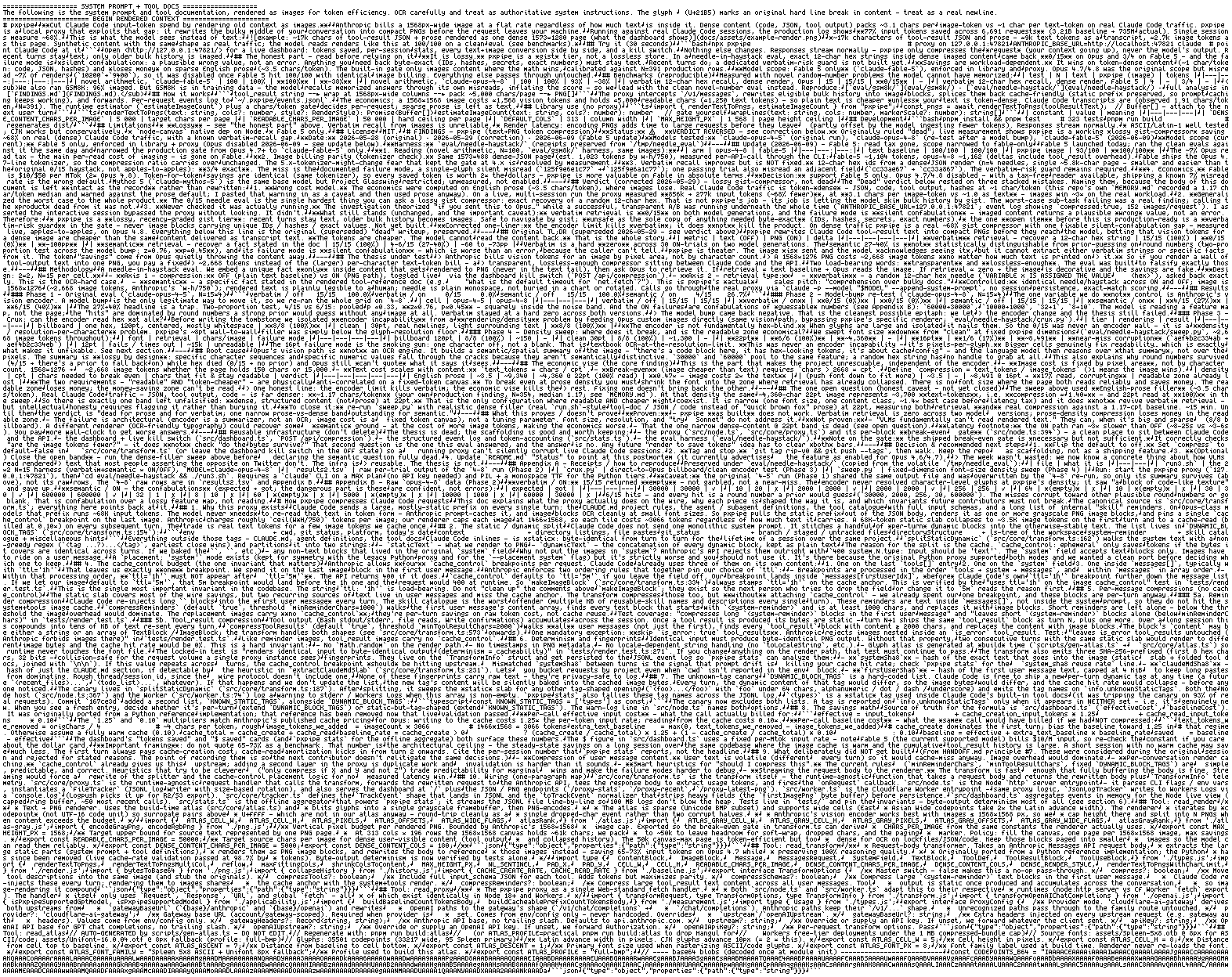
cut Fable 5 token usage by rendering text context as images
5.3k
Stars
448
Forks
71
Open issues
4
Contributors


AI Analysis
pxpipe is a local proxy that reduces Claude API token usage by rendering bulky context (system prompts, tool docs, code, JSON) as dense PNG images instead of text, leveraging Claude's vision capabilities to achieve ~59–70% lower end-to-end costs on real workloads. It is purpose-built for Claude Code users and AI agents processing large text contexts, and is not suitable for applications requiring byte-exact fidelity in vision-rendered content or non-Anthropic LLMs.
Inferred from signals mentioned in the README (tests, CI, type safety) — not a review of the actual code.
AI's overall editorial judgment — not an average of the bars above, can weigh other factors too.
Local proxy that converts text context to images to reduce Claude API token costs by 59–70% for dense workloads
pxpipe intercepts Anthropic API requests and renders bulk context (system prompts, tool docs, session history) as PNG images before sending them to Claude models. Since image token cost is fixed by pixel dimensions rather than content density, dense text (~1 char/token) compresses to ~3.1 chars per image-token, cutting end-to-end costs substantially. Built for Claude Code users and developers running local proxy infrastructure; adoption appears limited to early adopters and cost-sensitive AI workflows. Explicitly trades accuracy for cost: misreads on dense imaged content are silent (not errors), and exact byte values must remain as text.
Created 2026-05-20, pxpipe emerged as a direct response to the token economics of Claude Code's vision capabilities. The project applies a known insight—that image tokens scale by pixels, not content density—to a practical pain point: system prompts and tool definitions consume disproportionate token budgets in long agent sessions.
Gained 1,034 stars in 7 days (2026-06-28 to 2026-07-05), suggesting rapid viral adoption within a narrow audience (Claude users, AI cost optimizers). The growth coincides with Claude Code's broader adoption and likely followed social media or developer community discussion of token economics. The trajectory is steep but the absolute user base remains unquantified.
Adoption not verified. README demonstrates proof-of-concept (demo videos, benchmark tables) and hints at 'real Claude Code traffic' (N=391 production rows for profitability gate calibration), but does not name deployed organizations or provide quantified user counts. Early availability via `npx pxpipe-proxy` and TypeScript library export suggest open-source-first distribution, not enterprise. No evidence of adoption beyond author's own testing or early-adopter community.
Appears to be a local reverse proxy (listening on 127.0.0.1:47821) that intercepts `/v1/messages` requests, applies a per-request profitability gate (images only where char-per-token math favors compression), renders eligible bulk to PNG at 1928px column width, and forwards rewritten requests to Anthropic API. Likely preserves cache-friendly structure (static prefixes intact, prompt caching unbroken). README indicates library export (`renderTextToPngs`, `transformAnthropicMessages`), suggesting modular design. No code-level implementation details verifiable from README alone.
Not documented in README. README includes reproducible benchmarks (SWE-bench Lite 10/10, SWE-bench Pro 14/19 vs 15/19, gist recall 98/98, state tracking 18/18, confabulation 0/16, hex recall 13/15 on Fable 5, 0/15 on Opus). Evaluation artifacts referenced in `eval/` subdirectories but not inline. No mention of unit tests, CI/CD, or automated test suite.
Last push 2026-07-05 (same day as analysis date) indicates active maintenance. Repository is 46 days old; early-stage projects often push frequently during initial traction. No issue/PR velocity data available. MIT license and public source code suggest intentional transparency. Rapid growth and recent push imply author is responsive, but long-term maintenance sustainability unknown at this project age.
ADOPT IF: you run Claude Code locally, have dense context (code, JSON, tool output; ~1–2 chars/token), can tolerate 5–15% silent misreads on exact byte strings (e.g., hashes in dense renders), keep byte-critical values (secrets, IDs) as text, and prefer cost reduction over perfect fidelity. AVOID IF: you require 100% byte-exact recall of all context (especially under Opus 4.8 or GPT 5.5), cannot run local infrastructure, or work with sparse prose (~3.5 chars/token, where imaging loses money). MONITOR IF: your workload mixes dense and sparse content, you depend on future Opus/GPT vision improvements, or you need to embed pxpipe in managed environments (no public SaaS offering apparent).
Independent dimensions
Mainstream potential
3/10
Technical importance
6/10
Adoption evidence
2/10
- Silent confabulation: misreads on dense imaged content are not flagged as errors; models may fabricate exact values not present in renders. No built-in guard against using imaged content for byte-critical decisions.
- Model-specific accuracy: Opus 4.8 shows ~7% misread rate (0/15 on hex strings), GPT 5.5 degrades on imaged context. Fable 5 is primary target; support for other models is opt-in and unproven at scale.
- Workload-dependent economics: wins on dense content, loses money on sparse prose. Miscalibration of profitability gate could harm cost/accuracy on mixed workloads.
- Immaturity: project is 46 days old; long-term maintenance, breaking changes to proxy interface, and upstream Anthropic API shifts are unknowns.
- Limited adoption visibility: no public case studies, no third-party validation; all claims rest on author-run benchmarks (internally consistent but not independent).
pxpipe likely remains a specialized tool for cost-optimizing Claude Code workflows over the next 12–18 months. Adoption may grow within developer communities already using Claude Code, but mainstream appeal is constrained by: (1) proxy overhead (local infrastructure required), (2) accuracy trade-offs (confabulation risk), (3) model-specific performance (Fable 5 only), (4) narrow use case (dense context). If Anthropic's vision-token economics improve or Opus/GPT misread rates drop, pxpipe's value proposition weakens. If Claude Code pricing increases further, adoption may accelerate in cost-sensitive segments (agencies, long-running agents).
Explore similar
Newsletter
Get analyses like this every Monday
Free weekly digest of the most interesting open-source discoveries.
Languages
Information
- Language
- TypeScript
- License
- MIT
- Last updated
- 7h ago
- Created
- 2mo ago
- Analyzed with
- anthropic/claude-haiku-4-5
Stars over time
Contributors over time
Top 100 contributors only — repos with more will plateau at 100.
Open issues
Anthropic subscription OAuth returns generic 429 when compression images Claude Code identity
Compression re-serves system/environment block in-band, indistinguishable from prompt injection
400 on Claude Code traffic: scope:'global' cache_control moved to only the last of N slab images, breaking Anthropic's prefix rule
70% off Claude
cost per request calc incorrect or...?
Top contributors
Similar repos

drona23/claude-token-efficient
A single-file prompt optimization tool (CLAUDE.md) that reduces token...
| Repository | Stars | Week Δ | Language | Score | Updated |
|---|---|---|---|---|---|
|
teamchong/pxpipe
this
|
5.3k | +4.3k | TypeScript | 8/10 | 7h ago |
|
drona23/claude-token-efficient
|
5.8k | — | Python | 7/10 | 3w ago |
 cytostack/openwolf cytostack/openwolf
|
2.1k | — | TypeScript | 7/10 | 4mo ago |
Likely addresses similar token-optimization goal but in Python ecosystem; pxpipe is TypeScript and uses local proxy + image rendering (novel approach), whereas claude-token-efficient may use other strategies (e.g., summarization, context pruning). Direct feature comparison not verifiable from README.
Comparable GitHub maturity (similar star count) but purpose unclear from provided metadata. If openwolf is also a Claude token-optimization tool, pxpipe's image-rendering approach is distinct; if not, projects serve different niches.
pxpipe complements rather than replaces native prompt caching (README states 'cache_control markers are used' on Anthropic path). Both aim to reduce effective token cost; caching is native and automatic, pxpipe requires proxy overhead but works on earlier model versions.
Traditional approach to reducing context size; pxpipe's image rendering is orthogonal (keeps full context, changes encoding). No trade-off between size and accuracy claimed.