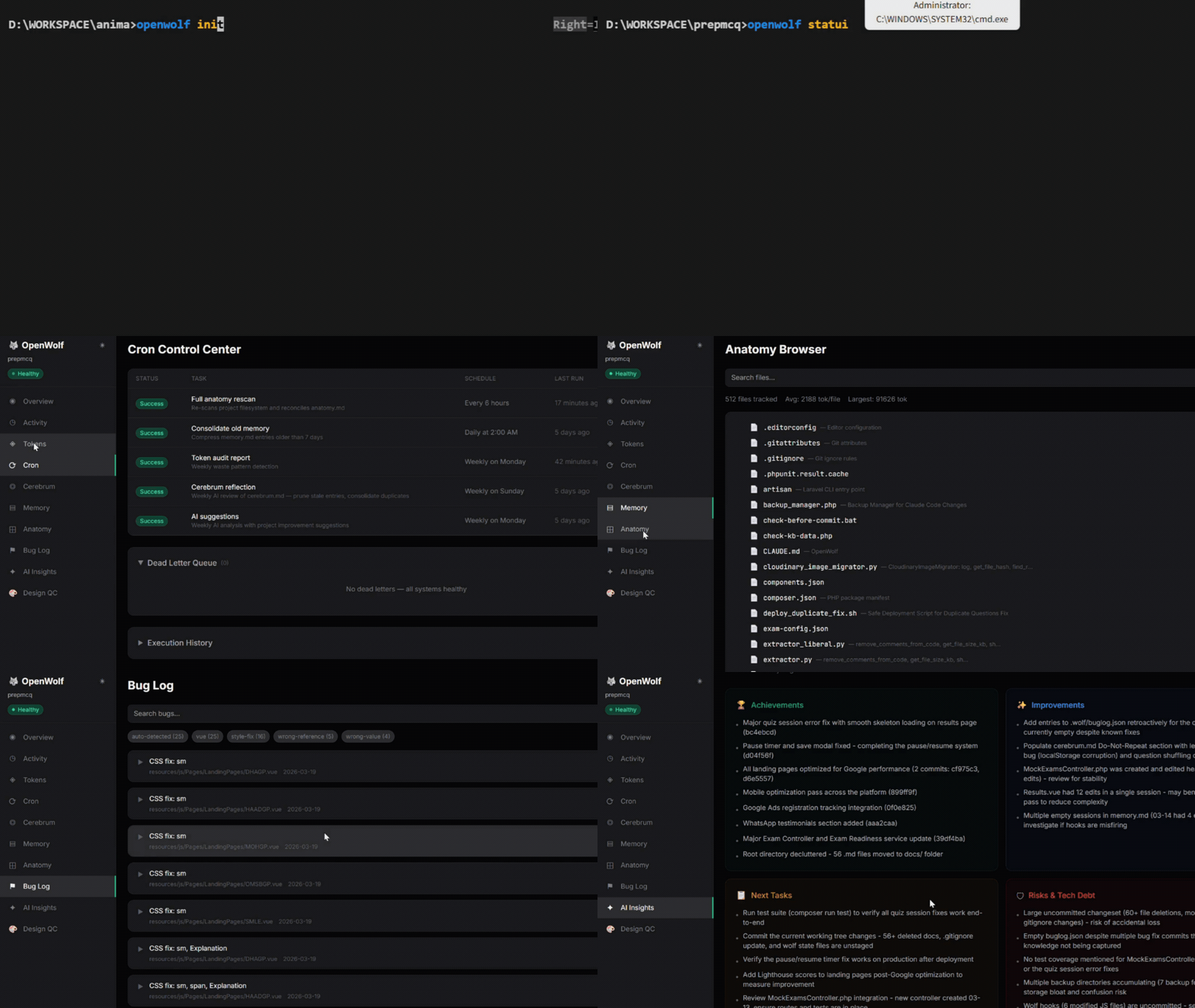
Sharper context. Fewer tokens. Open-source middleware for Claude Code.
2.1k
Stars
184
Forks
44
Open issues
1
Contributors

AI Analysis
OpenWolf is an open-source middleware that optimizes Claude Code's context usage by maintaining a project index, learning memory, and token ledger across sessions. It targets developers using Claude Code for complex projects, helping them reduce token consumption by tracking file reads, preventing redundant operations, and accumulating project knowledge—particularly valuable for teams working with large codebases where token costs and context efficiency matter.
Inferred from signals mentioned in the README (tests, CI, type safety) — not a review of the actual code.
AI's overall editorial judgment — not an average of the bars above, can weigh other factors too.
Claude Code middleware reducing token consumption through project indexing and memory hooks
OpenWolf is a Node.js middleware that intercepts Claude Code operations to provide project indexing, token tracking, and learned preferences across sessions. It targets developers using Claude Code who need tighter token budgets and prefer keeping AI context lean. The README claims 65.8% average token reduction across 20 projects; real-world adoption beyond initial GitHub momentum remains unverified.
Created 2026-03-15, less than 3.5 months old as of evaluation date. Authored by cytostack. Positions itself as specialized middleware for Claude Code workflows rather than a general-purpose tool. Early-stage project with rapid initial traction (2,079 stars, 116 gained in last 7 days).
Project achieved 2,079 stars in ~3.5 months with 116 stars in the most recent 7-day window, indicating sustained momentum rather than initial spike-and-decay. However, last push was 2026-03-20, meaning repository received no updates for ~3 months at evaluation date. Growth trajectory suggests strong early interest but recent development pause raises questions about maintenance commitment.
README includes specific token savings claims: 65.8% average reduction across 20 projects with 71% of repeated file reads blocked. Claims are presented as 'real usage, not benchmarks' but no publicly linked case studies, user testimonials, or third-party verification provided. npm package exists (openwolf) indicating distribution mechanism. Adoption not verified beyond GitHub stars and theoretical token ledger examples.
Based on README, appears to operate through 6 hook scripts that intercept Claude Code lifecycle events (file reads, writes, session start/end). Stores project state in `.wolf/` directory with markdown and JSON files (anatomy.md, cerebrum.md, memory.md, buglog.json, token-ledger.json). Likely stateless hook runner rather than persistent daemon. Implementation details not inspectable from README alone.
Not documented in README. No mention of test suite, CI/CD pipeline, or quality gates.
Red flag: last push 2026-03-20 with no activity for ~3 months despite high star count and recent 7-day momentum. README quality is high and well-documented, suggesting mature early work, but absence of recent commits during period of active GitHub discussion suggests either completed-and-stable status or abandoned post-launch. Cannot definitively distinguish between 'finished product needing no changes' and 'stalled development' from metadata alone.
ADOPT IF: you use Claude Code frequently on large projects, prioritize token economy, and accept AGPL-3.0 licensing constraints and novel tool addition to workflow. AVOID IF: you need actively maintained software with recent commits, require production support or documented case studies, or work on closed-source projects where AGPL-3.0 incompatibility is a blocker. MONITOR IF: you are evaluating Claude Code augmentation strategies—understand token savings claims are unverified by independent third party, and repository maintenance appears stalled despite recent GitHub interest.
Independent dimensions
Mainstream potential
3/10
Technical importance
5/10
Adoption evidence
2/10
- Three-month maintenance gap (last push 2026-03-20) suggests possible project stall; unclear if intentional stability or loss of author interest.
- Token savings claims (65.8% average, 80% on specific project) lack independent verification; no public benchmarks, audits, or third-party reproduction provided.
- AGPL-3.0 license creates friction for commercial codebases and may limit adoption; incompatible with proprietary software workflows.
- Hook-based integration couples OpenWolf to Claude Code's undocumented lifecycle events; breaking changes to Claude's hook interface could render OpenWolf non-functional.
- Adoption appears limited to early GitHub adopters; no evidence of deployment at organizational scale or production reliance in documented case studies.
Project will likely remain a niche tool for individual developers and small teams optimizing Claude Code sessions. Without recent maintenance commits and in absence of production adoption evidence, mainstream integration into Claude Code workflows seems unlikely. May be acquired or incorporated into Claude ecosystem, or remain stable-but-unmaintained utility if token-saving claims are validated by community use.
Explore similar
Newsletter
Get analyses like this every Monday
Free weekly digest of the most interesting open-source discoveries.
Languages
Information
- Website
- https://openwolf.com
- Language
- TypeScript
- License
- AGPL-3.0
- Last updated
- 4mo ago
- Created
- 4mo ago
- Analyzed with
- anthropic/claude-haiku-4-5
Stars over time
Contributors over time
Top 100 contributors only — repos with more will plateau at 100.
Open issues
post-write hook only excludes .env from anatomy/memory — other secret files (.p8/.pem/.key/.keystore/credentials) get captured
Is this Repo dead?
parseAnatomy drops every entry on CRLF line endings - post-write hook then truncates anatomy.md to an empty skeleton (Windows + git autocrlf)
feat: multi-project dashboard with in-page project switcher
feat: multi-project dashboard with in-page project switcher
Top contributors
Recent releases
No releases published yet.
Similar repos

different-ai/openwork
OpenWork is a desktop application (macOS, Windows, Linux) that enables users to...
| Repository | Stars | Week Δ | Language | Score | Updated |
|---|---|---|---|---|---|
|
cytostack/openwolf
this
|
2.1k | +21 | TypeScript | 7/10 | 4mo ago |
|
different-ai/openwork
|
16.8k | — | TypeScript | 7/10 | 6h ago |
 linuxhsj/openclaw-zero-token linuxhsj/openclaw-zero-token
|
5k | — | TypeScript | 7/10 | 9h ago |
16,436 stars vs. 2,079; appears to be dominant in related namespace but README does not specify direct relationship or feature parity. Insufficient information to assess competitive positioning.
OpenWolf assumes Claude Code as prerequisite. Saves tokens by preventing redundant reads and providing context summaries, but requires users to adopt tool and trust hook system with code repository.
Broader context-optimization ecosystems; OpenWolf is narrower, Claude Code-specific, and file-indexing focused rather than vector-database-based retrieval.
Likely competes with manual project documentation, static code index generators, or custom scripts that developers write; OpenWolf integrates with Claude Code hooks rather than replacing standalone tools.
Different architectural layer; OpenWolf operates at Claude Code hook level, not repository-scale code search or navigation.