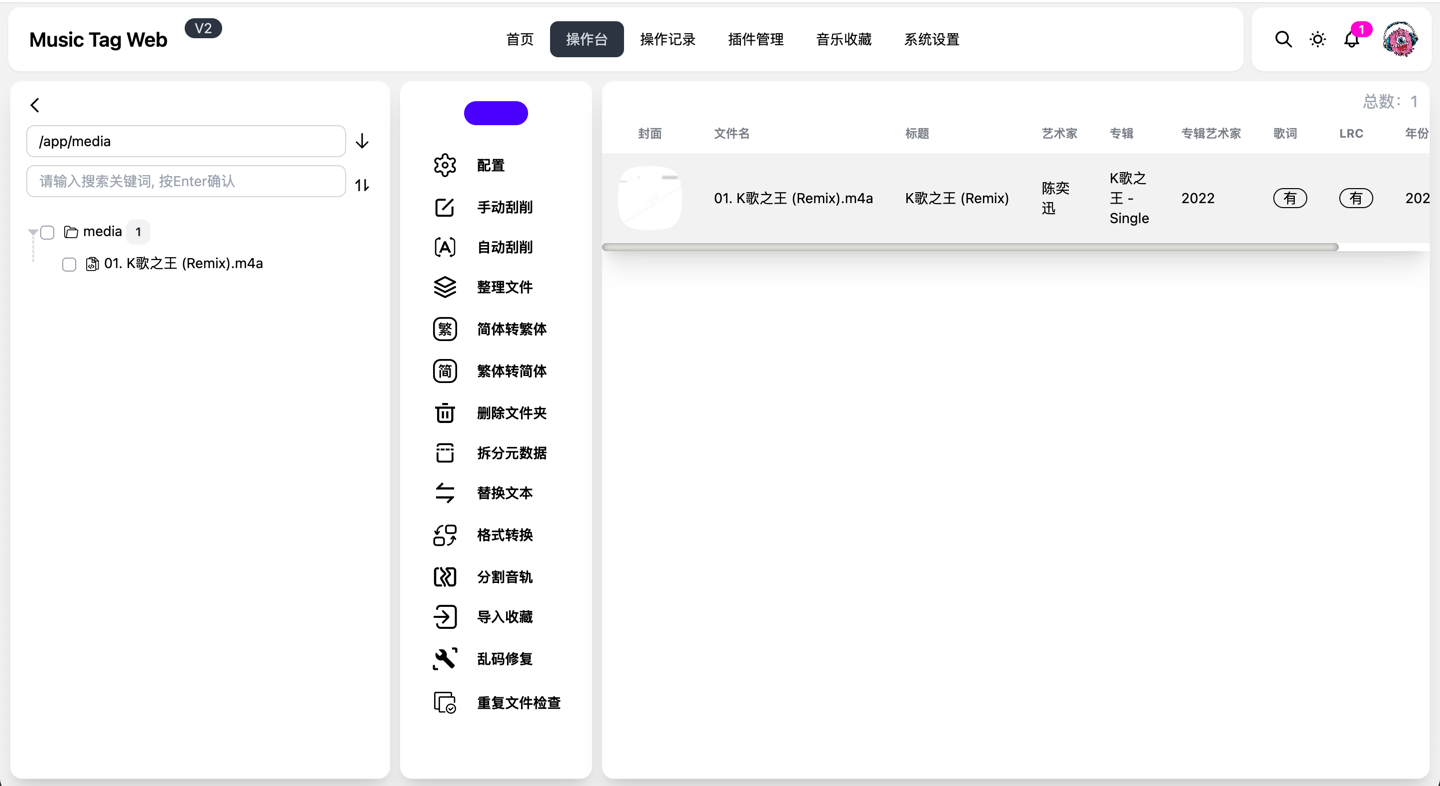
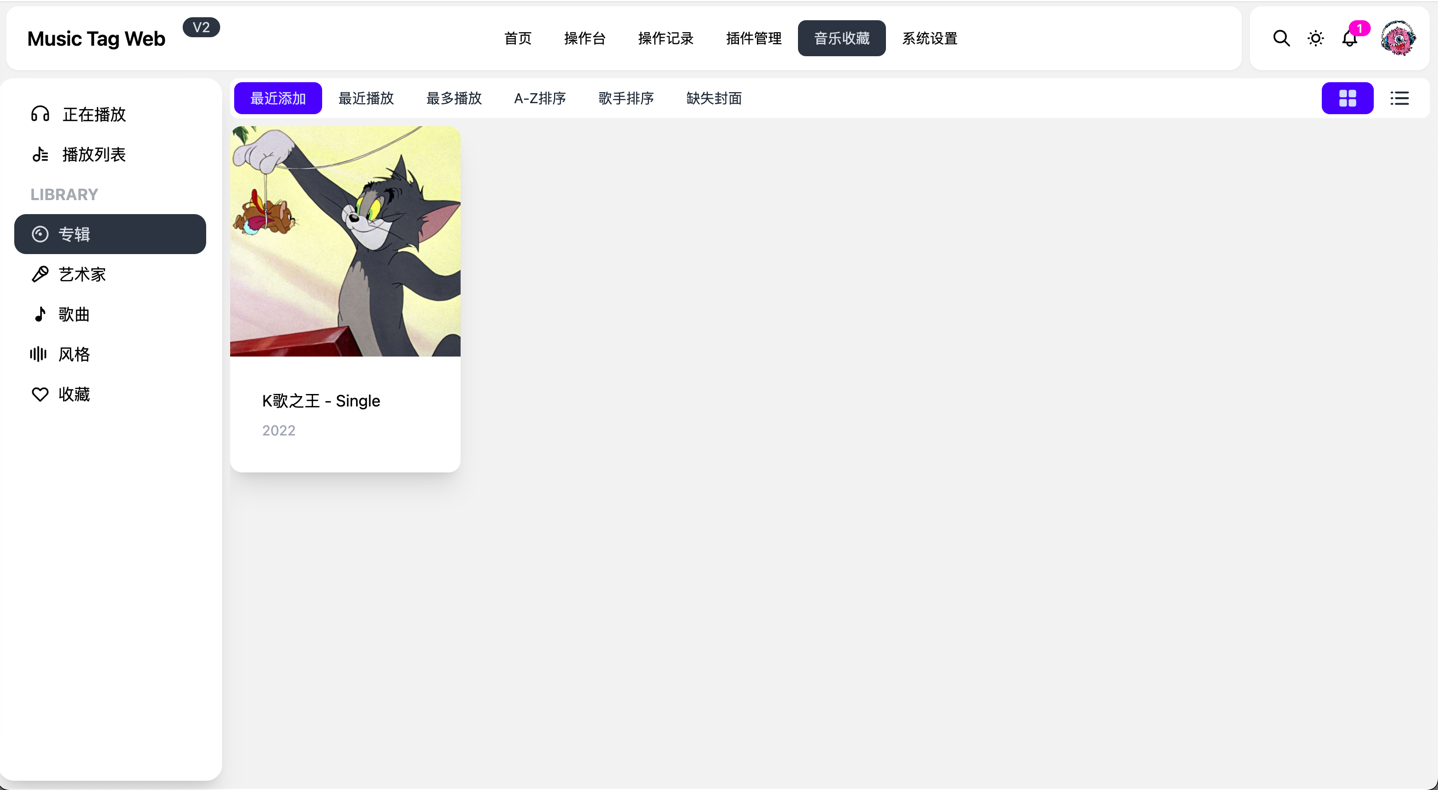
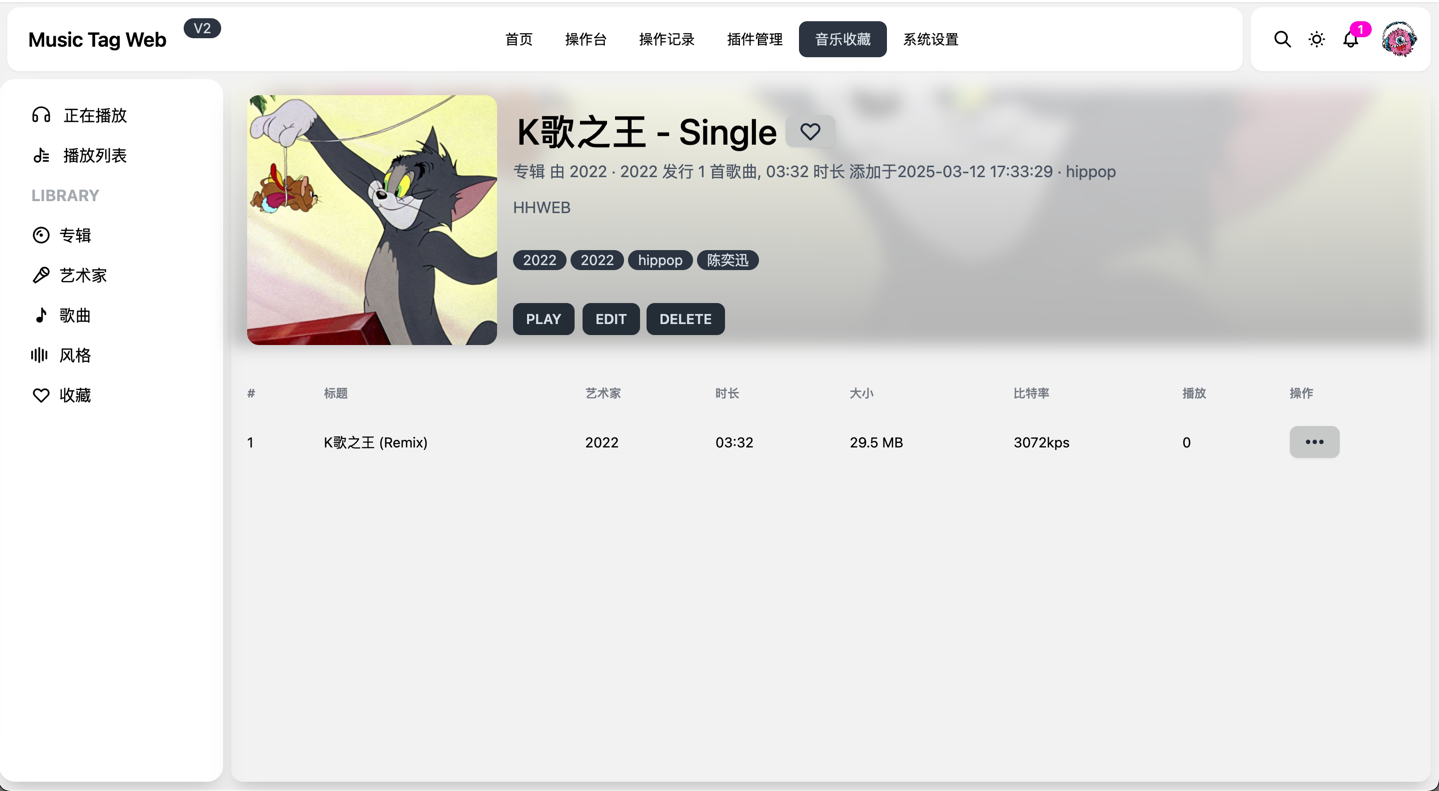
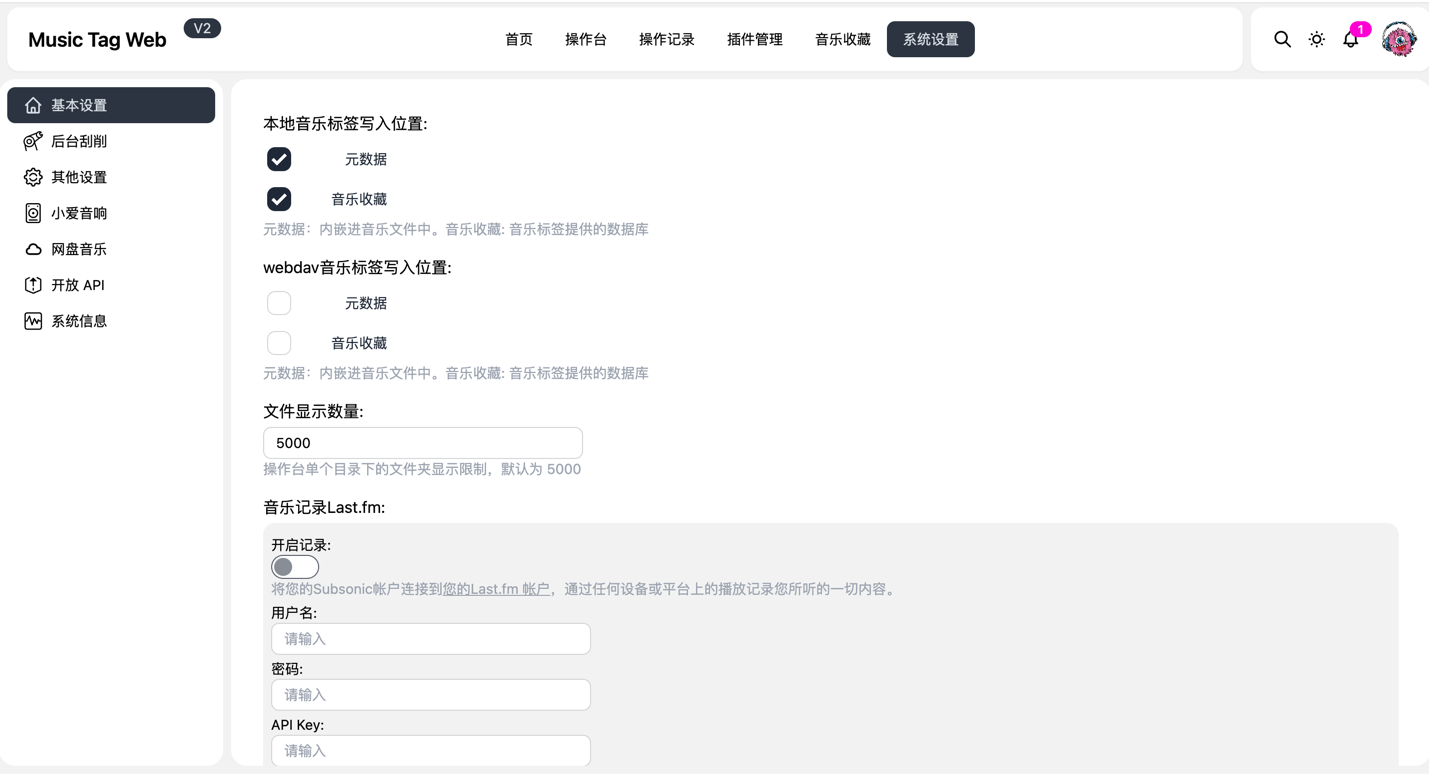
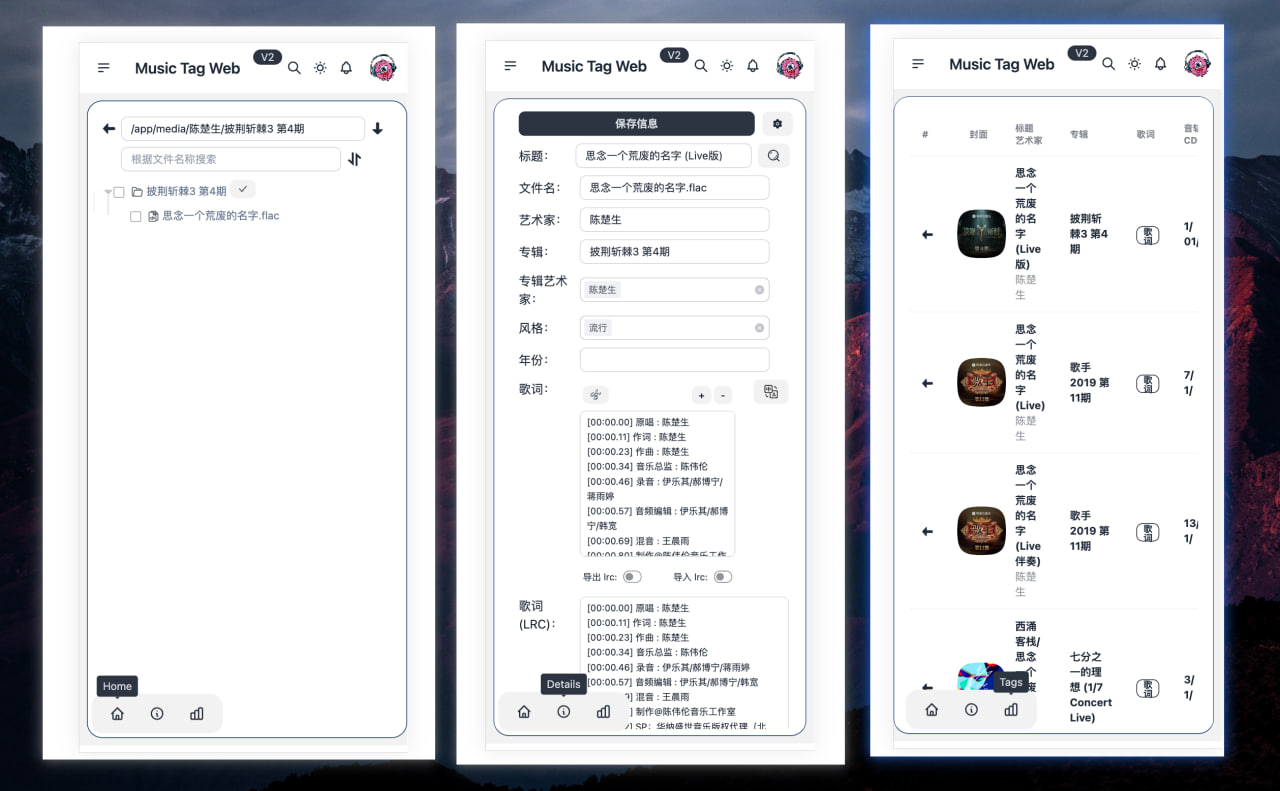
音乐标签编辑器,可编辑本地音乐文件的元数据, 音乐刮削。(Editable local music file metadata.)
5.9k
Stars
420
Forks
41
Open issues
1
Contributors
AI Analysis
Music Tag Web is a self-hosted Docker application for managing and editing audio metadata (ID3 tags) across multiple formats (FLAC, MP3, M4A, OGG, etc.), designed specifically for NAS and Homelab users with remote music libraries. It serves as a web-based replacement for desktop tools like MP3Tag and MusicBrainz Picard, offering batch metadata editing, music scraping, fingerprint recognition, and file organization. This tool is best suited for Navidrome/Jellyfin users and NAS enthusiasts; it ...
Inferred from signals mentioned in the README (tests, CI, type safety) — not a review of the actual code.
AI's overall editorial judgment — not an average of the bars above, can weigh other factors too.
Self-hosted Docker web UI for bulk music metadata editing and scraping, built for NAS and Homelab users
Music Tag Web is an open-source, self-hosted Docker application that lets users edit audio file metadata (ID3 tags, lyrics, cover art) through a browser interface. It targets NAS and Homelab users running Navidrome or Jellyfin who cannot use desktop tools like MP3Tag or MusicBrainz Picard because their music libraries live on remote servers. With support for 14+ audio formats, acoustic fingerprint recognition, batch scraping from Chinese and international metadata sources, and ffmpeg-based format conversion, it fills a specific gap that desktop-only tools leave open for the self-hosted media server community.
Created in March 2023, the project emerged alongside rapid growth of Chinese NAS enthusiast communities and the rise of self-hosted media servers. It reached V2 architecture within roughly two years, indicating sustained development iteration.
Growth appears driven primarily by Chinese NAS and Homelab communities (Synology, QNAP users) and spread through platforms like HelloGitHub and Telegram groups. The project accumulated ~5,800 stars and filled a genuine workflow gap: users running Navidrome/Jellyfin on remote servers had no good web-based metadata editor. Stars gained in the past 7 days (19) suggest steady organic growth rather than viral spikes, consistent with a niche tool building a loyal user base.
Docker Hub pull count badge is referenced in the README but the numeric value is not captured in available metadata. QQ group 1 (55,893,996 members listed as 'full') and an active QQ group 2 suggest a substantial real user base in the Chinese self-hosted community. A live public demo instance is provided. Featured on HelloGitHub. Concrete Docker pull numbers are not available for verification here, but community signals suggest meaningful real-world deployment.
Appears to be a Python (likely Django or Flask) backend with a web frontend, packaged as a Docker container. Likely uses mutagen or a similar library for audio tag manipulation. ffmpeg is integrated for format conversion. Data is stored locally within the container volume. Supports amd64 and arm64 architectures, indicating cross-platform build pipeline.
not documented in README
Last push was June 16, 2026 — approximately 10 days before the evaluation date. This indicates active maintenance. A V2 deployment guide exists alongside V1, suggesting the project has iterated on its architecture. Active Telegram and QQ community groups further signal ongoing engagement. The project appears healthy and actively developed.
ADOPT IF: you run Navidrome, Jellyfin, or a similar self-hosted media server with a music library stored on a remote NAS or Linux server and need a browser-accessible tool to bulk-edit metadata, scrape tags, or fix disorganized libraries — especially if your library includes Chinese music or you prefer a GUI over CLI tools. AVOID IF: your music library is local to your desktop (desktop tools like MP3Tag or Picard are more mature), you require enterprise-grade reliability or auditability, or you are uncomfortable with the legal ambiguity of scraping metadata from commercial Chinese music platforms. MONITOR IF: you are evaluating it for a non-Chinese-language library, as metadata source quality and coverage for Western music may be less reliable than for Chinese content — further user reports would clarify this.
Independent dimensions
Mainstream potential
3/10
Technical importance
6/10
Adoption evidence
5/10
- Legal and licensing ambiguity: the project scrapes metadata from commercial Chinese music platforms (QQ Music, NetEase, Kugou, etc.). The disclaimer acknowledges potential copyright issues and instructs users to delete scraped data within 24 hours, which creates compliance uncertainty for serious deployments.
- Metadata source dependency: the tool's core scraping value depends on unofficial API access to third-party music platforms that could block or change their APIs without notice, potentially breaking key functionality.
- Single maintainer risk: based on available signals, the project appears to be primarily maintained by one individual. Long-term sustainability depends on continued personal commitment or community contribution growth.
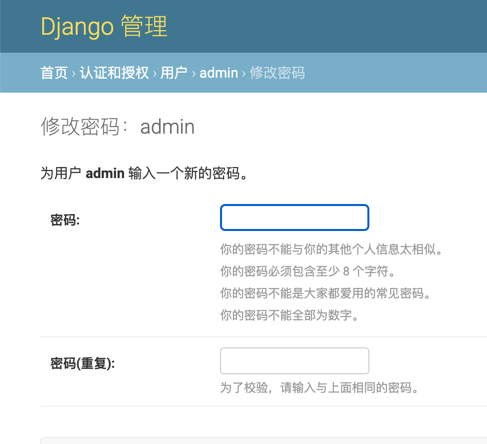
- Security exposure: the default admin/admin credentials and web-accessible admin panel on a NAS could be a security risk if users do not change defaults before exposing the service, even on a local network.
- Non-Chinese library coverage is uncertain: the README emphasizes Chinese music platforms and Chinese-language use cases. Coverage quality for Western artists and albums from non-Chinese sources is not well-documented.
Likely to continue growing steadily within the Chinese NAS and self-hosted media community. Mainstream potential outside Chinese-speaking users remains limited without expanded Western metadata source integration.
Newsletter
Get analyses like this every Monday
Free weekly digest of the most interesting open-source discoveries.
Languages
No language breakdown available.
Information
- Language
- Python
- License
- GPL-3.0
- Last updated
- 3w ago
- Created
- 41mo ago
- Analyzed with
- anthropic/claude-haiku-4-5
Stars over time
No commit data available.
Contributors over time
Top 100 contributors only — repos with more will plateau at 100.
Open issues
No open issues — clean slate.
Open pull requests
No open pull requests.
Top contributors
Contributor data not available yet.
Recent releases
No releases published yet.
Similar repos

Borewit/music-metadata
music-metadata is a TypeScript library for parsing and extracting metadata from...

TagStudioDev/TagStudio
TagStudio is a tag-based photo and file organization application that layers...
| Repository | Stars | Week Δ | Language | Score | Updated |
|---|---|---|---|---|---|
|
xhongc/music-tag-web
this
|
5.9k | +33 | Python | 7/10 | 3w ago |
 taglib/taglib taglib/taglib
|
1.4k | — | C++ | 7/10 | 5d ago |
|
Borewit/music-metadata
|
1.3k | — | TypeScript | 8/10 | 5d ago |
|
TagStudioDev/TagStudio
|
7k | — | Python | 7/10 | 13h ago |
 beetbox/beets beetbox/beets
|
15.4k | — | Python | 8/10 | 1d ago |
 NeptuneHub/AudioMuse-AI NeptuneHub/AudioMuse-AI
|
2.2k | — | Python | 7/10 | 16h ago |
Picard is a desktop application requiring local file access. Music Tag Web targets the same metadata-scraping use case but runs as a web service, making it more suitable for users whose libraries are on remote NAS devices. Picard has a larger community and broader metadata source (MusicBrainz), but lacks browser-based remote access.
Beets is a CLI-driven music library manager with powerful automation and plugin ecosystem. It requires SSH or terminal access, making it less accessible to non-technical NAS users. Music Tag Web offers a GUI and is easier to operate for casual users, though beets offers deeper scripting capability.
TagStudio focuses on a tagging and organization philosophy for general files with a desktop GUI. It does not specialize in audio metadata scraping or NAS deployment, making it a different use case rather than a direct competitor.
MusicPlayer2 is a Windows desktop music player with tag editing features. It requires local file access and a Windows environment, making it unsuitable for remote NAS server scenarios that Music Tag Web specifically addresses.
AudioMuse-AI is newer and AI-focused for music analysis. It targets a different problem (audio analysis/generation assistance) rather than bulk metadata editing for existing libraries. Minimal direct competition with Music Tag Web.