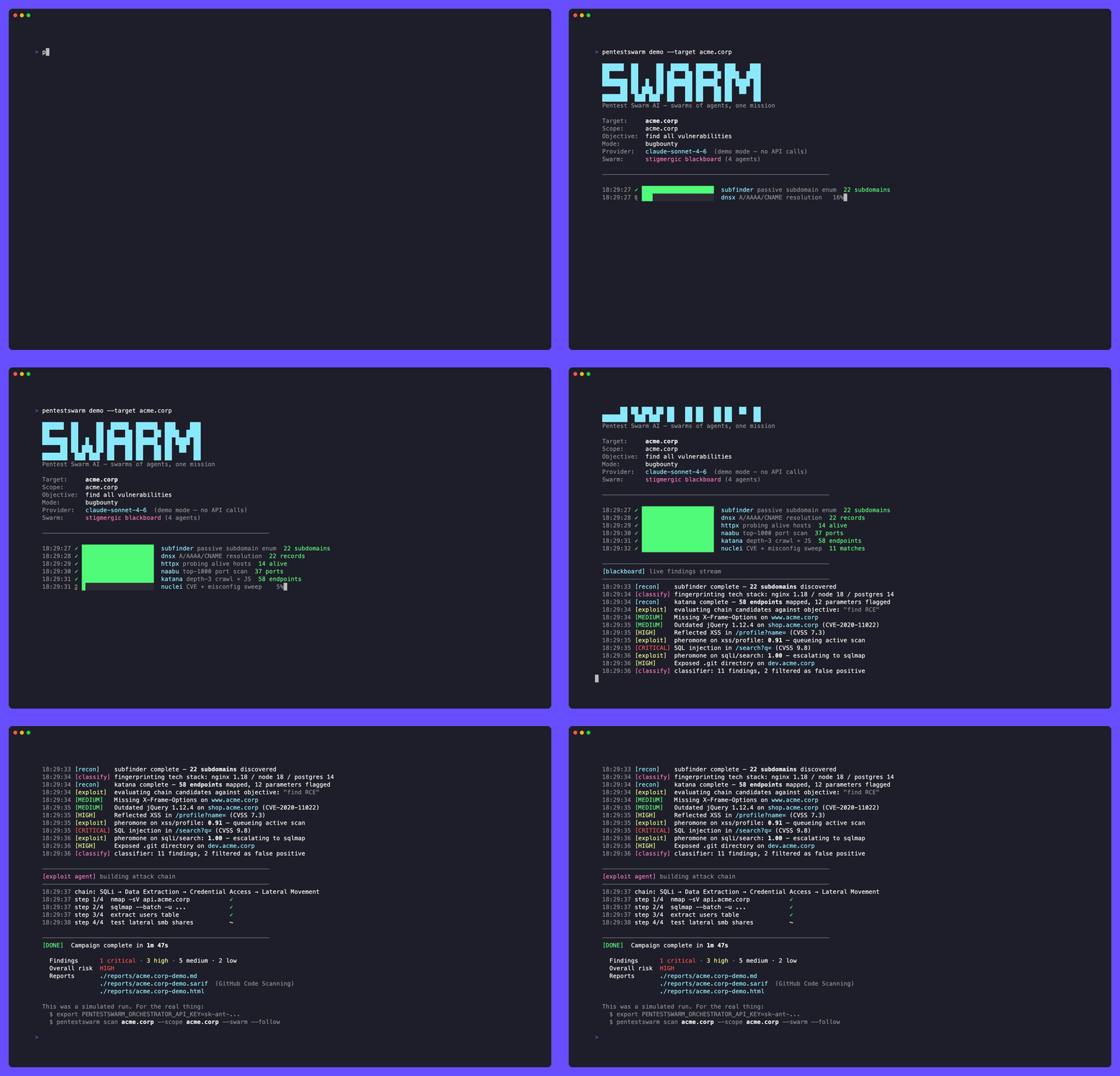
Autonomous penetration testing using a swarm of AI agents. Orchestrates recon, classification, exploitation, and reporting specialists with ReAct reasoning — supports bug bounty, continuous monitoring, and CTF modes. Built with Go, Claude API, and 7+ native security tools.
2k
Stars
396
Forks
12
Open issues
6
Contributors


AI Analysis
Pentest Swarm AI is an autonomous penetration testing framework that orchestrates multiple AI agents (recon, classification, exploitation, reporting) using stigmergic coordination and ReAct reasoning to conduct comprehensive security assessments. Built in Go with integrations to nmap, sqlmap, Burp, ZAP, Metasploit, and other offensive tools, it serves bug bounty hunters, red teams, and security researchers who need coordinated multi-agent reconnaissance and exploitation—not general-purpose de...
Inferred from signals mentioned in the README (tests, CI, type safety) — not a review of the actual code.
AI's overall editorial judgment — not an average of the bars above, can weigh other factors too.
Swarm-based autonomous pentesting with Claude; early-stage tool emphasizing multi-agent coordination over sequential pipelines
Pentest Swarm AI is a Go-based framework that orchestrates multiple AI agents (reconnaissance, classification, exploitation, reporting) using stigmergic coordination—agents share findings on a blackboard rather than following a linear pipeline. Built to work with Claude (and other LLMs via OpenAI-compatible APIs), it integrates nmap, sqlmap, Burp, ZAP, and Metasploit. Adoption remains early and adoption not verified at scale; project is ~15 months old with 1,974 stars and active maintenance. Targets bug bounty operators, red teamers, and CTF competitors who want automated reconnaissance and exploitation workflows.
Launched March 2026 as a response to the Anthropic Mythos release (frontier reasoning model). Explicitly positioned as a toolchain to operationalize advanced reasoning models in offensive security, building on precedent from PentestGPT, PentAGI, and similar multi-agent pentest projects. Frames itself as filling a gap between true swarm intelligence and sequential multi-agent pipelines.
Strong early adoption curve: 1,974 stars in 15 months, 134 stars in last 7 days as of June 2026, 392 forks. Growth appears correlated with Mythos release hype and expanded awareness of AI-driven security testing. Recent uptick in stars suggests continued interest, though whether this reflects genuine production deployments or research/hobby interest is unclear from public signals alone.
Adoption not verified. No case studies, testimonials, bug bounty platform integrations, or enterprise deployments documented. Tool is positioned for bug bounty and CTF use, but evidence of real operators using it in production workflows is absent from README and public metadata. Star count and fork activity suggest research/evaluation interest rather than confirmed production use.
Likely uses a Postgres-backed blackboard for stigmergic coordination, with agent trigger predicates that activate based on findings rather than a central orchestrator. README describes decentralized agent model with pheromone-weighted finding decay. Likely integrates native security tools via subprocess or API calls. Specific implementation details not verifiable from README alone.
Not documented in README. No indication of unit test or integration test suite mentioned.
Last push 2026-06-20 (8 days before evaluation date), indicating active maintenance. Repository appears to be under regular development. README references alpha status; typical sign of pre-1.0 project still evolving API and features. Go 1.24 dependency noted. Maintenance frequency is consistent with early-stage project actively seeking adoption.
ADOPT IF: you are evaluating AI-driven swarm coordination for pentesting, comfortable with alpha-stage tooling, and want to experiment with stigmergic agent architectures before committing to sequential multi-agent frameworks. You have time to contribute or fork if workflow doesn't match your target. AVOID IF: you require production-grade stability, extensive documentation, verified real-world case studies, or integration with established commercial pentesting workflows; adoption evidence is lacking and API may change. MONITOR IF: you work in red team automation or bug bounty operations and want to track whether this swarm model proves superior to centralized orchestration—early indicator of a maturing category.
Independent dimensions
Mainstream potential
4/10
Technical importance
6/10
Adoption evidence
2/10
- Alpha status and lack of documented production deployments create uncertainty about real-world reliability and tool robustness.
- Dependency on Claude API (and Anthropic Mythos availability) creates external bottlenecks; tool may be marketed for Mythos but availability/cost unknown.
- AGPL-3.0 license may deter some commercial users; forking or modification triggers copyleft obligations.
- No public evidence of bug bounty platform integration or automated reporting submission workflows; manual post-processing may be required.
- Stigmergic coordination model, while novel in pentest domain, is architecturally unproven at scale; blackboard contention, pheromone decay tuning, and emergence reliability untested in production.
If Mythos access widens and frontier reasoning models become standard, Pentest Swarm AI may grow into a recognized niche tool for researchers and well-resourced red teams. More likely: project remains in alpha/research territory; adoption plateaus unless real-world case studies emerge or integration with commercial platforms accelerates. Stigmergy concept may be influential for future multi-agent pentest design, but this specific tool may not achieve mainstream adoption.
Newsletter
Get analyses like this every Monday
Free weekly digest of the most interesting open-source discoveries.
Languages
Information
- Language
- Go
- License
- AGPL-3.0
- Last updated
- 3w ago
- Created
- 28mo ago
- Analyzed with
- anthropic/claude-haiku-4-5
Stars over time
Contributors over time
Top 100 contributors only — repos with more will plateau at 100.
Open issues
Implement `pentestswarm campaign explore <id>` — launch Bubbletea recon explorer
Implement `pentestswarm campaign list` to fetch campaigns from API/DB
Implement `pentestswarm campaign status <id>` to fetch campaign details
Implement `pentestswarm campaign stop <id>` to call the API
Implement config validation in `pentestswarm config validate`
Top contributors
Recent releases
Similar repos

GH05TCREW/pentestagent
PentestAgent is an AI-powered agent framework designed for autonomous black-box...

0xSteph/pentest-ai-agents
pentest-ai-agents is a collection of 50 Claude Code subagents that extend...
| Repository | Stars | Week Δ | Language | Score | Updated |
|---|---|---|---|---|---|
|
Armur-Ai/Pentest-Swarm-AI
this
|
2k | — | Go | 7/10 | 3w ago |
 vxcontrol/pentagi vxcontrol/pentagi
|
19.4k | — | Go | 7/10 | 7d ago |
|
GH05TCREW/pentestagent
|
2.8k | — | Python | 7/10 | 3d ago |
|
0xSteph/pentest-ai-agents
|
2k | — | Shell | 8/10 | 3w ago |
 Ed1s0nZ/CyberStrikeAI Ed1s0nZ/CyberStrikeAI
|
5k | — | Go | 7/10 | 1d ago |
 CyberStrikeus/CyberStrike CyberStrikeus/CyberStrike
|
1.2k | — | TypeScript | 7/10 | 14h ago |
Larger, more established; also Go-based autonomous agent. Pentest Swarm AI differentiates on stigmergy/blackboard model vs. PentAGI's orchestration model, but adoption and maturity significantly favor PentAGI.
Python-based; more stars. Pentest Swarm AI's Go foundation and claimed swarm coordination are structural differences, but adoption parity unclear.
Also Go; larger audience. Pentest Swarm AI's focus on stigmergic coordination may appeal to different use case, but market leadership firmly held by CyberStrikeAI.
Pentest Swarm AI aims to automate discovery and initial exploitation; success depends on reliability of agent reasoning and tool integration, not on replacing established methodologies but augmenting them.
Pentest Swarm AI sits atop these tools; orchestrates rather than replaces. Adoption success depends on whether swarm model + LLM reasoning delivers more value than traditional sequential workflows.