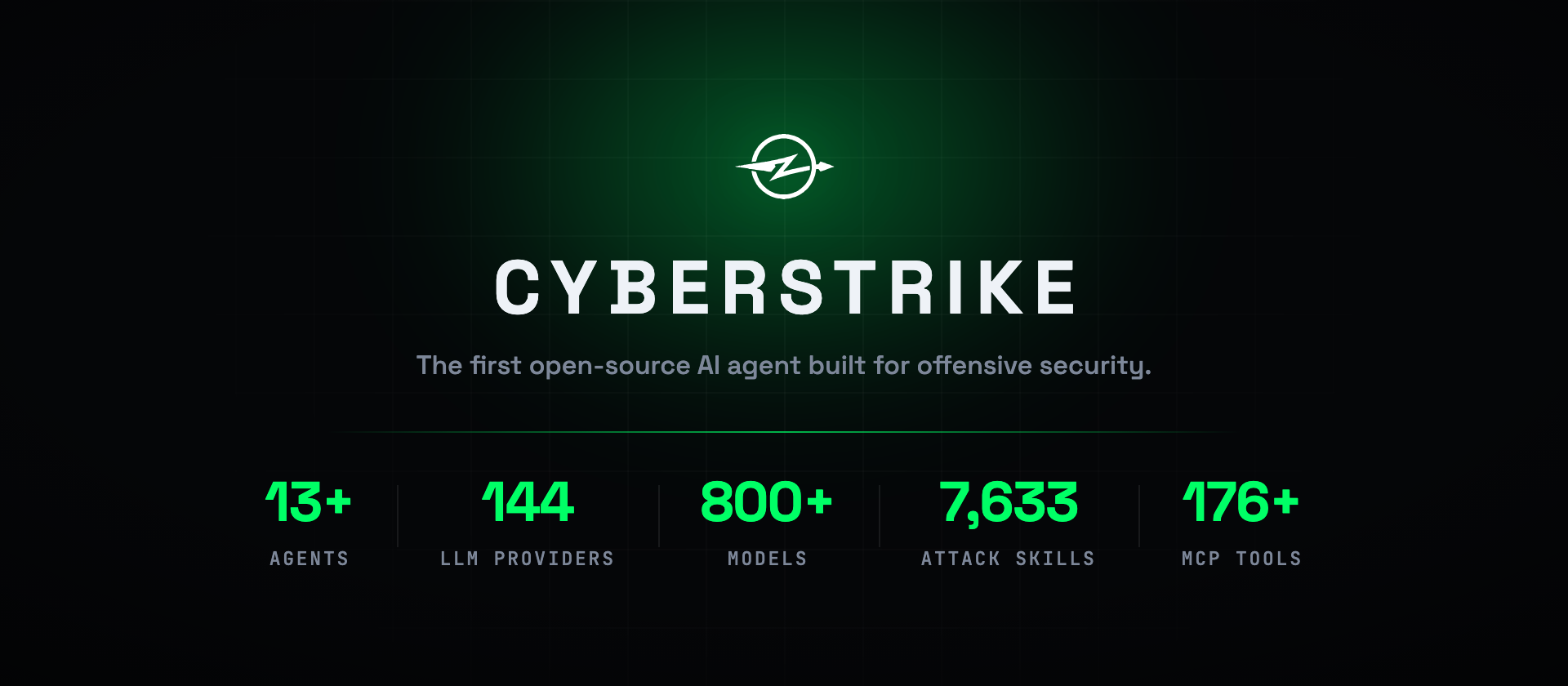
AI-powered offensive security agent with 7,300+ actionable security skills. Autonomous pentesting powered by MITRE ATT&CK (2,000+ Atomic tests), CIS Benchmarks (1,500+ controls), OWASP, NIST. Lazy-loading, zero context pollution. Your AI red team.
1.2k
Stars
192
Forks
18
Open issues
30
Contributors


AI Analysis
CyberStrike is an open-source AI-powered offensive security agent that automates penetration testing by integrating with LLMs (Claude, GPT, etc.) to execute security assessments autonomously. It serves specialized security professionals and red teams who need programmatic access to 7,300+ security skills, MITRE ATT&CK atomic tests, CIS Benchmarks, and OWASP controls—not a general-purpose tool for non-security audiences. Best suited for ethical hackers, DevSecOps engineers, and bug bounty rese...
Inferred from signals mentioned in the README (tests, CI, type safety) — not a review of the actual code.
AI's overall editorial judgment — not an average of the bars above, can weigh other factors too.
TypeScript AI pentesting agent with 7,300+ security skills, launched Feb 2026, gaining 436 stars weekly
CyberStrike is an open-source autonomous pentesting agent that wraps LLMs (Claude, GPT, Gemini, etc.) with domain-specific security knowledge—MITRE ATT&CK, CIS Benchmarks, OWASP—to conduct reconnaissance, vulnerability discovery, and exploitation via CLI and web UI. Built for security practitioners and red teams who want to leverage existing LLM subscriptions without separate tooling costs. Adopted by an unknown number of practitioners; 919 GitHub stars as of 2026-06-28 with explosive recent growth (436 stars in 7 days suggests viral or coordinated attention). No documented enterprise production usage identified.
Project created 2026-02-14 (4.5 months old at evaluation date). Positioned as 'first open-source AI agent built for offensive security' in a crowded space of AI-powered pentesting tools (CyberStrikeAI, Anthropic-Cybersecurity-Skills, hexstrike-ai, Pentest-Swarm-AI all exist with higher or comparable star counts). Appears to differentiate via TypeScript implementation, multi-provider LLM support, and emphasis on lazy-loading and 'zero context pollution.'
436 stars gained in 7 days (to 2026-06-27) represents ~48% weekly growth from a ~900-star baseline. This spike occurred very recently and may indicate: (a) successful launch announcement or HN/Reddit post, (b) product milestone or feature release, (c) organic momentum from early adopter word-of-mouth. Last commit 2026-06-27 (1 day before evaluation date) signals active development. However, the project is too new to distinguish sustainable growth from temporary viral attention. No historical growth curve available.
adoption not verified. No case studies, testimonials, or documented enterprise deployments mentioned in README. No CVE disclosures or security audit reports referenced. npm download metrics not provided in metadata (only npm exists as package). Discord server exists but member count and activity level unknown. Star count alone does not indicate production usage—many tools are forked/cloned for experimentation without operational deployment. GitHub forks (146) suggest some community interest but forks ≠ usage. No indication that users have deployed this in real pentests or continuous security assessments.
Based on README: agent architecture built in TypeScript with 13+ specialized agents, schema normalization for multi-provider LLM compatibility, context guard to prevent prompt leakage, tool orchestration layer. Supports 15+ LLM providers (Anthropic, OpenAI, Google, Bedrock, Azure, Groq, Mistral, DeepSeek, OpenRouter, Together AI) with auto-detection. Likely implements agentic loop for reconnaissance → vulnerability discovery → exploitation → reporting. Web UI and 'Bolt' remote execution mentioned but not detailed in README. MCP ecosystem integration referenced but not explained. Cannot assess code quality, error handling, or security posture from README alone.
not documented in README. No mention of unit tests, integration tests, or test suite in provided excerpt.
Last push 2026-06-27 (within 24 hours of evaluation date) indicates active development. Repository has 146 forks and a Discord community (1,391832426048651334). Published to npm (@cyberstrike-io/cyberstrike) with automated build workflow (GitHub Actions). License: AGPL-3.0. Multilingual README (24 language variants) suggests intentional localization effort. Overall: very recent, actively maintained, no signs of stagnation. Too new to assess long-term maintenance commitment.
ADOPT IF: you need autonomous pentesting via CLI with flexible LLM provider choice (Claude, GPT, Gemini, etc.) and want to avoid vendor lock-in; your team is comfortable with AGPL-3.0 licensing and early-stage tooling; you prioritize lazy-loading and context isolation over proven enterprise maturity. AVOID IF: you require production-hardened software with documented SLAs, audit trails, and extensive real-world deployment evidence; your organization has security policies restricting AGPL software; you need battle-tested tool stability over experimental features. MONITOR IF: you are evaluating AI-powered pentesting platforms and want to track whether CyberStrike's multi-provider approach and TypeScript implementation gain meaningful adoption; you expect to adopt in 6–12 months after maturity signals emerge.
Independent dimensions
Mainstream potential
4/10
Technical importance
6/10
Adoption evidence
2/10
- Project age (4.5 months old): insufficient operational history to assess reliability, bug stability, or handling of edge cases in real pentests.
- Adoption not verified: no documented production deployments, case studies, or measurable enterprise usage. Recent star spike may reflect hype rather than substantive adoption.
- AGPL-3.0 licensing: may deter commercial and some enterprise adoption due to copyleft obligations; unclear if acceptable in all security contexts.
- Multi-provider LLM strategy: broad support (15+ providers) may dilute quality of integration and testing per provider; potential for provider-specific bugs or inconsistent behavior.
- Competitive crowding: operates in crowded space with several higher-starred competitors (hexstrike-ai, Anthropic-Cybersecurity-Skills); viral growth may not sustain if feature differentiation is not compelling.
Likely to remain a specialized tool with modest adoption among TypeScript-native and multi-cloud security teams. May achieve 2,000–3,000 stars within 12 months if growth sustains; unlikely to reach hexstrike-ai or Anthropic-Cybersecurity-Skills scale unless significant differentiation emerges. Risk of becoming abandoned or merge-acquired if maintainers lose momentum post-launch hype. Will depend on: (a) quality of next 3–6 months of maintenance, (b) emergence of documented production use cases, (c) ability to compete on ease-of-use and LLM cost efficiency.
Newsletter
Get analyses like this every Monday
Free weekly digest of the most interesting open-source discoveries.
Languages
Information
- Website
- https://cyberstrike.io
- Language
- TypeScript
- License
- AGPL-3.0
- Last updated
- 13h ago
- Created
- 5mo ago
- Analyzed with
- anthropic/claude-haiku-4-5
Stars over time
Contributors over time
Top 100 contributors only — repos with more will plateau at 100.
Open issues
Open pull requests
fix(security): prevent SSRF via unvalidated GitHub Enterprise URL in Copilot plugin
chore(deps): Bump drizzle-orm from 1.0.0-beta.12-a5629fb to 1.0.0-beta.20 in /packages/cyberstrike
feat: Add Docker Compose environment for easy deployment
Top contributors
Similar repos

mukul975/Anthropic-Cybersecurity-Skills
This is a curated library of 817 structured cybersecurity skills mapped to six...
| Repository | Stars | Week Δ | Language | Score | Updated |
|---|---|---|---|---|---|
|
CyberStrikeus/CyberStrike
this
|
1.2k | +87 | TypeScript | 7/10 | 13h ago |
 Ed1s0nZ/CyberStrikeAI Ed1s0nZ/CyberStrikeAI
|
5k | — | Go | 7/10 | 1d ago |
|
mukul975/Anthropic-Cybersecurity-Skills
|
25.2k | — | Python | 8/10 | 2w ago |
 Armur-Ai/Pentest-Swarm-AI Armur-Ai/Pentest-Swarm-AI
|
2k | — | Go | 7/10 | 3w ago |
 0x4m4/hexstrike-ai 0x4m4/hexstrike-ai
|
10.2k | — | Python | 7/10 | 2mo ago |
 0xSteph/pentest-ai-agents 0xSteph/pentest-ai-agents
|
2k | — | Shell | 8/10 | 3w ago |
Higher GitHub visibility; different language stack (Go vs TypeScript). Comparison unclear without inspecting both codebases. CyberStrike appears to emphasize multi-LLM provider flexibility; CyberStrikeAI may be more specialized.
5x higher adoption by star count. Likely Python-first, possibly Anthropic-focused. CyberStrike positions itself as multi-provider, which may offer broader appeal or conversely dilute focus.
10x higher star count. CyberStrike's TypeScript + multi-provider approach may differentiate, but adoption data suggests hexstrike-ai has broader or earlier traction.
2x higher star count. CyberStrike's 'zero context pollution' and lazy-loading may be technical differentiators, but unverified in README detail level.
Similar star count. Shell-based implementation suggests lower barrier to entry; CyberStrike's npm-based distribution may target different workflow preferences.