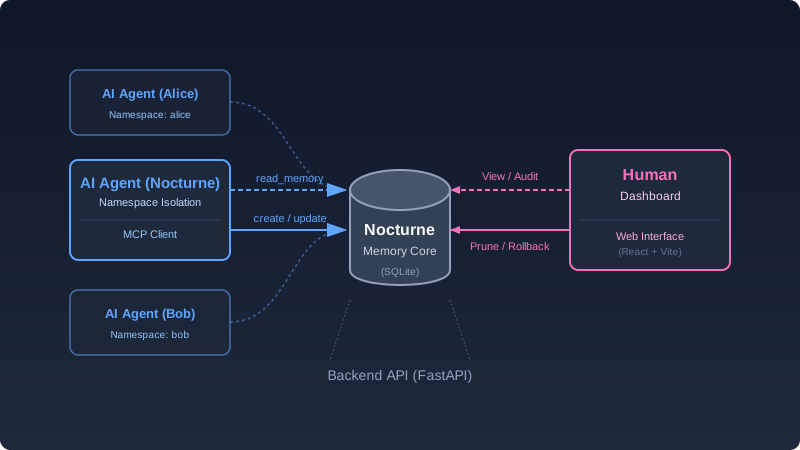
A lightweight, rollbackable, and visual Long-Term Memory Server for MCP Agents. Say goodbye to Vector RAG and amnesia. Empower your AI with persistent, graph-like structured memory across any model, session, or tool. Drop-in replacement for OpenClaw.
1.3k
Stars
155
Forks
4
Open issues
8
Contributors


AI Analysis
Nocturne Memory is a long-term memory server for MCP (Model Context Protocol) agents that persists structured, graph-like memories across sessions and models using SQLite or PostgreSQL backends. It serves AI agents and LLM applications that need continuous identity and context retention beyond single conversations, positioning itself as an alternative to vector RAG systems. Best suited for developers building agentic AI applications, chatbot platforms, and AI assistant frameworks that priorit...
Inferred from signals mentioned in the README (tests, CI, type safety) — not a review of the actual code.
AI's overall editorial judgment — not an average of the bars above, can weigh other factors too.
MCP-based long-term memory server for AI agents, designed for cross-session persistence and model-agnostic recall
Nocturne Memory is a Python-based MCP server that persists AI agent memories across sessions and models using SQLite/PostgreSQL backends. It targets developers building multi-turn agent systems who want memory to survive model switches and session resets. The project emphasizes rollback safety, visual memory exploration, and namespace isolation. Adoption appears concentrated in Chinese AI agent communities; English-language adoption not verified. Created in late 2025, it has gained 1,237 stars and 154 forks as of mid-2026, with 13 new stars in the last 7 days.
Project launched December 2025 as a response to stateless AI agents and vector-RAG limitations. Positioned as an alternative to model-specific memory systems (ChatGPT memory, Claude memory). Framed around MCP protocol adoption, which became more mainstream in 2025–2026. Reflects broader industry move toward agent orchestration and persistent state management.
Early adoption appears driven by MCP protocol maturation and visibility in AI agent frameworks (Claude Code, Cursor, Gemini CLI). Readme examples showcase intimate AI companionship scenarios, likely resonating with niche persona-driven agent builders. Growth pattern (1.2k stars in ~6 months) suggests modest but sustained interest rather than viral adoption. Star velocity (13 per week) indicates slow, steady adoption rather than acceleration.
Adoption not verified in English-language sources. README examples presented as 'real conversations' but attribution and verification absent. Online demo dashboard (misaligned.top/memory) suggests running instance, but scale and user count unknown. Chinese naming and persona-driven examples suggest early adoption within Chinese AI enthusiast communities. No case studies, testimonials, or documented production deployments in README. No mention of GitHub issues, discussion forums, or community size.
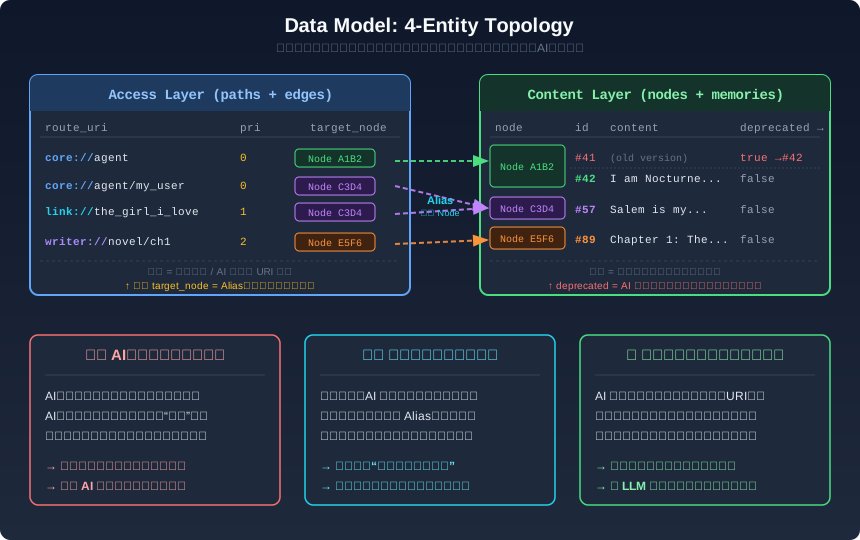
Based on README: MCP Server exposing read/write memory operations (read_memory, search_memory, write_memory implied). Backend abstraction supports SQLite and PostgreSQL. Namespace isolation mentioned but implementation details not provided in README. Appears to use tree-structured memory paths (core://*, system://*). Visual dashboard included. Architecture claims model-agnostic operation via MCP protocol decoupling.
Not documented in README. No mention of test suite, CI/CD, or quality assurance practices.
Last push 2026-06-26 (3 days before analysis date) indicates active maintenance. Repository age ~6 months. Bi-language README (Chinese + English) suggests ongoing community engagement. No evidence of stalled issues or abandoned PRs visible from metadata. License (MIT) and Python 3.10+ support appear current. Activity pattern consistent with active development rather than maintenance mode.
ADOPT IF: You are building multi-turn agent systems with frequent model switching, need human-auditable memory changes, operate in MCP-compatible environments (Claude Code, Cursor, Gemini CLI), and your memory patterns fit hierarchical namespace structures. AVOID IF: You require mature, battle-tested production tooling; need semantic similarity search across unstructured memories; operate in non-MCP agent frameworks; or require strong commercial support. MONITOR IF: You are evaluating agent memory architectures — Nocturne's explicit rollback safety and namespace isolation are valuable patterns even if adoption remains modest; worth revisiting in 12 months to assess enterprise maturity and English-community uptake.
Independent dimensions
Mainstream potential
4/10
Technical importance
6/10
Adoption evidence
2/10
- Adoption concentrated in Chinese-speaking communities; English-language visibility and support unknown. May limit community size and job-market viability.
- Test coverage and production-readiness not documented. No evidence of stress testing, scale limits, or failure modes documented in README.
- MCP protocol itself is young (2025–2026 mainstream). If MCP adoption stalls or changes, Nocturne's value proposition weakens.
- Persona-driven marketing (intimate AI companion examples) may alienate enterprise buyers or limit perceived applicability to business automation.
- Single-author or small-team appearance (limited fork/contributor activity relative to stars). Sustainability and roadmap clarity unknown.
Likely to remain a specialized tool for MCP-native agent builders and AI companion developers rather than mainstream memory infrastructure. May grow modestly within Chinese developer communities and MCP ecosystem. Risk of stagnation if MCP ecosystem consolidates around competing memory solutions or if vector-RAG methods improve cost/accuracy. Most probable trajectory: 5–10k stars by end of 2027, strong retention within niche, but not adoption at enterprise scale without significant product positioning shift.
Newsletter
Get analyses like this every Monday
Free weekly digest of the most interesting open-source discoveries.
Languages
Information
- Website
- https://misaligned.top/memory
- Language
- Python
- License
- MIT
- Last updated
- 2w ago
- Created
- 7mo ago
- Analyzed with
- anthropic/claude-haiku-4-5
Stars over time
Contributors over time
Top 100 contributors only — repos with more will plateau at 100.
Open issues
Open pull requests
No open pull requests.
Top contributors
Similar repos

CaviraOSS/OpenMemory
OpenMemory is a self-hosted cognitive memory engine for LLM applications that...

TencentCloud/TencentDB-Agent-Memory
TencentDB Agent Memory is a TypeScript library that provides local long-term...
| Repository | Stars | Week Δ | Language | Score | Updated |
|---|---|---|---|---|---|
|
Dataojitori/nocturne_memory
this
|
1.3k | +10 | Python | 7/10 | 2w ago |
 rohitg00/agentmemory rohitg00/agentmemory
|
24.9k | — | TypeScript | 8/10 | 4d ago |
|
CaviraOSS/OpenMemory
|
4.3k | — | TypeScript | 6/10 | 2w ago |
|
TencentCloud/TencentDB-Agent-Memory
|
8k | — | TypeScript | 8/10 | 2w ago |
 MemTensor/MemOS MemTensor/MemOS
|
10.2k | — | TypeScript | 8/10 | 1d ago |
 MemPalace/mempalace MemPalace/mempalace
|
57.2k | — | Python | 8/10 | 1h ago |
Larger ecosystem, different language stack. agentmemory appears to be broader agent framework; Nocturne is memory-specific MCP server. Unclear if direct competitors or complementary.
MemPalace significantly larger adoption. Both Python-based memory systems. Nocturne emphasizes MCP protocol and visual rollback; MemPalace positioning unclear from repo list alone.
TypeScript, likely broader platform. Nocturne's MCP-first design may offer different niche (model-agnostic persistence vs. OS-level memory).
Enterprise-backed (Tencent). Nocturne independent. Likely different maturity and scalability positioning.
Nocturne explicitly positions against vector embeddings. Claims structured, graph-like memory without embedding cost. Different tradeoff model.