Personal memory for agents - fast memory retrieval, self-evolving skills, and lower cost.
14k
Stars
1k
Forks
100
Open issues
30
Contributors


AI Analysis
memU is a personal memory system for AI agents that compiles conversations, documents, and tool traces into organized Markdown files (INDEX, MEMORY, SKILL) for efficient retrieval without long context windows. It's specialized for agent-based workflows and Claude integrations, targeting developers building AI systems that need persistent, evolving memory and skill refinement rather than general-purpose chatbot or data storage use cases.
Inferred from signals mentioned in the README (tests, CI, type safety) — not a review of the actual code.
AI's overall editorial judgment — not an average of the bars above, can weigh other factors too.
memU turns file-system workspaces into structured agent memory with a three-layer compile/serve model
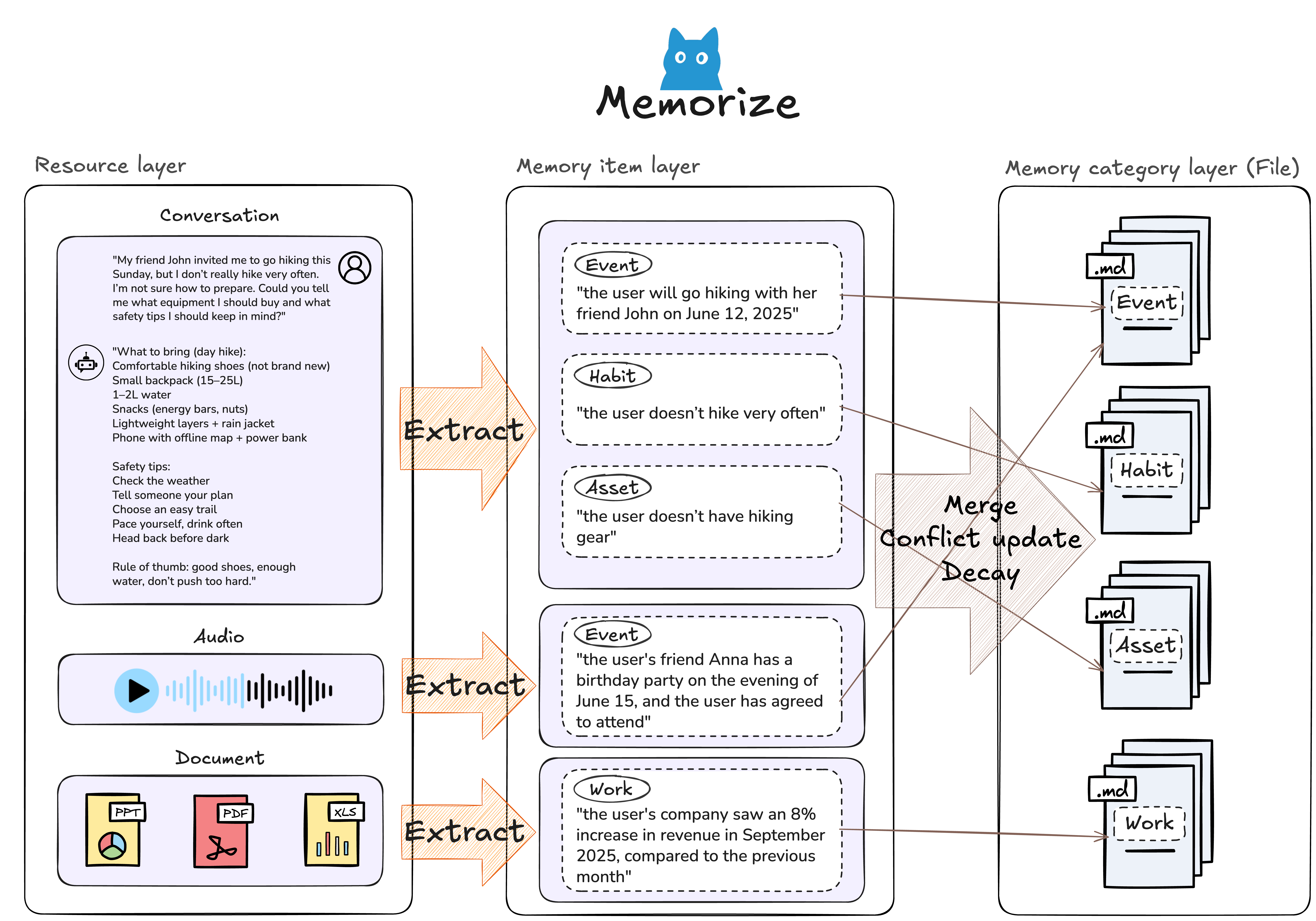
memU is a workspace runtime for AI agents that ingests heterogeneous sources — chat logs, documents, images, audio, tool traces — and compiles them into three structured layers (Index, Skill, Memory) stored as navigable markdown files. Agents then retrieve only the relevant slices rather than re-reading all sources, which the project claims can reduce token consumption by up to 95%. It targets developers building multi-session AI agents on Colab or similar file-system-backed environments who need persistent, auditable context without a managed vector database. The structured, inspectable output (plain markdown files) is a deliberate design choice that distinguishes it from opaque embedding stores.
Created in late July 2025, memU is a young project that reached ~14K stars within roughly 11 months, suggesting it caught a wave of developer interest in agent memory as LLM agent frameworks matured throughout 2025.
The project appears to have grown primarily through developer interest in token cost reduction and the practical problem of agent context management across sessions. The Trendshift badge and multilingual README (6 languages) suggest deliberate community outreach. Recent star velocity (~46 stars/7 days as of late June 2026) is modest but consistent, implying organic rather than viral growth. The star count of ~14K is substantial for an 11-month-old niche tool.
No explicit case studies, production deployment testimonials, or download statistics are cited in the README. PyPI package (memu-py) exists, suggesting installable releases, but actual download counts are not provided. The 1,037 forks and 13,940 stars suggest meaningful developer engagement, but verifiable production usage at scale is not documented. Adoption not verified beyond community engagement signals.
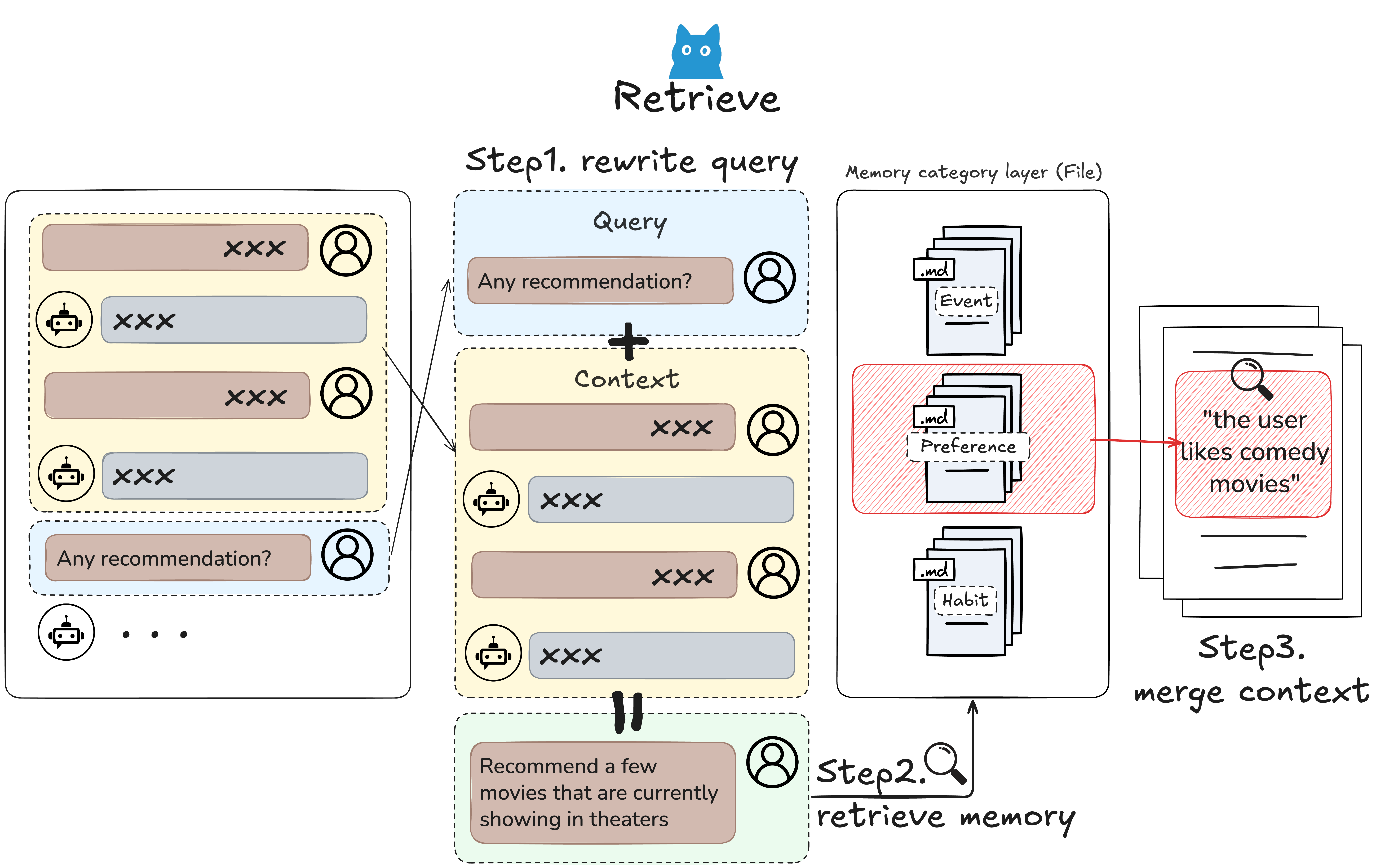
Based on README, the architecture appears to be a two-phase pipeline: a write path (memorize) that ingests raw sources, preprocesses by modality, extracts typed MemoryItems, organizes into MemoryCategory folders with embeddings and summaries, and persists via a configurable backend; and a read path (retrieve) that navigates the folder structure and returns ranked, scoped layers. The data model appears to be a three-tier hierarchy: MemoryCategory (folder) → MemoryItem (typed atomic memory) → Resource (raw source artifact), with CategoryItem edges linking items to folders. Likely uses an embedding model for semantic ranking during retrieval. Backend appears pluggable based on 'configured backend' language. Python 3.13+ requirement suggests modern async patterns are likely.
not documented in README
Last push was June 27, 2026 — one day before the analysis date — indicating very active maintenance. The project has been continuously updated since its July 2025 creation. Presence of a Discord server, Twitter account, and multilingual documentation suggests an organized maintenance effort rather than a solo side project.
ADOPT IF: you are building multi-session Python AI agents that need persistent, human-auditable context across Colab or file-system environments and want to reduce token costs through selective retrieval rather than full-context stuffing. AVOID IF: you need production-hardened, enterprise-supported memory infrastructure with documented SLAs, or if your stack is JavaScript/TypeScript-first, or if you require a managed cloud memory service rather than a local file-system runtime. MONITOR IF: you are evaluating agent memory solutions but need more evidence of production stability, test coverage documentation, and real-world scale benchmarks before committing.
Independent dimensions
Mainstream potential
5/10
Technical importance
7/10
Adoption evidence
3/10
- The '95% token cost reduction' claim is prominent marketing language with no benchmark methodology or reproducible evidence cited in the README — actual savings will vary significantly by use case.
- License shown as NOASSERTION in metadata despite the README badge claiming Apache 2.0 — this discrepancy should be investigated before any production or commercial deployment.
- Python 3.13+ requirement limits compatibility with environments that have not yet migrated to very recent Python versions, which may be a barrier in some enterprise or legacy cloud contexts.
- No documented test coverage or CI/CD signals in the README means code quality and regression safety cannot be independently assessed.
- As a young project (~11 months old) with a small team (no team size is documented), there is meaningful risk of API instability, breaking changes, or reduced maintenance if organizational priorities shift.
memU is likely to grow steadily as agent memory becomes a standard infrastructure concern. It may stabilize as a respected niche tool for Python agent developers rather than achieving category dominance, particularly given the crowded competitive landscape and the head start of JavaScript-ecosystem alternatives.
Newsletter
Get analyses like this every Monday
Free weekly digest of the most interesting open-source discoveries.
Languages
Information
- Website
- https://memu.pro
- Language
- Python
- License
- NOASSERTION
- Last updated
- 9h ago
- Created
- 12mo ago
- Analyzed with
- anthropic/claude-haiku-4-5
Stars over time
Contributors over time
Top 100 contributors only — repos with more will plateau at 100.
Open issues
[Feature|DreamMode] Reflect: project-scoped gotchas.md from session history
[FEATURE | Multi-Character] Multi-Character 记忆 — 让 Agent 拥有自己的画像和偏好 — 让 User 偏好成为可选择继承的模板
[FEATURE | Memory Graph] 给 MemoryItem 之间加上关联链接(wiki-links)
[BUG] memory_items table's happend_at collumn stores NULL value even though when proper timestamp provided in messages.
Top contributors
Recent releases
Similar repos

zilliztech/memsearch
Memsearch provides a persistent, unified semantic memory layer for AI coding...

MemMachine/MemMachine
MemMachine is an open-source memory layer that adds persistent, multi-tiered...
| Repository | Stars | Week Δ | Language | Score | Updated |
|---|---|---|---|---|---|
|
NevaMind-AI/memU
this
|
14k | +40 | Python | 7/10 | 9h ago |
 MemTensor/MemOS MemTensor/MemOS
|
10.2k | — | TypeScript | 8/10 | 1d ago |
|
zilliztech/memsearch
|
2.2k | — | Python | 7/10 | 6h ago |
|
MemMachine/MemMachine
|
3.3k | — | Python | 7/10 | 1d ago |
 rohitg00/agentmemory rohitg00/agentmemory
|
24.9k | — | TypeScript | 8/10 | 4d ago |
 thedotmack/claude-mem thedotmack/claude-mem
|
86.7k | — | JavaScript | 8/10 | 12h ago |
claude-mem has ~85K stars and is JavaScript-based, appearing to target Claude-specific memory use cases. memU is Python-focused, LLM-agnostic based on README framing, and emphasizes a file-system workspace metaphor rather than a chat-specific memory layer.
MemOS has ~10K stars in TypeScript and appears to position itself as a broader memory operating system. memU's Python implementation and explicit Colab/file-system framing suggests a more focused developer-tooling angle rather than a full OS abstraction.
mem9 has ~1.1K stars and is TypeScript-based. memU significantly outpaces it in adoption signals and offers a more detailed multi-modal ingestion pipeline based on README descriptions.
Also Python-based with ~3.1K stars. memU's explicit file-system workspace model with human-readable markdown output (INDEX.md, MEMORY.md, SKILL.md) appears to be a more auditable and transparent approach compared to what MemMachine documents publicly.
memsearch (~2.1K stars) comes from Zilliz, a vector database company, and likely emphasizes semantic search over memory. memU's approach combines structured markdown layers with embeddings, targeting agents that need both structured recall and semantic retrieval without requiring a standalone vector DB deployment.