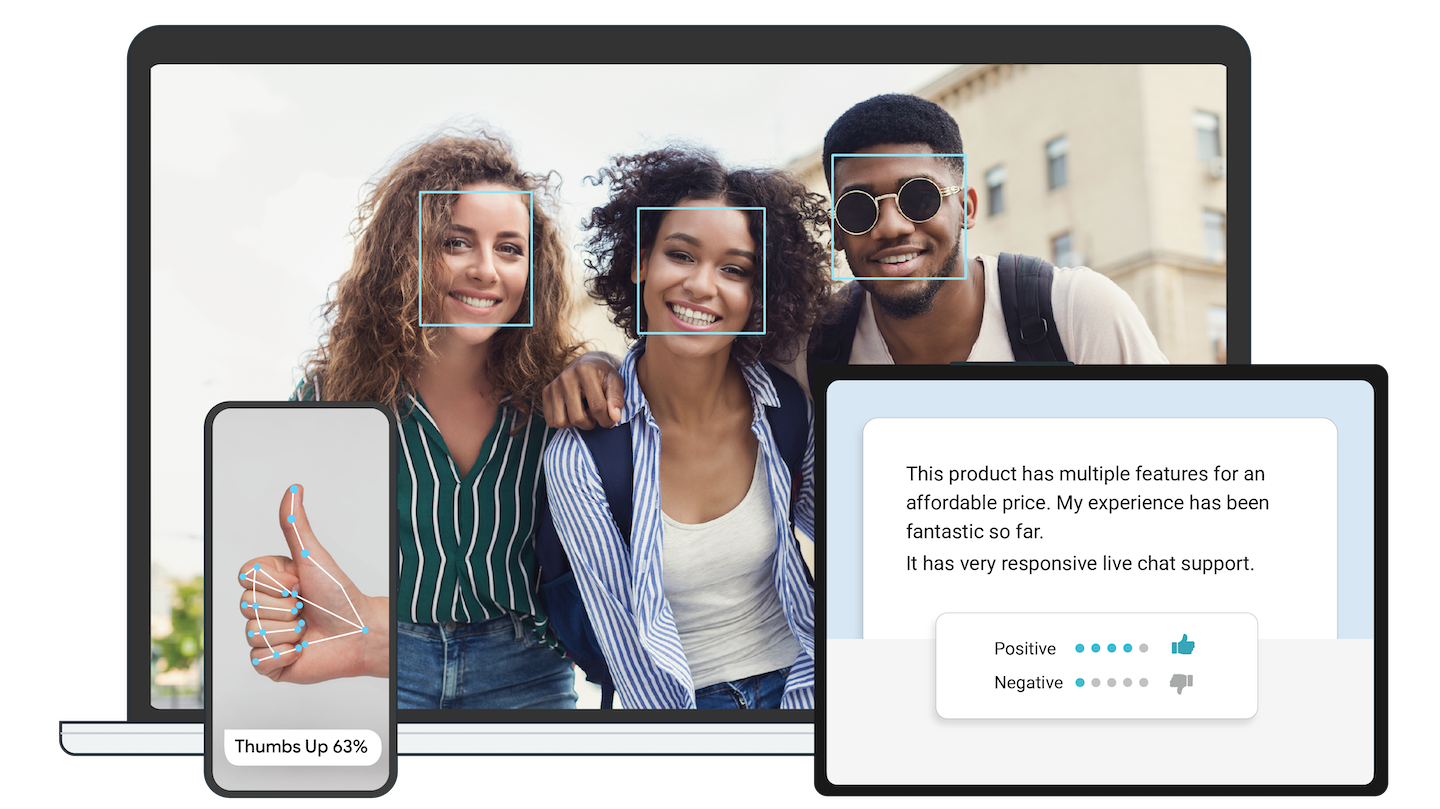
Cross-platform, customizable ML solutions for live and streaming media.
36k
Stars
6.1k
Forks
574
Open issues
30
Contributors


AI Analysis
MediaPipe is a cross-platform ML framework for deploying on-device machine learning solutions across mobile (Android, iOS), web, desktop, edge devices, and IoT. It specializes in real-time vision, audio, and text processing tasks with pre-built models and customization tools (Model Maker, Studio). Best suited for developers building ML-powered mobile and edge applications; less relevant for traditional server-side ML workloads or research experimentation.
Inferred from signals mentioned in the README (tests, CI, type safety) — not a review of the actual code.
AI's overall editorial judgment — not an average of the bars above, can weigh other factors too.
Google's MediaPipe brings on-device ML pipelines to mobile, web, and edge — still actively maintained in 2026
MediaPipe is a cross-platform framework from Google for building and deploying on-device ML inference pipelines, covering vision (face detection, pose estimation, object detection), text, and audio tasks. It targets mobile developers (Android, iOS), web developers, and embedded/edge teams who need real-time, privacy-preserving ML without server-side inference. It ships pre-trained models, a graph-based pipeline framework, and tooling for model customization. It is one of the most widely referenced on-device ML frameworks available, backed by Google's engineering teams and used in production across many apps.
Launched publicly in 2019 as an internal Google tool for streaming media ML pipelines, MediaPipe transitioned to a broader developer audience in 2023 with the MediaPipe Solutions rebranding, retiring older graph-heavy APIs in favor of higher-level task APIs.
Initial growth was driven by Google's internal credibility and the unique offering of production-quality, real-time vision models (hand tracking, face mesh) for mobile. The 2023 Solutions pivot simplified onboarding and drove a new wave of adoption among web and Python developers. Star growth has plateaued at a modest rate (~120/week as of mid-2026), suggesting the project has reached a mature, stable user base rather than explosive new adoption.
MediaPipe is explicitly used in Google products and is referenced extensively in developer documentation, Stack Overflow questions, and third-party tutorials. It powers features in Google Meet, Google Lens, and various Android system features. npm package downloads for the web variant and PyPI download counts for mediapipe Python package are publicly verifiable and historically high. Adoption is well-documented at scale.
Appears to use a graph-based pipeline model (Packets, Graphs, Calculators) as its core abstraction — each processing node is a 'Calculator' connected via typed data streams. The higher-level MediaPipe Tasks API likely wraps these primitives. C++ is the core runtime; platform-specific bindings (Android, iOS, Python, Web/WASM) appear to sit on top. Inference is likely delegated to LiteRT (formerly TensorFlow Lite) for model execution.
Not documented in README
Last push was June 23, 2026 — one day before evaluation date — indicating active, ongoing development. The privacy notice was updated June 5, 2026, confirming recent editorial attention. The project appears to receive regular commits from Google's AI Edge team. Legacy solution deprecation was handled transparently, which is a positive maintenance signal.
ADOPT IF: you need real-time, on-device ML for vision, audio, or text tasks on Android, iOS, or web and want production-quality pre-trained models with cross-platform APIs and Google support. AVOID IF: you need server-side inference at scale, require custom model architectures beyond what MediaPipe Tasks supports, or are on a platform with no MediaPipe binding (e.g., embedded Linux with niche hardware). MONITOR IF: you depend on any legacy solutions that were deprecated in 2023 — migration paths exist but require effort — or if Google shifts strategic priority toward LiteRT-LM exclusively.
Independent dimensions
Mainstream potential
8/10
Technical importance
9/10
Adoption evidence
9/10
- Google has a history of sunsetting or restructuring developer tools; the 2023 legacy deprecation already shows willingness to break APIs, and future pivots cannot be ruled out.
- The framework's complexity (graph model, Bazel build system for custom work) creates a steep learning curve for developers who need to go beyond the pre-packaged Tasks API.
- Pre-trained models shipped with MediaPipe may lag behind state-of-the-art benchmarks; developers needing highest-accuracy models may find the bundled options insufficient without custom model training via Model Maker.
- Web (WASM) performance on lower-end devices may be inconsistent; the runtime overhead of the pipeline abstraction can be a constraint in latency-critical applications.
- Dependency on Google's external documentation site (developers.google.com) means the GitHub README is intentionally thin — if Google reduces investment in docs, discoverability and onboarding could degrade.
MediaPipe is likely to remain a primary reference implementation for on-device vision ML through at least 2027, with gradual convergence toward LiteRT as the shared inference backbone across Google's edge portfolio.
Newsletter
Get analyses like this every Monday
Free weekly digest of the most interesting open-source discoveries.
Languages
Information
- Language
- C++
- License
- Apache-2.0
- Last updated
- 16h ago
- Created
- 86mo ago
- Analyzed with
- anthropic/claude-haiku-4-5
Stars over time
Contributors over time
Top 100 contributors only — repos with more will plateau at 100.
Open issues
Docker build per the directions does not seem to work anymore
[Tasks GenAI][Web] Gemma 4 E2B/E4B logs "audio_model_settings is defined but the model does not support audio"
Feature Request: Support local image outpainting / canvas expansion in ImageGenerator Task (0.10.26)
Add MyPy CI workflow
What's the difference between MediaPipe Pose Estimation and MLKit Pose Estimation?
Top contributors
Similar repos

sherlockchou86/VideoPipe
VideoPipe is a cross-platform C++ framework for video analysis and structuring...
google-ai-edge/LiteRT-LM
LiteRT-LM is Google's production inference framework for deploying Large...
google-ai-edge/gallery
AI Edge Gallery is an end-user application that enables running large language...
| Repository | Stars | Week Δ | Language | Score | Updated |
|---|---|---|---|---|---|
|
google-ai-edge/mediapipe
this
|
36k | +104 | C++ | 8/10 | 16h ago |
|
sherlockchou86/VideoPipe
|
2.9k | — | C++ | 7/10 | 5mo ago |
 alibaba/pipcook alibaba/pipcook
|
2.6k | — | TypeScript | 6/10 | 10h ago |
|
google-ai-edge/LiteRT-LM
|
5.8k | — | C++ | 8/10 | 6h ago |
|
google-ai-edge/gallery
|
24k | — | Kotlin | 8/10 | 7h ago |
 PaddlePaddle/Paddle-Lite PaddlePaddle/Paddle-Lite
|
7.3k | — | C++ | 7/10 | 2mo ago |
Apple's on-device ML is tighter on iOS but locked to the Apple ecosystem. MediaPipe supports cross-platform deployment including Android and web, which Core ML does not.
ONNX Runtime is a more general inference engine without the task-specific APIs and pre-trained models MediaPipe ships. Better for bring-your-own-model scenarios; MediaPipe wins on out-of-the-box vision/audio task coverage.
OpenCV DNN is lower-level and requires more integration work. MediaPipe offers higher-level abstractions and mobile-first packaging that OpenCV lacks.
VideoPipe focuses on video analytics pipelines for surveillance-style use cases. Far smaller community and less cross-platform support than MediaPipe.
LiteRT (the successor to TFLite) is the inference layer MediaPipe itself builds on. MediaPipe adds task abstractions, model bundles, and pipeline management on top of it — they are complementary, not competing.