XLS: Accelerated HW Synthesis
1.5k
Stars
246
Forks
1.1k
Open issues
30
Contributors


AI Analysis
XLS is a High-Level Synthesis (HLS) toolchain from Google that converts high-level functional descriptions into synthesizable Verilog/SystemVerilog hardware designs. It is purpose-built for hardware IP development in the post-Moore's Law era, enabling co-design between software and hardware engineers through a unified methodology. This tool is specialized for hardware engineers and chip designers who need to rapidly prototype and synthesize digital hardware, not for general software development.
Inferred from signals mentioned in the README (tests, CI, type safety) — not a review of the actual code.
AI's overall editorial judgment — not an average of the bars above, can weigh other factors too.
Google's high-level synthesis toolkit that compiles software-like descriptions to synthesizable hardware
XLS is an open-source HLS (High-Level Synthesis) toolchain from Google that lets hardware engineers describe digital designs in DSLX (a Rust-inspired DSL) and generates Verilog/SystemVerilog. It enables designs to run as efficient host software while also synthesizing to hardware. Primary audience: hardware teams seeking faster IP development cycles. Adoption remains limited to early adopters and appears concentrated within research and specialized accelerator contexts.
XLS emerged from Google's internal hardware design practices around 2020, released publicly as an experimental project. It reflects broader industry trends toward raising hardware abstraction levels and bridging software-hardware co-design gaps, though without mainstream adoption traction compared to established HLS competitors.
GitHub stars grew from 0 to ~1,500 over ~6 years, with only 4 stars in the past 7 days (as of July 2026). Growth appears steady but modest. Recent activity (last push July 1, 2026) shows continued maintenance. Adoption signaling via forks (244) and similar repos suggest awareness in niche compiler/synthesis circles, but broad ecosystem integration remains unverified.
Adoption not verified. README mentions Colab notebooks and tutorials as entry points but provides no case studies, named adopters, or production deployment examples. The 'experimental' status and explicit non-support disclaimer suggest internal Google use and research/evaluation by external early adopters, but commercial or large-scale deployment evidence is absent from public record.
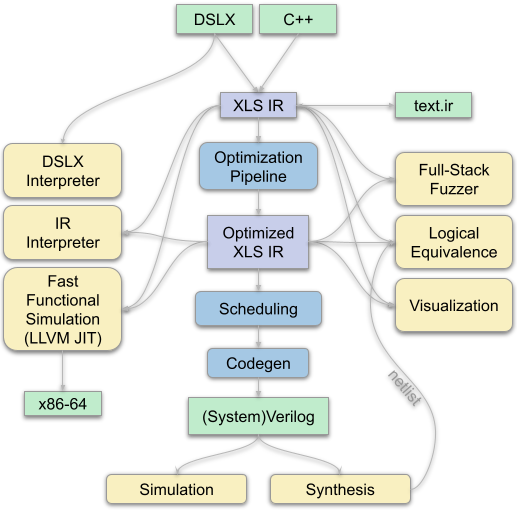
Appears to be a multi-stage compiler toolchain: DSLX front-end (Rust-inspired DSL) → IR (intermediate representation) → Verilog/SystemVerilog codegen. README mentions support for pipelined functions and concurrent processes ('procs'). Likely uses Bazel for builds. Based on README, the project includes an interpreter, IR converter, optimizer, codegen, and proto-to-DSLX translator.
Not documented in README. CI/CD badges shown (Ubuntu 22.04, nightly builds) indicate automated testing infrastructure exists, but scope and coverage percentages not disclosed.
Repository shows active maintenance as of July 1, 2026 (last push on analysis date). CI pipelines active. However, the README explicitly states 'XLS is experimental, undergoing rapid development, and not an officially supported Google product.' This is a deliberate disclaimer of production-ready status, not a sign of abandonment. Build times documented as 2–6 hours depending on configuration, suggesting non-trivial compilation overhead. No backward compatibility guarantees; breaking changes to DSLX are acknowledged as regular occurrence.
ADOPT IF: you are exploring HLS for research, prototyping accelerator IP, or have interest in open-source hardware synthesis with software-like semantics AND can tolerate experimental status, breaking API changes, and long build times. AVOID IF: you need production-ready HLS with backward compatibility guarantees, commercial support, or proven adoption in your domain; or if you require fast iteration and cannot accept 2–6 hour build cycles. MONITOR IF: you are a hardware team considering long-term HLS strategy; XLS may mature into a viable alternative if Google continues investment and adoption signals emerge over the next 12–24 months.
Independent dimensions
Mainstream potential
4/10
Technical importance
7/10
Adoption evidence
2/10
- Experimental status and explicit non-support disclaimer mean zero SLA or stability commitments; breaking changes to DSLX are acknowledged as routine.
- Adoption not verified at scale; no public case studies or production deployment data. Risk of investing in toolchain with uncertain real-world viability.
- Long build times (up to 6 hours) and Bazel dependency may create friction in resource-constrained or fast-iteration environments.
- Incomplete ecosystem integration; while Yosys/OpenROAD mentioned in Colab, end-to-end flow maturity from design to fabrication not documented.
- Limited manpower signals relative to scope. Google maintains it but project explicitly not officially supported, creating uncertainty about long-term priority.
XLS will likely remain a research and early-adopter tool through 2027–2028. If adoption in industry/academia accelerates (adoption_evidence signals emerge), it could become a reference open-source HLS for specialized accelerators. Otherwise, it may consolidate as a Google-internal tool or niche research asset. Commercial HLS incumbents (Xilinx, Siemens) are unlikely to be displaced by XLS unless critical mass of practitioners shift preference to open-source + co-design methodology.
Explore similar
Newsletter
Get analyses like this every Monday
Free weekly digest of the most interesting open-source discoveries.
Languages
Information
- Website
- http://google.github.io/xls/
- Language
- C++
- License
- Apache-2.0
- Last updated
- 9h ago
- Created
- 75mo ago
- Analyzed with
- anthropic/claude-haiku-4-5
Stars over time
Contributors over time
Top 100 contributors only — repos with more will plateau at 100.
Top contributors
Similar repos
| Repository | Stars | Week Δ | Language | Score | Updated |
|---|---|---|---|---|---|
|
google/xls
this
|
1.5k | +7 | C++ | 7/10 | 9h ago |
 openxla/xla openxla/xla
|
4.4k | — | C++ | 8/10 | 6h ago |
 enjoy-digital/litex enjoy-digital/litex
|
4k | — | Python | 8/10 | 16h ago |
 YosysHQ/yosys YosysHQ/yosys
|
4.6k | — | C++ | 8/10 | 1d ago |
 troldal/OpenXLSX troldal/OpenXLSX
|
1.8k | — | C++ | 7/10 | 4w ago |
 xLLM-AI/xllm xLLM-AI/xllm
|
1.5k | — | C++ | 7/10 | 9h ago |
Yosys is a mature, widely-used open-source synthesis framework for RTL to gates; XLS is HLS (higher abstraction). Yosys is downstream of XLS (XLS can output Verilog for Yosys). Different positions in the design flow, not direct substitutes.
LiteX is a Python-based SoC builder framework; XLS is a general-purpose HLS compiler. LiteX specializes in SoC composition, XLS in algorithmic IP synthesis. Complementary rather than competitive.
Silice is a language and toolchain for hardware design with some DSL elements. XLS is more comprehensive HLS with multiple front-ends (DSLX, C++ in development). Both target high-level hardware abstraction but different user models.
Xilinx tools dominate commercial HLS space for FPGAs. XLS is open-source and targets broader synthesis (ASIC + FPGA), not locked to Xilinx. Likely insufficient maturity/adoption to compete directly yet.
Catapult is established commercial HLS for ASIC/verification. XLS is open-source but experimental. No direct competition signaled; different market positioning.